National Bird follows the dramatic journey of three whistleblowers who are determined to break the silence around one of the most controversial issues of our time: the secret U.S. drone war.
At the centre of the film are three U.S. military veterans. Grappling with guilt over their participation in the drone programme, they decide to speak out publicly in spite of the possible consequences. Their stories take dramatic turns, leading one of the protagonists to Afghanistan where she learns about the horrific consequences of a drone strike for a civilian family. But her journey also gives hope for peace and redemption.
National Bird gives unprecedented insight into the U.S. drone programme through the eyes of veterans and survivors, connecting their stories to create a comprehensive overview of events as never seen before. Its images haunt the audience and bring a faraway issue close to home.
Discussion chaired by Juliana Ruhfus, journalist, filmmaker, and senior reporter at Al Jazeera English, People and Power.
Panel:
Sonia Kennebeck is an independent documentary filmmaker and investigative journalist with more than 15 years of directing and producing experience. She has directed eight television documentaries and more than 50 investigative reports. She lives in New York where she runs her own production company (Ten Forward Films) that makes films about international politics and human rights. Filmmaker Magazine recently selected her as one of the “25 New Faces of Independent Film 2016.” Sonia Kennebeck received a Master’s degree in International Affairs from American University in Washington, D.C. and was born in Malacca, Malaysia. NATIONAL BIRD is her first feature-length documentary film.
Frank Ledwidge is a barrister who served as a military intelligence officer in the Balkans and Iraq. He has also worked for the British government in Afghanistan and Libya. He is the author of ‘losing Small Wars’. He is the author of Losing Small Wars (Yale 2011) and Investment in Blood (Yale 2013)
Jack Serle is a specialist reporter on the Bureau’s Covert Drone War team. He has worked on the Bureau of Investigative Journalism’s drone war coverage since 2012.
Directed by: Sonia Kennebeck
Produced by: Ines Hofmann Kanna
Executive Producers: Wim Wenders and Errol Morris
Year: 2016
Country: United States
Runtime: 92′

Jesselyn Radack and Thomas Drake
Whether they spoke out against torture or mass surveillance, government officials who blew the whistle on the deplorable changes made to U.S. legislation after the 9/11 attacks have been left bankrupted, broke and broken.
The documentary Silenced, directed by James Spione and screened at the Frontline Club on Monday 9 March, follows the cases of three prominent whistleblowers who confronted and made public the unlawful practices of U.S. authorities.
Focusing closely on former CIA analyst and case officer John Kiriakou who spoke out against the CIA’s use of torture, Silenced shows the impact on Kiriakou and his family in the lead up to his nearly two year imprisonment, which ended in early February 2015.
In a Q&A following the screening, two of the film’s protagonists – activist and retired NSA executive Thomas Drake, and former DOJ Ethics Advisor Jesselyn Radack, director of National Security & Human Rights at the Government Accountability Project – discussed their struggles as whistleblowers and how journalists can help foster change.
.@SilencedFilm @frontlineclub Q&A: knowing what you know now would you do it again? @Thomas_Drake1: yes, but I’d go to the press earlier.
— Jen Robinson (@suigenerisjen) March 9, 2015
What Could Have Been Done Differently?
Thomas Drake said that both he and the government should have done things differently before and after he blew the whistle on the dubious legality of NSA dragnet surveillance. “I would have gone to the press a lot sooner,” said Drake.
“Despite the huge personal costs, what price do you put on freedom and liberty? We don’t have to forsake the future of freedom and liberty for all. Are there threats to civil society? Yes. It doesn’t mean that we turn everybody into suspects, even if it’s virtual. What it means to be free and what it means to have liberty means more to me now than ever.”
He responded to an audience question about how methods of surveillance could be changed to protect privacy. “You certainly don’t have to go outside of the constitution,” Drake said. “The U.S. unchained itself. Because they had failed to protect Americans, they decided they would unchain themselves from the rule of law. Five days after 9/11, Cheney said ‘we’re going to the dark side.’”
Both before and after bulk surveillance was introduced, Drake said he had continuously advocated for the use of a program called ThinThread, which would have protected the privacy of American citizens.
Foundation of Courage
Much has changed since Radack and Drake first spoke out, not least of which are the mass surveillance revelations by Edward Snowden, who brought international attention to the act of whistleblowing.
Radack praised the establishment of the Courage Foundation last year, set up to help financially support whistleblowers as they navigate the expensive court cases that stem from their revelations. “That foundation is now supporting legal defence for [Edward] Snowden, other clients of mine, other clients of other attorneys. None of that existed back when I blew the whistle and when Tom and John were going through their ordeals,” she said. Even if a whistleblower is found ‘not guilty,’ Radack added, “it’s very hard to recover,” and “there’s still such a price” financially.
Panel discussion with two of the “Original 7 #Whistleblowers” who were prosecuted under #Obama @frontlineclub pic.twitter.com/RiIOrpgBeH
— Luigi Rappallo (@LuigiRappallo) March 9, 2015
Double-edged Media
The media is both a key aspect in “demonising and vilifying the whistleblower,” Radack said, and at the same time their “saving grace” since “robust investigative journalism has been a tremendous help to whistleblowers.”
Whistleblowers “are always painted as being out for fame, or profit, or revenge,” she said. “Some journalists in the U.S. act more like the government lapdog than the government watchdog. And they very much care about maintaining their contacts.”
But the war on whistleblowers is really a backdoor war on journalists, Radack maintained. “There’s been a war on whistleblowers, a war on journalists, a war on hacktavists, and an overall war on information… because information is the currency of power, especially in the digital age.”
When leaks come from official sources, such as in the recent Hillary Clinton email controversy that has seen the former Secretary of State release State Department emails to the public, and former CIA Director David Petraeus’ leak of classified material to his lover, “they’re very self serving,” said Drake. “Whistleblowing is done in the public interest. The whistleblowers, the truth tellers, are really the canaries in this democratic liberty and freedom coal mine.”
Visit the Silenced website for more information on the film and upcoming screenings.
]]>What happened to the man who exposed the CIA’s use of waterboarding? And what are the consequences of making public illegal intelligence gathering techniques by the US government? In this revealing documentary, three prominent whistleblowers explain the radical changes that occurred following 9/11.
John Kiriakou (former CIA), Thomas Drake (former NSA) and Jesselyn Radack (lawyer and former ethics consultant to the American Department of Justice) talk candidly to filmmaker James Spione about their leaks: how they made public the illegal criminal practices of their own government and faced a choice between career and conscience that put their very lives at risk.
Following their revelations they were fired, isolated, cast into a financial abyss and even tried and incarcerated. The stories of these whistleblowers are told through interviews, excerpts from media appearances, official documents and re-enacted scenes. Spione’s film shows how the world view of this courageous trio changed forever. In the words of John Kiriakou, “I’m not sure anymore who the good guys are.”
Directed by James Spione
Duration: 104′
Year: 2014
On Wednesday 29 October, the Frontline Club held a special preview screening of documentary filmmaker Laura Poitras’s new film CITIZENFOUR ahead of its UK cinematic release on Friday 31 October.

While working on a documentary trilogy about post 9/11 America, Poitras began to receive encrypted emails from a subject known only as ‘Citizen Four’. This citizen claimed to be ready to blow the whistle on a global intelligence effort involving private information and communications of regular people. Poitras and confidant Glenn Greenwald flew to Kong Kong on Citizen Four’s instructions, where they would dissect the information he had to give them. It was here that Citizen Four revealed himself as the man we now know as Edward Snowden.
The film recounts the next eight days of interviews between Snowden, Greenwald and other investigative journalists. Poitras takes us through the day-by-day process of interviewing Snowden, making sense of the documents, writing the stories, and then eventually releasing them to the world. CITIZENFOUR puts to its audience clips from other experts such as Bill Finney, shedding light onto one of the most debated and controversial topics of the 21st century.
29/10/14 I cannot urge this enough – go see @laurapoitras @citizenfour @frontlineclub – chilling, compelling SEE IT pic.twitter.com/xq40XmycsS
— Fiona Hampton (@FionaHampton) October 29, 2014
Poitras joined via Skype from Germany, where she had just received the Leipziger Ring Award, at the Dok Leipzig Film Festival.
The first question addressed the style of the film, which one audience member characterised as ‘dressed down’. She wondered what her approach had been while editing the film. Poitras responded she “wanted it to unfold chronologically”. This would give the audience an idea of how the actual events unfolded, leaving them with the feeling they were actually present in the room.
Next, Poitras was asked how the film had effected how she communicates with people everyday and whether, as Greenwald joked, Snowden’s fear of snooping had rubbed off on her.
Poitras explained that even before she started this project she used encrypted messages and had only recently started using Skype for Q&As such as tonight’s, but had never felt it was secure as a means of communication.
When asked whether the film was able to attract a wider audience, Poitras said that it was more to do with a “shift in consciousness” and that it was the nature of the information that Snowden leaked that was attracting the attention.
@frontlineclub UK journalists putting questions to Laura on Skype after #CITIZENFOUR as she can't enter UK pic.twitter.com/natfLmbjQi
— SearchMe@universeodon.com (@jesssearch) October 29, 2014
Another question queried why Poitras thought the large telecoms and internet companies implicated in the scandal were willing to work with the US and other governments.
Poitras alluded to companies such as Twitter who did resist pressure from the US government to give them access to their user databases and then at the other end of the spectrum there is Microsoft who gave the NSA warning about encryptions and security changes ahead of them taking place so that the NSA could get a head start. Poitras’s main reason as to why she thought these companies were so compliant was the US government persuasion factor, sending National Security letters to these companies under legislation such as the PATRIOT Act and the PRISM program.
To find out more about the tools of encryption that were used in the making of the film, read this article.
CITIZENFOUR will be released in cinemas across the UK on Friday 31 October. Find our more screenings dates here.
]]>Governments often fail to protect whistleblowers and instead subject them to various forms of retaliation, including prosecution, for disclosing information governments wrongly want to keep secret. This includes information about human rights violations.
A panel of speakers with first-hand knowledge of these issues will talk about the experience of whistleblowers who face retaliation for their actions. They will explore how whistleblowers can be protected, and by extension protect the public’s right to information. This includes implementing measures such as those laid out in the Global Principles on National Security and the Right to Information (“Tshwane Principles”). These principles, which gained the support of the Parliamentary Assembly of the Council of Europe, provide critical guidance for ensuring that the public’s ‘right to know’ is protected.
Chaired by Michael Garcia Bochenek, senior director of international law and policy at Amnesty International.
The panel:
Frank La Rue has been the UN Special Rapporteur on the promotion and protection of the right to freedom of opinion and expression since 2008. He has worked extensively on a range of freedom of opinion and expression issues, including the links between the right to access to information and the right to truth. La Rue participated in the development of the Tshwane Principles. He has worked on human rights for over 30 years and is the founder of the Center for Legal Action for Human Rights (CALDH) in Washington DC and Guatemala. He also brought the first genocide case against the military dictatorship in Guatemala and has previously served as a presidential commissioner for human rights in Guatemala, as a human rights adviser to the Minister of Foreign Affairs of Guatemala, as president of the governing board of the Centro-American Institute of Social Democracy Studies and as a consultant to the Office of the High Commissioner for Human Rights.
Avigdor Feldman has practiced law since 1974 and obtained his master’s in civil rights in 1985. He worked for the Israeli Association for Civil Rights (ACRI), is a key founder of B’Tselem (The Israeli Information Centre for Human Rights in the Occupied Territories), and co-founded the Public Committee Against torture in Israel (PCATI). He founded the Litigation Center of the Association of Civil Rights in Israel and received the Robert F Kennedy Human Rights Award in 1991. He has worked on many prominent criminal cases related to civil rights and of a political nature including Mordechai Vanunu, the Israeli nuclear whistleblower who was abducted by Mossad agents in 1986 and brought to trial in Israel, charged for leaking information about Israel’s nuclear capacity to The Sunday Times newspaper. He represents Vanunu today mainly relating to a string of punitive restrictions, which include barring him from leaving Israel, and which, after over ten years of appeals to the Supreme Court, remain in force. Feldman has petitioned the Israeli Supreme Court many times on behalf of human rights organizations including in a case calling for a judicial inquiry into the Sabra and Shatila massacres in 1982; the torture case relating to the use of physical force in Israel’s General Security Service’s interrogations; and Israel’s targeted killings police in 2006.
Peter Hounam is a British investigative journalist who has worked for The Sunday Times, The Mirror, the London Evening Standard, and the BBC, and has also published several books including The Woman from Mossad: The Story of Mordechai Vanunu and the Israeli Nuclear Program. Hounam interviewed Mordechai Vanunu in Australia in 1986 and, with other members of The Sunday Times Insight Team, investigated his story of the inside workings of Israel’s Dimona nuclear plant. The story was published that September but beforehand Vanunu was abducted by Israeli secret service (Mossad). On behalf of The Sunday Times and the BBC, Hounam went to Israel for Vanunu‘s release from his 18-year prison sentence in April 2004. He was arrested the following May by plainclothes officers of the Israel security agency, Shin Bet, while working on a documentary about Vanunu, allegedly for nuclear ‘spying’. The Jerusalem district court imposed a gag order preventing further details of the arrest being disclosed but after international protests he was released without charge the next day, though 10 years later he is still banned from returning to Israel.
Kathleen McClellan works for the US Government Accountability Project (GAP) as National Security and Human Rights deputy director. GAP is a leading whistleblower protection and advocacy organisation, which advocates for cases including Edward Snowden. McClellan supports national security and intelligence community whistleblowers, with a focus on the issues of torture, surveillance, excessive secrecy and political discrimination. She has represented whistleblowers from the National Security Agency (NSA), Central Intelligence Agency, Federal Bureau of Investigation, Department of Defense and Department of Homeland Security, representing their interests in forums that include the Offices of Inspectors General, the Merit System Protection Board (MSPB), the Office of Special Counsel and federal court. Working with National Security and Human Rights Director Jesselyn Radack, she has represented NSA whistleblower Thomas Drake and CIA whistleblower John Kiriakou.
Nancy Hollander is lead counsel for Chelsea Manning on appeal. She is an internationally recognised criminal defence lawyer in the US firm of Freedman Boyd Hollander Goldberg Urias and Ward P.A. as well as being an associate tenant with Doughty Street Chambers in London. Her work is largely devoted to representing individuals and organisations accused of crimes, including those involving national security issues. She has also been counsel in numerous civil cases, forfeitures and administrative hearings, and has argued and won a case involving religious freedom in the United States Supreme Court. Hollander served as a consultant to the defence in a high profile terrorism case in Ireland, assisted counsel in other international cases and represents two prisoners at Guantanamo Bay Naval Base. She has qualified as a lead counsel for the Special Tribunal for Lebanon and for the list of counsel for the International Criminal Court. She has written extensively on these and other criminal law topics.
Lieutenant Colonel the Reverend Nicholas Mercer was admitted as a solicitor in 1990, and commissioned into the Army Legal Service in 1991, serving in Northern Ireland, Bosnia and Herzegovina, Cyprus and Germany. Later, as the former legal advisor to the UK army in Iraq, he revealed information about the UK’s complicity in the abuse of detainees in Iraq which he described as “institutional”. He made recommendations to the UK authorities to ensure the protection of detainees from torture and other ill-treatment to which, as he later said, no response or action was taken. He was named Liberty Human Rights Lawyer of the Year 2011.
Read more:
http://www.amnesty.org/en/news/israel-lift-ludicrous-restrictions-whistleblower-vanunu-decade-after-release-2014-04-16
http://www.amnesty.org/en/for-media/press-releases/usa-must-not-hunt-down-whistleblower-edward-snowden-2013-06-24
http://www.amnesty.org/en/appeals-for-action/chelseamanning
http://www.amnesty.org/en/library/asset/MDE15/057/2004/en/490abaa8-d5cb-11dd-bb24-1fb85fe8fa05/mde150572004en.html

https://soundcloud.com/frontlineclub/the-trade-off-individual
Privacy of the individual, secrecy of the state and national security have been in sharp focus in past weeks due to the leak of material from the US’s National Security Agency (NSA).
It has been revealed that under the so-called Prism programme millions of phone calls have been gathered and Internet use has been monitored on a massive scale. In the UK there are suggestions that the Government Communications Headquarters (GCHQ) has also accessed the material.
The chairman of the Intelligence and Security Committee, Conservative MP Sir Malcolm Rifkind, told BBC Radio 4’s Today programme “in order to protect the public that does require, as President Obama said in Washington, some intrusion on privacy in certain circumstances”. The murder on 22 May of Drummer Lee Rigby reignited calls for the draft communications data bill to be re-examined.
As the debate about individual privacy, state secrecy and national security continues, we will be joined by a panel of experts to ask whether it is possible to strike a balance. Are we moving towards a surveillance state or is the idea of online privacy a myth?
Chaired by Mark Urban, diplomatic and defence editor for BBC Two’s Newsnight. He is the author of several books including Big Boys’ Rules: The SAS and the Secret Struggle Against the IRA, The Tank War and Task Force Black: The explosive true story of the SAS and the secret war in Iraq.
The panel:
Sir Malcolm Rifkind is MP for Kensington and chairman of the Intelligence and Security Committee. In 1990 he became Secretary of State for Transport and in 1992 Secretary of State for Defence. From 1995-97 he was Foreign Secretary. He was re-elected as a Member of Parliament in May 2005 for Kensington and Chelsea. He was elected as Member of Parliament for Kensington in May 2010. He served as the Shadow Secretary of State for Work & Pensions and Welfare Reform until December 2005.
John Kampfner is adviser to Google on freedom of expression and culture. He is an author, broadcaster and commentator specialising in UK politics, international affairs, media and human rights issues. Previously he served as chief executive of Index on Censorship from Sept 2008 until March 2012 and was editor of the New Statesman from 2005-2008. He is the author of a number of books including, most recently, Freedom For Sale.
John Naughton is a senior research fellow at CRASSH, emeritus professor of the public understanding of technology at the Open University, vice-president of Wolfson College, Cambridge and an adjunct professor at University College Cork. He is director of the Wolfson Press Fellowship Programme and a well-known newspaper columnist, writing the Observer’s Networker column. He is author of a well-known history of the Internet A Brief History of the Future and most recently From Gutenberg to Zuckerberg: what you really need to know about the Internet.
Helen Margetts is the director of the Oxford Internet Institute (OII), a department of the University of Oxford investigating individual, collective and organisational behaviour online. Her research focuses on digital governance and politics, investigating the dynamics of online relationships between governments and citizens, and collective action on the Internet. She is the co-author of Paradoxes of Modernization: Unintended Consequences of Public Policy Reform; The Tools of Government in the Digital Age; and Digital Era Governance: IT Corporations, the State and e-Government. She currently holds an ESRC professorial fellowship entitled The Internet, Political Science and Public Policy, is editor-in-chief of the journal Policy and Internet and sits on the Advisory Board of the Government Digital Service in the Cabinet Office.
]]>
In 2010, WikiLeaks and its sources used the power of the internet to usher in what was for some a new era of transparency, and for others the beginnings of a new information war. Julian Assange. Bradley Manning. Collateral murder. Cablegate. WikiLeaks. These people and terms exploded into the public consciousness by fundamentally changing the way democratic societies deal with privacy, secrecy, and the right to information, perhaps for generations to come.
Academy Award winner Alex Gibney tells the story of what happens when an incredibly small group of people decide to break open the intelligence vaults of the most powerful nations on the planet. We Steal Secrets: The Story of WikiLeaks explores how this enormous trove of classified US data was leaked and the impact the documents have had on international events.
Directed by Alex Gibney
Duration: 130′
Year: 2012
In February this year Private First Class Bradley Manning pleaded guilty to sending restricted documents to Wikileaks in violation of military regulations, making him the source of the largest intelligence leak in US history. Ahead of his trial in June we will be examining the charges he faces and the implications if he is found guilty.
In his statement to the court he talked about “revealing the true costs of war” and how he “believed that if the general public, especially the American public, had access to the information… this could spark a domestic debate on the role of the military and our foreign policy in general”.
Manning has denied some of the most serious charges such as “aiding the enemy” which would see him face a life sentence, but has pleaded guilty to 10 out of 22 charges, which could carry a sentence of up to 20 years.
We will be discussing the questions raised by this case about the fate of whistleblowers and the future of relationships between journalists and their sources.
Chaired by Richard Gizbert, presenter of The Listening Post on Al Jazeera English.
The panel:
Naomi Colvin is a London-based writer and activist. In late 2010 she founded UK Friends of Bradley Manning, which successfully lobbied the UK government to recognise Bradley Manning’s dual citizenship status.
Professor David Leigh was the Guardian‘s investigations editor until 2013 and is a professor of journalism at City University. He is one of Britain’s leading investigative journalists, and winner of the 2007 Paul Foot Award for Campaigning Journalism. He is co-author of WikiLeaks: Inside Julian Assange’s War on Secrecy.
Chase Madar is a human rights attorney in New York, where he specializes in youth law, LGBT law and disability law. He reports and reviews for the London Review of Books, Le Monde diplomatique, CounterPunch, Al Jazeera, and the TLS. He is author of The Passion of Bradley Manning: The Story Behind the Wikileaks Whistleblower.
]]>After Assange gave his acceptance speech, there was time for a question and answer session. He spoke in depth in reponse to many questions, giving insight into his position on everything from the role WikiLeaks may have played in the uprisings across the Arab world, to his opinion on the News of the World phone hacking scandal.
We have already posted the first half of the Q&A here, with word from Assange on the Arab Spring, phone hacking and WikiLeaks’ ethics.
You can now find the second and final part of the edited transcript of the Q&A below, in which Assange gives a stern evaluation of the Wall Street Journal’s new ‘Safe House‘ leaks site and suggests new WikiLeaks material on the Lockerbie bombing may be appearing soon in a Scottish newspaper…
*****
There are many who think that [convicted Lockerbie bomber Abdelbaset] al-Megrahi was simply a fall guy who was used to cover up other people who were involved in that atrocity. My question is whether WikiLeaks has information, that goes back to that sort of period (1988), on any conspiracy between the British and American governments at that time in uncovering the perpetrator of that atrocity?
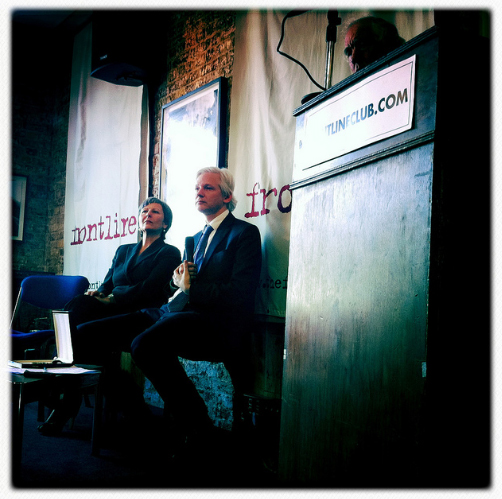 We have published quite a bit of material on the Lockerbie bombing. I suspect you will see more soon in [Scottish national newspaper] the Scotsman, but I can’t say off hand whether it will change the view that has evolved over the last year.
Some of the media have now tried to set up their own version of WIkiLeaks – the Wall Street Journal for example. I’m just wondering if you’ve had a look at them and what you think about those operations?
So we have pushed for a long time for media organisations to be more aggressive in their sourcing and to be more protective of the people who actually are involved [in leaking information]. So in so far as the Wall Street Journal represents a tendency to take up our ideas we were really pleased, and in fact we told everyone: ‘look, the Wall Street Journal’s doing this’. al-Jazeera has also done a similar thing.
Unfortunately, it’s not as easy as it looks. It’s not as easy to stand up to influence as it looks and taking heat is not as easy it looks. So, the Wall Street Journal, if you look at the fine print, says that it can sell you out to anyone at any time – law enforcement, any other interests that it feels like. It makes no guarantees. And a security system analysis shows that it is also weak. But there is a broader general principle, that I think that we’re going to see over the next couple of years – as major media organisations try to retain their role of having sources of information coming directly to them and not having any intermediary – and that is: whistleblowers, like writers, need agents. And for all the same reasons: that if they become captive to a particular publisher … they need someone who knows the system and knows how to deal with potential publishers.
Similarly, those presenting to a court need lawyers to represent them. And those presenting to the court of public opinion need experts in how to understand the difficulties and dangers of presenting to the court of public opinion.
What about the distrust between the ISI [Pakistani intelligence agency, Inter-Services Intelligence] and the US? How real is it?
From my reading the distrust has been there for a long time. But when a strong relationship started to occur between the ISI there was computerisation of ISI’s systems by the US – there was also scrutiny of the top tier staff within the ISI. There are divergent interests between the ISI and the United States as I outlined before. I don’t expect those divergent interests to go away. The battle between divergence and convergence I think is possibly on the side of divergence. But that’s just speculation on my behalf.
The Wall Street Journal have said that they won’t be able to protect sources. What do you think about that? And secondly, is it possible at the moment to give information to WikiLeaks?
Presently we are reengineering our submission system and that has to do with quite a long and difficult story of sabotage of various kinds and the differing and extra hostile environment which we have found ourselves in.
However, it is possible to get us information in a number of ways. We’ve also reached a publicity profile so high now that it means we have to do things differently. Because we’ve started to become completely inundated with material. So that’s a matter of the appropriate engineering, and making sure the material is of a particular calibre that fits the size of the number of people who can assess it.
It’s quite an interesting psychological problem, when dealing with sources, in that, most sources, most of the time, don’t reveal anything. People can go 40 years without revealing anything and then one day they do. So this is about an activations threshold. That at some point, the feeling becomes strong enough that if they want to act and they then need to be caught at this moment and protected at this moment. And some of them have a feeling that they want to act that is so strong that they don’t care about the risks at all. So one also must protect them from themselves, which is quite a difficult thing to do.
So the Wall Street Journal and the similar organisations that whistleblowers are thinking about dealing with: it is not just the technology, it’s a combination of technology and people. The technology is opaque and very complex and sophisticated if done right. So how are you to assess whether the technology has been done right? How are you to assess whether these people will sell you out? You have to look at the people who are running the organisation. What is their history and their experience. Have they stood up to pressure before? And have they managed themselves before?
There’s almost no organisations that have that track record other than us – and individual journalists, there’s just a few with a track record of not buckling when they receive pressure. So I advise everyone who’s thinking about disclosing confidential information to look very closely at the track record of the people that they may be dealing with. But don’t Google their name from your home.
So the Wall Street Journal doesn’t measure up?
No. It doesn’t measure up on any criteria.
]]>Whistleblowers make the world a safer place debate
You can listen to the podcast here and here’s a round-up of what some of the blog posts and websites said about the event.
Following Tuesday’s event, Sophia Spring‘s blog post In the Picture: On your doorstep, photography and poverty includes a slide show of her photographs and write up of the discussion between Liz Hingley and Gideon Mendel speaking about their work with Diana Smythe, deputy editor of the British Journal of Photography.
For quotes from our panel: Dina Matar, senior lecturer in Arab media and political communication at SOAS; Faisal J. Abbas, a blogger for the Huffington Post; Hugh Miles, award-winning investigative journalist specialising in the Middle East and North Africa and Ayman Mohyeldin, Middle East-based correspondent for Al Jazeera English, take a look at Can Arab state-owned media recover from crisis of credibility?which also has video of the discussion chaired by author and broadcaster Tom Fenton.
On our Frontline blog Deborah Bonello has written from Mexico about training for journalists covering drug-related violence.
Davide Morandini, an Italian freelance photojournalist based in Cairo, Egypt explains the opposition’s decision to suspend demonstrations, and cancel today’s protests calling for the Supreme Council of Armed Forces (SCAF) to step down in Why the revolution should leave Midan Tahrir, for a moment at least.
]]>