A packed house at The Frontline Club heard Matt Frei regale them with tales from his long and illustrious career. The former BBC Washington correspondent, recently poached by Channel 4 News, was on fine form as he spoke to former BBC executive Vin Ray about more than 20 years with the BBC:
“The BBC is mother, and it’s been a very good mother to me, but now and again it’s a good idea to leave mother and elope with a mistress. I’ve always admired Channel 4 because it’s a cross between current affairs and news. Newsnight with a bit more of a newsy edge at a decent hour. I’ve had my eye on it for some time, and I guess they may have had their eye on me for some time.”
The event was delivered in conjunction with the BBC College of Journalism, as part of the ongoing Reflections series in which journalists including Alex Crawford, Jon Snow, Bill Neely and Martin Bell have discussed their experiences as journalists.
Frei spoke of the time he met Bell in Serbia, during the Bosnian war, and the valuable lessons that he took from him:
“He taught me the craft of television. It’s a very strange craft because it’s more about what you deny yourself than anything else, he said: ‘If you can’t say it in one minute and 42 seconds you can’t say it. Don’t bother.’”
Delivering his reflections alongside a series of memorable video clips, he discussed some of the high and low points of his career, including his coverage of the fall of the Berlin wall:
“I was told by a famous American journalist that this was the best story I would cover, and that it was all downhill from here. He was sort of right – it was such a happy event.”
He also spoke of some less orthodox approaches to stories, including one particular experience during his time in Rome:
“Giorgio Armani was accused of bribing the financial police. I got an interview by saying I was a fashion journalist for the BBC – I said I wanted to talk about hemlines and colours. Halfway through the interview he turned to me and said, ‘You know **** all about fashion, don’t you?’ I said, ‘Did you pay the money?’ He said, ‘Yes, in brown paper bags.’”
With regard to the challenges facing the next generation of young journalists Frei expressed some optimism:
“I think the challenges are going to be the same: find a story, tell it well and make sure somebody is going to pay you for it. If you’re starting out now you have an incredible range of tools at your disposal – much better than the tools we had, and cheaper.”
The issue of social media was subsequently raised, and the question of what it meant for the future of sending journalists like him around the world – particularly in light of the numerous journalists who have recently been killed and injured whilst reporting from warzones:
“I don’t think most serious organisations are thinking social media will replace what they have. It’s just another source of information – if you can’t get into Syria but you have evidence on your mobile phone you’re going to use it.”
As the evening drew to a close he discussed his only regret, the fact that he had to cover the Iraq war from Washington:
“I never went to Iraq, and in some ways I wish I’d covered it. In some ways talking about it from Washington makes you a bit of a fraud: unless you’ve seen the impact of policy on the ground you can’t really talk about it.”
Watch the full event:
]]>Newly-appointed to Channel 4 News as Washington correspondent, Matt Frei, will be in conversation with former BBC executive Vin Ray to look back over nearly two decades at the BBC before his move was announced in May last year.
]]>In association with BBC College of Journalism
From the fall of the Berlin Wall to the handover of Hong Kong to China, Matt Frei has spent over two decades reporting across the globe.
Newly-appointed to Channel 4 News as Washington correspondent, Matt Frei, will be in conversation with former BBC executive Vin Ray to look back over nearly two decades at the BBC before his move was announced in May last year.
The author of Only in America,Frei has covered numerous high profile stories and reported from Asia, Europe, America and Africa. He has been awarded, amongst others, the Prix Bayeux award for War Reporting for his coverage of the conflict in East Timor. He presented the BBC World News America broadcast and a weekly Radio 4 show, Americana.
Image Credit: Channel 4 News
]]>The decision to go into Afghanistan was necessary as a kind of “acting out” to restore American national confidence and pride in the wake of the terrorist attacks of September 2001, but it was done with little idea about what was to be achieved by it.
That was the claim of Jean MacKenzie, senior correspondent for GlobalPost and previously programme director for the Institute for War & Peace Reporting in Kabul, about the decision of president George Bush to send troops into Afghanistan less than a month after the terrorist attacks of 11 September, 2001.
"We had to go in, America had to kick ass because we had been attacked and we had to prove that we were big guys, and there was very little resistance to going in to Afghanistan, Afghanistan was a very convenient ass to kick, because it was not being really defended," said MacKenzie.
MacKenzie, who was taking part in a recent discussion titled: Counterinsurgency and the "War on Terror": Doomed to fail? agreed that America had to react to the terror attacks in New York and Washington. The problem was not the decision to intervene, but the fact that it was done without a clear idea of what it would accomplish, she said:
"We didn’t need to go in with this open-ended brief of we’re going in there to get rid of al-Quaeda, now we’re going in there so that little girls can go to school and maybe we’re there so women don’t have to wear burqas and now we’re there, as Time magazine tells us, so that women’s noses are not cut off. Where does it stop? We needed to define our goals from the very beginning."
There was also a lack of clarity about who the enemy was, said MacKenzie, who claimed local groups could manipulate NATO or the International Security Assistance Force into fighting their battles by claiming their opponents were Taliban:
"We go into an area, like in Kunar, where two groups are fighting over logging rights – another gets close to us and says they are the Taliban. We start fighting them and they fight back and as soon as they do, they become an insurgency."
As a result of the lack of clarity the rhetoric about the US mission in Afghanistan had taken on a life of its own, MacKenzie argued:
"It’s a very broad statement but I think we are now fighting the Afghan people, the Afghan society. We say the Taliban stone women for adultery, the Taliban stone young couples, the Taliban throw acid in the faces of school children.
But in most of these cases, if you unravel it, it’s not the Taliban, it is the community that has done these things. So if we are fighting those manifestations of Afghan culture, we are not fighting the Taliban, we are fighting Afghan society, we are fighting a culture that we find noxious. That, I think, is quite a bit beyond our brief."
Ten years on, the mood in Afghanistan was one the “darkest despair”, said MacKenzie, adding that there is little trust on the ground in the ability of the Afghan forces to protect the people. In addition, things have gone "way beyond the point" when outside nations could impose anything on the country:
"There was a point at the beginning when there was a certain amount of hope and goodwill among Afghans, but I don’t feel it there any more," she said.
"The Afghans are more and more pessimistic, they have given up on their own government, how do you fight counterinsurgency when you have no legitimate government to partner with? How do we begin to do anything?
Yet the US is likely to leave Afghanistan with "honour and dignity in the strategic communications sense," said MacKenzie, who predicted that from now until the end of 2014 the US administration was going to be "busily engaged in painting a narrative of victory":
All that is required for us to have won is for the media to pack up and go home so there’s no focus on what’s actually happening and for us to redefine victory and to move the goalposts as it were."
Malte Roschinski, a security consultant, political analyst and author who reported from Afghanistan for AFP news agency, was also pessimistic about the future of Afghanistan and said he believed the best that the US could do was to "come up with a good PR strategy and hope for the next six months or so it’s going to stay fairly quiet".
]]>"After that the media focus will have moved away from the country. There will be stories afterwards but the media works in cycles and public attention has just so much bandwidth anyway so it’s just going to be a PR exercise."
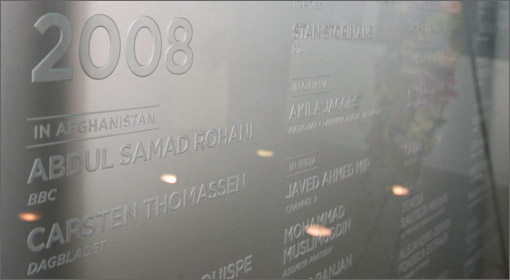
The names of 62 journalists killed in 2008 and 15 killed in previous years have been added to a memorial wall at the Newseum in Washington D.C. that honours journalists killed doing the job of journalism. Iraq and Mexico were the deadliest places for journalists last year. 13 names from Iraq were added to the wall and 5 from Mexico, including El Diario newspaper reporter Armando Rodriguez who was gunned down as he took is daughter to school,
"These are not long ago and far away events," [said Alberto Ibarguen, the Newseum’s chairman, and president and CEO of the John S. and James L. Knight Foundation and a former publisher of The Miami Herald.] "The story they’re covering in Mexico is a story of drugs and corruption and guns… These murders strike at the heart of democracy by silencing speech and by depriving a community of the information it needs to conduct its affairs." link
Photo by AP Photo/J. Scott Applewhite
]]>