Tim Page took some of the most confronting images of the Vietnam War. As a young photojournalist he spent six years covering the conflict for outlets including TIME-LIFE, UPI, PARIS MATCH and ASSOCIATED PRESS, and became one of a small group of iconic photographers whose arresting images of war woke the world up to what was going on.
Page was also a man made mythical before his time, the inspiration for Dennis Hopper’s photojournalist in Apocalypse Now, he had a reputation for getting closer to the action than most of his colleagues. Embedded with the US military, he went everywhere, covering everything. As a result, he was injured four times, once or twice almost fatally.
Since then Page has spent decades covering events from Timor-Leste to Afghanistan and Cuba to Cambodia. His photographs are held by London’s Tate Gallery and Washington’s Smithsonian. He was recently named as one of The 100 most influential photographers of all time and has been the subject of many documentaries, two films and the author of ten books. He now lives in Brisbane Australia and this is his first visit back to the UK in 14 years.
Tim will be talking to journalist Jon Swain about his work and career, focussing on Vietnam and Cambodia. A selection of his prints will be on sale following the event.


Marines coming ashore March ’65
John Laurence covered the Vietnam War for CBS News from 1965 to 1970 and was judged by his colleagues to be the best television reporter of the war. His documentary film, The World of Charlie Company, won every major award for broadcast journalism and also the George Polk memorial award for best reporting in any medium requiring exceptional courage and enterprise abroad. He is also the author of “The Cat from Hue: a Vietnam War Story“. It won the Overseas Press Club Cornelius Ryan Award for “best book on international affairs” in 2003.
]]>As he publishes Irreconcilable Truths, a definitive retrospective of his life and work, he will be joining us in conversation with Channel 4 News presenter Jon Snow to reveal the stories behind some of the most iconic images of the second half of the 21st century.
]]>Last Days in Vietnam chronicles the chaotic final days of the Vietnam War as the North Vietnamese Army closed in on Saigon. In April of 1975, the North Vietnamese Army was advancing on Saigon as the South Vietnamese resistance was crumbling. Approximately 5,000 Americans remained, with roughly 24 hours to get out. Their South Vietnamese allies, co-workers, and friends faced certain imprisonment and possible death if they remained behind, yet there was no official evacuation plan in place.
With the clock ticking and the city under fire, American officers on the ground faced a moral dilemma: follow official policy and evacuate U.S. citizens and their dependents only, or ignore orders and save the men, women, and children they had come to value and love during their years in Vietnam.
Over the last days in Vietnam, with the clock ticking and the city under fire, 135,000 South Vietnamese managed to escape with help from a number of Americans who took matters into their own hands, engaging in unsanctioned and often makeshift operations in a desperate effort to save as many people as possible. Through remarkable archive footage and candid present day interviews, director Rory Kennedy reconstructs the evacuation efforts with sensitivity and concern for accurate historical record.
Last Days in Vietnam is an Academy Award Nominee for Best Documentary Feature and will premiere on PBS America at 8pm on Sunday 1 November (Sky 534 & Virgin Media 276).
Director/Producer: Rory Kennedy
Producer: Kevin McAlester
Executive Producer: Mark Samels
Year: 2015
Runtime: 60′
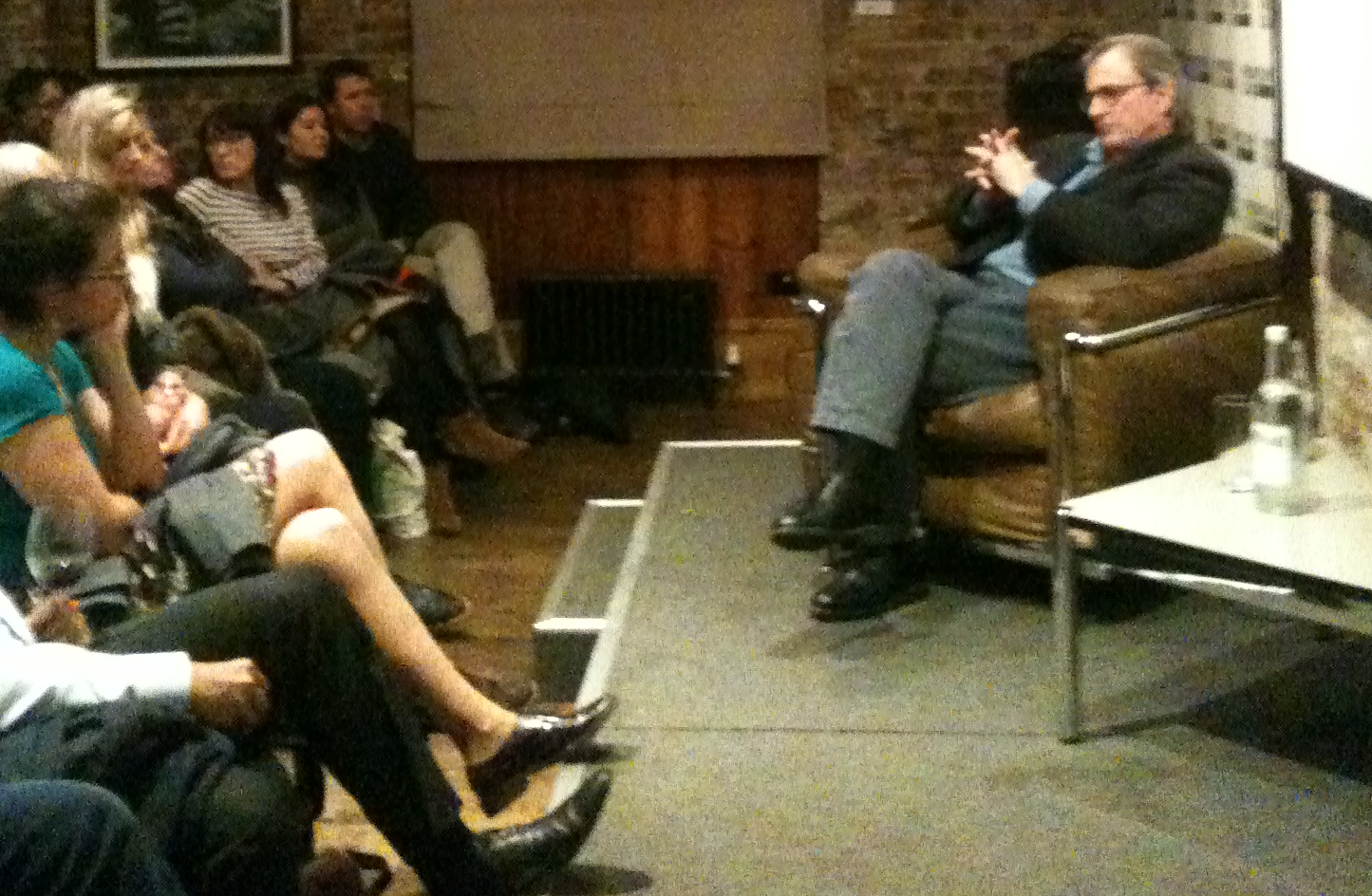 "He was there!" Director Thomas O’Connor said of English author and journalist Graham Greene (1904-1991), the subject of his documentary Dangerous Edge: A Life of Graham Greene, which was viewed by a full house at the Frontline Club on 1 October.
"There, you know, for 70 years, from one place to another, in these hot spots."
Greene – whether meeting with the Pope, giving a speech to Gorbachev’s Kremlin, conversing with Latin American rulers, or journeying in the 1930s through the hinterlands of Mexico or Liberia – had his finger on the very pulse of the 20th century: its crimes of foreign policy, the inner angst of its inhabitants.
In his own life, Greene left his wife and two daughters early on, indulged in drugs, prostitutes and affairs, suffered from bipolar disorder, and fought powerful suicidal urges, often admitting to his own yearning to die.
"Dear Vivien," he wrote to his wife, "the fact that must be faced, dear, is I have been a bad husband. You see, my restlessness, moods, melancholia, even my outside relationships, are symptoms of a disease, not the disease itself. Unfortunately, the disease is also one’s material. Cure the disease and I doubt whether a writer would remain."
"He was a tremendously courageous writer and journalist," O’Connor reflected, sharing that a driving motivation to make the film was that he "worried about journalism [today]," that future generations would lack voices as brave and voluminous as Greene’s.
"Some writers write their novels," O’Connor said, "and then every once in a while a letter to the Editor. Greene had a whole book of letters to the Editor!"
His eyes searing with intelligence and sensitivity, Greene asked readers to see more deeply into the world around them. He challenged the injustices of big business, globalization, Soviet totalitarianism, and British and American interventionism.
"I would go to any lengths to put my feeble twigs into the spokes of American foreign policy," Greene wrote.
His 1955 novel The Quiet American paired the damage done by a naive American idealist with that by a cynical English journalist like himself, both living in Saigon and desiring the same Vietnamese woman. The work so touched a nerve that, as O’Connor highlighted, even George W. Bush could not help mentioning it in a 2007 speech to American war veterans.
O’Connor wished Greene had been alive to challenge the narrative that led to the latest invasion of Iraq.
]]>"We still need writers," he argued, "as [Greene] famously said, ‘with a sliver of ice in their heart,’ and willing ‘to be a piece of grit in the state machinery.’"
In 1970, director Michael Grigsby portrayed three young men returning home after spending a year at the frontline of the Vietnam War. The award-winning documentary I Was a Soldier focused on how David Johnson, Dennis Bolinger and Lamar Wyatt were trying to readjust to life in Texas – and was one of the first films to show the devastating impact of the war on soldiers who returned home.
Over 40 years later, Grigsby and co-director Rebekah Tolley return to Texas to pick up the stories of the three men. Merging past and present We Went to War is a contemplative, visual and touching film that reveals how much their experience of war shaped their lives.
With many young men and women returning home from different wars today, We Went to War sheds a sharp, but sensitive light on the long-lasting psychological impact the experience has on young veterans and their families.
Directors: Michael Grigsby and Rebekah Tolley
Duration: 77′
Year: 2012
Time Out – “One of Britain’s finest documentarists”
The Independent – “His films are landmarks… from Girgsby back to Grierson runs an unbroken tradition in British documentary making: a passionate commitment to the poetry of everyday life.”
The Guardian – “I won’t say Michael Grigsby is too good for television. He might believe me and leave it. But he surely shines among the surrounding shoddy. The style of a good director is such that you do not need a credit title. You know. A Grigsby has a unique sense of stillness which is, paradoxically, most moving.”
]]>Private Nolan vanished 40 years ago in mysterious circumstances from the Vietnamese border with Cambodia. The US military says he went native, joining the Viet Cong before being murdered by the Khmer Rouge, but it won’t release the files.
What’s known is that he did propaganda work for the Viet Cong and married a Vietnamese woman. But then it turns murky. Did he slip into Cambodia rather than face being returned to the US at the end of the war? Did he become one of the million victims of Pol Pot’s killing fields? Or was he the American who spoke to a retired US Army Lieutenant in 2006 during the veteran’s visit to Cambodia?
Part thriller, part meditation on the brutality of war, the film follows Michael Nolan on a brother’s quest for new facts in a buried past. Did McKinley abandon America or did America abandon him?
Directed by Henry Corra
2011
88 mins
]]>
We will be discussing Kashmir’s future, the changing role of the foreign correspondent with The Guardian‘s Jonathan Steele, torture and the Arab Spring, and the coming presidential elections in the Democratic Republic of Congo.
A series of Film Africa documentaries look at the people of the Western Sahara and a community of women living in exile after being accused of witchcraft. There’s a film about the street vendor Mohammed Bouazizi who, by setting himself on fire, sparked an uprising in Tunisia, and another tells the story of the brother of Private McKinley Nolan and his quest to find out the truth about what happened to the missing G.I.s in Vietnam.
Following on from this month’s #fcbbca discussion on Israel, we will be discussing women and the Arab Spring at Westminster College’s Paddington Green Campus. The focus of our November First Wednesday discussion will be announced on Wednesday 26 October.
Follow us on Twitter and catch up on any events you missed on the Forum blogor download our podcasts on iTunes.
]]>
By Millie Cartwright
Veteran war correspondent Martin Bell was at the Frontline Club last night to look back on his long career as a journalist and share some pearls of wisdom for aspiring foreign correspondents.
Bell, who later went on to become MP for Tatton, a UNICEF ambassador and prolific writer, was talking to former BBC executive Vin Ray for a Reflections event in association with the BBC College of Journalism about a 35-year career that took him to 102 countries.
Inspired to take up journalism after observing the press corps while serving in Cyprus with the Suffolk Regiment back in the 1960’s, Bell covered numerous wars including Vietnam, Bosnia and the troubles in Northern Ireland during his 30-year career.
Twice winner of the Royal Television Society’s TV journalist award, he got into the BBC with the help of an ex-girlfriends father: “You didn’t apply for jobs back then,” he said.
Three years later he was broadcasting from London and ended up ‘unintentionally’ covering the Vietnam War in 1967 after catching they eye of the BBC bosses for his coverage of the overthrow of Kwame Nkrumah the previous year.
His initial broadcasts were, in his own words, examples of “How not to do television news.”
His first clip, in black and white, showed a young Bell covering American operations in Vietnam where “You’ll see no Vietnamese from start to finish.” He still looks the other way while the clip is shown, hands over his eyes: “I imitated the voice of the officer class and eventually I found my own style. By 1972 I’d humanised myself; I was talking Vietnamese, going to refugee camps and had better connections in the government.”
Amongst his other assignments that included reporting the election of Ronald Reagan, Bell covered the conflict in Bosnia. Safety standards were less rigorous at that time and journalists only began wearing flak jackets in the summer of 1992; just weeks after Bell narrowly missed a sniper bullet. For him, Libya today is a sharp reminder of those days 15 years ago, where journalists once again are at risk.
“The real heroes of this business are people like Tim Hetherington, but they don’t get the recognition they deserve,” he said. “I’m glad I’m not doing it anymore.”
Bell expressed concerns that reliance on security advisers has had a negative impact on journalistic neutrality. He is also critical of the kind of reporting that developed, particularly during the wars in Iraq and Afghanistan, when journalists remained in hotels in green zones and be at a distance from the conflict. This has led him to be somewhat critical of reporting today as for him there is no alternative to being as close to the action as possible.
“I always made the habit of hanging out with the bad guys because you have to understand why it is that they are doing what they are,” he said.
As UNICEF ambassador Bell enjoys “going to places where they can’t send celebrities like Robbie Williams and David Beckham” and a greater level of access compared to his time as a journalist.
Bell closed with a reading of one of his poems that looked back on his career from his latest book, For Whom the Bell Tolls: Light and Dark Verse. The closing line read: ‘You may recall I made no bloody difference at all.’
Martin Bell’s Advice for Future Foreign Correspondents:
- Don’t ever go into a village where there are no people or chickens, it’s always a bad sign.
- Know when to stop talking; silence is an art
- Don’t be a hotel roof dish monkey
- On reporting a shocking story: have one striking image, that’s all people can take
- Don’t make yourself the centre of any story
- Tone of voice is key
- Make sure you don’t editorialise
- Find your own style; there isn’t one for everybody.
With access to Dr Henry Kissinger over the past two years, this award-winning documentary gives unique insight into the personality and motivation of one of America’s most powerful and controversial international statesman.
Film maker Adrian Pennink intercuts twenty hours of interview with Dr Kissinger by Niall Ferguson, with archive and contemporaneous telephone conversations between him and President Nixon, to recount the extraordinary and violent events of their time in power during the 1970s.
Best remembered for negotiating peace with Vietnam, opening up China to the West and creating détente with Brezhnev’s Soviet Union, Kissinger also stands accused of illegally bombing Cambodia, aiding Pinochet’s coup against the elected President of Chile, Salvatore Allende, and arming the Indonesians so they could invade East Timor.
But this film is no mea culpa. Kissinger stands resolutely by his historic decisions as he recounts the fulcrum in which they were made. When controversial questions are asked or he fears how his response will seem, he asks the camera to stop, and it obeys. But there are moments when his control slips, as he recounts his wartime arrival at a concentration camp, the fall of South Vietnam. All in all an intriguing portrait of an international leviathan, who doesn’t dispute he’ll be as much remembered for saying that power is the ultimate aphrodisiac as winning the Nobel Peace Prize.
Kissinger will be screening at the Frontline Club on the 3rd of October, followed by a Q&A with Producer Melanie Fall and Director Adrian Pennink. To book click here.