Tim Page took some of the most confronting images of the Vietnam War. As a young photojournalist he spent six years covering the conflict for outlets including TIME-LIFE, UPI, PARIS MATCH and ASSOCIATED PRESS, and became one of a small group of iconic photographers whose arresting images of war woke the world up to what was going on.
Page was also a man made mythical before his time, the inspiration for Dennis Hopper’s photojournalist in Apocalypse Now, he had a reputation for getting closer to the action than most of his colleagues. Embedded with the US military, he went everywhere, covering everything. As a result, he was injured four times, once or twice almost fatally.
Since then Page has spent decades covering events from Timor-Leste to Afghanistan and Cuba to Cambodia. His photographs are held by London’s Tate Gallery and Washington’s Smithsonian. He was recently named as one of The 100 most influential photographers of all time and has been the subject of many documentaries, two films and the author of ten books. He now lives in Brisbane Australia and this is his first visit back to the UK in 14 years.
Tim will be talking to journalist Jon Swain about his work and career, focussing on Vietnam and Cambodia. A selection of his prints will be on sale following the event.


Marines coming ashore March ’65
John Laurence covered the Vietnam War for CBS News from 1965 to 1970 and was judged by his colleagues to be the best television reporter of the war. His documentary film, The World of Charlie Company, won every major award for broadcast journalism and also the George Polk memorial award for best reporting in any medium requiring exceptional courage and enterprise abroad. He is also the author of “The Cat from Hue: a Vietnam War Story“. It won the Overseas Press Club Cornelius Ryan Award for “best book on international affairs” in 2003.
]]>Last Days in Vietnam chronicles the chaotic final days of the Vietnam War as the North Vietnamese Army closed in on Saigon. In April of 1975, the North Vietnamese Army was advancing on Saigon as the South Vietnamese resistance was crumbling. Approximately 5,000 Americans remained, with roughly 24 hours to get out. Their South Vietnamese allies, co-workers, and friends faced certain imprisonment and possible death if they remained behind, yet there was no official evacuation plan in place.
With the clock ticking and the city under fire, American officers on the ground faced a moral dilemma: follow official policy and evacuate U.S. citizens and their dependents only, or ignore orders and save the men, women, and children they had come to value and love during their years in Vietnam.
Over the last days in Vietnam, with the clock ticking and the city under fire, 135,000 South Vietnamese managed to escape with help from a number of Americans who took matters into their own hands, engaging in unsanctioned and often makeshift operations in a desperate effort to save as many people as possible. Through remarkable archive footage and candid present day interviews, director Rory Kennedy reconstructs the evacuation efforts with sensitivity and concern for accurate historical record.
Last Days in Vietnam is an Academy Award Nominee for Best Documentary Feature and will premiere on PBS America at 8pm on Sunday 1 November (Sky 534 & Virgin Media 276).
Director/Producer: Rory Kennedy
Producer: Kevin McAlester
Executive Producer: Mark Samels
Year: 2015
Runtime: 60′
On Friday 18 January the sound of spontaneous applause rang out from the upper room at the Frontline Club as the Bafta nominated documentary ‘McCullin’ came to an end. The room was packed despite the snow, and there was eager anticipation in the air for the Q&A with director Jacqui Morris and producer David Morris, which followed the screening.

Through intimate interviews with Don McCullin and his former editor at The Sunday Times, Sir Harold Evans, ‘McCullin’ chronicles the photographic escapades of the renowned photojournalist, and gives a unique insight into his experiences. The film also uses extensive archive footage and incorporates many of Don McCullin’s photographs, some of which were previously unseen. Director Jacqui Morris described the process:
We shot the film in three days, and archive research and post production was 18 months – a massive job!
Don McCullin became famous for his harrowing images of warfare and humanitarian disaster, which were published in The Sunday Times magazine throughout the 60s, 70s and 80s. These publications, Jacqui Morris explained, were to become of central importance to the film:
I think they are hugely important in the film, the [Sunday Times] magazines, hugely important, because we’ve all grown up with those Don McCullin shots, but actually when you see them as double page spread as somebody would see them on a Sunday morning . . . the truth you know, from a truthful photographer, there is nothing like that now, nothing like it. And I think they’re incredibly important.
An audience member pointed out how the film also provides a history of warfare in the latter half of the 20th century. Jacqui Morris explained how this element of the film evolved:
That came as I was reading the [Sunday Times] magazines, I thought if I don’t know [about these things] other people might not know.
Producer David Morris added:
It was an organic process but we thought it was an interesting process to show people the history of the second half of the 20th century.
The discussion also explored the comparisons between Don McCullin’s printed images and new trends in photo-based journalism, affected by the image-saturated landscape of social media:
[There is] an infinitely huge amount more information now than you had then, and so those images that you got in The Sunday Times, and other magazines, had a much bigger impact than they’d ever do now. I don’t think it’s fair, really, to expect any publication to ever have that kind of influence again, it just will not happen.
But David Morris added that:
There is a thing about still photography and the still image that really does haunt you.
For information on future screenings, you can visit the film’s Facebook page here.
]]>In 1970, English documentarian Michael Grigsby released I Was a Soldier, which explored life after war for three young men returning from Vietnam to their homes in the heartland of Texas.
Grigsby went back to Texas last year, rekindling his friendships with these men and their families, and telling their updated story in We Went To War.
After a screening at the Frontline Club on September 17, Grigsby and co-director Rebekah Tolley answered questions from the audience. They elaborated a philosophy of film that seemed, at its very core, to be about feeling, healing, and connecting – processes that veterans, weighed down by trauma and loneliness, can find as rare as they are vital.
Tolley and Grigsby were asked how they had captured such authenticity in their subjects.
"It’s a word called trust," Grigsby answered. "Very simple."
When making We Went to War, he and Tolley spent the first few days with their subjects discussing directions the film might take, but the next three weeks without a camera, simply spending time together. In the end, Grigsby reflected:
"We gave the [subjects] the space to be themselves … That’s a crucial thing in the way I like to make pictures: let people be what they are, and don’t let’s try to have an agenda in which we try to force the pace."
Yet once filming began, they shot We Went to War in only 11 days.
"I like to shoot fast, actually," Grigsby said. "The main reason is … if you’re invading some people’s life, you want to give them the minimum hassle."
Meditative in style, We Went to War’s scenes often contain little more than shots of Texas’ beautiful rustic landscape, set to a mournful guitar. Grigsby explained:
"When you hear some very powerful dialogue, I want time to absorb it, actually. I don’t want to be pushed on to the next scene, and the next scene. And one of the ways we’ve done that, I think, is just cutting to a landscape … and you can just resonate, and think, about things … just to give us, the audience, time to think, to feel, to listen. And I feel very deeply this is something sadly missing now … that time, the space, to think, to feel."
Another reason to highlight space, Grigsby said:
"Was to emphasize all that loneliness. I feel, in the world, we’re like figures in a landscape. We rarely communicate and rarely touch one another."
"In a sense, I don’t think we [as documentary makers] have a mission to explain. We have a mission to feel."
Both I Was a Soldier and We Went to War have drawn rave reviews, particularly from veterans. Grigsby shared:
"We heard of one veteran who saw the film … and we’re told that he went home and apologized to his lady of 40 years, that he hadn’t been able to understand what she was going through. And for the first time in 40 years, it seems that they are now having a dialogue. And that’s incredible. It’s just incredible to ask that one film can actually just open the eyes and the heart a little bit and enable this thing to happen. That’s, that’s beautiful."
We Went to War has not been officially released yet, but the trailer and future screening dates can be found on this website
]]>Michael Herr’s memoir of his time as a correspondent for Esquire magazine from 1967 to 1969, first published in 1977, was described as the best to have been written about the Vietnam War.
And the best piece of advice Mason received during his career?
It was a lesson from a feature writing tutor at Reed Business Information in the 1990s who taught him about the "nut graf".
The nut graf is the part of the story that reveals the story’s content and message and explains its significance as a news story. It’s called the nut graf because, like a nut, it contains the “kernel,” or essential theme, of the story. You can read more about the nut graf here.
The Reflections events at the Frontline Club are a great opportunity to hear about the craft of journalism from the experts.
ITV News’ Bill Neely’s discussion with VIn Ray was full of insight , as were those by other Reflections interviewees, including Lindsey Hilsum and Nick Robinson, who also reflect on what makes good television reporting.
If you want to hear more from Paul Mason, the BBC Newsnight’s economics editor about the lessons he’s learnt during his careers and the work of those journalists who inspired him, then book now for the latest in our Reflections series on Wednesday. Paul Mason will be in conversation with Matthew Eltringham, editor of the BBC College of Journalism website and events.
]]>Just announced: John Laurence will be joining the panel.
Join us for this special event to discuss the iconic war reportage, to mark 35 years since the end of the Vietnam War.
This special event brings together reporters who covered Vietnam to reflect on the war that changed the way the public think about conflict.
Saturation bombing, worldwide protests, napalm, agent orange and an estimated two million lives lost.
Has any war since had such an impact on the public psyche? Why was the reaction to the carnage in Vietnam so strong? Was it because of a lack of conviction in the cause the US was fighting for? Or was it because of these reporters and photographers and their work that so poignantly captured the brutality of war?
Jon Swain was the only British journalist in Phnom Penh when it fell to the Khmer Rouge in April 1975. His coverage of these events and their aftermath won him the British Press Award for Journalist of the Year. His story was retold in the Oscar-winning film, The Killing Fields and his bestselling book River of Time. Swain wrote an article about covering Vietnam in his early 20s in the most recent issue of Frontline: A Broadsheet.
French war photographer Patrick Chauvel was only 18 when he started covering the Vietnam war. In the years that followed he has covered over 20 wars and in 1995 won the World Press Photo award for Spot News. He is the author of two books in French, Rapporteur de Guerre and Sky.
John Laurence, author of the prize-winning memoir The Cat from Hue, covered the war for CBS News from 1965 to 1970 and made the multi-award winning documentary The World of Charlie Company. He also covered 15 other wars in Asia, Africa, the Middle East and Europe.
This special event will be moderated by Michael Nicholson OBE, former senior foreign correspondent for ITN. Nicholson reported for over 25 years from 15 conflicts, including Vietnam. The film Welcome to Sarajevo and his book Natasha’s Story were both based on his experiences covering the war in Bosnia.
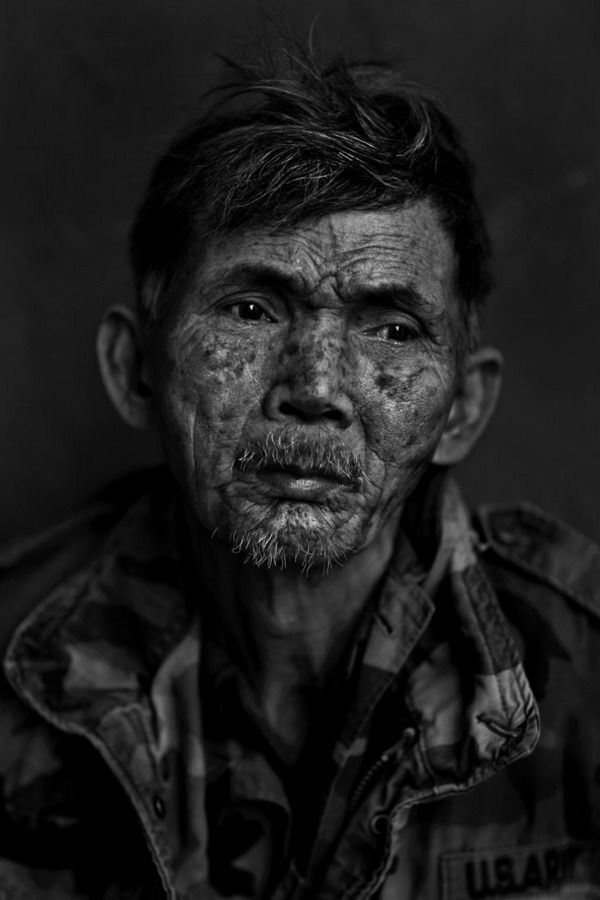
]]>I have just met Ong Nuoi, who is slightly mentally disabled. He is the adopted brother of Bac Trai, my girlfriend’s father. Nuoi translates directly to: To nourish, to bring up, to feed, to breed.
Loggers, who worked for Bac Trai’s father, found Ong Nuoi wandering in the forest as a child. The Loggers brought him to the family house and Bac Trai’s father took him in.
Ong Nuoi had said the French bombed his village in the North and his family was killed. Bac Trai’s family figured he came to Da Lat with the French troops as a service boy because he able to speak a few words in French such as fork, knife, and plate.
When they asked his name he just said Nuoi. The family thought maybe someone was talking about taking care of him – Nuoi – so he thought that was his name.
When Ong Nuoi was of drafting age for the South Vietnamese army, he was at the training camp for only a week. He failed the minimum qualification test. When the soldiers were standing in a line, the officer yelled out commands. “Turn left”. Ong Nuoi turned right. He was sad for a long time. His only desire has long to become a soldier.
Ong Nuoi has always hated the Communists. When the North Vietnamese came into Da Lat, he stood out in front of the house and wore his South Vietnamese uniform from training camp waiting for the Americans to show up. They never did.
Now the family thinks Ong Nuoi is around 72 years old. He spends his days raising animals. Six dogs, two cats, one bird and several chickens. No one is allowed to eat the chickens. He sells the eggs to earn enough to buy food for the dogs. A tear rolls down his cheek as he talking about the recent passing of a pet dog.
He lives quietly in his small bedroom outside of the house. He wears his US Army uniform as much as possible. He still longs for military service.