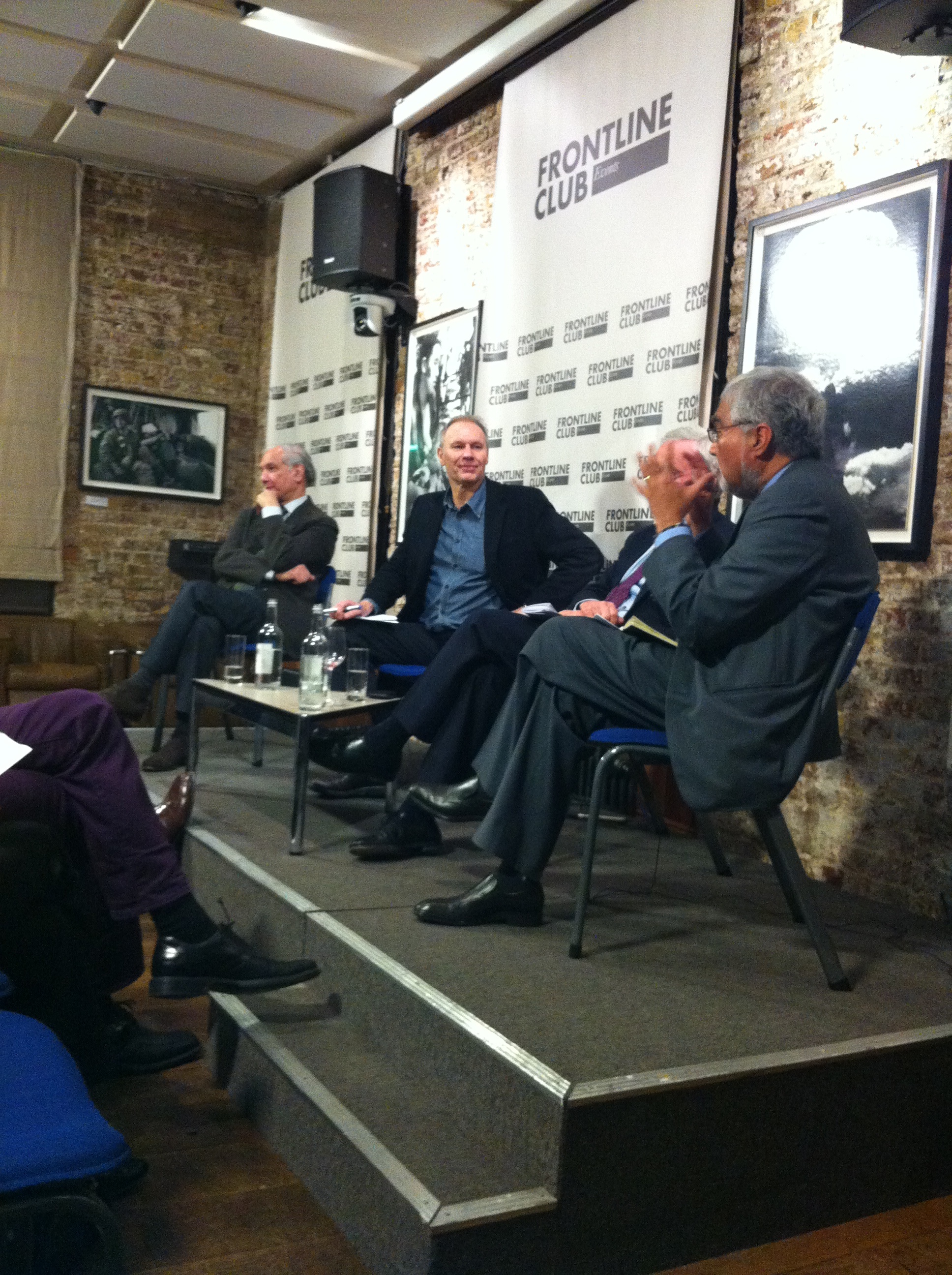
On a panel moderated by David Loyn, Gordon Brown, Julia Gillard and Kevin Watkins discussed funding education for Syrian child refugees.


More than 20 global leaders – including former presidents, prime ministers and Nobel Prize winners – will meet in London on 23 January to champion the world’s young people by bidding to reverse a dangerous decline in financing for education, particularly in conflict zones.
Following this meeting, the United Nations Special Envoy for Global Education, Rt Hon Gordon Brown; the chair of the Global Partnership for Education and former Prime Minister of Australia, Julia Gillard; and the head of the Overseas Development Institute, Kevin Watkins, will be in conversation at the Frontline Club. The discussion will be chaired by foreign correspondent David Loyn, and will focus on how the international community must fund 1 million school places for Syrian refugee children. The event takes place just 10 days ahead of a major United Nations-sponsored Syria relief funding conference, also being held in London.
The International Commission on Financing Global Education Opportunity is supported by the Government of Norway and Prime Minister Erna Solberg and co-convened by President Michelle Bachelet of Chile, President Joko Widodo of Indonesia, President Peter Mutharika of Malawi and the Director-General of UNESCO, Irina Bokova. It will review the future of global education, which currently leaves 124 million young people out of school. The selection of this diverse group of individuals comes at a crucial time, when more children are out of school than a year ago and increased conflict has forced millions of children out of the classrooms – becoming refugees with no prospects of education. The Commission will explore how over the next 15 to 20 years, education could lead to greater economic growth, better health outcomes, and improved global security.
]]>On Tuesday 10 November the Frontline Club hosted a preview screening of Julia Dahr’s Kisilu: The Climate Diaries, ahead of the film’s December screening at the UN climate change conference in Paris. The screening was followed by a discussion with the film’s producer, Hugh Hartford.
The documentary, produced for Al Jazeera, focuses on the eponymous farmer from southeast Kenya and his first hand experiences of the effects of climate change, as he captures much of the footage himself.
Kisilu Musya shows us how his house is destroyed by savage winds and how his crops are first parched and then flooded. In Musya’s words, the extremes that climate change brings mean “everything is being contradicted.”
Throughout the filming period, Musya helped both himself and his community by beginning a village-wide movement to improve the quality of the soil by planting trees.
Yet the documentary is not solely focused on the environment. Hartford said: “If we made it too much about the trees, it would take over the story.” As the film progressed “the trees got surpassed by his relationship with his wife,” said Hartford. “It’s much more of a personal story.”
The producer was clear about the fact that the film provides no grand solutions to the environment crises. Instead, in the film, “what we’re witnessing is a person becoming a leader,” said Hartford.
The film begins not with a description of the global problem, but with a depiction of Musya’s family life and the nine children he supports.
One audience member said that they felt the introduction of the subject of climate change was sudden, to which Hartford replied: “Delaying the mention of climate change is actually deliberate.”
He underlined the idea that although the film is about Kenya’s environmental problems, Kisilu’s life and personality formed the central narrative.
Great film tonight @frontlineclub by @JuliaDahr about #Kisilu – fighting #climatechange in #Kenya. Catch it on @AJWitness 7 December.
— Louise Orton (@louloulorton) November 10, 2015
Another audience member congratulated Dahr’s distinct approach to such a large problem that is difficult to understand. He said she was the only director who had the “creativity to get out of the non-government organisation straightjacket, as it were, and do bigger films.”
Hartford concurred, and commented on the fact that the film’s special quality comes in part from the fact that the viewer cannot always tell who is behind the camera.
Although Kisilu is a useful tool for climate change activists, “we’re not making a campaign film,” he said.
Another audience member raised the question of how foreign filmmakers manage to tell the Kenyan story without being personally involved, Hartford replied that there was “an interesting dynamic between the crew and the family,” but that was “never a reason not to do something.” The relationships between crew and Musya would endure, Hartford said.
This sentiment of collaboration is expressed in the film. As Musya filmed insects working in teams, he contemplated human inaction in the face of climate devastation. Musya said that insects, “have power in coming together… I wonder why human beings are not doing it.”
]]>
L-R: Mukesh Kapila, James Copnall, Lindsey Hilsum, Heather Pagano and Thomas Mawan Muortat discuss South Sudan.
The audience packed out the Frontline Club for the first event of the year on 8 January, a testament to the subject that has been dominating international headlines for the last few weeks – the crisis in South Sudan. A panel of experts from different fields, chaired by Channel 4 international editor Lindsey Hilsum, discussed the current fighting in the world’s youngest country, each offering valuable opinions on where it came from and where it’s going.
The BBC’s South Sudan and Sudan correspondent, James Copnall, gave some context to the recent fighting and imparted what he has seen on the ground first hand. When Hilsum asked if it was an attempted coup that started the fighting, as President Salva Kiir has claimed, or a mutiny amongst the presidential guard, as alleged by former vice-president Riek Machar, Copnall said it is still too early to tell, but “the key objective is to get both sides to stop fighting and at least start talking.”
Heather Pagano from Medecins Sans Frontieres (MSF) added a humanitarian perspective: “The situation is quite concerning… the speed with which everything changes on the ground, which makes it incredibly difficult to plan a proper aid response, especially in such a big country with very little logistical capacity.”
“I’ll share with you MSF’s main humanitarian concerns at the moment,” Pagano added. “In Juba, we are working in a UN camp where there is 30,000 displaced. It is so cramped that people are taking turns sleeping at night. A physic on the team worked out that the population density there is 10x the population density in Mumbai.”
MSF’s other concerns for those in refugee camps are ethnic based attacks, a lack of water (“wells are running dry by 10am”), and a high risk of disease outbreak.
Hilsum asked Thomas Mawan Mourtat, a South Sudanese political analyst, how South Sudan has come to this so quickly after the jubilation of independence in 2011. He explained that there were many underlying factors that led to this: “The population feels it has be let down and agitated by the ruling party. It was not surprising to many people that it blew up – the extent of the violence was a surprise, but people were feeling something was going to happen.”
Professor of Global Affairs Mukesh Kapila, who prior to teaching at the University of Manchester was the UN Resident and Humanitarian Coordinator for Sudan, pointed out that history suggests new countries go through a level of instability.
“The international community needs to be tolerant. The idea that you could impose a western style democracy, a winner takes all approach, and the rituals of a mature state and expect everything to work is complete nonsense.”
“Peace and society is built from the bottom up, not top down. You need a much more grassroots approach, local democracy and local governance.”
Mourtat agreed with Kapila that a resolution could be best reached through the grassroots, specifically through the strengthening of local councils: “During the war, one of the most successful campaigns was organising grassroots district councils.” He explained, “the SPLA has lost its way since it came into power. This local administration has been lost and that needs to be re-established.”
When an audience member asked if more UN peacekeepers were needed, the former Sudan UN coordinator, Kapila, went as far to call the current peacekeeping response “abominable”.
“If you look at the case of Darfur, the biggest UN peacekeeping operation” said Kapila, “the situation is as bad as ever. Why are [global taxpayers] paying a billion dollars a year, yet there is ongoing violence. How is a UN peacekeeper force going to bring about peace between a sovereign government and an armed insurgency?”
He reasoned: “Spend it on trying to build grassroots to build community reconciliation and community peace building capacities.”
https://soundcloud.com/frontlineclub/first-wednesday-south-sudan
On 23rd April 2013, The Frontline Club held the first UK preview screening of award winning television director Callum Macrae’s new documentary, No Fire Zone – The Killing Fields of Sri Lanka.

No Fire Zone uses forensically verified footage from civilian mobile phones and government forces cameras to chronicle the last 138 days of the 26 year long Sri Lankan civil war between the Sinhalese led government and the Tamil Tigers (LTTE).
The film documents with sometimes disturbing footage the barbaric onslaught and effects of shelling by Sri Lankan government forces on the self-proclaimed no fire zone in the northeastern region of Sri Lanka known as the Vanni. Macrae says that the film is evidence of war crimes by the Sri Lankan government led by president Mahinda Rajapaksa.
. @Callum_Macrae – if there are any #lka govt reps here they will say that this evidence is fake. It is not. It has been checked.
— Tamil Guardian (@TamilGuardian) April 23, 2013
But why didn’t the UN or any international governments recognise the atrocities at the time? Macrae answered:
“Sri Lanka had an extraordinary breadth of support because of its strategic position . . . and because the world powers like to deal with a single government there was an extraordinary alliance in support of, or at least looking the other way, whilst the Sri Lankan government did this.”
On interviewing Sir John Holmes, former Under-Secretary-General for Humanitarian Affairs and Emergency Relief Coordinator of the UN, Macrae seemed still shocked at how out in the open officials were being about the facts, yet not doing anything about them:
“To start with, I thought he was being a whistleblower. I thought he was exposing what happened and then I realised that actually behind it was an extraordinary cynicism that this is exactly what the leadership and the highest hierarchies of the UN thought, which is basically ‘we will put our fingers in our ears and we’ll close our eyes and we’ll hum loudly and hope that not too many people die.’ An absolutely appalling neglection of the UN’s duties.”
Why does Rajapaksa and his government continue to target the Tamils, which now only makes up about 15% of the Sri Lankan population?
“It is important to understand the kind of culture that exists . . . [it] is a kind of ultra-nationalist, singular paranoia . . . which fails to distinguish between Tamil civilians and Tamil fighters. [It] basically sees enemies around every corner.”
Macrae emphasised that the same people who are seen to commit the war crimes in his documentary still occupy positions of power. Rajapaksa is still president and scheduled to chair the next Commonwealth leaders meeting at the end of 2013. His brother, Gotabhaya Rajapaksa, is Defence Secretary of Sri Lanka and General Shavendra Silva, who was director of operations in the civil war, is now Sri Lankan Deputy Permanent Representative to the United Nations in New York.
“This is not some kind of historical, academic exercise which we’re saying we need some kind of justice or accounting or truth telling for historical reasons. The situation . . . is absolutely desperate. Repression continues . . . this is a very live issue. This has to be confronted. As Vani said at the end [of the film], there is a generation of very angry young Tamils who watched the world betray them and allowed these massacres to happen. The world now has an opportunity and a duty . . . to ensure that justice is done.”
In UK @frontlineclub @nofirezonemovie discusn- @Callum_Macrae "legitimate grievances of the #Tamil people have been ignored."
— Aust Tamil Congress (@austamilcongres) April 23, 2013
Having already screened No Fire Zone in the Hague and in Geneva, Macrae will be running a Kickstarter campaign over the next month in order to fund a worldwide tour of the documentary including visits to Africa, Latin America and Australia. Find out details on the No Fire Zone Twitter feed soon. Macrae ended by saying:
“It would be a tragedy if this did not get seen around the world. . . . [We need to] tell people what happened because they don’t know.”
Watch the trailer for No Fire Zone – The Killing Fields of Sri Lanka:
]]>
Monday 18 February

In Moscow, the posthumous trial of whistleblowing lawyer Sergey Magnitsky on tax evasion charges is scheduled to resume. Magnitsky died aged 37 in prison in November 2009 as he awaited trial. Critics suggest the charges were trumped up in retaliation for Magnitsky’s role in exposing an alleged $230m fraud that was linked to a Russian Interior Ministry official.
In Brussels, there is a debate on the EU’s long-term budget which will be attended by EU Council President Herman van Rompuy and European Commission President Jose Manuel Barroso.
In Turkey, the trial of pianist Fazil Say for insulting Islam on Twitter is scheduled to resume, having been adjourned last October when a request to have the case dismissed was rejected.
Finally, Armenians will head to the polls on Monday for presidential elections, with incumbent Serzh Sargysyan hoping to secure a second five-year term.
Tuesday 19 February

Russian Foreign Minister Sergey Lavrov, meanwhile, is scheduled to travel to Brussels for talks with EU High Representative Catherine Ashton. Although Syria is likely to come up in the talks, it seems highly unlikely that the meeting will produce any fundamental breakthrough in terms of reconciling the divergent positions of Moscow and Brussels vis-a-vis the conflict.
Finally, parliamentary elections are scheduled to take place in Grenada.
Wednesday 20 February
China’s Foreign Minister Yang Jiechi is scheduled to begin a three-day visit to Russia on Wednesday. Although there have been telephone talks between Moscow and Beijing since North Korea conducted its third nuclear test last Tuesday, the visit will provide the first opportunity for face-to-face talks between Yang and his Russian counterpart Lavrov on Pyongyang’s latest provocation to the international community.

Finally, in New York, Japanese electronics giant Sony is due to hold mysterious media event, which many speculate will be used to launch the PlayStation 4.
Thursday 21 February

In Brussels, NATO defence ministers will converge for a two-day meeting. It follows the announcement made in President Obama’s State of the Union address that a further 34,000 US troops would be home from Afghanistan by next February ahead of the scheduled end of NATO combat operations next December. The meeting may also provide an opportunity for informal discussions on Syria.
Finally, a highly-anticipated meeting of shareholders of the mining group Bumi is scheduled to take place on Thursday. The meeting was called by financier Nat Rothschild, who has been locked in a dispute with Indonesia’s powerful Bakrie family, with whom he co-founded the company. Rothschild was ousted from the board, but retains a significant stake in the group and is seeking to oust 12 of Bumi’s 14 board members.
Friday 22 February

In the US, an Irish nanny charged over the death of a baby in her care is scheduled to make a court appearance. Aisling McCarthy Brady is charged with the assault and battery of one-year-old Rehma Sabir, who died last month. Some have compared the case to that of Louise Woodward.
Finally, parliamentary elections are scheduled to take place in the tiny east African nation Djibouti.
The weekend
The son-in-law of the Spanish king, Iñaki Urdangarin, has been ordered to appear before a magistrate in Mallorca on Saturday in connection to accusations of fraud and corruption at the Noos Institute, a charitable institution which he ran. Although he has not been formally charged, the connection of a royal to a case is the last thing the Spanish monarchy needs at the moment, given the dire economic situation many Spaniards are finding themselves in at the moment.

Monday 11 February

Further pre-trial hearings in the case of alleged 9/11 mastermind Khalid Sheikh Mohammed and his four co-defendants resume on Monday and continue all week at Guantanamo Bay in Cuba. At the last session, held at the end of January, it emerged that proceedings were being censored by figures outside the courtroom. The judge overseeing proceedings, Colonel James Pohl, subsequently ordered the release of the transcript of the censored section of proceedings.
Finally, Egypt marks the second anniversary of Hosni Mubarak stepping down as President following unprecedented protests in the Arab world’s most populous state. Two years on, the turmoil in Egypt continues with little prospect of an end in sight.
Tuesday 12 February
On Tuesday, all eyes will turn to the United States, when President Barack Obama delivers his State of the Union address. Of note too is the fact that this year the Republican response will be delivered by Florida Senator Marco Rubio, described on a recent Time magazine cover as the ‘saviour’ of the GOP.
Also in the US, UN High Commissioner for Human Rights Navi Pillay will address a Security Council meeting on the protection of civilians in armed conflict, where she is likely to highlight the plight of Syrians.

Finally, France’s National Assembly is due to begin consideration of a banking reform bill, which would increase oversight of banks and aims to curb risky trading activities. Critics argue the proposed reforms concede too much to banks and fall short of lofty campaign rhetoric about getting tough on banks.
Wednesday 13 February
On Wednesday, it is EU High Representative Catherine Ashton’s turn to address the UN Security Council at a session discussing cooperation with the EU. She may well discuss the upcoming talks on Iran’s nuclear programme, now scheduled for 26 February in frosty Almaty, Kazakhstan.
In Moscow, meanwhile, the head of the state-run arms exporter Rosoboronexport, Anatoly Isaykinis, is scheduled to hold a press briefing at Russia’s Foreign Ministry. He may face questions on Russian arms sales to Syria.
Finally, Turkey’s European Affairs Minister Egemen Bagis will be in London addressing a RUSI/Open Europe discussion.
Thursday 14 February

Also on Thursday, a slew of interesting economic data is scheduled to be released. Highlights include fourth quarter GDP data for Germany, Japan, Italy and Greece, as well as a flash estimate for the whole EU area.
Friday 15 February
On Friday, Russia will host G20 finance ministers and central bankers for a meeting in Moscow, attended by IMF Managing Director Christine Lagarde.
In the US, President Barack Obama will hold talks with Italian President Giorgio Napolitano, where they are likely to discuss the upcoming Italian elections, scheduled for 24-5 February. At the moment, it seems likely Italy’s next premier will be Pier Luigi Bersani, of the centre-left Partido Democratico.
Saturday 16 and Sunday 17 February

Voting also takes place in Cyprus, where eleven candidates are seeking to replace President Demetris Christofias. If no clear winner emerges, a run-off will take place on 24 February. Cyprus is seeking a bailout from the EU and IMF, however this is highly unlikely to be finalised until after the elections.
Lastly, environmentalists are scheduled to hold a major rally in Washington DC. Particularly focused on opposition to the proposed Keystone XL pipeline which would transport Canadian oil, including oil gleaned from controversial tar sands, into the US.
Some pictures courtesy of Telekhovskyi / Pablo Hidalgo / Shutterstock.com
]]>By Nicky Armstrong
Last night’s event at the Frontline Club saw a heated debate between the expert panel and the audience on the UN’s presence in Darfur. Chaired by Patrick Smith, editor of Africa Confidential, the discussion bought up many of the tangled complexities surrounding the conflict in Darfur. With the recent expulsion of the former UN head in Sudan and tensions rising in the Nuba mountains the UN has come under scrutiny, charged with failing the people of Darfur.
The discussion opened with Sir John Holmes, a former British diplomat and UK ambassador for France and Portugal. He claimed the UN had been given an impossible task dealing with a political system that was obstructing the UN, recounting the situation when he first arrived in Sudan:
“There were still regular attacks on villages by the Janjaweed, there was tribal fighting of different kinds, occasional rebel attacks form these forces and a very unstable security situation…the overall security situation was stuck, it wasn’t really moving, it was stagnant, there was no real progress and frankly it stayed that way throughout my time and its pretty much the same way now.”
Dr. Mukesh Kapila CBE went on to discuss the failures of not only the UN but of a collective failure on behalf of the international community:
“My journey did not start in 2003, it began exactly 10 years before in Rwanda…and there I saw for myself what happens when an international response system basically implodes because there are contradictions…if there is a failure it is a collective failure…this is all extremely relevant to why we failed in Darfur…. all the lessons of enquiry on Rwanda which were big enquiries of the system and produced a big report, all of [these] were forgotten.”
The deafening silence from the UN and lack of response to memos was described as an ‘amnesia’ from the very top as they remained seized up on the matter of Darfur.
Dr Ahmed Al-Shahi offered his opinion on why the UN has failed. When asked who was the principal author by an audience member, Al-Shahi went on to describe a number of factors, but it was apparent that a lot of the problems lay with the political system under President Omar Al-Bashir and his regime in Khartoum.
China’s involvement in Darfur and why the UN is not reacting as it has recently in Libya were just some of the issues raised. It seems the issue of Darfur shall remain complex, with the situation not reflecting well on the UN.
Mukesh made a poignant closing statement:
“The UN should honestly admit its failure and its paralysis, for the reasons we have been debating. But it’s a mother bearing child relationship, you can’t make yourself redundant, what it should not do is be false prophet, launch misleading missions, which distract and bring false hope…I think we should be honest, that’s what I am saying and I think the UN is bound to fail…we are talking about the 21st century with twitter and globalisation and we are dealing with an instrument that I think is a relic to the Second World War, and conflict after conflict it has proven that it can’t succeed.”
Click Here to read the Amnesty International 2011 Sudan report.
]]>
Join us at the Frontline Club to discuss the actions of the UN and whether they are still failing Darfur.
]]>https://soundcloud.com/frontlineclub/nine-years-on-is-the-un-still
Since the start of the 2003 conflict in Darfur, questions have been raised about the role played by the United Nations and the viability of its mandate.
With the recent expulsion from Chad of the former UN head in Sudan during the original outbreak of violence in Darfur, and the crisis edging towards its first decade, is there any more that the UN can do? Or has the situation reached a level that is beyond resolution?
After the UN came under fire for not having done enough to help civilians during recent attacks, we will be discussing how the enduring situation in Darfur reflects on the UN.
Join us at the Frontline Club to discuss the actions of the UN and whether they are still failing Darfur. What could be done to reduce the possibility of future failures?
Chaired by Patrick Smith, editor of Africa Confidential.
With:
Dr. Mukesh Kapila CBE, former Under Secretary General, National Society and Knowledge Development for the International Federation of Red Cross and Red Crescent Societies based in Geneva. He has worked extensively in the Sudan where he was previously UN Humanitarian Coordinator and UNDP Resident Representative. He is Special Representative for The Aegis Trust.
Sir John Holmes, a British diplomat for over 30 years, serving as the UK’s Ambassador to France and Portugal, and as Overseas Adviser to both Tony Blair and John Major when Prime Minister. He was Under-Secretary-General for Humanitarian Affairs and Emergency Relief Coordinator at the United Nations in New York from 2007-2010, and visited Sudan five times during that period. He is now the Director of The Ditchley Foundation.
Dr Ahmed Al-Shahi, Research Fellow and Co-founder of the Sudanese Programme at St Antony’s College, Oxford University.
In association with the Aegis Trust.
Image Credit: Babasteve / Flickr
]]>
By: Ivana Davidovic
When the United Nations was founded after World War II it embodied the world’s hopes for a more peaceful and just world. Since it’s noble founding, wars and human rights abuses have continued unabated, throwing a spotlight at the UN’s role in keeping the peace and building a fairer world for all.
Has the UN managed to stick to its founding principles?
The US documentary maker Ami Horowitz went on a search for some answers in his harrowing and sometimes darkly humorous documentary U.N. Me.
Featuring interviews with with former U.N. ambassador John Bolton, former CIA Director James Woolsey, former U.N. weapons inspector Charles Duelfer, Nobel laureate Jody Williams, and others, U.N. Me exposes incompetence, denial and corruption at the highest levels of the organisation.
From the corruption-tainted Oil for Food Programme in Iraq to the catastrophic and deadly unwillingness to intervene in Rwanda and Darfur, Horowitz portrays the UN more as a clubhouse for the dictators and tyrants who sit on its various Councils, than the world’s most distinguished humanitarian organisation.
Not everyone at the Frontline Club’s screening agreed with Horowitz’s analysis and the author was subjected to some vigorous questioning during the Q&A session.
One member of the audience likened Horowitz to Ali G, the satirical character invented and performed by Sacha Baron Cohen, wondering whether it would have worked better to adopt a more serious approach when questioning, for example, a Sudanese Ambassador.
Horowitz responded:
“Politicians are trained to avoid the questions directly or just to lie. He spent about five to seven minutes talking about nothing relating to the questions, I had unusable video. I would have loved to have made a straight up documentary of real power all the way through, but I am a slave to the market and the market wants something a little bit comical at times.”
There was also strong criticism from another member of the audience who dismissed the film as a “US-Republican pro-Israeli critique of the UN – a piece of propaganda,” that did not focus sufficiently on Israel or America.
Horowitz defended his editorial decisions, however:
“When you weigh the problem of Israel, he UK and the US with what Sudan, North Korea and Iran are doing, I think it is a fairly simple conclusion who’s worse. These are some of the worst players. These are evil governments. North Korea – it’s a gulag. Would you not agree with it?”
Several current and former UN workers among the audience were more positive about the film. Responding to suggestions that there should be more detailed analysis of why the UN behaved the way it did and possible solutions, as well as an examination of the “total immunity and impunity as UN staff are outside of all national laws,” Horowitz said:
“We made a difficult decision not to talk about the solutions, for several reasons. You make a 90 minute movie and you can’t give that sort of a subject 15 minutes at the end. We tried and it sounded trite.
I want people to feel empowered, upset and to come up with their own way of solving the problem.
I am very much split. I am not one of those who calls for eradication of the UN. I think it should pursue the vision and the values from its charter."
]]>