
Since the attacks of 11 September 2001, drones, or as the military prefers to call them “unmanned aerial vehicles,” have winged from an obscure surveillance tool to a central weapon in conflicts in Afghanistan, Iraq, Libya, Yemen, Pakistan and Somalia.
To explain why, investigative journalist and Martha Gellhorn Journalism Prize-winner Chris Woods spoke about his new book Sudden Justice: America’s Secret Drone War at the Frontline Club on Wednesday 15 April with Mark Urban, diplomatic and defence editor for BBC Two’s Newsnight.
Woods, whose work has followed the development of drone warfare since 2011, described speaking with spies, soldiers, victims, and advocates to understand how these remote weapons have affected not only civilians and conventional battlefields, but the legality of secret assassination.
Today, with one in three RAF strikes against the Islamic State carried out by reaper drones, he looked ahead to how the technology will impact warfare in years to come.
A Brief History of Drones
Drones had been in the works for decades before 9/11. But had the attack not happened, the CIA’s Predator drone would probably have been sent back to the drawing board, said Woods, adding that it turned out to be quite good at two things: surveillance and assassination.
“When I spoke with a lot of elderly generals, they told me that there used to be this huge rift between the war fighting bit of the Air Force and the intelligence gathering Air Force,” he said. “They didn’t want to arm surveillance aircraft.”
But that changed when the CIA began using weaponised drones to strike in Pakistan in 2004. “By 2008 they pretty much destroyed Al Qaeda,” Woods said. But “the CIA’s drone program in Pakistan began being used as cover for a much more conventional drone program across the border [in Afghanistan], much more like the bombing of Laos and Cambodia in Vietnam, but under the name of ‘targeted killing’,” he continued.
The CIA “did things in Pakistan that would not be tolerated on a conventional battlefield,” he said, adding that even under Obama “the CIA was deliberately bombing rescuers and mass funerals attended by hundreds of people.”
Is ‘targeted killing’ with drones legal?
Drones were a heavy presence in the 2014 war in Gaza. However, when it comes to ‘targeted killing’ programs the Israelis, unlike the Americans, have worked out a legal framework that went all the way to their Supreme Court.
“The Supreme Court judgment in 2006 was quite interesting and said that assassinations weren’t lawful nor unlawful, each had to be judged on its individual merit,” said Woods.
Watch and listen back:
America, by contrast, has “really blocked the examination of their program at every possible turn,” he said. “And, in fact, the Department of Justice puts ridiculous effort in preventing the U.S. federal courts from engaging on the lawfulness of the American program,” he added, suggesting the assassination program “comes out of that same legal black hole” as Guantanamo and extraordinary rendition.
Under Obama, ‘targeted killing’ becomes “just another plank of American foreign policy,” he said. But “there is still a huge question mark about whether this is somewhere where we want to go,” and, “whether this is somewhere we want other nations to go.”
Where are the drones headed?
In the fight against the Islamic State in Iraq and Syria, US Central Command claim they are not killing civilians. But this feeds into the “fiction of the perfect war” that drones create, said Woods.
In the past, U.S. National Security Council spokeswoman Caitlin Hayden has said “we can’t give guarantees that we’re not going to kill civilians,” said Woods. “I think that’s honest. That’s a grown up way of dealing with it,” he continued. But “in terms of accountability, can we hold the coalition members to account for what’s happening in Iraq and Syria?” he asked.
Proportionally, drones are killing fewer civilians than weapons 20 years ago, “and a hell of a lot less than we were 50 years ago,” Woods argued. But it’s a challenging question to answer whether this has an impact on radicalisation. “That is the problem, and we just don’t know what the implications of that will be ten years, 20 years down the line,” he said. “We’re telling a lot of people we’re doing the right thing at the moment without really knowing what we’re doing. We may yet reap what we’re sowing.”
]]>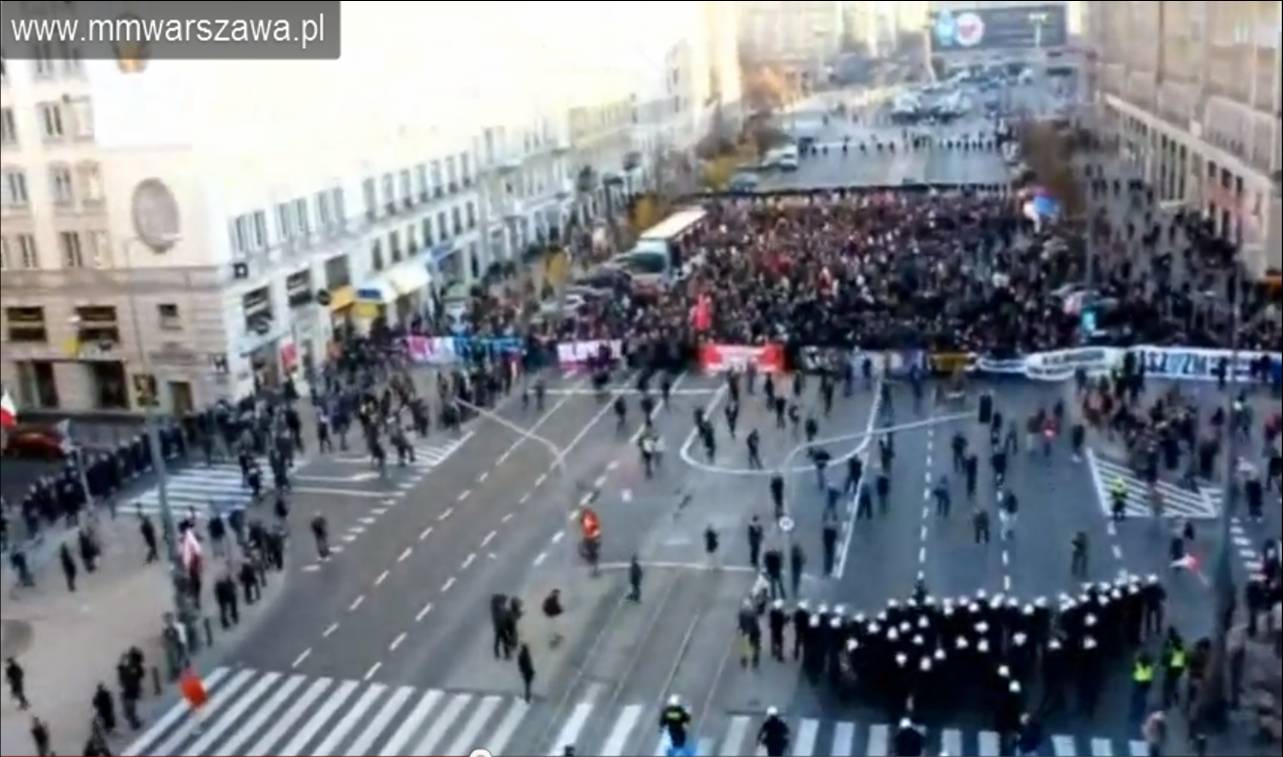
In November 2011, Polish firm RoboKopter filmed striking images of a political demonstration in Warsaw using a video camera attached to a drone or unmanned aerial vehicle (UAV).
The New York Times heralded the footage as signalling the arrival of ‘drone journalism’. Since then, we haven’t seen many newsgathering drones in UK skies, but we might well be seeing them some time soon.
Drones have been receiving more attention in recent months usually in the context of military operations. The Bureau of Investigative Journalism has been tracking the controversial use of drone strikes by the US military in Afghanistan, Pakistan and Africa. It has also emerged that the RAF were flying US drones during the conflict in Libya last year.
But much smaller UAVs – whether fixed wing or rotary – are now being used in civilian settings not for targeted killing but for image gathering. Last week, BBC Newsnight explored some of the issues around civilian drones and earlier in the year, Al Jazeera English filmed a training exercise with the German fire brigade which showed how UAVs could support firefighting.
I understand that several media organisations in the UK have already started to explore how they could use UAVs for newsgathering.
UAVs for Aerial Newsgathering
Aerial footage is not new of course, but UAVs are much smaller than helicopters allowing them to provide imagery from previously inaccessible locations.
The fact that they are unmanned also means there is no risk to a journalist or pilot. The latest models are being equipped with high definition technology allowing them to potentially provide stunning footage of national celebrations, political protest, natural disasters and conflict.
Safety, legality and ethics
The use of UAVs for newsgathering nevertheless raises a host of practical, legal and ethical issues. Question marks remain over safety concerns and the reliability of the technology, although the UAV industry is developing features such as an automatic ‘return to base’ function if the battery runs out or the operator loses control.
Legally, there is already a fairly well-established regulatory framework in place in the UK for flying UAVs which is outlined in guidance issued by the Civil Aviation Authority (CAA).
But this is an evolving area. The CAA’s chapter on ‘Civil Operations, Approval to Operate [UAVs]’ was completely rewritten in the latest guidance for August 2012. The requirements for ‘the licensing and training of United Kingdom civil Remote Pilots have not yet been fully developed’ and there is no European-wide standard to test UAV pilot competency.
It is likely that larger media organisations will look to fully licensed and CAA approved UAV operators to provide them with a newsgathering capability or apply for their own licenses to operate UAVs. But there is no particular reason why smaller organisations or individual ‘citizen’ ‘drone’ ‘journalists’ couldn’t do the latter and attempt to gather their own footage.
Gizmodo recently featured the (intriguingly named) Spy Hawk RC Glider which allows you to record video from the sky for a mere £250. With a battery life of 15 minutes it’s unlikely to have any heavyweight journalistic applications but we can expect the cost of more sophisticated equipment to come down.
Ethically, UAVs are likely to compound longstanding editorial dilemmas. It is not hard to imagine scenarios in which the deployment of UAVs for newsgathering is likely to directly invade individuals’ privacy or indirectly facilitate ‘collateral intrusion’.
These concerns might need to be balanced against a ‘public interest’ defence in a situation where it is deemed that the footage reveals serious wrongdoing.
News organisations might then face requests from other organisations for access to video footage. Only last year, the Metropolitan Police asked UK media organisations to handover footage of the London riots, but the police have already been exploring the deployment of their own UAVs and are likely to continue to do so in the future.
Indeed, in a rather strange – but perhaps not unrealistic vision of the future – it is possible to envisage a stand off between a fleet of media-operated UAVs and their police counterparts at the site of a protest or emergency. Newsgathering sorties might have to be coordinated or argued over with ‘rival’ UAV operators or interested parties.
Another possible scenario which raises some profound questions is the use of UAVs in the context of conflict. What would happen if a news organisation flew a UAV from Jordan over the border into Syria? Will opposition activists of the future be streaming live video footage to YouTube shot with UAVs?
Newsgathering UAVs coming soon?
Until now, these have been hypothetical debates set out in ‘future scenarios’ by interested thinkers and there has not been much visible evidence of UAVs being deployed by media organisations in the UK.
But recently I’ve been in contact with several people from the media and UAV industries. Behind the scenes discussions are taking place about UAVs for newsgathering and I think we can expect to see major developments in this area within a year and perhaps even by the end of 2012.
It would not be a surprise to see UAV footage being played out on air in the near future and maybe we’ll run into some of these other issues before too long as well. So watch this space – the one just above your head.
]]>