With Senior Reporter and investigative filmmaker for AJ English Juliana Ruhfus in the chair, the panel will share their expertise and experience working as journalists covering traumatic events in Somalia, and reflect on the impact of such trauma for those who live and report in the country.
The Dart Center for Journalism and Trauma, a project of the Columbia University Graduate School of Journalism, is dedicated to informed, innovative and ethical news reporting on violence, conflict and tragedy.
Chair
Juliana Ruhfus is an award-winning journalist and filmmaker for Al Jazeera English specialised in human rights and investigative work. Prior to Al Jazeera Juliana worked as a freelance reporter/ producer for international broadcasters and twice as a consultant to the UN as part of a Security Council monitoring group tasked with investigating breaches of the arms embargo on Somalia.
In 2013 “Action on Armed Violence” named Juliana as one of the top 100 journalists covering armed violence. Her interest in journalism that deals responsibly with conflict and tragedy earned her the Ochberg Fellowship and a scholarship for Harvard’s Global Trauma Programme. Juliana now serves on the European board of the Dart Centre for Journalism and Trauma and the advisory board for the International Bar Association eyeWitness project.
Speakers
Mary Harper, the BBC Africa Editor, has reported on Africa and from its conflict zones for a quarter-century. The author of Getting Somalia Wrong?, she has served as an expert witness and advised the European Commission on the Horn of Africa, and contributes to The Times, The Guardian and The Economist. Her latest book, Everything You Have Told Me Is True: The Many Faces Of Al Shabaab recounts her extraordinary experiences following the extremist jihadist
Ismail Einashe is a journalist and writer. He has written for the Guardian, The Sunday Times, NBC News, the Nation, Foreign Policy, Frieze, NPR and the New York Times, among many other places. He has worked for BBC Radio Current Affairs and presented on BBC Radio. Ismail has reported from over a dozen countries across Europe, Africa and the Middle East covering everything from migration, refugee issues to human rights and conflict. He is a 2019 Alicia Patterson Foundation Fellow, a Dart Center Ochberg Fellow at Columbia University Journalism School and an associate at The Centre for the Study of Global Human Movement at the University of Cambridge.
Idil Osman has worked for over 12 years as a national and international journalist for the BBC, the Guardian and the Voice of America, spending the majority of her career covering stories from the Horn of Africa. Through her work, she has developed a vast network of media contacts including those based in the region and the diaspora. She has authored publications that focus on media, migration, development, conflicts in the Horn of Africa and diaspora communities in Europe. She completed her PhD in Journalism and is an expert on diasporic media and development communications.
Image: Suspected al-Shabaab militants wait to be taken for interrogation during a joint night operation by the Somali security services and the African Union Mission in Somalia (AMISOM), in Mogadishu. 04 May 2014. Mogadishu, Somalia. UN Photo/Tobin Jones. More info here.
]]>In the past 40 years Iraq has endured three major wars, a violent coup, two invasions, a decade of bombing, two insurgencies, attack by the so-called Islamic State group, and a sectarian civil war. Living through such relentless bloodshed has taken a heavy toll on the nation’s mental health. More than one third of Iraqi children are thought to have moderate to severe mental illness and all social indicators, from divorce to suicide, show significant increases.
There’s only one psychiatrist for every 300,000 Iraqi people and just one psychiatric hospital in the entire country. Abu Leith, the hospital’s registrar, has been in post for decades and embodies its memory of Iraq’s dark times. He signs in all the new arrivals and takes it on himself to give a decent burial to those patients who die in hospital. Some have been admitted with no documentation; they languish inside for years, their identities never known.
The film tells the stories of children who, as a result of extreme trauma, are suffering a severe physical impairment such as the inability to talk or walk. This loss of ability is the physical expression of a mental condition, as we see with Maryam, who was 12 years old when IS sold her into sex slavery. Later she was forced to wear a suicide belt, though she managed to cut herself free from it. Since then, her speech has become impaired; we see her being treated by a mobile psychiatry unit, and finding some comfort in learning to be a seamstress.
As this film reveals, the biggest obstacle to overcoming Iraq’s mental health crisis is stigma. This is now changing, as community leaders encourage Iraqis to defy the traditional culture of shame and speak without fear about their abuse. More and more women are coming forward to speak out.
A year in the making, BBC Arabic’s documentary Iraq: A State of Mind explores the mental health crisis that’s gripped the Iraqi people.
Chair
Christopher Mitchell became Documentaries Editor at BBC Arabic in April 2018, after two years working for the BBC as a freelance executive producer. He is an award-winning writer, director and executive producer, having made many films for networks including BBC TV, ITV, Channel 4, ARTE, WDR Germany and Al Jazeera English. He was managing director of the independent production company OR Media from 2005 until 2014.
Speaker
Namak Khoshnaw is a Kurdish filmmaker from Iraq who obtained his MA degree at the University of West London in film and Art. He has produced numerous compelling documentaries for the BBC uncovering the plight of the Iraqi people living under Islamic State rule. Among his work is the harrowing documentary titled Slaves of the Caliphate which tells the story of Yazidi women held as sex slaves by ISIS fighters. the film was broadcasted internationally in 2014, and Namak won New Ground Award for outstanding reporting. He has also produced number of 360 virtual reality films for the BBC and New York Times.
Photograph courtesy of Namak Khoshnaw.
]]>

Frontline Freelance Register (FFR) and Frontline Club are running a one day travel and trauma first aid refresher course led by 1st Option – The Safety Group.
1st Option are a leading provider provider of safety advice, support, training and equipment to the media and entertainment sector and their clients include the BBC, ITN, Channel 4, CNN, NBC, Washington Post, Alaraby TV, Global Radio among others.
*Please note the course is aimed at journalists who have already completed a hostile environment and first aid training in the last 3 years and who wish to keep their skills up-to-date.
The course will be held before the start of the Byline Festival, at the same location, and participants to the course will receive complementary tickets to the weekend festival.
]]>Filmed during the 2014 siege of Gaza, which left 507 children dead and 3,598 wounded, Born in Gaza follows a group of young children growing up in a war zone. The film examines the widespread psychological trauma experienced by adolescents coping with injury, fear, and the loss of loved ones. It is estimated that 400,000 children in Gaza are in desperate need of psychological support.
‘We were eight kids on the beach. We came to play football’ recalls Hamada, 13. Then the shelling started. Four boys, all aged between nine and eleven, were killed. Motasem, 11, and Hamada were wounded. ‘I may need to go abroad for surgery’ states Motasem. ‘I have shrapnel in my back, hands and legs’.
Suffering from post-traumatic stress disorder, six year old Bisan finds it increasingly difficult to communicate. ‘She does not talk to us about what happened’ says one of her friends. ‘If anyone asks, she gets mad’.
Through observational footage and interviews Hernan Zin provides, with sensitivity, individual stories that go far beyond news coverage of the events and offer children the opportunity to be heard. In doing so, he also provides space for dialogue and healing. ‘The situation is really complicated. We have a war every two years’, states 13 year old Mohamed. ‘I often think about our situation and I never see the end’.
Directed by Hernan Zin
Produced by La Claqueta & Contramedia Films
Duration: 74′
Year: 2014
Almost 20 years ago, the war in Bosnia and Herzegovina came to an end. Children born after the fighting stopped are entering adulthood today, but are still facing violence, abuse and abandonment. Through the stories of four remarkable young people, filmmakers Sophia Scott and Georgia Scott capture the hopes and dreams of this new generation, forced to live with the ongoing effects of the war.
Ante is struggling to define his own identity after his father was convicted of war crimes, for which he is now serving a 20-year sentence. Magdalena’s abusive father struggles to recognise his post-traumatic stress disorder. Ilija has been rejected by his mother who refuses to tell him who his biological father is.
In the Shadow of War is a poignant account of the ongoing consequences of war – of its psychological effects that can last for decades and the great strains it imposes on society as a whole.
Directed by Sophia Scott and Georgia Scott
Duration: 89′
Year: 2014
On Monday 27 January a large audience gathered at the Frontline Club for a screening of Mark Cousins’ contemplative essay-film Here Be Dragons, followed by a Q&A with the director, via Skype, and with producer Don Boyd, founder of HiBROW.

Producer Don Boyd
Here be Dragons assumes the form of an intimate travelogue, tracking the director’s week-long stay in Albania as a jury member of Tirana’s 13th international film festival. Cousins explores Albania’s current cinematic culture, notably the plight of the national film archives, which sit in a state of disrepair, whilst reflecting on wider questions of trauma, history and memory in the context of post-communist Albania. Here Be Dragons interweaves shots of Tirana, namely the Pyramid of Enver Hoxha and other architectural remnants of the former totalitarian regime, with old film clips – emphasising Cousins’ sentiment that “to look is to travel”.
An audience member opened the post-screening discussion by noting the sense of “sadness” and “greyness” that, in his opinion, pervaded the film, and asked Cousins whether this was representative of present-day Albania.
Cousins responded that his aim was to document the “emotional landscape” of the nation and to capture the “balance between happy and sadness which you find in many places”.
“If you spend time in Albania, you do find that it is a kind of post-traumatic world. . . . It has had so many dreams thrust upon it, and so many of those dreams ended up to be empty dreams. And so people aren’t sure what to believe.”
He concluded that while the overall melody of Here Be Dragons was one of sadness, “there is a hopeful tune there, especially amongst the young people”. Cousins later pointed out that compared to all the Albanian films produced in the last five years, which he had watched in his capacity as a jury member of the Tirana International Film Festival, Here Be Dragons remained less bleak.
Boyd then paid tribute to the “phenomenal knowledge of the cinema” in which Cousins’ rooted his work, adding that the director balanced his filmic enthusiasm with “his considerable intellect . . . which is so rare in modern cinema”.

Director Mark Cousins joins the Q&A via Skype
Another member of the audience, who had travelled to Albania on numerous occasions, asked whether dealing with a little-known subject matter involved a greater responsibility on the part of the filmmaker, as film plays a crucial role in the shaping of a nation’s identity. Cousins echoed this sentiment with his statement that “film legacy is a kind of autobiography of a nation”. The audience member also enquired as to the reaction that the film provoked in Albania, in particular from viewers outside of the creative community.
Cousins responded that Here Be Dragons had inspired an extremely positive reaction from Albanian viewers, with one critic naming it “the best film ever made by a foreigner about Albania”. Boyd confirmed the film’s positive reception, and stated that he found the Albanian people to be “sensationally not bleak . . . and really positive about what they call their ‘experiment’ to do with the future, and they felt that Mark’s film was a metaphor for what had gone before”.
A member of the audience asked Cousins to comment on the level of engagement of young Albanians with their national history, and their relationship to Albania’s past and future. Cousins responded:
“Most people [in Albania], young and old, realise that they have a toxic history. But one of the reasons why I think that I felt strongly that I wanted to make this film, was that I realised that every country has a toxic history. . . . England, Ireland and Scotland all have toxic histories. Right down the road from me there are big, fancy houses built from the slave trade . . . so I think there is a sense of solidarity in common humanity.”
Cousins concluded from his ‘study of looking’ that, with regard to the future, young Albanians had “a degree of optimism, but a massive amount of caution, and that’s what I tried to capture in the film”.
Cousins closed the discussion with an impassioned response to an audience member’s suggestion that the film expressed a certain sympathy for Hoxha’s communist dictatorship:
“I absolutely believe in equality, I absolutely believe that . . . the idea of serfdom . . . is one of the biggest crimes in history. Anything that tried to redress that, started out good. However, I ended up furious with Hoxha before I went there. . . . He poisoned this principle which is so important for emancipation and equality around the world.”
To find out more about the current plight of the Albanian Film Archive, and the work of activists to restore it, visit the site of the Albanian Cinema Project.
To watch the trailer for Here Be Dragons, and to keep up to date on upcoming filmic collaborations between Mark Cousins and Don Boyd, visit the website of HiBROW, and click here to follow the film on Facebook.
View in iTunes
Charles Glass is a veteran broadcaster, journalist and writer. His latest book Deserter explores the widely untold stories of the British and American deserters in the Second World War. He follows a group of soldiers into the heat of battle and explores what motivated them to take their fateful decision to run away.
Jake Wood is a former soldier who worked in parallel as a business analyst. In Among You he tells the story of his time serving in Iraq and Afghanistan, and the battle he faced upon his return when diagnosed with chronic post-traumatic stress disorder (PTSD). Through his own experiences he examines the harsh reality of front-line combat, the courage of the troops and the devastating after-effects of service that some suffer.
They will be joining us in conversation, chaired by Frontline Club founder Vaughan Smith, to talk about their respective works and the comparisons in the trauma suffered by soldiers from World War Two to Afghanistan.
]]>
By Nicky Armstrong
Half way through the film the ripple effect that war has on journalists and the stresses that leak out from being present at such horrific moments in people’s lives are laid bare for the audience to see. The question of morals, as well as dealing with your own problems and family life back home seem to be put to the back of the reporters minds; the job in hand is their only real focus at the time. But these problems cannot be ignored, and the psychological cost of covering a war really becomes apparent.
PTSD (Post Traumatic Stress Disorder) is a repetitive premise throughout the film. The reality of dealing with war once you are out of combat is a different task all together. When producer Anthony Feinstein was asked if every journalist suffers from Post Traumatic Stress Disorder his answer was no, but the reality is that journalists, and indeed soldiers have a much higher risk of suffering from PTSD than the average person – the way each individual journalist deals with the trauma is different. It was made clear by the journalists in the film that they seek no sympathy for their troubles, after all these are their decisions, but this does not stop the overwhelming feeling of guilt that comes with the job. As mothers and fathers, with families back home, it is hard to withhold emotion when witnessing events where they are faced with the dilemma of ‘report or help’.
The film shows that a recurring side effect from reporting is that most of the journalists seem to suffer from nightmares, “it is not a normal nightmare, it is impounding and insisting,” and many use drink to block out the memories. It seems that journalists learn to cope with these intrusive thoughts, but not all are successful.
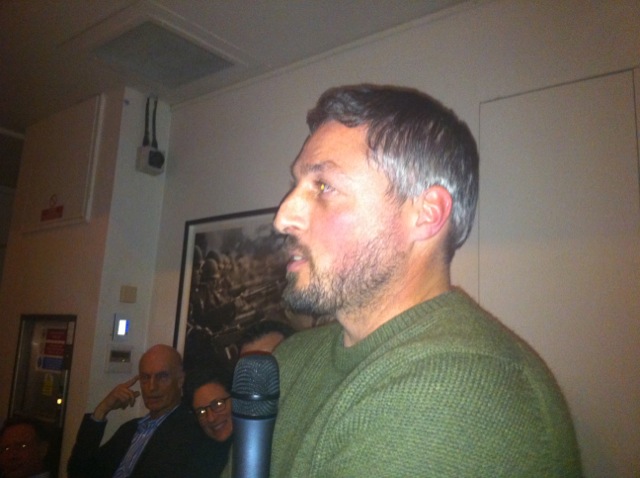
Why do you do it? Was the key question asked of Finbarr O’Reilly, a Reuters reporter featured in the film and present at last night’s screening; “I don’t enjoy being scared” he stated, and certainly the loss of friends such as Tim Hetherington has shifted his focus and left him questioning his future. But the truth is these pictures need to be taken, and as one reporter said in the film “you will never feel as alive as when you are staring death in the face.”
It seems that news agencies are finally recognizing the stresses of reporting in combat and that PTSD is a very real phenomenon among combat journalists that is starting to lose its stigma and is being accepted as reality. The nature of war reporting has changed over the years, journalists put themselves in highly volatile environments and many pay for it with their mental health and in some cases even their lives. Under Fire: Journalists In Combat is a film that addresses these issues.
]]>
Journalists in Kyrgyzstan Get Help to Deal with Post-Conflict Trauma

Internews
Local journalists in Kyrgyzstan use a press center in Osh set up by Internews to support post-conflict reporting.
|
(September 8, 2010) During inter-ethnic clashes in Southern Kyrgyzstan in May and June, many local journalists suffered physical and psychological trauma. Unable to do their jobs and practice their profession because of the immediate physical threat and fear for their lives, local reporters, both of Kyrgyz and Uzbek ethnicity, found themselves on two opposite sides of the conflict.
Effects of the Conflict on Journalists
Journalists became targets for attacks; for example, a local state TV crew comprised of an Uzbek husband and a Kyrgyz wife, were beaten by an angry mob. Several journalists had their houses burnt, while others had to be evacuated out of the region altogether. Due to the lack of credible information sources, many journalists (and the rest of the public) believed the rumors and misinformation sweeping the country. As a result, they grew increasingly distrustful of their colleagues from the "other" side.
In the weeks following the conflict, with Internews launching press centers in Osh and Jalalabad to serve as safe places for journalists to gather and work, many local reporters found it difficult to work side-by-side because they continued to suspect betrayal from colleagues of a different ethnic group. A Kyrgyz journalist would refuse to go on a shoot with an Uzbek cameraman, and vice versa.
While the rest of the country as well as the international community wondered why local media coverage was relatively slow to address key issues, local journalists faced an uphill battle to recover from the trauma, rebuild mutual trust, and start communicating with each other in a professional manner.
Providing Post-Trauma Training and Counseling
Internews launched an initiative to bring a group of local journalists to the shore of Lake Issyk-Kul in Kyrgyzstan, a place where they could rest, recover and interact with each other in a neutral, non-threatening environment. In late August, a group of 49 journalists from Osh, Jalalabad and Batken were able to relax in the sun while working with professional psychologists on post-traumatic rehabilitation.
Two trainers worked with the journalists – Olga Kravtsova, a professional psychologist who specializes in the post-traumatic recovery of journalists and is affiliated with the Center for Journalism in Extreme Situations in Russia and the Dart Center for Journalism & Trauma in the US; and Mikhail Munkin, director of Kyrgyzstan’s Association of Psychologists and Psychiatrists, who has experience working with victims of the April-June events in the South.
Kravtsova and Munkin designed the seminar program to combine serious discussion about the nature of trauma and stress with interactive exercises and teambuilding games. The participants also learned self-help and relaxation techniques, filled out specialized surveys to determine their stress level, and had time for individual consultations with the two psychologists.
In the evenings, they watched documentary films from the Frontline collection. After one of the films, the Emmy-winning "Baghdad ER," the journalists had a chance to speak with the film director, Jon Alpert, online from New York City via Skype video conference. And while many of the participants said in their seminar review questionnaires that it was too difficult and traumatizing for them to watch the film, they mentioned their conversation with Jon as one of the highlights of the seminar.
To close the seminar, a local NGO, El Pikir, implementing a post-conflict reconstruction project in Osh funded by the Norwegian Helsinki Committee, presented the participants with flash drives and also pledged financial support to those who suffered material or physical damage during June events. Also, the Presidential Administration awarded special certificates to about ten journalists (most of whom have been based at the press center in Osh) who were the first ones to return to work in June. Internews’ Resident Advisor Denis Bevz, producer Elima Japarova and cameraman Tair Tursunaliev were recognized in this group.
To organize the seminar, Internews partnered with the Osh Media Resource Center, with additional funding for the event from UNICEF and the local Soros Foundation.
]]>
It has been a while since I wrote here the last time… I apologize for the long silence (not that I really hope that you’ve really noticed – but I have been sort of ashamed that I abandoned my blog here for ages…) well, anyway, I’m back.
Back – and have a question for you. I would really appreciate if you brainstorm on the topic above, what could emergency workers do to help reporters cover tragedies and conflicts? What would you like them to do or not to do so that it would be a tandem not a Pushmi-Pullyu?
I’m giving a seminar for young / future emergency workers and plan to talk with them about trauma and trauma coverage.
***
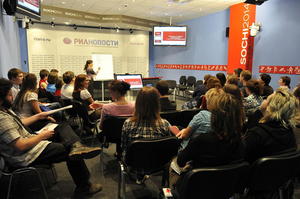
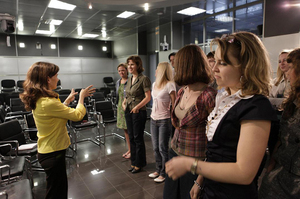
To fill the gap between my rare posts I’ll report that this summer I conducted a series of seminars on stress and trauma for journalists and editors of the Russian Information Agency "Novosti" (News), one of the largest news agencies in Russia. It was very interesting – for me, and hopefully for my participants. At least we had fun writing down our stressors at work – and finding out that we love our job for the same reasons we hate it (lack of time means fast flow of diverse information – not boring; multitasking causes stress sometimes but also makes you feel important and responsible, etc. etc. etc.)
Here are some pictures:
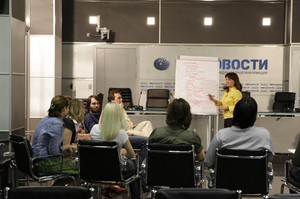
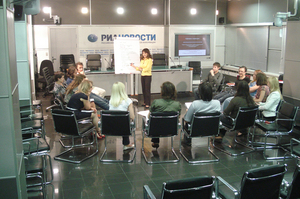
Looking forward to your input, and thanks in advace!
Olga.
]]>