On Monday 15th April, the Dutch Embassy and Time magazine partnered to co-organise a screening at the Frontline Club of Peace vs Justice: a documentary about the violence of Joseph Kony’s Lord’s Resistance Army (LRA), particularly against children, in northern Uganda. An expert panel discussion followed.

Klaartje Quirijns (left), Geoffrey Robertson (centre left), Matthew McAllester (centre right), Mugambi Kiai (right) Photo: Jim Treadway
Directed by Klaartje Quirijns, Peace vs. Justice explores how to find justice for Kony, and peace for Uganda, where three million people have been victimized by the LRA, either directly or indirectly, according to the film’s closing credits.
If Kony is captured (one hundred U.S. Special Operations troops were dispatched toward this end in Central Africa last year ), the film asks: should his crimes be placed solely into the hands of local justice in Uganda? “The people I met in northern Uganda…actually most people…will say that,” Quirijns told the audience.
The movie highlights however that Ugandans have failed to achieve peace with the LRA for over two decades.
Many hope to see Kony tried by the International Criminal Court (ICC) in the Netherlands, yet panelist and British barrister Courtenay Griffiths was sceptical:
“If you look at virtually every situation in which the ICC are involved, you can see certain Western interests at play. And what you have to realize is that the language of human rights, and humanitarian intervention, has now become a fig leaf behind which powerful Western countries can intervene around the world to protect their own, particularly economic, interests.”

Courtney Griffiths (left), Barney Afako (centre), Klaartje Quirijns (right) Photo: Jim Treadway
Was Griffiths right to doubt the ICC’s intentions? asked moderator Matthew McAllester.
“No,” human rights lawyer and fellow panelist Geoffrey Robertson affirmed. The ICC has brought both hope and fear that war crimes will not be tolerated, he emphasized.
“You can’t say it’s a neocolonial court,” he added. “Yes, we won’t probably get [Tony] Blair. Although Dr. Kissinger’s travel plans are very curtailed. So are George Bush’s. There are a lot of places they can’t go to. Why? Because of international justice.”
Finally, Mugambi Kiai, a professional advocate for accountability in African governance, demanded a change in the conversation about Kony, Uganda, and the ICC:
]]>“When is it that we stop looking at the ICC as a panacea? As the vehicle through which we get justice? … Where are the domestic remedies that we so need? [In Kenya,] we’ve been told: we’ve got a new judiciary, we’ve got a new constitution. That’s all hogwash!
They’re not doing enough to transform the political conversation that transforms all of these historical injustices into good governance, into a political method that respects rights, respects values, respects dignity. That is not the conversation that’s going on, and that’s a tragedy.”
You can watch the discussion below:
View in iTunes
Despite hundreds of thousands of people having taken to the streets of London and elsewhere to voice their opposition to military action in Iraq, on 19 March 2003, air strikes on the Presidential Palace in Baghdad began.
What followed was a US-led invasion that toppled Saddam Hussein’s government, and marked the start of years of violent conflict. Ten years on, in a debate chaired by Channel 4 News’ Jon Snow, we will ask: have lessons been learned?
The legacy of the Iraq War changed Western foreign policy, but with talk of Northern Africa becoming a new front in the war on terror, have the mistakes of Iraq been sufficiently ingrained on the consciences of populations and governments? To what degree is the impact on relations between the Middle East and the West still felt?
We will also be examining what has been heard at the Chilcot Inquiry and why we are still waiting to hear the findings.
Chaired by Channel 4 News presenter Jon Snow.
The panel:
Caroline Wyatt has been BBC defence correspondent since October 2007, covering the work of British Forces in Iraq and Afghanistan. In 2003 she was embedded with British troops reporting on the war and its aftermath in and around Basra. Previously she has been BBC correspondent covering Paris, Moscow, Berlin and Bonn.
Rt Hon Jim Murphy is Labour Member of Parliament for East Renfrewshire. He is currently the Shadow Secretary of State for Defence and has previously served as Secretary of State for Scotland.
Jack Fairweather is the author of A War of Choice: Britain in Iraq 2003-9. The Daily Telegraph’s Baghdad and Gulf correspondent for five years, he was an embedded reporter during the Iraq invasion, winning the British equivalent of the Pulitzer prize for his reporting. Most recently he has been the Washington Post’s Islamic world correspondent. He is a fellow of the Centre for Middle Eastern Studies at Harvard University, and is working on a history of the Afghan war.
Peter Oborne, the Daily Telegraph‘s chief political commentator and author of The Rise of Political Lying and The Triumph of the Political Class.
Sir Jeremy Greenstock is chairman of the UN Association in the UK, the strategic advisory company Gatehouse Advisory Partners Ltd and Lambert Energy Advisory Ltd. He was a career diplomat from 1969 to 2004, developing specialisations in the Middle East, Transatlantic Relations and the United Nations. He served as UK Ambassador to the UN in New York from 1998 to 2003 and as UK Special Envoy for Iraq, based in Baghdad, from 2003 to 2004.
]]>The sheer scope and significance of the revelations is shocking. Among them are great abuses of power, corruption, lies and war crimes. Yet there are still some who insist WikiLeaks has "told us nothing new". This collection, sourced from a range of publications across the web, illustrates nothing could be further from the truth. Here, if there is still a grain of doubt in your mind, is just some of what WikiLeaks has told us:
* American planes bombed a village in Southern Yemen in December 2009, killing 14 women and 21 children (see Amnesty)
* The Secretary of State’s office encouraged US diplomats at the United Nations to spy on their counterparts by collecting biographic & biometric information (see Wired.com)
* The Obama administration worked with Republicans to protect Bush administration officials facing a criminal investigation into torture (see Mother Jones)
* A US Army helicopter gunned down two Reuters journalists in Baghdad in 2007 (see Reuters)
* US authorities failed to investigate hundreds of reports of abuse, torture, rape and even murder by Iraqi police and soldiers (see the Guardian)
* In Iraq there were scores of claims of prison abuse by coalition forces even after the Abu Ghraib scandal (see the Bureau of Investigative Journalism)
* Afghan President Hamid Karzai freed suspected drug dealers because of their political connections (see CBS News)
* Israeli Prime Minister Benjamin Netanyahu expressed support for the concept of “land swaps” (see Yahoo News)
* The United States was secretly given permission from Yemen’s president to attack the Al-Qaeda group in his country (see the Guardian)
* Then-Secretary of Defence Donald Rumsfeld and his top commanders repeatedly knowingly lied to the American public about rising sectarian violence in Iraq beginning in 2006 (see the Daily Beast)
* The US was shipping arms to Saudi Arabia for use in northern Yemen even as it denied any role in the conflict (see Salon.com)
* Saudi Arabia is one of the largest origin points for funds supporting international terrorism (see the Guardian)
* A storage facility housing Yemen’s radioactive material was unsecured for up to a week (see Bloomberg)
* Israel destroyed a Syrian nuclear reactor in 2007, fearing it was built to make a bomb (see the Sunday Times)
* Top officials in several Arab countries have close links with the CIA (see the Peninsula)
* Swiss company Trafigura Beheer BV dumped toxic waste at the Ivorian port of Abidjan, then attempted to silence the press from revealing it by obtaining a gagging order (see WikiLeaks)
* Pakistan’s government has allowed members of its spy network to hold strategy sessions on combating American troops with members of the Taliban (see the New York Times)
* A stash of highly enriched uranium capable of providing enough material for multiple "dirty bombs" has been waiting in Pakistan for removal by an American team for more than three years (see CBS News)
* US military Special Operations Forces have been conducting offensive operations inside Pakistan, despite repeated denials from US officials (see the Nation)
* China was behind the online attack on Google (see ZDNet)
* North Korea is secretly helping the military dictatorship in Myanmar build nuclear and missile sites in its jungles (see CBS News)
* The Indian government "condones torture" and systematically abused detainees in the disputed region of Kashmir (see CBS News)
* The British government has been training a Bangladeshi paramilitary force condemned by human rights organisations as a "government death squad" (see the Guardian)
* BP suffered a blowout after a gas leak in the Caucasus country of Azerbaijan in September 2008, a year and a half before another BP blowout killed 11 workers (see the Guardian)
* Saudi Arabia’s rulers have deep distrust for some fellow Muslim countries, especially Pakistan and Iran (see CBS News)
* Saudi Arabia’s King Abdullah repeatedly urged the United States to attack Iran (see the Guardian)
* Iranian Red Crescent ambulances were used to smuggle weapons to Lebanon’s militant Hezbollah group during its 2006 war with Israel (see CBS News)
* Dozens of US tactical nuclear weapons are in Germany, the Netherlands and Belgium (see * The Libyan government promised "enormous
repercussions" for the UK if the release of Abdel Baset al-Megrahi, the Lockerbie bomber, was not handled properly (see CBS News)
* Pope Benedict impeded an investigation into alleged child sex abuse within the Catholic Church (see MSNBC)
* Sinn Fein leaders Gerry Adams and Martin McGuinness carried out negotiations for the Good Friday agreement with Irish then-prime minister Bertie Ahern while the two had knowledge of a bank robbery the Irish Republican Army was planning to carry out (see CBS News)
* Anglo-Dutch oil giant Royal Dutch Shell PLC has infiltrated the highest levels of government in Nigeria (see the Guardian)
* A US official was told by Mexican President Felipe Calderon that Latin America "needs a visible US presence" to counter Venezuelan President Hugo Chavez’s growing influence in the region (see Yahoo News)
* Cuba’s economic situation could become "fatal" within two to three years (see Business Week)
* McDonald’s tried to delay the US government’s implementation of a free-trade agreement in order to put pressure on El Salvador to appoint neutral judges in a $24m lawsuit it was fighting in the country (see the Guardian)
* British officials made a deal with the US to allow the country to keep cluster bombs in the UK despite the ban on the munitions signed by Gordon Brown (see Politics.co.uk)
* The British government promised to protect America’s interests during the Chilcot inquiry into the Iraq war (see the Guardian)
* The US government was acting on behalf of GM crop firm Monsanto in 2008, when the US embassy in Paris advised Washington to start a military-style trade war against any European Union country which opposed genetically modified (GM) crops (see the Guardian)
* Pfitzer tested anti-biotics on Nigerian children, contravening national and international standards on medical ethics (see Medical News Today)
* Prisoners at Camp Delta (Guantanamo Bay) were denied access to the Red Cross for up to four weeks (see the Telegraph)
* More than 66,000 civilians suffered “violent deaths” in Iraq between 2004 and the end of 2009 (see the Telegraph)
* Russia is a “virtual mafia state” with rampant corruption and scant separation between the activities of the government and organised crime (see the Guardian)
* The Obama administration tried to “sweet-talk” other countries in to taking Guantanamo detainees, as part of its (as yet unsuccessful) effort to close the prison (see the New York Times)
]]>Illustration by Chris Riddell
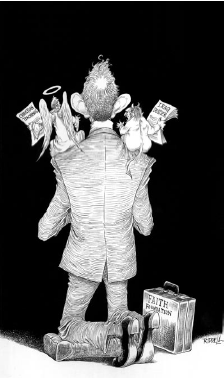
Tony Blair is busy outing himself as a man of God. Which is immediately ironic after all that time during which Blair refused to “do God” – as his media manager Alastair Campbell informed us. Since leaving Downing Street, Blair has used the G-word with a mixture of the fervour and regularity of a Jehovah’s Witness knocking on your front door, and the calculated spin of a Labour campaign. And this is not the result of a road-to-Damascus conversion since leaving office in June 2007, or a public-relations campaign to promote his retirement toy, the Tony Blair Faith Foundation. While the Foundation plans to use religion to solve the problems of the world, Blair lectures at the Yale Divinity School, preaches from pulpits including that of Westminster Cathedral, and gives a drip-drip-drip of interviews during which he acts coy before divulging more details about how Jesus was his guiding light when he was Prime Minister. His Christian faith had been “hugely important” to him while in office, he told the BBC in 2007. And more recently – ironically in an edition of New Statesman guest-edited by Campbell – Blair intoned: “My faith has always been an important part of my politics.”
All of which offers an invitation to take him at his word, rather than simply allowing the former British Prime Minister, now banker and aspirant global statesman, to wrap himself and his record in a comfort blanket of moral oneupmanship. How does the Blair legacy compare with the New Testament that the one-time leader was always apparently dipping into? And was the architect of New Labour inspired by Jesus, or did he come to imagine that he understood the mind of God rather better than his saviour?
Hiding the light of his faith under a bushel while Prime Minister does, of course, offend against the basic rule of Christianity, which was born as a missionary faith and still encourages believers to evangelise. “Go,” Jesus tells his apostles, “and make disciples of all nations; baptise them in the name of the Father and of the Son and of the Holy Spirit, and teach them to observe all the commands I gave you…” Contemporary Christianity concedes that there are different ways of doing this. You can set an example by your words or your deeds. So if, post-resignation, Blair is majoring on words, while in office he seems to be saying that God was in the detail. Moreover, he would surely contend that in the particular circumstances of late-20th-century Britain – officially Protestant but with strong leanings towards secularism and scepticism – to start waving his crucifix around, would not have been appropriate. He would, as he put it in a BBC interview, have been taken for a “nutter”.
Fair enough, up to a point, though Blair’s desire to be all things to all men was always both his greatest strength and his greatest weakness. But as the Anglican Bishop of Rochester, Michael Nazir-Ali, pointed out at the time of Blair’s ‘nutter’ remark, if the New Labour Prime Minister was genuinely following the dictates of a highly developed religious conscience when in 10 Downing Street, it might have led to a more constructive social policy at home and principled policies abroad.
Christianity, of course, comes in 57-plus varieties, so the first thing to establish is quite what sort of Christian was Prime Minister Tony Blair. Nazir-Ali is a bishop of the Anglican Church of England, the denomination he officially espoused during his premiership. However, a key part of Blair’s running confession since resigning has been to suggest that his reception into the Catholic Church in 2007 was a formality, a public acknowledgment of something he had been living out in Downing Street. This impression is reinforced by third-party revelations. In December 2008, his former spokesman Lance Price told Radio 4 that as early as 1998, his boss had asked him to “squash” a report that he had told the Catholic Archbishop of Siena that “in my heart I feel more of a Catholic”. Blair explained it to Price by saying: “I don’t discuss my Catholicism with anybody.” So it is reasonable to deduce that the correct yardstick for measuring Blair’s God-inspired deeds as Prime Minister is Catholicism.
Long before he became premier, Blair had been attending Catholic services and receiving communion with the blessing of his local priest, but without ever joining the Church of Rome. The impression given subsequently was that he was doing so to please his cradle-Catholic wife, Cherie, and to maintain a united front once they had decided to raise their children as Catholics. But this now looks like a smokescreen in the light of Blair’s post-resignation remarks on faith. If going to mass and communion was only a question of pleasing Cherie, why were the couple married in an Anglican church? And, as she has hinted, he was more devoutly Christian than she was when they met, and it was he who encouraged her, rather than the other way round, to build on the cultural Catholicism that came with her childhood and upbringing in Liverpool, at the same time he was constructing his own hybrid of politics and religion.
Once Blair was Leader of the Opposition, his hitherto-unnoticed practice of taking communion started making headlines. In 1996, shortly before his first landslide election victory, he received a letter from Cardinal Basil Hume, reminding him that as an Anglican he could not join the rest of his family at the altar rails to receive the bread and wine, since the Catholic understanding of Eucharist is different from that of other Christian faiths. For his first years in office, Blair appeared to take this on the chin and was to be seen going to mass in the Cardinal’s Westminster Cathedral, but not taking communion. After 9/11, security concerns ruled out such trips, and a Catholic priest would come on a Sunday to Chequers or No 10 to say a private mass for the Blair family. The clerics concerned have always refused to comment on suggestions that, behind closed doors, the Prime Minister once again started living the sacramental life of a Catholic in pectore – “in the heart or chest”, a phrase usually used by the Roman church for bishops secretly appointed in communist lands whose status had to remain a mystery for reasons hardly applicable to Blair.
If he was unofficially our first Catholic Prime Minister since the Reformation, Blair’s reception into the Church by Cardinal Cormac Murphy O’Connor was a question of tying up the loose ends from a decision made long ago. In such a scenario, Blair’s delaying formal conversion until after he had left office was a typical bit of realpolitik, sacrificing his own religious sentiments on the altar of public prejudices. It is intriguing, though, to ask if Blair’s delay in coming out as a Catholic was because he didn’t want the teachings of the Catholic Church to be used against him as Prime Minister.
In 2003, Blair made the defining decision of his premiership, joining his fellow, more overt, Christian George W. Bush in taking Britain to war in Iraq. In a rare name check for the Almighty, he told television interviewer Michael Parkinson in March 2006 that God would be the judge of the invasion as a moral decision. Parkinson asked if Blair had prayed before committing British troops to Iraq. “Well, I don’t want to get into something like that,” Blair replied, as if suddenly remembering what Campbell had told him. The implication, though, was that h
e had indeed been on his knees seeking divine guidance (or blessing), and this has only been borne out by everything that has been said since.
Jesus is equivocal on war. “Put your sword back,” he tells one of his followers when he is arrested, “for all who draw the sword will die by the sword.” But earlier he tells a crowd: “do not suppose that I have come to bring peace to the earth: it is not peace I have come to bring but a sword”. Blair has enjoyed a close friendship with Cardinal Murphy O’Connor. But the Archbishop spoke on behalf of his fellow bishops in 2002 when he said that governments had a “moral responsibility” to avoid war with Iraq, and “the need to avoid war is a cornerstone of Christian teaching”. O’Connor was not alone. Every church and denomination in Britain and the USA, apart from the extreme rightwing Southern Baptist Church in America, vociferously opposed the war. The leadership and congregation of President Bush’s United Methodists pleaded with and petioned its member in the White House not to go to war. More of the putting away the sword, then, than drawing it.
If Christ’s statement did still leave Blair with wriggle-room to reconcile the war with Catholic morality, Pope John Paul II left no leeway at all. The ageing Polish pontiff warned repeatedly and passionately in the run-up to the US-UK invasion of Iraq that a pre-emptive strike would be wrong and a “defeat for humanity” that couldn’t be morally or legally justified. “Violence and arms can never resolve the problems of man,” he said. The conventional Catholic “just war” theory – rooted in the New Testament’s ambiguity and teaching that war, in some circumstances, could have a positive moral purpose – didn’t apply to Iraq, he added. Indeed, throughout his long pontificate, this Pope showed a marked disinclination to “just-war” criteria in any conflict. He was, for instance, a lonely voice on the global stage in 1991 in damning the first Gulf war. The “just war” theory was first set out by St Augustine in the 5th century, in the light of the invasion of Rome by the Barbarians.
There are four criteria: the damage inflicted by the aggressor on the nation or community of nations must be lasting, grave and certain; all other means of putting an end to it must have been shown to be impractical or ineffective; there must be serious prospects of success; and the use of arms must not produce evil and disorders graver than the evil to be eliminated. The current catechism of the Catholic Church, the 800-page rulebook approved by John Paul II in 1992 as a guide to good Catholic living in the modern world, adds a note to this final point: “The power of modern means of destruction weighs very heavily in evaluating this condition”.
This anti-war stance is therefore the mainstream of Christian theology and of current interpretations of Jesus’s teaching. Blair is utterly out of step. So, does this give the lie to all his high-and-mighty talk about faith influencing his decisions? Here is probably the most important judgment he made in office – and the most calamitous for his political and moral standing – and he is lining up against the Pope. Well, not quite. There is a group of American “theocons”, admired by the Methodist George W Bush, though they are largely Catholic.
They are led by George Weigel of the Ethics and Public Policy Center in Washington, and since the mid 1990s had been arguing that a “preventive war”, as they termed it, could be justified by Catholic just-war conditions. In Iraq they saw a perfect case for the application of their own take on the “just war”. Weigel is an influential fi gure in world Catholicism and wrote a bestselling biography of John Paul II. But on Weigel’s efforts to label the invasion of Iraq a just war, the two parted company. Weigel attacked the church’s “presumption against war”, which, he claimed, had infected Catholicism since the second world war.
In a 2002 lecture on Moral Clarity in a Time of War, given to the Catholic University of America Law School, he argued that true just- war theorists “did not stigmatise first resort to force because their concern was with responding to injustice… and [thus] did not define just cause in terms of self-defence”. In the influential Catholic journal America, Weigel wrote in 2003 that “classic just war thinking begins with moral obligations… the obligation to defend the peace of order in world affairs”.
The words carry a familiar echo. Once Blair had stopped talking about nonexistent weapons of mass destruction, his only justification for the invasion was the moral one: defending peace and order by pre-emptive regime change. This defence rested heavily on the Weigelian argument: the world and Iraqi people would be better off without Saddam Hussein. Though subsequent events have shown the invasion violating not one but all four just-war criteria – as John Paul II predicted in rebutting Weigel and the theocons – Blair might just argue that he was not entirely out on his own in Catholic terms in choosing to commit British forces to this unpopular conflict. But he was out on a limb – as John Paul II himself would have made clear to him when Blair visited the Vatican in February 2003 and lobbied on behalf of the planned invasion. The Pope refused to budge an inch in his opposition to Blair’s war. Catholic social teaching is sometimes called its “best-kept secret”. Yet it is the very core of Jesus’s teaching in the gospels. “I tell you solemnly, in so far as you did this to one of the least of these brothers of mine,” he predicts his father will say on the Day of Judgment, “you did it to me.” The Catholic Code of Canon Law, its rulebook, makes plain that this must shape how each of us interacts with our neighbour.
Good Catholics, it says, “are also obliged to promote social justice and, mindful of the precept of the Lord, to assist the poor from their own resources”. Throughout the cold war, Catholicism tended to try to position itself as a “third way” between capitalism and communism. When Pope John Paul II visited the United States in 1995, he confounded and irked his hosts by suggesting that neither capitalism nor the ideology he had devoted his life to overthrowing in Poland was compatible with Christianity.
Four years earlier, after the collapse of the Soviet Union, John Paul II had produced one of the keynote encyclicals of his papacy, Centesimus Annus. It contained some of the warmest words a Catholic leader had ever uttered in modern times about wealth creation, though it balanced them with warnings about respecting workers’ rights. At first glance, it might be taken for a blueprint for Blair’s economics: the light hand of regulation and cosying up to business. On his approach to the banking and business sectors, however, Blair was out of step with both the political left and the Polish pope.
“The church acknowledges the legitimate role of profit as an indication that a business is functioning well,” John Paul wrote in Centesimus Annus. “When a firm makes a profit, this means that productivity factors have been properly employed and corresponding human needs have been duly satisfied. But profitability is not the only indicator of a firm’s condition. It is possible for the financial accounts to be in order and yet for the people, who make up the firm’s most valuable asset, to be humiliated and their dignity offended… In fact, the purpose of a business firm is not simply to make a profit, but is to be found in its very existence as a community of persons who i
n various ways are endeavouring to satisfy their basic needs and who form a particular group at the service of the whole society.”
The Pontiff had tough words about politicians’ role as regulators of a market economy: “Economic activity, especially the activity of a market economy, cannot be conducted in an institutional, juridical or political vacuum. On the contrary, it presupposes sure guarantees of individual freedom and private property as well as a stable currency and efficient public services. Hence the principal task of the State is to guarantee this security, so that those who work and produce can enjoy the fruits of their labours and thus feel encouraged to work efficiently and honestly. The absence of stability, together with the corruption of public officials and the spread of improper sources of growing rich and of easy profits deriving from illegal or purely speculative activities, constitutes one of the chief obstacles to development and to economic order.” “Easy profits deriving from… purely speculative activities”.
These words in some ways sum up Blair’s economic legacy, now shown to have created a gap between the richest and poorest greater than at any time in Britain since before the boom of the 1960s. For the duration of his time at No 10, there is no evidence that he made any attempt to warn or even gently remind those who were making easy profits from purely speculative activities that they were walking a tough moral line. Instead he invited them to dinners and awarded them honours, the bankers and financiers who we now know to have been breaking the backs of the poor, and whose ranks Blair has now himself joined. “My faith has always been an important part of my politics” begins to ring a little hollow. Jesus may have been equivocal about war, but he was very clear when he said (Matthew 19:24) that “it is easier for a camel to pass through the eye of a needle than for a rich man to enter their Kingdom of God”.
The party line now is that the cause of the present distress is a global problem, and that Blair, Brown et al cannot shoulder the blame. But distinguished Catholic theologians locate responsibility closer to home. “While there are many proximate causes of the current financial crisis,” says Dom Christopher Jamison, Benedictine Abbot of Worth, “the ultimate cause is ethical. We can now see that the financial services industry was both over-regulated and unethical, a lethal combination.” Far from Blair’s view of his premiership at a time when there was a strong moral and religious undertow to public policy, Jamison sees a climate where “public morality has become rule and law compliance [with] the term ‘moral’ so debased that it is usually connected to ‘moralizing’, a pejorative term to describe people sticking their noses into other people’s business”. While it would be naive to expect Prime Minister Blair to act in imitation of Christ and drive the usurers out of the modern-day temple, it is not unreasonable to wonder that he might have exercised more caution in personal dealings with the money-lenders while in office. For Catholicism has long abhorred usury. In the 13th century, one of its greatest thinkers, Thomas Aquinas, wrote: “Now money… was invented chiefly for the purpose of exchange: and consequently the proper and principal use of money is its consumption or alienation whereby it is sunk in exchange. Hence it is by its very nature unlawful to take payment for the use of money lent, which payment is known as usury…”
Medieval principles that have no place in the current world? Well, not according to the current Catholic catechism: “Those whose usurious and avaricious dealings lead to the hunger and death of their brethren in the human family indirectly commit homicide, which is imputable to them.” In his ‘Concordance’ to the Bible of 1737, the Anglican Alexander Cruden spoke with uncanny clarity to the present when he wrote: “The law of God prohibits rigorous imposing of interest or exacting it, of a return of a loan without regard to the condition of the borrower, whether poverty occasioned his borrowing, or a visible prospect of gain by employing the borrowed goods” – in other words, it is sinful to get rich on interest on loans to people who are skint – the premise of the system, underwritten by Blair, which brought about global financial disaster.
His resignation as Prime Minister has allowed Blair, he has himself claimed, finally to be his own man in terms of a public reconciliation of his work and his religious beliefs. “Religious faith,” he writes in The New Statesman, “could help guide and sustain the era of globalisation, lending it values, and, in bringing faiths and cultures to a great understanding of each other, could foster peaceful coexistence”. Sounds good.
“All leaders, whether of religious faith themselves or not, have to ‘do God’.” So, do as I say, not as I did. To his warning on usury, Aquinas attaches guidance on how to repent: “just as man is bound to restore ill-gotten goods, so is he bound to restore the money which he has taken in usury”. Not much sign of that.
But there is a temptation to see Blair’s post resignation activities as attempting to make good his legacy and use his new-found freedom to live out more clearly the religion he now publicly professes. His Faith Foundation wants to harness the power of the world’s religions to end rather than start conflicts. And his work in the Middle East as a peace envoy arguably shows him, in a religious sense, as seeking some sort of redemption for the damage he caused to the region. In Catholic terms, this retirement activity – especially since it is patently so pointless, as he has no credibility left with Arab leaders – might be counted as him doing his penance.
But the peace-envoy role comes with a salary as well as a hairshirt, and an award in May 2009 of $1m by the Israeli Dan David Foundation for “his exceptional leadership and steadfast determination in helping to engineer agreements and forge lasting solutions to areas of conflict”. Few are sure what Blair’s contribution to peace in the region amounts to, despite rental of an entire storey of a beautiful hotel in East Jerusalem, apart from a proposal to build a special road for tourists to Bethlehem – the last thing needed in the West Bank, already a maze of special roads. Blair’s laureate preceded the carnage in Gaza by a matter of months.
Peacemaking, however, is not Blair’s main source of income, to which should be added a reported £2.5m from American investment bank JP Morgan (Blair’s conversion having done little to quench his appetite for easy profits from usury and speculation), £2m as an adviser to the Swiss insurer Zurich, £4.5m for writing his Downing Street memoirs, and an income of an estimated £200,000 per speech on the international lecture circuit (though some of his talks are unpaid). And in February he announced his latest venture, Tony Blair Associates, a “commercial partnership” that will advise paying and non-paying clients on matters of economics and politics. It promises to be a nice little earner. All of which brings us to the final intuitive problem with Blair’s attempts to cloak himself and his legacy in a religious imperative. He just doesn’t quite look like, sound like or act like a man of God. He simply doesn’t fit any of the stereotypes of Godliness. There is the whiff of money that hangs over him: the houses with million-pound-plus price tags, the lavish holidays in villas with Silvio Berlusconi and the Bee Gees, and accumulation of advisory roles.
My Christian Br
other teachers would have condemned it as vainglory. Moreover, there is Blair’s failure, in all his endless talk about God, to accept that he may have got anything wrong in the past. It is all very well trying to indulge in a little self mortification by being a peace envoy destined to fail in the Middle East; but in Catholic theology, you have to confess the sin first and then do the penance.
Please subscribe to the Frontline broadsheet. It is only £15 a year including postage for four issues.
]]>week got reminded about what first rate powerful documentary making is
all about. It’s been far too long since we’ve had a blockbuster Brook
Lapping series. But Iran & the West is in the best tradition of
Death of Yugoslavia and the Russian series. Last night’s Frontline
“world premiere” screening of Paul Mitchell’s “Nuclear Confrontation”
was gripping stuff. All the key players taking us inside history. At our screening former Foreign Secretary Jack Straw who makes it clear in the film that he disagreed with Tony Blair on Iran. ]]>