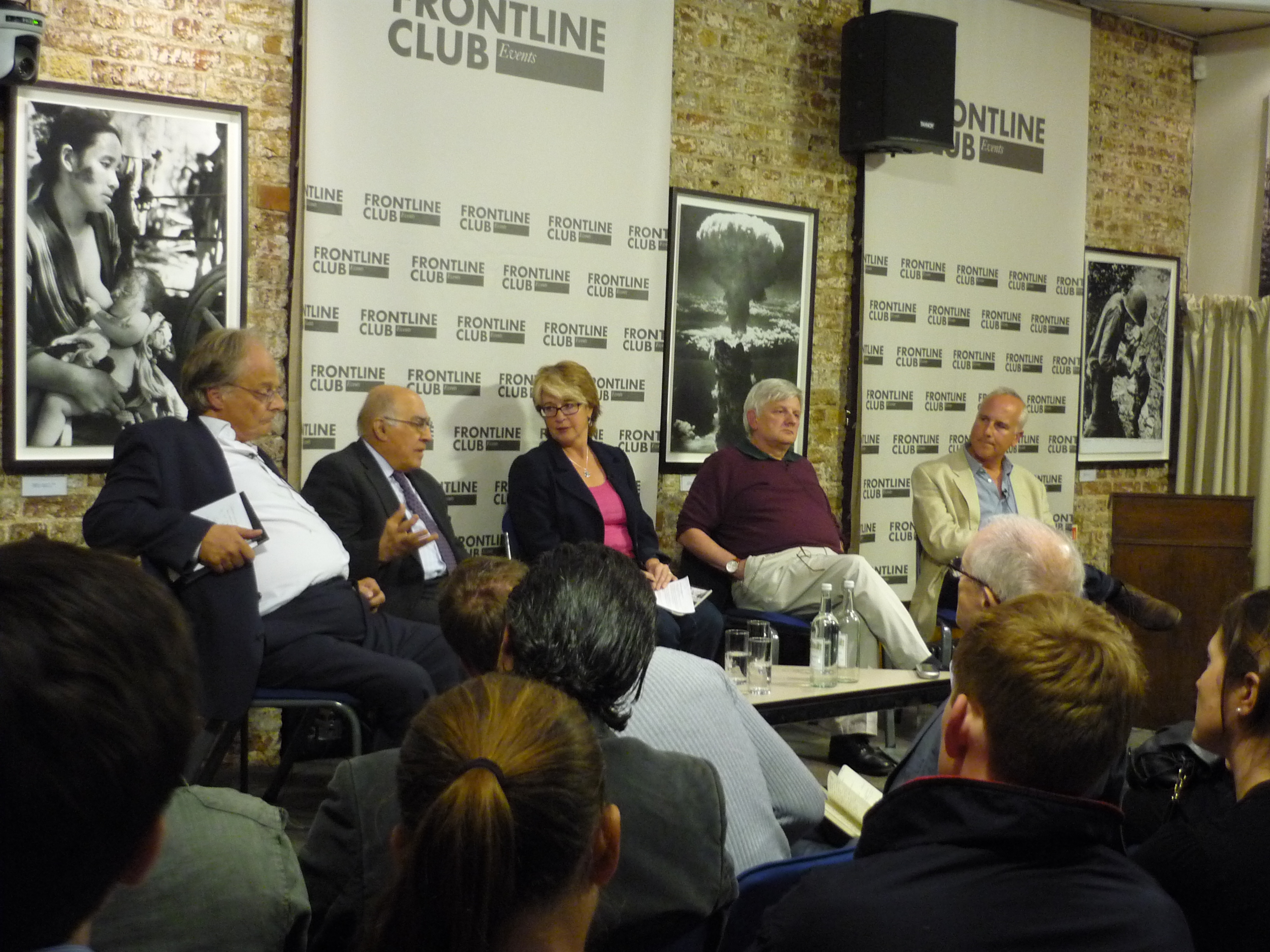
CBS News’ Elizabeth Palmer led an expert discussion at the Frontline Club on 11 September regarding the latest crush of violence in Iraq.
The panel painted a portrait of a country desperately in need of peace, independence, rule of law, reconciliation with its traumatic past, and unity amidst hardening divisions along ethnic, class, and religious lines. Yet none of these needs are being met.
Professor Charles Tripp lamented Iraqis’ inability to trust their government, with a:
"Parliament that sat for 20 minutes in the whole of the year 2010 after being elected … a judiciary which seems to be completely in the pocket of the executive power, and of course a police that you have to be very wary of calling."
Tripp expressed sadness at a "hatred of the state" that he perceived fueling many Sunni and Shi’a attacks.
"The blowing up of people who are looking for employment … of a large number of people standing outside army recruiting or police recruiting. These are people who are just like [their killers] in some senses, these are, you know, sad people who are looking, desperate for employment."
Kamran Karadaghi, distinguished Kurdish Iraqi journalist, downplayed recent attacks as anything out of the ordinary.
"This was something that was meant to happen," he said. "There is always from time to time a wave of violence in Iraq … Iraqi people are very violent. Killing, getting rid of others, is something which sometimes is like a normal thing."
Different factions who make up the government, The Independents‘ Patrick Cockburn added:
"Sunnis, Shi’a, Kurds … none of these people like each other … [but] they all have quite a lot to lose if the present system collapses. So despite the very high levels of violence … in a way it has a sort of grisly stability."
Karadaghi agreed.
"Being an oil economy … everybody in Iraq wants to be a part of it. So this is why, despite … all the animosities … nobody actually left the government. They are all still in the government. This kind of arrangement will continue."
On one topic, however, the panel found optimism, Kurdish independence.
Karadaghi, as well as Tom Hardie-Forsyth, a senior adviser to the Prime Minister’s office, Kurdistan Regional Government (KRG), Northern Iraq, both touted the transparency and success of recent Kurdish oil contracts, a more stable and prosperous way of life in the region, and a stronger sense of unity and purpose among Kurds.
"They are the largest disenfranchised nation in the world. They deserve [independence]," Hardie-Forsyth said.
But are they ready for it?
Karadaghi smiled: "Not yet, but like Andy Murray said, getting closer."
]]>
In the past few months a fresh wave of violence has swept through Iraq. The 23 July saw the worst of these attacks when a string of coordinated bombings and shootings in 15 cities across the country left over 100 people dead and many more injured.
But do these recent events really signal new depths of instability in a nation that has already suffered so much trauma in recent history? Is there a way through the maze of sectarian rivalries and power plays? And what, if any international intervention could take place to remedy the Iraqi predicament? The panel discussion on the 11 September saw four experts wrestle with these questions.
Much of the discussion focussed on precarious political situation, which is inevitably reflected in the wider community. Kamran Karadaghi, distinguished Kurdish Iraqi journalist emphasised the cyclical pattern of such violence, attributing this to underlying sectarian and therefore political fractures which have never completely healed. It is other interests, he said, that hold these factions in the balance, not true reconciliation:
“I felt that there never was real reconciliation among the different … political players.”
Senior Middle East correspondent for the Independent Patrick Cockburn, also pointed to the fragile sectarian situation within the political sphere:
“None of these people like each other, a lot of them hate each other, some have tried to kill each other, but a certain stability is there in the balance of power between them, and they all have quite a lot to lose if the present system collapses.”
During the debate the presence of oil also emerged as a key factor at play within the continuing unrest in Iraq. Putting aside sectarian conflict for a while, Professor Charles Tripp, explained how the focus on oil wealth creates a "kind of wary stability" within the government. Along with this elitism he argued, comes destabilising effects within the general populace. "If you create class privilege you create class resentment" he said, referring to the the lack of trust in state institutions.
Adding to this Tom Hardie-Forsyth spoke of his extensive military experience and criticized the inadequacy of Western intervention during the recent occupation:
“We did not have the boots on the ground to fulfil our obligations as an occupier to the civil population under the Geneva Conventions. Instead we left reconstruction and security to a bizarre alliance between private and public sector.”
Western mistakes he argued, contributed to the continuation of Mukhabarat state governance-mentality, which in turn has lead to the disenfranchisement of ordinary Iraqis. Perhaps the most poignant question asked during the evening was whether the ‘signature of Saddam Hussain’ was still visible within Iraq. The panel agreed that Al-Maliki’s security orientated government would certainly imply so.
For reactions to the discussion including those of panelist Kamran Karadaghi, watch below:
Frontline Club Events – Iraq: Escalating violence and sectarian division from Lizzie Kendal on Vimeo.
You can watch the full debate here.