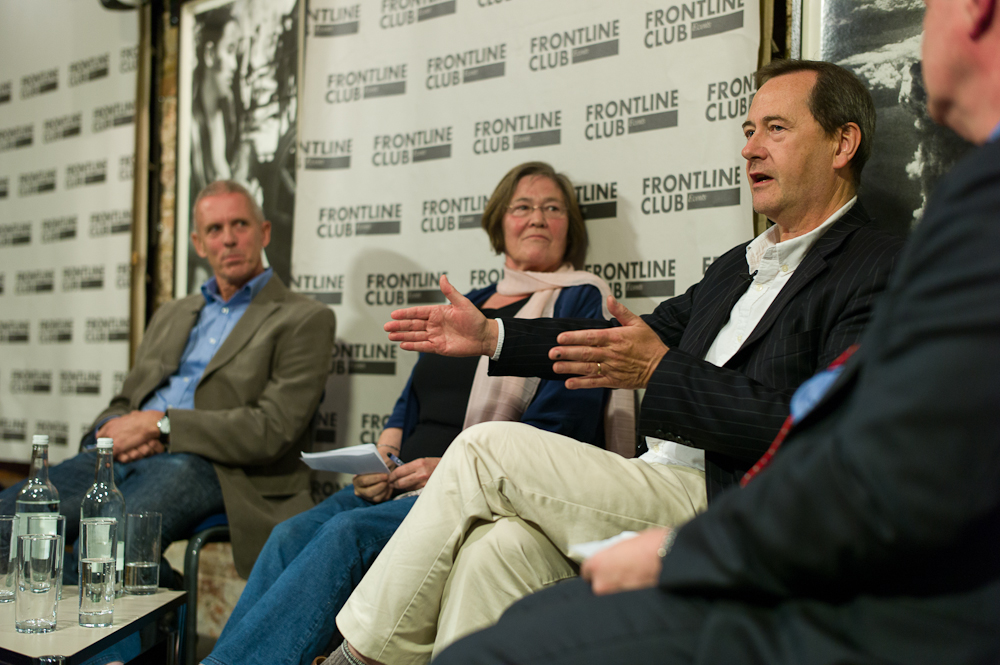
Ten years on from the publication of the September dossier, Kevin Marsh, former editor of the Today programme, spoke at the Frontline Club on 18 September about the political firestorm in the aftermath of the Radio 4 show’s "sexed up" comments made by former Defence Correspondent Andrew Gilligan.
The insider story of what happened at the BBC during the fallout, documented in Marsh’s new book, Stumbling over the Truth, fills in a “massive piece of history” said discussion chair Roy Greenslade, media commentator and Professor of journalism at London’s City University. The book details the “turning of the wheels” at the BBC in the run up to and in the wake of the Hutton Inquiry, set up to investigate the circumstances surrounding the death of weapons expert Dr. David Kelly, who was identified as Gilligans’ unnamed source. The controversy cost the BBC its Chairman and Director General.
Marsh pointed out that there was a daily deluge of complaints and denials of facts and figures from Downing Street, with the first few complaints about Gilligan’s comments from then communications chief Alastair Campbell aimed at his lack of knowledge about the way intelligence works:
“[Alastair Campbell] thought at the time that Gilligan’s story was just a rehash of old stories … this notion that he was outraged from the very beginning, it is complete nonsense, as he recalls in his own diary,” he said.
Though agreeing that Campbell’s agenda was to stay on top of the news and that the communications office did try to “point to the truths that suited”, Lance Price, former BBC political correspondent and director of communications for the Labour Party, said that characterising the barrage of complaints as a daily event was an exaggeration and remarked that at the time the BBC show appeared biased:
“I felt that John Humphrys [presenter on Today Programme], Andrew Gilligan and by implication the programme itself, had made up their minds that Tony Blair and the new Labour government were untrustworthy people and that came through to me,” he said.
Responding to a question about whether the media failed to tell the British public the truth and hold power to account, Richard Tait, Professor at Cardiff University and chairman of INSI UK as well as former BBC Governor and Trustee, from 2004 to 2006 and 2007 to 2010 respectively, said that journalists were too focused on reacting to the government’s agenda and that the challenge is to look beyond the daily battle:
"What happened to the BBC and other organisations during this period is that they got stuck into a very detailed aspect of the story … and at the end … you have a situation where David Kelly commits suicide because he gets caught up in a knife fight between the BBC and Alastair Campbell, which he was [ill-equipped] to deal with.”
Also on the panel was Clare Short, who resigned from the government over the Iraq war and has since authored her own account of events. She noted that the media’s failure should be seen in a larger context and reminded the audience that the Iraq Inquiry, headed by Sir John Chilcot, is yet to issue its final report.
“I hope and expect Chilcot in very calm language to say all our institutions failed and need some correcting … What do we have to do to make these decisions more carefully and consider the evidence more carefully from inside government?” Short said.
Concluding the discussion, Greenslade reminded the audience that in spite of Hutton, British people believed the BBC more than the government and turned the floor over to audience questions, many of which focused on the situation today. Can the public now trust reports on WMD in Iran or the volatile situation in the Middle East? In general there was agreement on the panel that the effects of Hutton on today’s reporting are negligible though it did reinforce the power held over journalists who faced being cut out of the loop if they didn’t tow the line. There is no doubt, however, that cynicism over the affair continues to the present day.
Greenslade said:
At the end of the book …[is] a straightforward-ish transcript … of John Humphrys interviewing Blair in which he scores about five key points to show that Blair’s whole way into war was founded on a set of…”
Lies?” said an audience member.
Propaganda,” finished Greenslade.
Photo courtesy of Chris King, Frontline Club member and photographer
Watch the full event here:
]]>
It has been ten years since the publication of the “September Dossier”, part of an ongoing investigation by the government into weapons of mass destruction in Iraq. The following year, on 29 May, the then BBC defence correspondent Andrew Gilligan reported on Radio 4’s Today programme that he had been told by an unnamed source that the dossier had been “sexed up”. His source was later revealed to be government scientist Dr David Kelly who was subsequently found dead in a field in Oxfordshire.
The Hutton Inquiry set up to investigate the circumstances surrounding Dr Kelly’s death lead to one of the biggest shake ups the BBC has seen. Not only did it cost the corporation its chairman and director general, but many believe it brought in a new age of caution.
Kevin Marsh who was editor of the Today programme at the time was not given an opportunity to give evidence at the Inquiry.
Now, after leaving the BBC, he reveals for the first time in his new book how the BBC reacted in the face of unprecedented government pressure.
Kevin Marsh and others will be joining us to ask to what extent have the events of ten years ago affected the BBC and its willingness to tackle stories that challenge the government line. Does the British media still have the ability – or appetite – to hold power to account?
Chaired by Roy Greenslade, media commentator and Professor of journalism at London’s City University. He was editor of the Daily Mirror (1990-91), was managing editor (news) at The Sunday Times (1987-90) and assistant editor of The Sun (1981-86). Twitter: @GreensladeR
With:
Kevin Marsh, one of the BBC’s longest-serving frontline programme editors. He has edited Radio 4’s PM, The World at One, The World This Weekend and Today. He also developed and launched Broadcasting House. In 2006 he became the BBC College of Journalism’s first executive editor and left the BBC in 2011 to set up his own media teaching and coaching company OffspinMedia.
Lance Price, a writer, broadcaster, commentator and executive director of the Kaleidoscope Trust. He is author of Where Power Lies, The Spin Doctor’s Diary and Time & Fate. He is a former BBC Political Correspondent and Director of Communications for the Labour Party.
Clare Short, former MP for Birmingham Ladywood from 1983 to 2010 and Secretary of State for International Development from 1997 to May 2003. In 2003 she resigned from the Government over the Iraq war and in 2006, she resigned the Labour whip. She is author of An Honourable Deception? New Labour, Iraq, and the Misuse of Power.
Professor Richard Tait CBE, Professor of Journalism and former Director of the Centre for Journalism Studies at Cardiff University. He has served as a BBC Governor from 2004-2006 and a BBC Trustee from 2007-2010. He is a former editor of BBC’s Newsnight, Channel 4 News and Editor-in-Chief of ITN. He is is currently Chairman of INSI UK.
]]>