Navai focuses on eight protagonists: a porn star, an ageing socialite, an assassin and enemy of the state who ends up working for the Republic, a volunteer religious militiaman who undergoes a sex change, a dutiful housewife who files for divorce and an old-time thug running a gambling den. Drawn from across the spectrum of Iranian society, their lives present a fascinating and intimate portrait of a complex, colourful and changing city.
Ramita Navai, winner of The Debut Political Book Of The Year Award and The Jerwood Award For Non-Fiction, is a British-Iranian journalist and reporter. Born in Tehran, she has reported from over 30 different countries, including Sudan, Afghanistan, Egypt, Nigeria, El Salvador and Zimbabwe. She was awarded an EMMY for her undercover reporting from Syria. She has also worked as a journalist for the United Nations in Pakistan, northern Iraq and Iran, was the Tehran correspondent for The Times from 2003 to 2006 and reported for Channel 4’s foreign affairs series, Unreported World.
Guests are encouraged to read the book before the event, although you are also welcome to join if you’ve just started your exploration. This an informal dinner event. We start with drinks from 7pm, followed by a sit-down dinner at 7:30 PM. Menu £25 per person excluding drinks.
The event will be hosted by Pranvera Smith and Ed Vulliamy, senior correspondent at the Guardian and the Observer.
]]>“To live in Tehran you have to lie. Morals don’t come into it. Lying in Tehran is about survival.”

Speaking at the Frontline Club on Wednesday 21 May about her new book City of Lies, Ramita Navai was joined in conversation by the BBC’s Middle East Correspondent Jeremy Bowen. She began by elaborating on the notion of lying as a means for survival and how each character in the book reflects these contractions within Iran:
“For me it was interesting to see how Iranian’s have adapted during the 30 years of the Islamic regime. One of the ways they have adapted is that lying [has become] an everyday common place activity. You have to do it and don’t think twice about it. Its really become part of the culture.”
Referencing an important theme running through the book, Bowen asked how this culture of lying manifests itself, specifically focusing on sex and how it is used as an act of rebellion in Tehran. Reading from the book, he continued:
“Sex is a form of protest. Only in sex do many of the younger generation feel truly free. Their bodies are weapons of revolt, a backlash against years of sexual repression.”
On the disconnect between Iran’s perception in the west of a totally sexually repressive society and the reality in Tehran, Navai described the explosive atmosphere which, nevertheless, demonstrates the inherent contradictions within the society:
“On one hand you could get killed for you sexual preferences yet it is still extraordinary what is happening with the youth and sex.”
Speaking specifically on the characters she encountered and chose to illustrate these contradictions, Navai described many of them as coming from the margins of society:
“To really understand a city and the way it ticks, the way it works, I am always drawn to the dark underbelly. While you have sex and drugs in every city, in Tehran everything is just so much more extreme because of the social strictures and because of the boundaries that you have.”
With so little of this known or reported outside of Iran, Bowen described the western perception as one based on “unreconstructed viewpoints” containing none of the subtleties that emerge in the book or any of the human frailties on display on the ground. Responding to this, Navai posits a misrepresented view of Iran “as this monolithic society”.
“One thing I wanted to do with my book is to show that it is actually so complex, that there are so many different layers where it is impossible to assume somebody’s views or how religious they are from their class or how much money they have.”
Navai commented that while the uprising of 2009 was ultimately repressed and failed, Iranian’s, having seen what has happened in Syria and as a consequence of the Arab spring, are now “resigned and yet happy with change happening very slowly”.
Citing Iran’s current brain drain, Navai questioned the failure of any one Mandela-like reformist figure to emerge and challenge the regime. Bowen responded by asking whether this meant any subsequent reform would have to come from the regime itself?
“I think so. Pretty much everyone that I spoke to, say seven or eight out of ten people, have said that they believe that the system can only change from within.”
Speaking of a gradual, organic process led by a Gorbachev-like figure, Navai commented that “they have been scared off by the Arab Spring and scared off by Afghanistan”.
Do book titles distort perceptions of #Iran? City of Lies? Reading Lolita? @ramitanavai says titles symbolic of what's beneath the surface.
— Azadeh Moaveni (@AzadehMoaveni) May 21, 2014
In closing, Navai was again asked to elaborate on her choice of title, the reception it has had received within Iran and to define her conception of lying as an act akin to breathing – necessary as a means of survival.
“Most Tehrani’s have loved [the title] because they can relate to it. It is not said in a pejorative way. It is because of the everyday need to lie to be true to yourself. To me, it is testament to the spirit and Iranian’s romantic spirit that you must be true to yourself. The fact that Iranians are these adaptable people – that they want to lead the lives they want to lead, means that in order to do that they will lie.
“Names of books are symbolic as well. So it is symbolic of what happens in a city of 12 million people where you are forced to live two lives; your internal home life and your external public life.
“Of course you lie in every city, but the point with Tehran is that everything is more exaggerated because of the contradictions within the society.”
Watch and listen again here:
]]>The politics of Iran are frequently analysed and debated on the international stage but rarely do we glimpse what everyday life is like in Tehran. In her new book City of Lies, Ramita Navai returns to the city where she was born to explore the lives of its residents.
Navai focuses on eight protagonists: a porn star, an ageing socialite, an assassin and enemy of the state who ends up working for the Republic, a volunteer religious militiaman who undergoes a sex change, a dutiful housewife who files for divorce and an old-time thug running a gambling den. Drawn from across the spectrum of Iranian society, their lives present a fascinating and intimate portrait of a complex, colourful and changing city.
Ramita Navai will be joining us in conversation with the BBC’s Middle East Editor, Jeremy Bowen, to talk about her exploration of modern-day Tehran and what life in the city signals about how the country will develop.
Ramita Navai is a British-Iranian journalist and reporter for Channel 4’s foreign affairs series, Unreported World. Born in Tehran, she has reported from over 30 different countries, including Sudan, Afghanistan, Egypt, Nigeria, El Salvador and Zimbabwe. She was awarded an EMMY for her undercover report from Syria. She has also worked as a journalist for the United Nations in Pakistan, northern Iraq and Iran, and was the Tehran correspondent for The Times from 2003 to 2006.
The election of cleric Hassan Rouhani to Iran’s presidency last week has Iranians and the world turning their heads to wonder: is the Islamic Republic changing direction? Will Rouhani’s promised pragmatism and reform replace the hardline conservatism of incumbent Mahmoud Ahmadinejad?
An expert panel convened at the Frontline Club on 26 June, to probe for answers.

Saeed Barzin and Mark Fitzpatrick. Credit: Jim Treadway
CBS Correspondent Elizabeth Palmer, chair for the discussion, observed:
“He’s [Rouhani] had a career which has kept him at the very core of power, very close to the Supreme Leader. So it’s hard to imagine that he will be a radical reformer. And yet, at certain stages in his career he has shown that he is a pragmatist, that he is capable of being flexible.”
During his campaign, Rouhani promised greater engagement with the West while urging the world to “acknowledge the rights” of Iran. His primary promise was to try to ease sanctions imposed on Iran over its nuclear program.
Meanwhile, as Arab Spring upheavals echo across the region, panelists saw the election as a sign that Tehran is tuning in acutely to the demands of the people. Author and journalist Azadeh Moaveni asserted:
“I see Iran changing, and I see the prospects for Iran changing from below. [It] feels differently inside the country. . . This is a break from the police state atmosphere of the last 8 years, which has just been suffocating.”
Saeed Barzin, a longtime Iran analyst now with BBC Persian, agreed:
“What I learned from the elections is that Iranians are getting [ready] for change. That is quite clear in the way that the establishment behaved, the way that the candidates behaved, and the way that people behaved. . . . People are desperate for change. The economic situation is not good: inflation, unemployment, the value of the national currency. But, they want gradual change. They don’t want…a Libya scenario. They don’t want an Egyptian story. They want their new TV at the end of summer, and they want a new fridge for their children . . . gradual, calculated, reasonable, common sense change, and this is what indeed Mr Rouhani is representing.”
“One phrase which did not occur in this election, strikingly, was ‘Islamic Awakening’,” reflected Scott Lucas, a professor at the University of Birmingham and editor-in-chief of EA WorldView.

L-R: Elizabeth Palmer, Azadeh Moaveni, Scott Lucas. Credit: Jim Treadway
Barzin added: “The faction which was defeated in these elections was what I call the right wing of the establishment…which initially brought Ahmadinejad to power.”
With 72% of eligible voters casting ballots, Rouhani won just over 50% of the vote, while his nearest rival, conservative Tehran Mayor Mohammad Qalibaf, received only 16%, and hardliner favorite Saeed Jalili received 11%.
So, will Tehran’s tenor change in nuclear negotiations with the United States? Mark Fitzpatrick, director of the Non-Proliferation and Disarmament Programme at the International Institute for Strategic Studies, commented:
“The [current] nuclear negotiating team was criticizing Rouhani during the election, so they’re all out. But, that’s only a handful of people. My read is that Rouhani will probably bring in more pragmatists, as opposed to hardliners.”
Watch the event here or listen/download the podcast:
https://soundcloud.com/frontlineclub/iranafterahmedinejad
]]>Will 2013 see an escalation in tensions between Israel and Iran? The Frontline Club in association with BBC Arabic brought together an expert panel to decipher the drumbeat of war and predict what 2013 may hold.
Channel 4 News presenter Jon Snow began by telling an audience at LSE’s Sheikh Zayed Theatre on 12 December, that the consequences of military strikes would be “unbelievably catastrophic”.

- From left: Meir Javedanfar, Azadeh Moaveni, Jon Snow, Abdel Bari Atwan, and Scott Peterson debate war and peace between Israel and Iran in the Sheikh Zayed Theatre at the London School of Economics.
Abdel Bari Atwan, editor-in chief of the London-based Arabic newspaper Al Quds Al Arabi, opened the debate by stating he feels war is imminent. Iran is tripping into the same fate that awaited Iraq during the last two decades, he said:
“When I say the comparison with Saddam Hussein and Iran, it is because the Israelis…want these weapons actually to be exclusive to the Israelis so they can scare the people from the Middle East and they can actually expand as they like…
The Israelis are preparing themselves… The war against Gaza, which lasted about eight days, it was to test the Iranian missiles [from Hamas]…to test the Iron Domes, which [are] supposed to actually intercept all kinds of missiles…from Iran in particular.”
Toward this agenda, America supported Israel, Atwan said:
“[The U.S.] doesn’t want any regional superpower to possess nuclear weapons or weapons of mass destruction in order to threaten [its] domination of the oil fields in the Gulf. That’s facts… Saddam Hussein tried to do so, and he paid the price – his regime [was] deposed. The Iranians are repeating the same mistakes in the eyes of the Israelis and the Americas.”
Israeli-Iranian analyst Meir Javedanfar disagreed:
“It’s not because we don’t want the Iranians to have nuclear weapons. It’s because of this regime… [It] has called for Israel to be eliminated, time and time again… [It] has put its hatred into action. We saw in the Second Intifada, 700 Israelis were killed by suicide bombings paid by Iranian money, half of it at least… You would not want that regime to have a nuclear weapon.”
Moreover, Javedanfar added:
“I don’t think there will be war… We see that the sanctions and the diplomacy are [already] hurting the Iranian regime very badly…
[And] I don’t see Ayatollah Khomeini having the confidence to tell his officers that, ‘tomorrow we’re going to kick out all the IAEA inspectors, we’re going to take that enriched uranium…and we’re going to make a bomb with it,’ because the moment he does that, that’s the moment he’s going to risk an American attack.”
Other panelists Azadeh Moaveni, former Middle East correspondent for Time magazine and Scott Peterson, journalist and photographer, agreed with Javedanfar that war seems improbable.
Javedanfar thought injustice in Palestine, rather than nuclear saber-rattling in Tehran, was ultimately Israel’s greatest danger:
“Israel’s security? You know what? We can beat the Iranian regime. The Iranian regime doesn’t scare me. [But] if these guys, the Palestinian people, don’t have a state, that is an existential threat to the security of the state of Israel.”
The panel mostly agreed, with relief, that Israeli Prime Minister Benjamin Netanyahu, who has been particularly vocal in antagonizing Iran, seems somewhat isolated on this issue within Israel itself.
When the topic turned to sanctions against Iran, echoes of Iraq reemerged. Moaveni argued that they destroy goodwill and are excessively cruel.
“It is becoming impossible to be middle class anymore in Iran,” she said. “This is the slow dying of the Iran middle class… Do we want to impoverish another major Middle Eastern middle class the way we’ve done [in Iraq]?”
Snow ended the discussion by highlighting the need for the West to engage Iranians with the respect he thinks they crave. And to resolve tensions, he offered his own alternative:
“When you spend time on the streets in Shiraz, in Tehran… you meet young people who look west. This doesn’t happen anywhere else in the region. These people look remorselessly west… And, you go around, and you ask people, and they want ipads! That’s why I’ve always said: if you want to bomb Iran, bomb it with ipads… That’s what people want… They want life. And they want joy… It isn’t as if they crave a prayer-mat.”
Watch the full event here:
]]>We will be discussing the "War on Terror" that was waged in the wake of 9/11, the impact of a global battle characterised in terms of "good vs. evil": and asking if it is a war that can ever be won. What has been the impact of both the reality and rhetoric on an increasingly interconnected world? The panel will also be taking stock of the seismic events the world has witnessed in the past decade.
Paddy O’Connell of BBC Radio 4’s Broadcasting House who was living and working in New York on 9/11 and anchored the New York end of the special programme that night for BBC One. Twitter: @paddy_o_c
With:
Mehdi Hasan, senior editor (politics) at the New Statesman and a former Channel 4 news and current affairs editor, co-author of Ed: the Milibands and the Making of a Labour Leader and author of the new ebook The Debt Delusion. Twitter:@ns_mehdihasan
Carne Ross, a former British diplomat, author and journalist. Having resigned from the British foreign service after giving secret testimony to an official inquiry into the Iraq war, he then set up the world’first independent diplomatic advisory group, Independent Diplomat, which advises marginalised countries and groups around the world. He is author of The Leaderless Revolution: How Ordinary People Will Take Power And Change Politics in the 21st Century. Twitter: @carneross
Maajid Nawaz, co-Founder and executive director of Quilliam and founder of Khudi, and Founder of Khudi, he was formerly on the UK national leadership for the global Islamist party Hizb ut-Tahrir (HT). During his 14 years with HT he was a founding member of its Denmark and Pakistan operations. During a four year sentence in an Egyptian prison he renounced Islamist ideology while remaining Muslim. He now engages in counter-Islamist thought-generating, social-activism, writing, debating and media appearances. Twitter:@MaajidNawaz
Michael Goldfarb, author, journalist, broadcaster and GlobalPost’s London correspondent. Goldfarb has covered conflicts and conflict resolution in Northern Ireland, Bosnia, the Middle East and Latin America for NPR and the BBC. He covered the war in Iraq as an unembedded reporter based in Kurdistan. His book on the conflict, Ahmad’s War, Ahmad’s Peace: Surviving Under Saddam, Dying in the New Iraq was named one of The New York Times‘ Notable Books of 2005. On September 11, 2001 he was live on the air from 10 until noon in the US presenting part of NPR’s coverage and since then has reported extensively on radical Islam from Cairo and Tehran to the streets of London. Twitter: @MGEmancipation
Book tickets here.
]]>We’ll be discussing the situation in Iran following the disputed election results at the Frontline Club tonight. Specifically, how did hotel-bound foreign journalists report from Tehran and beyond during the election and days and weeks following? We start at 7pm GMT and as usual if you can’t join us in person please come and join us on the Frontline Club broadcast channel or on the Club events page where we will be streaming the discussion. In addition, we now partner Livestation and we will be broadcasting the event with them. To try out Livestation, which gives better quality audio and video than our usual channel and allows a greater degree of interaction, you’ll need to download the software to your PC/Mac.
Joining us will be Channel 4 News International editor Lindsey Hilsum, Behrouz Afagh, head of the Asia & Pacific Region for the BBC World Service, CBS News correspondent Elizabeth Palmer, one of the last US network journalists to leave Iran and The Times journalist Marie Colvin.
]]>Maziar Bahari envoyé par Khanjar. – Explorez des lieux exotiques en vidéo.
Newsweek reporter, film maker and Frontline Club regular Maziar Bahari has been detained in Tehran. Maziar has been living in the Islamic Republic for the past ten years. Foreign media have been barred from covering the post election protests and many journalists, including the BBC’s Jon Leyne, have been kicked out of the country. A total of 24 journalists and bloggers are reportedly among the hundreds of people who have been detained by the Iranian authorities since the protests began. You can listen to Maziar talking about the President Mahmoud Ahmadinejad and the government in Iran in the video above.
]]>We’re discussing the aftermath of the June 12 presidential elections in Iran tonight. We start at 7pm GMT/11am PST and as usual, if you can’t make it to the Club in person, do please join us online in what should be a fantastic debate. We’ll be streaming the event on the Frontline Club broadcast channel, on this very blog post and on the Events page. Chairing the event will be Robin Lustig, presenter of BBC Radio 4’s The World Tonight and Newshour on the BBC World Service. The panel consists of,
Kasra Naji, special correspondent for BBC Persian TV and the author of a recent biography of President Ahmadinejad
Sina Motallebi, senior editor interactive programmes for the Persian section of the BBC World Service who left Iran after his arrest in 2003 because of his blogging.
Afshin Rattansi, author and freelance journalist who was based in Iran and is developer and former presenter with Press TV link
If you want to keep with how the story is developing online you could far, far worse than going through Frontline blogger Daniel Bennet’s posts on Iran here and here. More coming soon I’m reliably told… And Club regular Richard Sambrook has been doing sterling work negotiating sources of information from and about Iran.
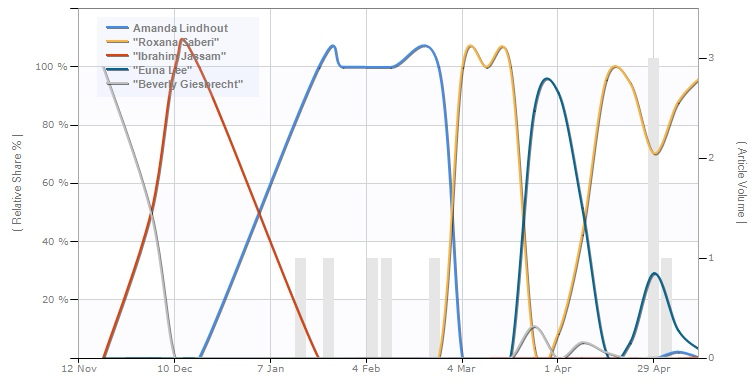
]]>
While the world welcomes the release of US/iranian journalist Roxana Saberi and the analysts pile in with their take of what it all means for US/Iranian relations, roughly 125 journalists remain behind bars around the world according to the Committee to Protect Journalists.
The Iranian-Canadian blogger Hossein Derakhshan, arrested in Tehran on November 2008, slips on and off the media radar. However, he has received nowhere near the attention of Saberi or Current.tv journalists Laura Ling and Euna Lee, who were arrested in North Korea in March, 2009. Journalist kidnap cases fare no better. Freelance hacks Amanda Lindhout and Nigel Brennan, who were kidnaped in Somalia some eight months ago, and Beverly Giesbrecht, held on the border between Pakistan and Afghanistan since November, 2008, have all but disappeared off the mediascope along with their ransom deadlines.
It appears Roxana Saberi is a better "fit" for today’s US media – new US administration and what it might mean for US/Iranian relations and her former beauty queen status offers editors a cheap, but irresistable tag to hang the story on. Writing on Salon.com, Glenn Greenwald does an excellent job discussing the Roxana Saberi story and highlights a number of cases of journalists being imprisoned where the US media have either chosen to forget, ignore or in some way deem them less newsworthy their plight. In particular, he mentions the story of freelance photographer Ibrahim Jassam,
Right now — as the American press corps celebrates itself for demanding Saberi’s release in Iran — the U.S. continues to imprison Ibrahim Jassam, a freelance photographer for Reuters, even though an Iraqi court last December — more than five months ago — found that there was no evidence to justify his detention and ordered him released. The U.S. — over the objections of the CPJ, Reporters Without Borders and Reuters — refused to recognize the validity of that Iraqi court order and announced it would continue to keep him imprisoned.
One finds only a tiny fraction of news coverage in the U.S. regarding the treatment of al-Haj, Hussein, Jassam and these other imprisoned journalists as has been devoted to Saberi. link
The Silobreaker graphic above illustrates the media attention given to Amanda Lindhout in Somalia, Ibrahim Jassam in Iraq, Euna Lee in North Korea, Beverly Giesbrecht on the Afghan/Pakistan border and Roxana Saberi in Iran over the last six months. Ibrahim Jassam has all but completely disappeared from the media. How convenient.
Silobreaker claims to draw upon "approximately 10,000 news, blog, research and multimedia sources" for its data compared to the 4,500+ sources Google News uses.
]]>