On 5 November, No Fire Zone was shown at Riverside Studios as part of a series of Between the Lines follow up events hosted by Frontline Club and DocHouse. This documentary chronicles the last 138 days of the civil war in Sri Lanka, revealing the brutal tactics employed by the Sri Lankan army and government against the Tamil population. The screeninng was followed by a lively Q&A with director, Callum Macrae, who introduced the film as evidence of war crimes and crimes against humanity, and warned the audience to prepare themselves accordingly for the images they were about to see.
The film uses footage taken by civilians, Tamil Tigers and government soldiers, plus testimonies from civilian survivors and UN officials, forming a harrowing and disturbing picture of the final stages of the 26-year civil war, where an estimated 40,000 – 70,000 Tamil civilians were massacred by the government’s military. The title of the film refers to the government-allocated no fire zones that were set-up as safe areas for Tamil civilians, which the military then purposefully attacked.

All the footage used in the film has been authenticated as genuine by forensic pathologists. However, as Macrae told the audience, the Sri Lankan government continues to maintain that the videos in the film, which have mostly been taken using camera phones or satellite phones, are fabrications, as are the estimated death count and disappearances.
The Sri Lankan government has strongly opposed the release of this film, using their influence to pressure other countries into preventing screenings. A recent Malaysian screening was raided and one of the organisers was arrested for censorship charges, facing a possible three year prison sentence. Macrae is also having problems obtaining an Indian visa to attend screenings of the film, an application process which he started in February.
One audience member asked why the videos and photos of the atrocities presented in the film did not make it into our news media or social media the same way images from the Arab Spring did? Macrae responded that the Western media needs to ask themselves that question, as the images did make their way onto the Internet, as events were occurring, and British Tamils were staging large campaigns and protests to draw attention to the atrocities.
The Sri Lankan government dismissed the videos as propaganda. They were able to gain international support from allies, as much of the world already viewed the Tamil Tigers as terrorists, and were able to hide behind a ‘shameless’ adoption of the West’s rhetoric of the “war on terror”, creating a ‘conspiracy of silence’, Macrae said. This view was challenged, towards the end of the session, by a Sinhalese audience member who accused the film and Channel 4 of bias against the government, which was vehemently rejected by Macrae.
Much of the Q&A focused on the lack of action by the international community. The Commonwealth Heads of Government Meeting (CHOGM) is due to be held in Colombo towards the end of November, despite criticism from international human rights organisations. Currently the only government who has expressed their opposition to this decision is Canada, who will boycott the conference.


The film depicts the UN leaving Sri Lanka, and presents testimonies from former UN staffers on their distress over this decision, and the abandonment of their role as protectors. Macrae was also critical of the UN, noting that the Human Rights Council passed a resolution congratulating Sri Lanka on ending the civil war. He stated that the UN made no real effort to intervene while in Sri Lanka, and strongly believes that they consciously concealed information about the number of deaths by preventing information being revealed during the time. Furthermore, Macrae added:
“I believe [that by staying there] it wasn’t just that it was complicit in what was going on, it provided an active cover for what was going on, because . . . people were assuming the UN was providing some kind of monitoring process. I think, in a sense [the UN] facilitated the ongoing massacres by saying nothing.”
He did, however, acknowledge that some progress has been made since, in part due to his film, and is hopeful that the UN’s criticism of Sri Lanka’s actions will grow stronger. He noted that the film has been shown to UN delegations also, with positive responses.
Congrats to @Callum_Macrae on powerful documentary showing truth to power #NoFireZone pic.twitter.com/2oFxaYPJZX
— James Denselow (@jamesdenselow) November 5, 2013
Many audience members wanted to know what they could do as individuals, and what the international community is doing or should be doing to hold Sri Lanka to account. Macrae stated that the intention of the film was to increase awareness of the war crimes committed by the Sri Lankan government and hopes that it will be used as a form of evidence for justice in the future. He continued:
“Without justice you can’t have peace and reconciliation, and to get justice you need truth”
He asked that everyone put pressure on the UK government, by contacting their MPs and the Prime Minister, to remain true to their promises to raise these issues with Sri Lanka during CHOGM. He pointed out that David Cameron maintains that it is a better decision to participate in the conference to bring attention to the issues, but that the government has made no sign of opposing Sri Lanka’s actions.
Macrae remains hopeful, however, that India, an influential country in the region with a large Tamil population, will decide to boycott CHOGM. He told the audience that he has received threats over his decision to travel to Sri Lanka during CHOGM, due to the opposition to this film.
A shortened version of No Fire Zone can be viewed on Channel 4 4od and there are a number of international events lined up.
]]>
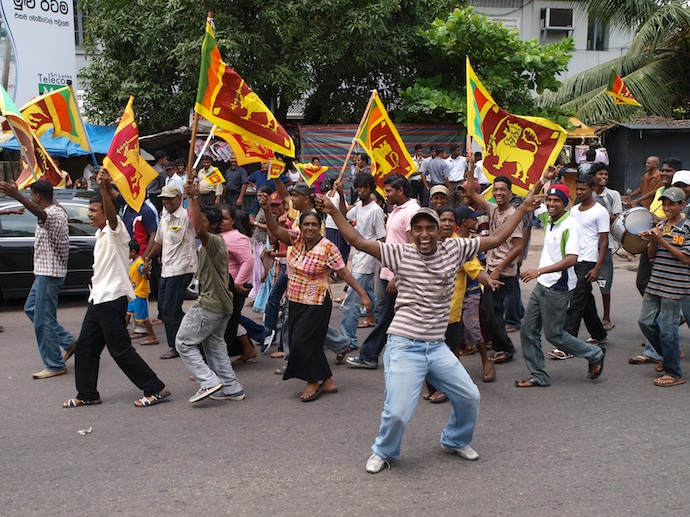 Also on the MoD website, and just about everywhere else, is President Mahinda Rajapakse’s instructions to his subjects on how to celebrate the victory over the LTTE without hurting anyone’s feelings. “Magnanimous Mahinda” has a good ring to it, and to be fair, most of the 100,000-plus crowd in Friday’s flag-filled festivities to honour the country’s war heroes behaved far better than the man in the cafe. Not all did, though. After a few hundred metres of the parade had passed came the less-than-magnanimous effigies of dead LTTE leader Velupillai Prabhakaran. Closely followed, perhaps by coincidence, by the not entirely media-friendly government minister Mervin Silva.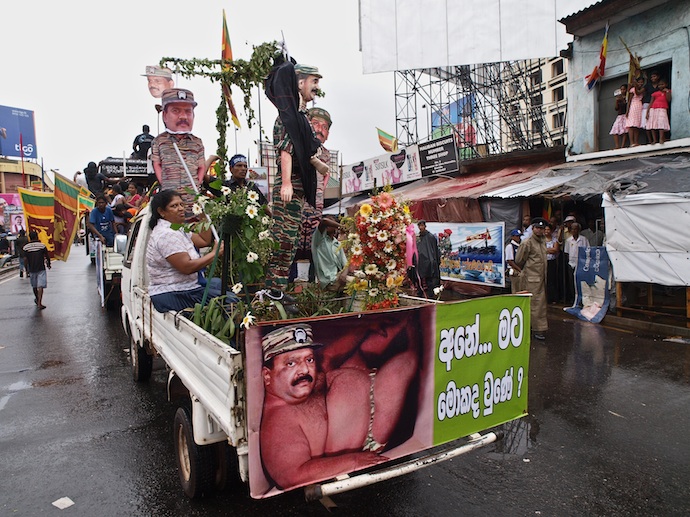
"Ayubowan", is the first word a visitor to Sri Lanka hears on arrival. These days one could be forgiven for thinking it means something very rude. It doesn’t, and the increasingly rare tourist would probably not suspect any hostility behind the still ever-present smiles. Until, that is, she or he makes the mistake of picking up a local newspaper. Traditionally fairly diverse, most Sri Lankan media outlets now speak with one voice to the "International Community", and the message is not "ayubowan", it’s "mind your own business".
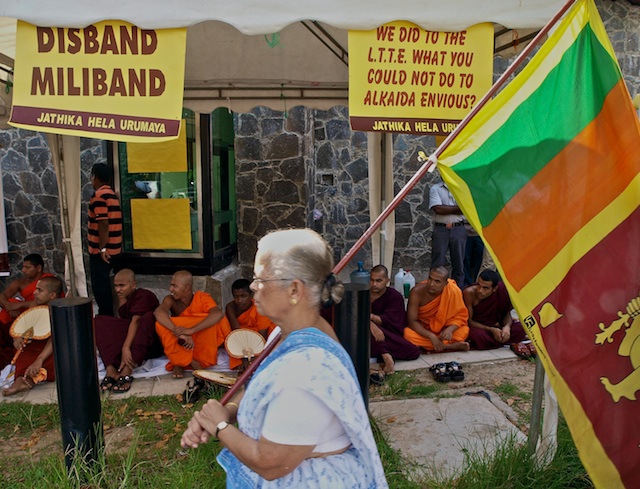
Increase the impact of the culture shock by going to cover what appears at first sight to be a peaceful demonstration against Foreign Secretary David Miliband by orange-robed buddhist monks in front of the British High Commission in Colombo. Nothing much to photograph (most people smile at the camera and ask where I’m from), and I soon get sleepy from the buddhist chanting and incense. I wake up when the monk speaking into the microphone switches to English. It turns out his rhetoric is somewhat less than peaceful, and within minutes he has concluded that Miliband "represents terrorism" and has come to Sri Lanka to rescue LTTE leader Velupillai Prabhakaran. The monk, who has stopped smiling at this stage, gives no reason as to why Miliband or any reasonably sane individual or nation would want to rescue a Tiger with a reputation as spotty as Prabhakaran’s. Some of the banners do though, by suggesting that Miliband is jealous of Sri Lanka’s apparent success in "wiping out terrorism".
Granted, the monks at the High Commission are from the JHU, a small-ish Sinhala buddhist political party that rises to the surface by stirring up a murky brew of religion, nationalism and anti-pretty-much-anything-else propaganda. But the same recipe seems to also work well for other, more moderate Sinhala buddhist Sri Lankans. There is very little real debate about the war. Politicans and local media have all draped themselves in the flag to combat their two main enemies. The main foe is the Tamil Tiger, now threatened by the process of "eradicating terrorism", a term much loved by the spin doctors. The other enemy would appear to be us. In the eyes of many Sri Lankans, the international community has become an international conspiracy. Foreign governments, the UN, NGO’s of all kinds, and of course the media are treated with suspicion and disdain. Many of the ever smiling Sri Lankans seem to genuinely believe that we are at best incompetent, and at worst have a hidden agenda. Hence, we the media simply aren’t allowed to cover events in and around the no-fire/combat zone, and the "welfare villages" where the internally displaced are being held.
So when the Swedish Foreign Minister gets snubbed and leading international officials are vilified, there are, in the minds of many here, good reasons for it. More surprising perhaps is that many of the young and educated have wrapped their heads in the same opaque flag. The other day Indi Samarajiva, a brilliant young Sri Lankan Canadian American blogger publicly dismissed my colleagues and me as a "tourists". And he didn’t even smile and say "ayubowan".
]]>