[vimeo clip_id=”57211223″ width=”400″ height=”225″]
No Fire Zone – The Killing Fields of Sri Lanka, chronicles the final 138 days of the 26-year Sri Lankan civil war. Told by the people who lived through it, the film builds on two award winning television documentaries by director Callum Macrae.
Civilians, Tamil Tiger camera operators and government soldiers filmed the events using small cameras and mobile phones. This disturbing footage is carefully analysed and authenticated by video analysts.
Macrae pieces together the scenes with personal accounts from civilians who survived the conflict and testimonies from UN officials who were forced to leave the area. The Sri Lankan government contests the depiction of events shown in No Fire Zone and dismisses the documentary as fake.
Directed by Callum Macrae
Duration: 90′
Year: 2013
Between the Lines was a three-day festival that took place at Rich Mix from 1 to 3 March. In a series of follow up events we continue to explore the challenges facing documentary makers, investigative journalists and citizen reporters in the new media landscape.
Presented by:


Supported by:


[vimeo clip_id=”57211223″ width=”400″ height=”225″]
No Fire Zone – The Killing Fields of Sri Lanka, chronicles the final 138 days of the 26 year Sri Lankan civil war. Told by the people who lived through it, the film builds on two award winning television documentaries by director Callum Macrae.
Civilians, Tiger camera operators and government soldiers filmed the events using small cameras and mobile phones. This disturbing footage is carefully analysed and authenticated by video analysts, and shows the extreme violence against Tamil civilians and bombing of hospitals by the Sri Lankan armed forces.
Macrae pieces together the scenes with personal accounts from civilians who survived the conflict and testimonies from UN officials who were forced to leave the area. The Sri Lankan government contests the depiction of events shown in No Fire Zone and dismisses the documentary as fake.
Directed by Callum Macrae
Duration: 90′
Year: 2013
View event here.
View in iTunes
Epitomising the troubled state of Sri Lanka post-conflict, an impassioned panel spent Wednesday night disputing the truth. Facing an equally ardent audience, they proved that the country has a long way to go before reconciliation will become a reality.
Chaired by BBC Hardtalk’s Stephen Sackur – who summarised the evening’s topic as “highly contentious [and] still hugely controversial” – the discussion first focused on two films broadcast by Channel 4: Sri Lanka’s Killing Fields and Sri Lanka’s Killing Fields: War Crimes Unpunished. Callum Macrae, director of both, clashed repeatedly with Professor Rajiva Wijesinha MP, government advisor on reconciliation who dismissed Channel 4’s work as illegitimate and “sordid.”
Wijesinha stated that while the film was not necessarily false, he believed it to have been “doctored”, although did at times direct his criticism at an earlier Channel 4 news item rather than the films under debate. Macrae rejected the suggestion that he had been an apologist for the Tamil Tigers (LTTE) as “nonsense”, and was later backed by an audience member who described a “very clever propaganda film [by the government] refuting the Channel 4 film” as “an excellent piece of editing.”
Yolanda Foster, Amnesty International’s Sri Lanka researcher, weighed into the debate by describing the government’s “merely cosmetic” act of lifting the state of emergency last year, and recounted ongoing disappearances and systematic torture. Foster served as a voice of calm in the panel – although criticised by Wijesinha as “avenging”, her measured tone helped her avoid heckles steeped on other panellists.
In December, Sri Lanka’s Lessons Learnt and Reconciliation Commission released a report on atrocities committed during the civil war. Foster said on careful reading the report was “good”, although pushed for the government to move forward with the Commission’s recommendations.
While the panellists failed to agree on the portrayal of war crimes by media and human rights groups, they broadly stood for legal remedies. Wijesinha deflected a question from Sackur about whether anyone had been prosecuted for wartime atrocities, but stated clearly that he was frustrated by delays in pushing the judicial process forward.
Arun Thambimuttu, a Tamil political activist, argued that atrocities were widespread over a 30 year period rather than just a few months, and committed by all sides. Recognising this, Jan Jananayagam, spokesperson for Tamils Against Genocide (TAG), stated that prosecutions must cover the breadth of the war:
“The judiciary has failed. I don’t agree that the government has an opt-out clause; that because they didn’t deliver justice for 30 years they won’t do it now.”
The international community has taken a much lesser role in post-conflict resolution and by all accounts momentum from within Sri Lanka seemed lacking.
“The international law which governs the behaviour of all governments around the world applies to Colombo, and that is something we cannot escape from,”
Sackur reminded Wijesinha, as tempers seethed throughout the room.
After two hours, a ceasefire was called on the divided panel. One audience member summarised the withering hope of reconciliation:
“If this is the reaction you get sitting in London; what chance do you have?”
Watch the full event here:
[acf field=”Tickets”]
Join us at the Frontline Club to discuss the impact of Sri Lanka's Killing Fields and the situation today in Sri Lanka.
]]>Nearly three years after the end of the 26-year civil war in Sri Lanka that reportedly left an estimated 80,000-100,000 dead, questions are still arising about alleged war crimes and how they will be addressed.
The Killing Fields, first broadcast by Channel 4 in June last year and a follow up aired this March called Sri Lanka’s Killing Fields: War Crimes Unpunished, have been significant in bringing evidence of executions, the shelling of civilians and other atrocities to light.
The Sri Lankan Ministry of Defence rejects the evidence, however, arguing that it has been falsified by Channel 4 and that the Liberation Tigers of Tamil Eelam (LTTE ) were responsible for a proportion of the civilian casualties. It also rejected calls from the UN-led investigation into alleged war crimes, opting for a locally-organised investigation, the Lessons Learnt and Reconciliation Commission (LLRC).
What action will the Sri Lankan government take in light of new footage and will it be forced address the issue of high-command responsibility? After the failing of the international community to prevent such atrocities, what role can they play in the future?
Join us at the Frontline Club to discuss the impact of Sri Lanka’s Killing Fields and the situation today in Sri Lanka.
Chaired by Stephen Sackur, the host of BBC Hardtalk.
With:
Callum Macrae, journalist, filmmaker and Director of both Sri Lanka’s Killing Fields and Sri Lanka’s Killing Fields: War Crimes Unpunished that documents evidence of alleged war crimes committed by the Sri Lankan Government.
Arun Thambimuttu, a Tamil political activist from Batticaloa, in the Eastern province, Sri Lanka. His father, Sam Tambimuttu, a Member of Parliament of the Tamil United Liberation Front (TULF), and his mother were both assassinated by the Liberation Tigers of Tamil Eelam (LTTE) in 1990.
Jan Jananayagam, spokesperson for Tamils Against Genocide [TAG] an NGO that assists victims and witnesses of war crimes, crimes against humanity and genocide including by bringing litigations against perpetrators.
Professor Rajiva Wijesinha MP, adviser to the President on Reconciliation.
Yolanda Foster, Amnesty International’s Sri Lanka researcher.
]]>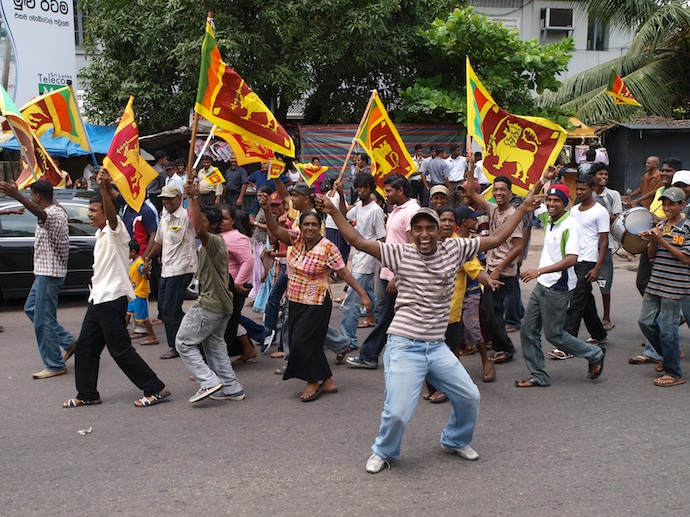 Also on the MoD website, and just about everywhere else, is President Mahinda Rajapakse’s instructions to his subjects on how to celebrate the victory over the LTTE without hurting anyone’s feelings. “Magnanimous Mahinda” has a good ring to it, and to be fair, most of the 100,000-plus crowd in Friday’s flag-filled festivities to honour the country’s war heroes behaved far better than the man in the cafe. Not all did, though. After a few hundred metres of the parade had passed came the less-than-magnanimous effigies of dead LTTE leader Velupillai Prabhakaran. Closely followed, perhaps by coincidence, by the not entirely media-friendly government minister Mervin Silva.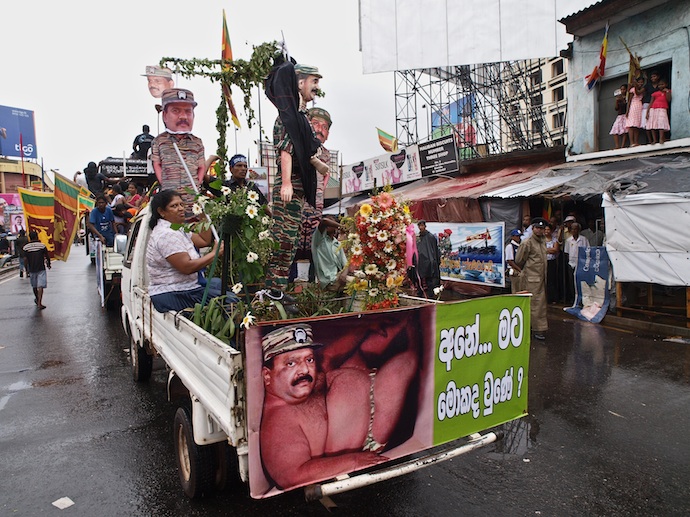
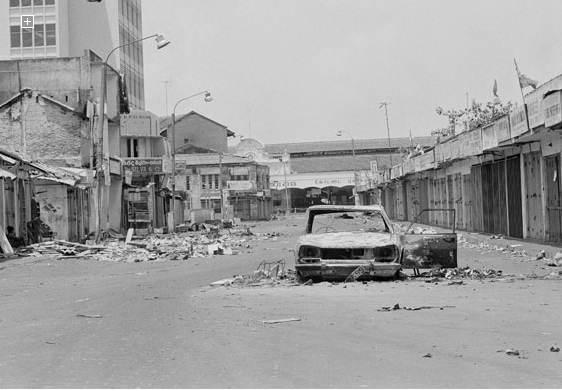
As the government of Sri Lanka declares an end to the civil war that has lasted 25 years, The Guardian newspaper looks back over the conflict in a series of 31 images.
]]>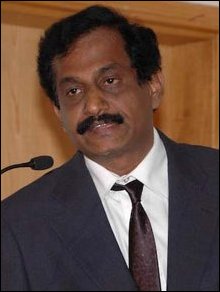
Nadesapillai Vithyatharan, a senior Sri Lankan newspaper editor, was abducted by armed men in police uniform this morning, according to the Tamil Eelam News Services. The editor of both the Uthayan newspaper in Jaffna and the Colombo based Sudar Oli was attending the funeral of a friend on the Galle Road in Colombo when the abduction took place,
“When you kill one journalist, you silence a hundred. After the killing of Lasantha, I am told 11 journalists have left. In fact, 35 journalists left the country after December. We started feeling the heat from December,” said [Sunanda Deshapriya, a prominent journalist, living in exile in India]. “This is the toughest period if you consider the killings of journalists. In the last three years, at least 18 journalists and media workers have been killed though the government puts the number at only at nine.” link
Press freedom in Sri Lanka has been severely under attack in recent months. The assasination of Sunday Leader editor Lasantha Wickrematunge in January, 2009 forced many journalists to flee the island nation in fear of their lives. This week the Committee to Protect Journalists released a special report on the detiriorating situation for Sri Lankan journalists. Earlier this week the Frontline Club held a discussion which touched on issues of press freedom in Sri Lanka.
]]>The Tamil Tigers are looking closer than ever to military defeat as government forces continue to overrun the last remaining rebel strongholds in the north of the country. With an end to the military stalemate and the 25 year civil war potentially in sight, what is the future for the LTTE and what are the consequences more generally for Sri Lanka?
Will a military defeat for the LTTE mean a return to its insurgency roots and will the Tigers continue to use their notoriously heavy-handed tactics on the Tamil people? Or can we now expect to see a new era in Sri Lankan politics with the government and the LTTE returning to dialogue and peace-building? What will happen to the thousands of displaced persons and injured civilians that have resulted from this war – a situation that the international aid agencies have declared to be a humanitarian disaster? And what is the likelihood that the end of the war will bring with it a return to press freedom and an improved human rights record?
Frances Harrison was the BBC’s Colombo correspondent from 2000 to 2004 during the last peace process between the Tamil Tigers and the government. She is now a freelance journalist.
Charu Lata Hogg worked as an international journalist in India and Sri Lanka for over 12 years, writing for numerous publications. As Associate Fellow in the Asia Programme at Chatham House, she has briefed governments, NGOs, corporations and the media on a range of issues in South Asia covering political, economic and security trends. She is currently also researcher with Human Rights Watch and covers developments in India, Sri Lanka, Bangladesh and Nepal.
Pearl Thevanayagam is an exiled journalist from Sri Lanka from the Tamil minority. She has been a print journalist since 1990 for various newspapers in Sri Lanka including the Weekend Express (independent English weekly) where she served as a news editor until she was forced to resign under pressure from the government in 1997 and had to go into hiding until 2001. She was also Colombo Correspondent to Times Of India. Pearl is a founder member and secretary of EJN (Exiled Journalists Network) and in October 2007 was co-organiser of the Press Freedom Forum on Sri Lanka in the UK parliament to highlight the increasing threats, murders and abductions of media personnel.
Lal Wickrematunge is the managing editor of the Sunday Leader, the newspaper founded by his brother Lasantha Wickrematunge who was killed on 8 January 2009.
Raj Jayadevan is the leader of the Tamil Democratic Congress and the General Secretary of the recently formed Alliance for Peace and Reconciliation in Sri Lanka (APRSL). He has been involved in Sri Lankan politics since the mid 1970’s and came to the UK to study in 1979 following anti-Tamil violence in 1977. He was taken captive in 2005 by the LTTE and released after 62 days.
Priyath Liyanage is head of the Sinhala Serviceat the BBC
We’ll be discussing the future for Sri Lanka at the club tonight, 24 February at 7 pm GMT/11 am PST. As usual, if you can’t make it to the club in person, we’ll be broadcasting the event live on the Frontline Club live channel or you can watch it on this very blog,
The Tamil Tigers are looking closer than ever to military defeat as government forces continue to overrun the last remaining rebel strongholds in the north of the country. With an end to the military stalemate and the 25 year civil war potentially in sight, what is the future for the LTTE and what are the consequences more generally for Sri Lanka? link
Taking part will be Frances Harrison, freelance journalist and former BBC Colombo correspondent, Charu Lata Hogg, from Human Rights Watch, Pearl Thevanayagam a Tamil journalist living in exile, Raj Jayadevan, from the newly launched Alliance for Peace and Reconciliation in Sri Lanka and Lal Wickrematunge will be joining us by phone from Sri Lanka. He is the managing editor of the Sunday Leader newspaper which was set up by his brother and the Leader’s former editor Lasantha who was assasinated in January, 2009. The discussion will be chaired by Priyath Liyanage is head of the BBC Sinhala Service .
]]>