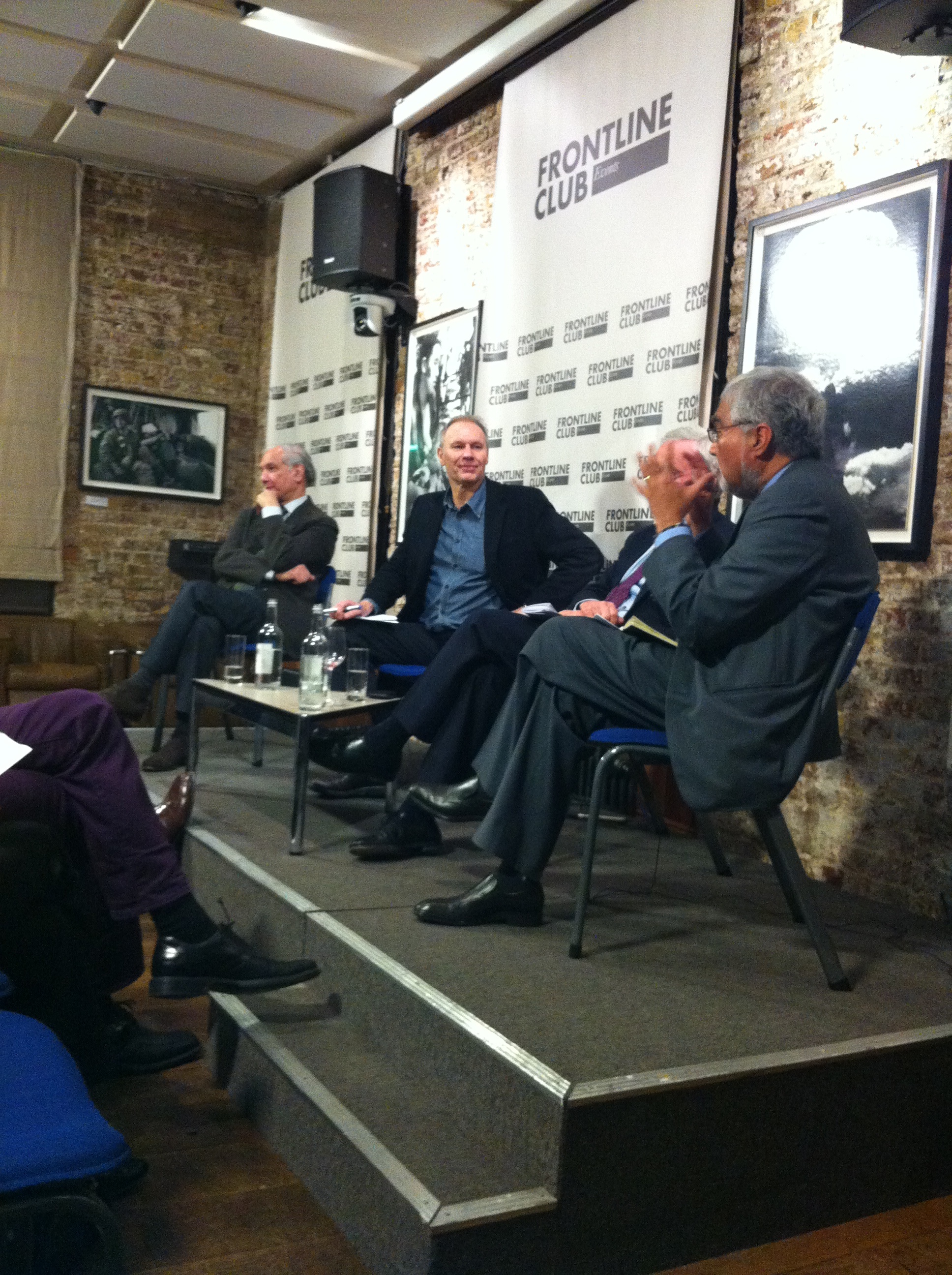
On Wednesday 18 November, Gulwali Passarlay enlightened a packed audience at the Frontline Club into his journey as an unaccompanied child refugee from Afghanistan to the United Kingdom. Joined by former Afghanistan correspondent for the BBC David Loyn, and Nadene Ghouri who co-authored his book The Lightless Sky, Passarlay was keen to address the complexities of the refugee crisis from both a personal and political perspective.
“My mother sent me away- she saved me but she lost me too”- @GulwaliP who left Afghanistan aged 12, running for his life (@frontlineclub)
— Maeve McClenaghan (@MaeveMCC) November 17, 2015
Loyn began the discussion by offering context on the current refugee crisis. “There are many Gulwalis in the world. Almost 60 million people are displaced, between 10 and 15 million people a year move from their homes and Afghanistan is the second largest country people flee from – 800,000 people are internally displaced.”
Passarlay began his journey when his mother paid smugglers to help him escape from Afghanistan after his father and grandfather were shot by US soldiers. “For a mother to decide to send her 12 and 13 year-old children away is extraordinary. I am sure she did not understand the implications and the dangers that I would face along the way. Neither did I,” said Passarlay. “Throughout my journey, my biggest issue and fear was uncertainty.”
Loyn asked Passarlay: “Why do you think your mother trusted your life with smugglers? And what was in it for the smugglers to keep you alive?”
“Smugglers need to maintain their reputation. The system of smuggling is more effective and efficient than the government! She was faced with a difficult circumstance, and through family friends she found a smuggler that was her only hope in giving her sons a better life,” answered Passarlay.
During the harrowing journey Passarlay was separated from his brother, which he referred to as a significantly traumatic experience. “My mother said to not let go of each other, but in Peshawar we were so quickly separated. For the rest of my journey, I had three things to do: I wanted to look for my brother, I needed to get across and I desperately missed home.”
Even arriving in Italy after a life-threatening boat trip from Greece, Passarlay was determined to get to England and find his sibling. “I am forever grateful to the people of Italy who genuinely wanted to keep me safe and welcomed and wanted to help me. But I had to find my brother.”
Responding to Loyn‘s question on why many refugees and migrants have their sights set on the United Kingdom as their final destination, Passarlay said: “I would have loved to have settled in Italy, but the language barrier was far too difficult. Whenever I talk to people from the right-wing, I tell them it’s a great thing for people to want to come to seek refuge in their country. Why? England embodies ideals of hope and opportunity; English is an international language and holds a historical and cultural connection to many countries thanks to the British Empire. But some also believe that Britain was involved in the conflict that exists in their country, such as Afghanistan, so migrants feel Britain has a moral responsibility to take them in.”
Passarlay concluded that he eventually managed to reach England and survive his journey thanks to fellow refugees, who have become his “brothers.”
“As the youngest, I needed help more than anyone. I tried not to show my innocent side, so I acted tough and put on a brave face – but this was not the case. The thousands of people I met were all literally in the same boat as me. We needed each other’s companionship and partnership.”
Loyn then directed the discussion towards Passarlay‘s difficult journey into Greece by boat, when his vessel almost didn’t make it. “Hearing that 2,000 migrants sunk earlier this year kept me awake at night. I feel their pain. I know exactly what they are going through. We were stuck [in the overcrowded boat] for 49 hours.”
Speaking on her experience of writing The Lightless Sky with Passarlay, Ghouri said: “It was a privilege to work with him. The story of unaccompanied refugee children is one I have always wanted to tell, and Gulwali is amazing for deciding to give a voice to many others who have been in his situation.”
@frontlineclub thank you for giving us the opportunity to have this evening' event for #TheLightlessSky it was great pic.twitter.com/8iJKOtqKSZ
— Gulwali Passarlay (@GulwaliP) November 18, 2015
In response to a question from Loyn on his advice for the Home Office, Passarlay commented: “What we are doing right now is not enough.”
An audience member from the Office of the Children’s Commissioner for England commended Passarlay for his courage in reporting his story, and said that his book should be used by the Home Office as a guide into how to better process unaccompanied child refugees. The audience member said: “I believe that things have gotten worse since you made your journey Gulwali. My organisation has churned numbers and figures to notice that since December 2014 to March 2015, over half of unaccompanied minors have their age disputed… Local authorities need to rise to the challenge.”
Ghouri agreed that the response to the refugee crisis by both the government and the media had been far from acceptable. “The British press do not report the full picture on the migrant crisis, so people in this country do not understand what is happening. There are only 3,000 people in Calais, but the press makes it feel like there are much more.”
More information about The Lightless Sky is available here.
]]>
Florian Schewe
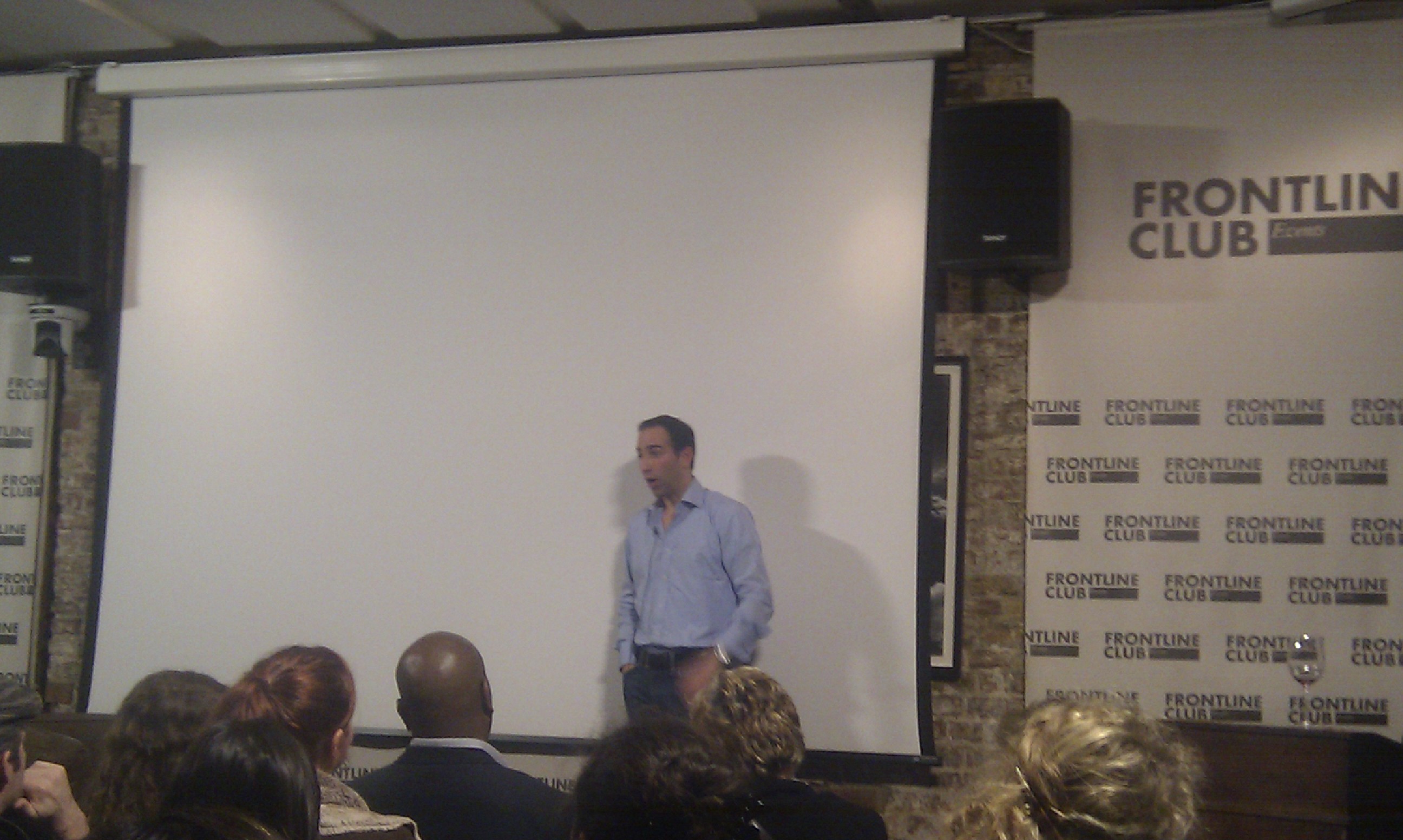
On Friday 10 April, the Frontline Club hosted a screening of We Were Rebels, which was followed by a Q&A with director Florian Schewe. The film focuses on the struggles of South Sudan, the word’s youngest country, following its independence and through the eyes of Agel, a former child soldier during the civil war. Agel was able to flee Sudan and become a professional basketball player in Australia. On his return to South Sudan following independence, he joined his national team as captain and, after injury forced him into early retirement, focused on helping to build the country through his new development NGO.
We Were Rebels was well received by the Frontline Club audience, with many wanting to know about the film’s key protagonist, Agel. The former child soldier, portrayed as an active and patriotic member of his community, was optimistic about the future of his new country but also reflective on its shortcomings and limitations.
Schewe explained that he had met Agel in 2010, and had originally intended to include him, as captain of the new national basketball team, in a series of short films about South Sudan. When this project fell through, Schewe and co-director Katharina von Schroeder decided to work on a new documentary focusing solely on Agel.
Despite his height, Schewe told the audience that the project felt more like a collaboration with Agel rather than a standard protagonist/director dynamic; they saw “eye-to-eye” throughout. However, Agel was also very conscious of the power of the media in relation to the portrayal of the conflict in South Sudan, and was motivated by using the documentary as a “tool.”
Schewe also discussed the many restrictions and obstacles encountered during filming. The team were forced to apply for endless permits in order to film in South Sudan, and every visit to a new village or town involved a substantial amount of bureaucracy before filming could commence. As the country was still so new, many of the areas requiring administration were still being developed. Schewe also told Frontline Club audience members that the government and the “foundation of the society” in the nation were largely ex-military.
In response to a question on the general attitude towards former child soldiers, Schewe said that he encountered very little bitterness or resentment from general society towards the ex-military members of the government. The South Sudanese instead targeted their anger at the attacking North, and viewed the use of child soldiers as legitimate. Schewe said:
“Every family was affected. In the society there are now many ruptures. The current ruling party was once the rebel army and every powerful government person was once in the military. But there is no blame on the military for making them child soldiers, it is viewed by most as a just cause.”
However, much corruption remains within the government in South Sudan. An audience member enquired into the infrastructure of the government. Schewe responded that, unfortunately, he had been witness to huge amounts of corruption and that, due to the lack of resources and the difficult relationship with Sudan, the country remained underdeveloped.
We Were Rebels also highlighted the re-starting of violence in the young country. This was largely due to difficulties relating to oil, South Sudan’s main source of income, which was increasingly becoming inaccessible due to sanctions put in place by Sudan. Schewe ended the Q&A session by explaining that oil had since started to again be distributed, and that South Sudan had also begun talks with Kenya and China.
Click here for more information on the film and upcoming screenings.
]]>We Were Rebels tells the story of Agel, a former child soldier who returns to South Sudan to help build his country. The film accompanies him over a period of two years – from South Sudan gaining its independence in 2011 to the renewed outbreak of civil war in December 2013.
As a child soldier, Agel was taught to kill and lost almost all of his male relatives to violence. Later he managed to flee via Kenya to Australia, where he became a professional basketball player and returned to South Sudan a free man. As the captain of the national basketball team, he coaches his fellow teammates through their very first international match against Uganda. The conflicts within the team bear a striking resemblance to the political problems festering across the country.
When an injury forces Agel to leave the basketball team, he goes on to form an NGO that provides the country’s most remote areas with clean drinking water. His journeys give him time to reflect on his country – on how it was, how it is, and how he hopes it will be one day. Today, four years after gaining its independence, the world’s youngest nation is once again teetering on the edge of a precipice, as more than half a million people are fleeing the country. Agel faces the possibility of fighting as a soldier once again.
Directed by Katharina von Schroeder and Florian Schewe
Duration: 92′
Year: 2014
https://soundcloud.com/frontlineclub/first-wednesday-south-sudan
Fighting continues as delegations from South Sudan’s warring factions meet for talks in Addis Ababa, Ethiopia. The country, which gained its independence in July 2011, has seen at least 1,000 killed and 180,000 displaced since mid-December.
We will be joined by a panel of experts, journalists and aid workers to give you an up-to-date picture of what is happening on the ground and an insight into the divisions and tensions that have caused the conflict.
As fighting between supporters of President Salva Kiir and sacked deputy Riek Machar continue, we ask what the future holds for the world’s youngest country.
Chaired by Lindsey Hilsum, international editor at Channel 4 News and author of Sandstorm; Libya in the Time of Revolution.
The panel:
Heather Pagano joined Medecins Sans Frontieres/Doctors Without Borders (MSF) in 2008 and is currently the Regional Information Officer for East and Central Africa, based in Nairobi, Kenya. She has a special interest in South Sudan and recently returned from Juba.
James Copnall was the BBC correspondent for Sudan and South Sudan from 2009-12.. He is author of A Poisonous Thorn in Our Hearts: Sudan and South Sudan’s Bitter and Incomplete Divorce which will be published in March 2014. He has just returned from Juba.
Mukesh Kapila, CBE is professor of Global Health and Humanitarian Affairs at the University of Manchester. Previously he was Under Secretary General at the International Federation of Red Cross and Red Crescent Societies and the UN Resident and Humanitarian Coordinator for Sudan.
Thomas Mawan Muortat, is a South Sudan political analyst, with an interest in development, democracy and peace issues. He has lived in the UK since 1984, and has travelled back and forth to South Sudan since 2008.
]]>https://soundcloud.com/frontlineclub/gino-strada-in-conversation
Since Italian NGO Emergency was established in 1994 it has provided free, high quality health care to more than 5,200,000 victims of war, landmines and poverty.
Founded by Gino Strada and a group of colleagues, Emergency has now worked in 16 countries, building hospitals, surgical centres, rehabilitation centres, paediatric clinics, first aid posts, primary health clinics, a maternity centre and a centre for cardiac surgery.
It is with great pleasure that we welcome Gino Strada to the Frontline Club, where he will be talking to photographer Giles Duley about his life and work as a war surgeon and founder of Emergency.
Gino Strada graduated in medicine and trauma surgery from the University of Milan in 1978. In 1988 he decided to apply his surgical experience to helping and treating war victims. From 1989 to 1994 he worked in war zones across the world from Ayacucho, Peru to Kabul, Afghanistan, with the Geneva-based International Red Cross. The experience accumulated from years of war surgery made him realise the need for a small, agile, highly specialised medical organisation and in 1994 with few resources he and a group of colleagues founded Emergency.
Giles Duley worked for 10 years as a fashion and music photographer before becoming an accomplished humanitarian photographer. His work has been exhibited and published worldwide in many respected publications including Vogue, GQ, Esquire, Rolling Stone, The Sunday Times, The Observer and the New Statesman. In 2010 he was nominated for an Amnesty International Media Award and was a winner at the Prix de Paris in 2010 & 2012. His self-portrait was selected for the 2012 Taylor Wessing Exhibition at the National Portrait Gallery. In 2011, whilst on patrol with 75th Cavalry Regiment, United States Army in Afghanistan, Duley stepped on an improvised explosive device. He was severely injured, losing both legs and an arm.
]]>By Nicky Armstrong
Last night’s event at the Frontline Club saw a heated debate between the expert panel and the audience on the UN’s presence in Darfur. Chaired by Patrick Smith, editor of Africa Confidential, the discussion bought up many of the tangled complexities surrounding the conflict in Darfur. With the recent expulsion of the former UN head in Sudan and tensions rising in the Nuba mountains the UN has come under scrutiny, charged with failing the people of Darfur.
The discussion opened with Sir John Holmes, a former British diplomat and UK ambassador for France and Portugal. He claimed the UN had been given an impossible task dealing with a political system that was obstructing the UN, recounting the situation when he first arrived in Sudan:
“There were still regular attacks on villages by the Janjaweed, there was tribal fighting of different kinds, occasional rebel attacks form these forces and a very unstable security situation…the overall security situation was stuck, it wasn’t really moving, it was stagnant, there was no real progress and frankly it stayed that way throughout my time and its pretty much the same way now.”
Dr. Mukesh Kapila CBE went on to discuss the failures of not only the UN but of a collective failure on behalf of the international community:
“My journey did not start in 2003, it began exactly 10 years before in Rwanda…and there I saw for myself what happens when an international response system basically implodes because there are contradictions…if there is a failure it is a collective failure…this is all extremely relevant to why we failed in Darfur…. all the lessons of enquiry on Rwanda which were big enquiries of the system and produced a big report, all of [these] were forgotten.”
The deafening silence from the UN and lack of response to memos was described as an ‘amnesia’ from the very top as they remained seized up on the matter of Darfur.
Dr Ahmed Al-Shahi offered his opinion on why the UN has failed. When asked who was the principal author by an audience member, Al-Shahi went on to describe a number of factors, but it was apparent that a lot of the problems lay with the political system under President Omar Al-Bashir and his regime in Khartoum.
China’s involvement in Darfur and why the UN is not reacting as it has recently in Libya were just some of the issues raised. It seems the issue of Darfur shall remain complex, with the situation not reflecting well on the UN.
Mukesh made a poignant closing statement:
“The UN should honestly admit its failure and its paralysis, for the reasons we have been debating. But it’s a mother bearing child relationship, you can’t make yourself redundant, what it should not do is be false prophet, launch misleading missions, which distract and bring false hope…I think we should be honest, that’s what I am saying and I think the UN is bound to fail…we are talking about the 21st century with twitter and globalisation and we are dealing with an instrument that I think is a relic to the Second World War, and conflict after conflict it has proven that it can’t succeed.”
Click Here to read the Amnesty International 2011 Sudan report.
]]>
Join us at the Frontline Club to discuss the actions of the UN and whether they are still failing Darfur.
]]>https://soundcloud.com/frontlineclub/nine-years-on-is-the-un-still
Since the start of the 2003 conflict in Darfur, questions have been raised about the role played by the United Nations and the viability of its mandate.
With the recent expulsion from Chad of the former UN head in Sudan during the original outbreak of violence in Darfur, and the crisis edging towards its first decade, is there any more that the UN can do? Or has the situation reached a level that is beyond resolution?
After the UN came under fire for not having done enough to help civilians during recent attacks, we will be discussing how the enduring situation in Darfur reflects on the UN.
Join us at the Frontline Club to discuss the actions of the UN and whether they are still failing Darfur. What could be done to reduce the possibility of future failures?
Chaired by Patrick Smith, editor of Africa Confidential.
With:
Dr. Mukesh Kapila CBE, former Under Secretary General, National Society and Knowledge Development for the International Federation of Red Cross and Red Crescent Societies based in Geneva. He has worked extensively in the Sudan where he was previously UN Humanitarian Coordinator and UNDP Resident Representative. He is Special Representative for The Aegis Trust.
Sir John Holmes, a British diplomat for over 30 years, serving as the UK’s Ambassador to France and Portugal, and as Overseas Adviser to both Tony Blair and John Major when Prime Minister. He was Under-Secretary-General for Humanitarian Affairs and Emergency Relief Coordinator at the United Nations in New York from 2007-2010, and visited Sudan five times during that period. He is now the Director of The Ditchley Foundation.
Dr Ahmed Al-Shahi, Research Fellow and Co-founder of the Sudanese Programme at St Antony’s College, Oxford University.
In association with the Aegis Trust.
Image Credit: Babasteve / Flickr
]]>
By: Ivana Davidovic
When the United Nations was founded after World War II it embodied the world’s hopes for a more peaceful and just world. Since it’s noble founding, wars and human rights abuses have continued unabated, throwing a spotlight at the UN’s role in keeping the peace and building a fairer world for all.
Has the UN managed to stick to its founding principles?
The US documentary maker Ami Horowitz went on a search for some answers in his harrowing and sometimes darkly humorous documentary U.N. Me.
Featuring interviews with with former U.N. ambassador John Bolton, former CIA Director James Woolsey, former U.N. weapons inspector Charles Duelfer, Nobel laureate Jody Williams, and others, U.N. Me exposes incompetence, denial and corruption at the highest levels of the organisation.
From the corruption-tainted Oil for Food Programme in Iraq to the catastrophic and deadly unwillingness to intervene in Rwanda and Darfur, Horowitz portrays the UN more as a clubhouse for the dictators and tyrants who sit on its various Councils, than the world’s most distinguished humanitarian organisation.
Not everyone at the Frontline Club’s screening agreed with Horowitz’s analysis and the author was subjected to some vigorous questioning during the Q&A session.
One member of the audience likened Horowitz to Ali G, the satirical character invented and performed by Sacha Baron Cohen, wondering whether it would have worked better to adopt a more serious approach when questioning, for example, a Sudanese Ambassador.
Horowitz responded:
“Politicians are trained to avoid the questions directly or just to lie. He spent about five to seven minutes talking about nothing relating to the questions, I had unusable video. I would have loved to have made a straight up documentary of real power all the way through, but I am a slave to the market and the market wants something a little bit comical at times.”
There was also strong criticism from another member of the audience who dismissed the film as a “US-Republican pro-Israeli critique of the UN – a piece of propaganda,” that did not focus sufficiently on Israel or America.
Horowitz defended his editorial decisions, however:
“When you weigh the problem of Israel, he UK and the US with what Sudan, North Korea and Iran are doing, I think it is a fairly simple conclusion who’s worse. These are some of the worst players. These are evil governments. North Korea – it’s a gulag. Would you not agree with it?”
Several current and former UN workers among the audience were more positive about the film. Responding to suggestions that there should be more detailed analysis of why the UN behaved the way it did and possible solutions, as well as an examination of the “total immunity and impunity as UN staff are outside of all national laws,” Horowitz said:
“We made a difficult decision not to talk about the solutions, for several reasons. You make a 90 minute movie and you can’t give that sort of a subject 15 minutes at the end. We tried and it sounded trite.
I want people to feel empowered, upset and to come up with their own way of solving the problem.
I am very much split. I am not one of those who calls for eradication of the UN. I think it should pursue the vision and the values from its charter."
]]>
Once a year, the world’s leaders descend on New York for the UN’s blue ribbon event, the cumbersomely-titled UN General Assembly’s General Debate.
This year, the build-up has been dominated by the Palestinian Authority’s planned bid to become the 194th member of the UN, following South Sudan’s incorporation earlier in the year.
Notwithstanding any last minute deals, Palestinian Authority President Mahmoud Abbas will personally submit the application to Secretary-General Ban Ki-moon on Friday, September 23, after Abbas has delivered his speech to assembled leaders.
Indeed, Friday’s session is set to be a cracker, since it also features Israeli Prime Minister Benyamin Netanyahu’s speech, in which he must surely address the issue. And yet while the Palestinian membership-issue is grabbing all the headlines, there’s plenty of other highlights.
Ahead of the formal UNGA opening today, there was a high-level meeting on Libya yesterday, the first since the UN formally recognised the Transitional National Council as the official representative of Libya last Friday.
US President Barack Obama met privately for the first time with TNC Chairman Mustafa Abdel Jalil, and held separate summits with President Hamid Karzai before he returned to Aghanistan to join the mourning of the assassinated leader Burhanuddin Rabbani.
Tuesday also saw French Foreign Minister Alain Juppe host a ministerial-level meeting of the so-called Deauville Partnership, a G20-offshoot dedicated to supporting fledgling Arab democracies.
The Debate kicks off today with an address by the Brazilian President, the first for Dilma Rousseff since she took office in January and no doubt a welcome relief from domestic troubles.
A notable absence, though, is Russian leader Dmitry Mevedev, who has chosen to delegate responsibilities this year to Foreign Minister Sergey Lavrov.
In the afternoon South Africa’s Jacob Zuma will be speaking. On Thursday morning, Mahmoud Ahmadinejad gives his traditionally polemical speech (who can forget last year, when he alluded to the 9/11 attacks being a conspiracy). British Prime Minister David Cameron also speaks that session.
Highlights from the afternoon session on Thursday include an inaugural address by newly-elected Peruvian President Ollanta Humala, an address from ageing despot Robert Mugabe, and also remarks from Turkish Prime Minister Recep Tayyip Erdogan, whose star is in the ascendancy amid Turkey’s role in the Arab Spring.
On the sidelines that day, UN Secretary General Ban Ki-moon is hosting a UN High-Level Meeting on Nuclear Safety and Security, likely to focus significantly on lessons to be learned from the crisis at Japan’s Fukushima Daiichi plant back in March. Friday, as we’ve seen, is all about the Palestinian-membership issue.
But in the morning there is also a first-time address from new Japanese Prime Minister Yoshihiko Noda , who is expected to put in appearance also at the nuclear safety meeting. That afternoon South Sudanese President Salva Kiir – who meets one on one with President Obama earlier in the week – will give his country’s address for the first time since it became member number 193 last July
Sadly, one of the traditionally more entertaining speakers – Venezuela’s Hugo Chavez – is not expected to make the journey to New York this time, as he is recovering from a fourth round of chemotherapy for cancer discovered earlier in the year.
]]>https://soundcloud.com/frontlineclub/focus-on-sudan-what-does/s-w2jPO
Salva Kir is to lead South Sudan into independence on the 9 July after a landslide referendum earlier this year where 99% of the South voted to secede from the North. But with relations still tense over disputed border regions of Abyei and the surrounding area, what does the future hold for North and South alike?
With Northern Sudan’s President Omar al Bashir wanted by the ICC for war crimes and the vast majorities of NGO’s being based in the south, will the North even recognize its legitimacy? Will this be the real start of peace, or will it merely be the start of another land grab explosion by the North?
Analysts fear that the South will become a failed state before it has even had a chance at success. With little to no public services and foreign aid being the main source of food, the South stands in a precarious position and faces an up hill struggle.
Join us at the Frontline club with a panel of experts to discuss what the future holds for North and South Sudan – will this be the start of peaceful beginnings and economic prosperity for both? Or will fraught relations win out again?
Chaired by Richard Dowden, director of the Royal African Society. He was Africa editor of The Independent from 1986 to 1994 before being appointed Diplomatic Editor, and then joining The Economist as their Africa Editor. Author of Africa: Altered States, Ordinary Miracles.
With:
Lindsey Hilsum, Channel 4 News’ International Editor.
Dr Ahmed Al-Shahi, Research Fellow and Co-founder of the Sudan Programme at St Antony’s College, Oxford University.
Natznet Tesfay, head of Africa Forecasting at Exclusive Analysis Ltd. Prior to joining Exclusive Analysis she worked in the field of urban development, consulting for municipal governments in the Middle East, Asia and Latin America.
Mohamed Abdalla Ali Eltom, Deputy Head of Mission at the Embassy of the Republic of Sudan in London.
Picture credit: fieldreports
]]>