
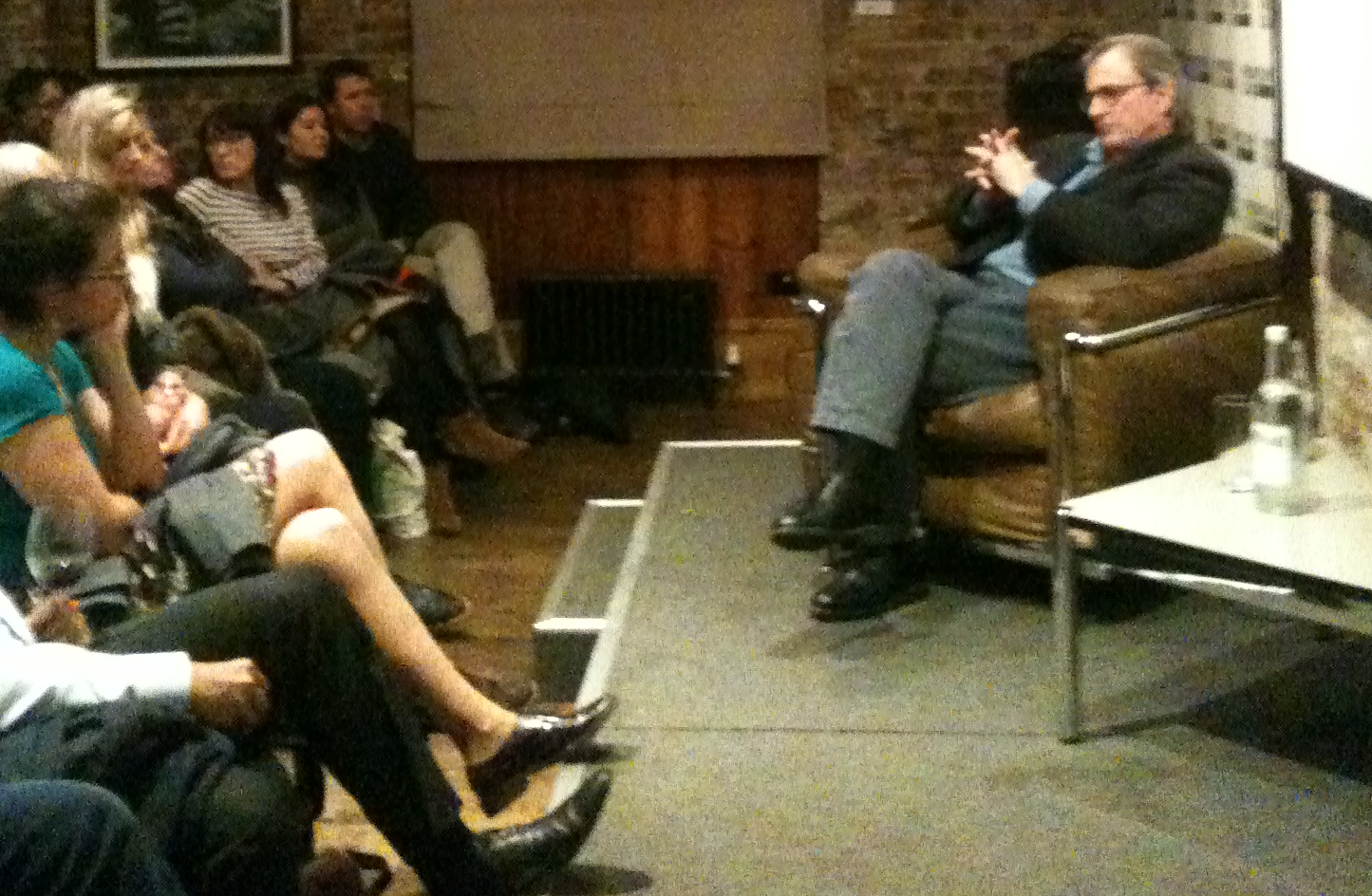
On Thursday 18th April at the Frontline Club, authors Irina Prokhorova and Oliver Bullough talked about their experiences of Russia which have informed the research and writing of their two very different books.
Prokhorova’s book 1990: Russians Remember a Turning Point charts the missing year after 1989 when the Soviet empire fell apart and before 1991 when the Soviet Union was formerly dissolved.
“The close study of this period showed that all genesis of new life, just grew out of 1990. With its best achievements and worst [ . . . ] my idea was to show [ . . . ] this point of growth, the potential of the society of which probably we still don’t know enough.”
Anne Applebaum, Pulitzer Prize winner and most recently author of Iron Curtain: The Crushing of Eastern Europe 1944-56 , who was chairing the event, said that it felt that on reading the book one of the most notable points was how teachers were inspired to be creative with their curriculums. Prokhorova responded:
“I expected to find it but I was amazed how many things have been created at that time [ . . . ] we always underestimate the creativity of our own society [. . . . ] Somehow started in this period the whole basis of new life was created.”

Irina Prokhorova
While Prokhorova‘s book charts the lives of both ordinary and elite Russians at the fall of communism through interviews and documents of the time, Bullough‘s book, The Last Man in Russia and the Struggle to Save a Dying Nation, follows the story of an Orthodox Priest named Father Dmitry who throughout the sixties tried to combat the alcoholism that was commonplace throughout Russia. Bullough said:
“He attempted, in a small way because he was one man and this is a very large country, to create an alternative community in which people could trust each other [ . . . ] His theory was – and I think he was right – that the nature of a totalitarian society is that it can only survive by breaking down the bonds of trust between individuals.”

Oliver Bullough and Anne Applebaum
“So many of the dissidents, Marchenko or Sakharov…they are authentic heroes. Cast iron, 100% astonishingly brave, wonderful people and when you read about them it is inspirational. Father Dmitry is as it turns out not quite like that. In a totalitarian society heroes are a vanishing small minority; most people have to compromise. For whatever reasons, to get ahead, to get married or to get a job or to get a drink – to get anything. And once you compromise it’s difficult to stop. That is why I wanted to write about him.”
Prokhorova added:
“They have to compromise to save their lives and their loved ones.”
In contrast to Prokhorova‘s optimistic view of society flourishing throughout 1990 and hopefully into the future, Bullough offered a different opinion:
“The protests against Putin are a sign of a growing society and people are beginning to trust each other in a way that they weren’t before [. . . . ] However, the damage that has been done by vodka is so awe-inspiring. The UN estimates that the population by the middle of the century will be 116 million – it’s currently 143million. That’s a drop of about the population of Canada.”
Prokhorova added later on:
“Liberating yourself from the most horrific regime is a very painful process. You have to do quite a lot of things: psychologically, intellectually, practically. It’s very difficult to create this social fabric, I can assure you, for 20 years I’ve been trying to do it. The whole idea of survival was an individual thing [. . . . ] You have to teach people and you have to teach yourself too. We need a span of time.”
To which Bullough voiced his concern:
“There is a risk that people will become disillusioned and leave. This is something that the Soviet Union didn’t have – that it was very difficult to leave [. . . . ] The book does end in a relatively upbeat way. I’m encouraged that the new Soviet generation is much more socially active than I think I realised.”
Listen to Irina Prokhorova on how the Russian government should approach society in the future:
Watch the full discussion here:
 "He was there!" Director Thomas O’Connor said of English author and journalist Graham Greene (1904-1991), the subject of his documentary Dangerous Edge: A Life of Graham Greene, which was viewed by a full house at the Frontline Club on 1 October.
"There, you know, for 70 years, from one place to another, in these hot spots."
Greene – whether meeting with the Pope, giving a speech to Gorbachev’s Kremlin, conversing with Latin American rulers, or journeying in the 1930s through the hinterlands of Mexico or Liberia – had his finger on the very pulse of the 20th century: its crimes of foreign policy, the inner angst of its inhabitants.
In his own life, Greene left his wife and two daughters early on, indulged in drugs, prostitutes and affairs, suffered from bipolar disorder, and fought powerful suicidal urges, often admitting to his own yearning to die.
"Dear Vivien," he wrote to his wife, "the fact that must be faced, dear, is I have been a bad husband. You see, my restlessness, moods, melancholia, even my outside relationships, are symptoms of a disease, not the disease itself. Unfortunately, the disease is also one’s material. Cure the disease and I doubt whether a writer would remain."
"He was a tremendously courageous writer and journalist," O’Connor reflected, sharing that a driving motivation to make the film was that he "worried about journalism [today]," that future generations would lack voices as brave and voluminous as Greene’s.
"Some writers write their novels," O’Connor said, "and then every once in a while a letter to the Editor. Greene had a whole book of letters to the Editor!"
His eyes searing with intelligence and sensitivity, Greene asked readers to see more deeply into the world around them. He challenged the injustices of big business, globalization, Soviet totalitarianism, and British and American interventionism.
"I would go to any lengths to put my feeble twigs into the spokes of American foreign policy," Greene wrote.
His 1955 novel The Quiet American paired the damage done by a naive American idealist with that by a cynical English journalist like himself, both living in Saigon and desiring the same Vietnamese woman. The work so touched a nerve that, as O’Connor highlighted, even George W. Bush could not help mentioning it in a 2007 speech to American war veterans.
O’Connor wished Greene had been alive to challenge the narrative that led to the latest invasion of Iraq.
]]>"We still need writers," he argued, "as [Greene] famously said, ‘with a sliver of ice in their heart,’ and willing ‘to be a piece of grit in the state machinery.’"