
The young Harvard-educated economist Miklós Németh didn’t dream he would play a decisive role in the fall of the Berlin Wall when he was appointed Prime Minister by Hungary’s Communist Party to fix the nation’s finances in late 1988. Only a year later he was at the centre of it all.
On Wednesday 5 November, the Frontline Club tuned in to the world premier of 1989, a new documentary by Anders Østergaard detailing the months and days of Németh’s tense political manoeuvring that precipitated demolition of the wall, as it was shown in 57 cities across Europe during the 2014 Copenhagen International Documentary Festival (CPH:DOX).
Stitching together archival footage seamlessly with reenactments of behind-the-scenes political moves, 1989 shows how Németh’s decision to dismantle one of the biggest drains on Hungary’s budget – a 240 kilometre-long electrical fence bordering Austria – reverberated through the former communist block. Just months later, tens of thousands of East Germans were scrambling across the divide.
Post-screening, Németh joined Danish Broadcast Corperation news anchor, Lene Johansen; professor and EU analyst, Lykke Friis; Senior Advisor to the European Policy Centre, Hans Martens; and former Prime Minister of Denmark, Poul Nyrup Rasmussen, to reflect on 25 years of changes his decisions brought to Europe.

Continuing Conflict
The continuing conflict between Russia and Ukraine was at the top of the agenda. “I am a great believer in dialogue and compromise. That is the way of finding your way out of a difficult situation,” Németh said of the fighting, adding that his good rapport with Mikhail Gorbachev helped guide him through difficult times.
“Putin is not stupid. I don’t like seeing a comment or an article in the paper that now we’re facing Cold War number two. This is not cold,” Németh said. “Last month Ukraine, Russia, and the EU signed a very important contract on the gas supply. So dialogue, dialogue, dialogue.”
What we’re seeing in Russia is a generation of people who never really accepted what happened in 1989, added Hans Martens. “I think they’re striking back now,” he said. “It’s not just about Ukraine and Crimea, it’s also about trying to reestablish a kind of Soviet Union or at least an empire like that. So dialogue is very good.”
Find out more about 1989 on the film’s website, where director Anders Østergaard will answer questions submitted by audiences from audiences all over Europe participating in this simultaneous screening.
]]>
For 12 years, Oleg Klimov documented the disintegration of the Soviet Union. Throughout the 1990s he witnessed almost all the conflicts and ethnic tensions of the region. His photographs appeared on the front pages of many Western newspapers, silent witnesses of conflict in the former Soviet Union.
Personally affected by his experiences as a war photographer and longing for inner peace, Klimov returns to some of the areas he photographed during wartime: Nagorno-Karabakh, Abkhazia and Chechnya. Director Masha Novikova follows Klimov on this journey, combining his memories with the stories of the people he photographed at the time.
Directed by Masha Novikova
Duration: 83′
Year: 2013
On Friday October 12, the Frontline Club hosted the UK Premiere of 900 Days, followed by a Q&A with director Jessica Gorter, and Anna Reid, author of Leningrad: Tragedy of a City Under Siege 1941-44.
The documentary looks at different perspectives on the blockade of Leningrad (1941-1944) during which approximately one million people died due to starvation and sub-zero temperatures. By interspersing footage of present day Victory Day parades with personal accounts from survivors, Jessica Gorter’s film illustrates the discrepancy between the different narratives surrounding the blockade:
"Survivors often hold two different narratives in their heads."
Explained Jessica Gorter, referring to the Soviet triumphalism which can still be seen reflected in today’s parades and government rhetoric, and to the memories of survivors, which in many cases are too painful to share.
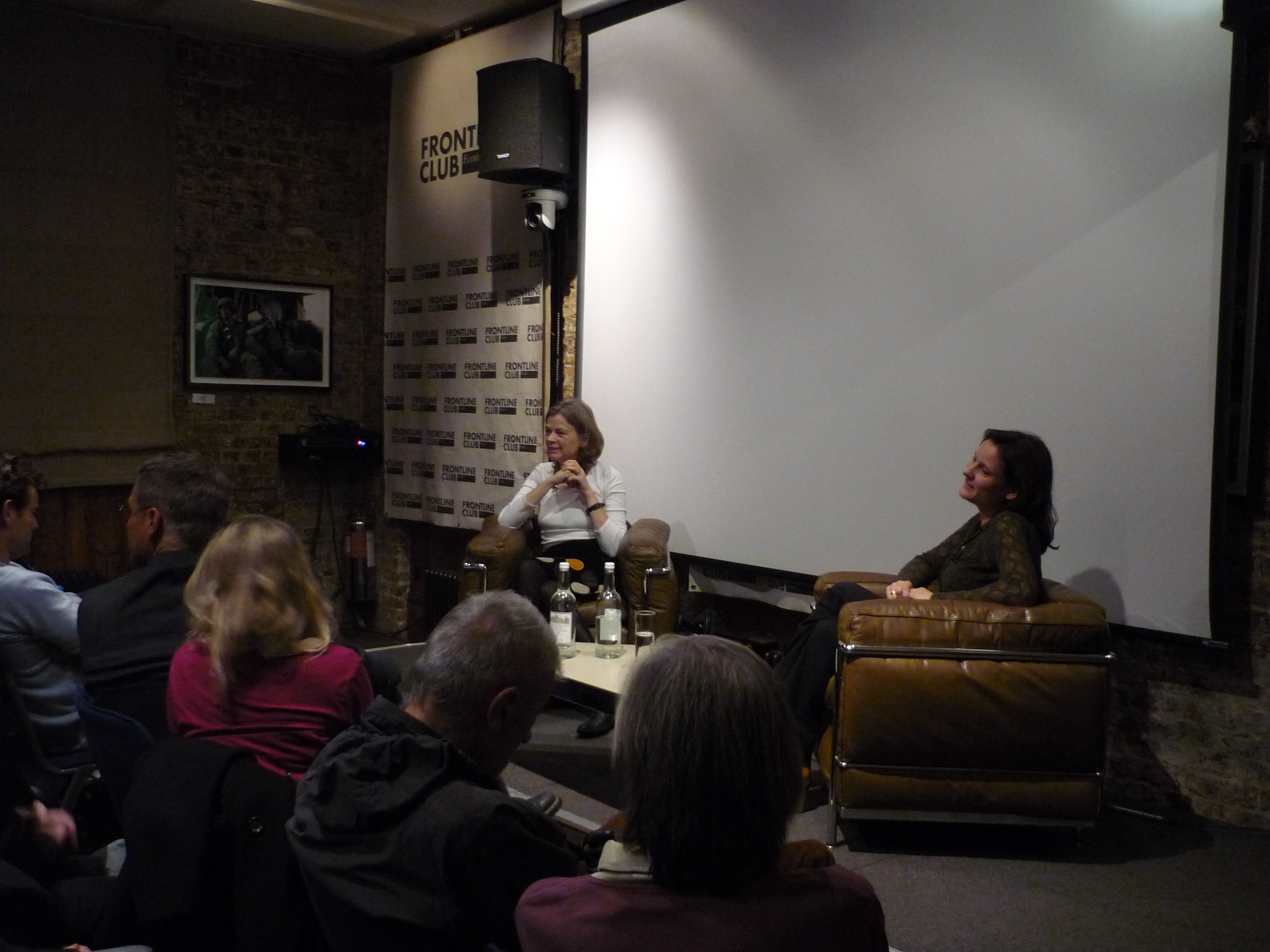
"I was on a journey because I was trying to figure out, I mean I didn’t understand this enormous contrast that I encountered between the world version and the stories that people actually started telling me. That’s what triggered me to make the film, and this journey is what the film is about."
"When British historians started writing for the first time about the looting of bombsites during the blitz, about crime during the blitz and the black market, about collaboration in the occupied Channel Islands – that was very uncomfortable. That didn’t happen for a long time after the war, … so this isn’t just a Russian thing, rewriting the war. But in Russia you have … decades of censorship so it’s more acute."
Anna Reid was quick to point out that the film sought to explore:
"How the siege has been remembered and how it has effected the survivors, it’s an analysis of memory rather than an analysis of the actual events of the siege."
Agreeing, Jessica Gorder added:
"Then at least you leave room for the people themselves."
Despite the film being currently barred from Russian TV by companies who are nervous of causing offence, 900 Days is so far creating an opportunity to provide this ‘room’ off screen as well as on it by starting new conversations with the next generation:
"It’s very difficult to have normal discussions about it [the Leningrad blockade]. Which is why it was really special when this premier happened in St Petersburg because all of a sudden the discussions started. There were a lot of young people, I was really surprised, … and they also were in tears afterwards telling me that they didn’t know about it."
For a taster of the film watch the trailer:
]]>
900 Days is a haunting documentary about a tragedy that took place 70 years ago in Russia during the blockade of Leningrad. From September 1941 to January 1944, the German army had Leningrad under siege with nearly three million inhabitants were trapped inside the city. During these 900 days approximately one million lives were lost due to mass famine and subzero temperatures.
Through old letters and diaries, survivors recall what life was like in this period and dismantle the myth created by Stalin. For decades they were not allowed to talk about the siege to prevent the undermining of the ‘the land of victors’ illusion, a myth now being revived by President Putin.
Director Jessica Gorter captures the distance between individual memory and the way history can be exploited by politics. She shows how censorship, propaganda and fear can get a grip on people’s memory.
Directed by: Jessica Gorter
Year: 2011
Running Time: 77′
Awards:
Prize of the Interreligious Jury, Visions du Reel 2012
Special Jury Price, ArtDoc 2011
Best Dutch Documentary, IDFA 2011
In the 1930’s Welsh journalist and foreign correspondent Gareth Jones’ greatest scoop was to reveal the starvation to death of millions in Ukraine, caused by Stalin’s policies. In the political reality of those days of competing ideologies there was a fine line between journalism and spying. Hitler, Stalin & Mr. Jones explores to what extent Jones’ own dual role may have contributed to his early death.
Filmmaker George Carey follows Jones’ footsteps through the former Soviet-Union, Wales, China and finally inner Mongolia. A portrait emerges of a fiercely bright young man who preferred a journalist’s life of courage and danger over that of an academic in his homeland.
Hitler, Stalin & Mr. Jones is a fascinating investigation of Jones’ life through his own elaborate notes, letters to his parents cleverly formulated as not to rase suspicion among the Soviet sensors, and recently released secret police files.
Director: George Carey
Duration: 80
Year: 2012
This screening is in partnership with BBC Storyville, the BBC’s international feature documentary strand.

In the 1930’s Welsh journalist and foreign correspondent Gareth Jones’ greatest scoop was to reveal the starvation to death of millions in Ukraine, caused by Stalin’s policies. In the political reality of those days of competing ideologies there was a fine line between journalism and spying. Hitler, Stalin & Mr. Jones explores to what extent Jones’ own dual role may have contributed to his early death.
Filmmaker George Carey follows Jones’ footsteps through the former Soviet-Union, Wales, China and finally inner Mongolia. A portrait emerges of a fiercely bright young man who preferred a journalist’s life of courage and danger over that of an academic in his homeland.
Hitler, Stalin & Mr. Jones is a fascinating investigation of Jones’ life through his own elaborate notes, letters to his parents cleverly formulated as not to rase suspicion among the Soviet sensors, and recently released secret police files.
The screening will be followed by a Q&A with director George Carey moderated by Nick Fraser, editor of BBC’s documentary strand Storyville.
Director: George Carey
Duration: 80′
Year: 2012
]]>