On Friday 16 January, the Frontline Club was at full capacity for an evening that showcased the diverse faces of documentary filmmaking, both journalistic and poetic. The documentaries screened offered snapshots into five very different worlds, allowing the audience to glimpse the lives of remarkable individuals in addition to illuminating pressing issues, such as female genital mutilation and the rise of ISIS in Syria.

Shorts at the Frontline Club
Chappin’
“I don’t really know what came to kickstart it, it just kind of … seemed to happen,” says 17-year-old schoolboy Liam McLaughlan as he attaches a sign advocating Scottish independence to a lamppost.
“You look around an area you come from – things like that – that’s where the desire for change really starts, and then it kind of spots out.”
A resident of Glasgow’s infamous Easterhouse Estate, Liam is determined that Scottish independence is what his area desperately needs in order to tackle the ongoing political neglect of the poor and underprivileged.
Director Igor Slepov tenderly captures the pride and determination of a young man whose political campaign is passionate and deeply personal.
Central Station Sofia
The biggest railway station in the Balkans today resembles an empty shell. Built during the years of socialism, it was once a hub of activity with twenty staff members employed to provide for its commuters. Today only three remain, and its sense of abandonment echoes the current economic instability in Sofia.
“The restaurant and café were always full,” says a station worker as the camera pans across an empty cafeteria.
Fragments of the workers’ lives are shown, interspersed with shots of a near-deserted station hall. A lady selling lottery tickets says, “Everyone is hoping to win a million so they can go to a warm country and never come back here.”
Despite the bleak subject matter, Central Station Sofia, directed by Alberto Iordanov, is not free from humour. The film includes a shot of a solemn-faced man standing behind a counter who announces, “My name is Georgi Zarev and I run the station gun shop (…) I love cars and guns like every boy”.
Syria’s Second Front
In this short documentary, reporter Muhammed Ali crosses into Syria in order to document a violent new phase of the civil war. Ali travels with fighters from the Free Syrian Army, whom he films at their base as they prepare to battle jihadist militant group ISIS.
“It’s very important for me to tell you what’s happening on the ground; no Western media can get in,” he says, conscious of the significant risk he is undertaking by entering the country as a journalist.
Ali persuades rebels to sneak him into the northwestern town of al-Atareb, which is under the control of the so-called Islamic State. He returns with footage of an ISIS rally in the town square, at which fighters are pledging their allegiance to global Jihad. The film shows ISIS members joining hands and repeating, “I pay homage to ISIS, to listen and obey, God is a witness to what we are saying. Praise God, God is the greatest, praise God.”
Godka Cirka (A Hole in the Sky)
“My mother was a shepherdess too. She died when I was born. My auntie Sahra took care of me.” These are the words of young narrator Alifa describing life in the village of Beerato, Somaliland. She exposes her own vulnerability as she discusses her pending genital mutilation, “I will lie until the rainy season with my legs tied until I can walk again.”
Alex Lora’s powerful film looks at three generations of shepherdesses – Alifa, her aunt Sahra and grandmother Faadumo – as they deal with the daily struggles of poverty and water shortage.
The Orchard Keepers
As Cairo rocks with revolution, two Bedoiun tender their orchards in the brown Sinnai desert. The first, Amariya, has created a magnificent patch of green amidst the rugged bareness of the landscape. “Look how beautiful my garden is today”, she says, her eyes beaming above a black niqab. “Everybody thinks I’m crazy living in the mountains, but I am not crazy. I said to myself that I want to make a garden and to be free.”
The film, directed by Bryony Dunne, highlights the fact that during a time of political volatility in Egypt, and despite the difficulty in maintaining them, the gardens offer freedom and timeless stability.
The project is apparently funded by an unknown donor country and employs the services of Pierre Prosper, the ambassador-at-large for war crimes issues under the previous US administration and Michael Shanklin, who was the CIA’s deputy chief of station in the Somali capital 20 years ago.
The East African reported a link between Saracen and General Akandwanaho, nick named Salim Saleh, who is not only President Museveni’s brother but also a senior government advisor. This detail is of particular interest since Uganda heads AMISOM [African Union Mission in Somalia]. The African Union was also reportedly unaware of Saracen’s activities which could have serious security implications.
This is a promotional video available on YouTube showcasing some of Saracen’s products:
In a further development, a plane was seized at Hargeisa airport by the Somaliland authorities after apparently landing without authorisation. It was reportedly carrying military supplies en route to Puntland. Somaliland’s Interior Minister, Mohamed Gabose, told reporters the cargo plane was in violation of the international arms embargo on Somalia which was imposed in 1992 by the UNSC [United Nations Security Council].
Initially all eight crew members, six Russians and two South Africans were being investigated. The South African nationals were reportedly going to be charged with falsely posing as journalists. In a surprising twist, authorities in Somaliland have released the South African nationals. Deputy Attorney General of Somaliland Adan Hero-dhiiq held a press conference in Hargeisa in which he said there was no evidence against the two South Africans. He added the two were journalists working for an American television station. However, the Deputy Attorney General said the six Russian nationals will face prosecution.
Somalia though associated with conflict and humanitarian catastrophes over the last two decades has in fact vast resources of yet unexploited natural energy reserves including uranium. This makes the strategic Horn of Africa of economic as well as geopolitical value to competing interests, nations and corporations. Meanwhile plight of the 1.5 million internally displaced Somali refugees continues in the backdrop to the lucrative and secretive worlds of private security and conflicts.
]]>
The Somali passion for the ballot box was illustrated to me by the president of the university of Hargeisa (whose students are playing an important roll in election administration and logistics) who recounted to me a conversation he had had in the past with an electoral official in neighboring Ethiopia. The Ethiopian official explained that elections in his country were faced with two problems – a problem of the majority (the ethnically diverse Ethiopian population at large) and a problem of the minority (the ethnic Somalis of eastern Ethiopia). The problem of the majority was that so few people trusted the electoral system or even believed that they had a genuine right to vote. Given a cultural-political experience of hierarchical state power and repression from the centre many people to this day remain wary about voicing an opinion about any possible change in government. This problem of the majority had to be overcome by the Ethiopian electoral authorities who had to convince people that they actually had a vote. What was the problem of the minority, the Ethiopian Somalis? To convince them that they only had one vote…
Speaking to people here it often seems as though the ballot box is conceived of as a right, a duty and also a kind of comptetion. It’s not uncommon, for example, for people to show off proudly how many electoral ID cards they’ve managed to obtain and how many votes they anticipate on being able to cast. The Ethiopian anecdote illustrates how perceptions of the state, governance and popular participation are shaped by the histories and environments of different locations and the contrast between most of Ethiopia and Somalia/Somaliland is striking. Up until the closing stages of colonial rule and independence in the 1960s there was nothing even resembling a centralized state governing the far flung Somali people. The state that was formed on top of the pastoral and politically egalitarian society crumbled under the weight of its own contradictions and left a bitter legacy of violence and repression from which the north has been able to partially move on. A new form of micro-level state-formation is taking place in Somaliland, largely beneath the radar of official inter-state relations and patronage, and the election happening today is a reaffirmation of this ongoing process. Whatever the result, this long-delayed election is undoubtedly the most important which has taken place in Somaliland and the people of this young Republic will be awaiting in anticipation of the next stage of the competition. For today though, the roads are closed (to prevent large-scale clan mobilization and multiple voting), and the market is bizarrely quiet – everyone’s standing in line.
For pictures of the election and campaign see my photo journal
]]>With the date for
Campaigning on alternate days in the capital Hargeisa the parties pack their supporters in (and around and on top of) buses, four-wheel drives and sedans to tour the city and pack out the downtown rallies. It’s almost as though the presidency was being awarded to the party that can fit the most supporters and banners into already overflowing vehicles and drive in the most terrifying, death-defying fashion around Hargeisa’s pot-holed, goat filled roads. To an outside observer it sometimes seems as though the election campaign is serving as a welcome outlet for public celebration, complete with music and dancing, in an otherwise conservative society. There’s certainly a party atmosphere when the marches and rallies kick into motion, complete with hundreds of flag waving children and dancing women clad in custom made partisan coloured burqas. Indeed, the wanton-abandon of the political festival is drawing fire from the some of the mosques. As well as calling for a peace and vigilant approach to the election several Imam’s Friday sermons focused on the potential moral consequences of over-excited campaigning – women hanging out of the windows of cars driven by men was a particular target of the Imams’ ire last Friday (Geeska Afrika, Hargesia June 13).
In amongst the festivities it’s impossible however to forget how much is riding on this election for
The ‘internationally recognized’ Transitional Federal Government (the TFG) has remained quiet about electoral developments in the north, though many here believe that, whilst it remains battling for survival behind the barricades in Mogadishu, it retains an interest in seeing the election fail in Somaliland. This is an interest arguably shared by the ‘Islamist’ militia groups who appear to be extending their grip over even larger areas of south central
In the international forums of the ongoing Somali story the political process playing out in the northern breakaway
If the election taking place on June 26th passes off peacefully and produces a workable and generally accepted result then not only will this constitute another remarkable achievement in Somaliland’s ongoing political history but may alter the regional playing field and invite a re-evaluation of international engagement with the northern state. The cold realities of international relations aside this is certainly a dominant perception in the minds of Somalilanders who are preparing to go to the polls. The T-shirts of at least one of the parties are complete with slogans talking about ‘change we can believe in’ (I’m sure I’ve heard that somewhere before…) and whilst even a free and fair election or peaceful transition of power may not bring a fundamental change in Somaliland’s relationship with the world, there is no doubt that a lot of eyes will be looking this way come June 26th.
For pictures of the campaign see http://petechonka.wordpress.com
]]>
Word on the street, filtering out from the electoral commission, has it that the election will take place in June. The next word on the street has it that this may be a bit optimistic, though this now seems to be the timeframe emphasized by the electoral commission and its external supporting agencies. Interpeace, the leading facilitating international organisation has returned to Somaliland after their ignominious expulsion last year and is insisting that progress is being made to bring a democratic voice to bear on the prolonged tenure of President Rayaale and his UDUB party.
With a holiday being called in the national universities for voter registration purposes and plane loads of new registration cards arriving in Hargeisa the clock is most certainly ticking.
Political tensions which have bubbled beneath the surface in Somaliland are already showing some signs of eruption and two incidents have highlighted the potential for violence which exists when the three political parties flex their mobilizing muscles. Most recently violence has flared in Ceerigaabo in the east of Somaliland when groups of supporters from the president’s UDUB party and the opposition KULMIYE party clashed and pelted each other with rocks. One man was killed by gunfire coming apparently from the local police force (Saxafi News, May 8).
Around a month ago in Hargeisa a rather bizarre incident occurred between the government and the KULMIYE opposition when the minister for sports declared a football tournament organized by the party to be illegal and ordered its immediate halting. Players and supporters, ignoring the order, descended on the stadium and clashed with the police force. After the ubiquitous stone-throwing, one man was shot and wounded by the police. The local media reported the incident and a newspaper printed a copy of a letter apparently written by the Somaliland Football Federation authorizing the KULMIYE competition (Haatuf, April 13). This strange incident illustrates the undercurrents of tension which remain in a divided political system. Violence of this kind strikes a nerve in Hargeisa where the memories of the repressive force of the previous southern-based regime of Siyaad Barre are still important in the political discourse. Members of the other opposition party, the UCID, evoked this very history in condemning the steps taken by the sports minister and the wider Rayaale government (Saxansaxo, April 14).
It can be very easy to despair at the ‘democratic’ process in Somaliland especially when one considers the clan dynamics which define the party political landscape. Manifestos printed in the Hargeisa newspapers (which themselves generally refrain from even mentioning clan, thus giving a somewhat misleading impression of politics here) show little ideological or practical difference between the three sanctioned parties. Perhaps that isn’t a million miles away from the recently run-through British major party political spectrum although a fundamental difference exists in the logistics of organizing ‘free and fair’ registration for elections in a place like Somaliland where an accurate census has never been carried out. Democracy here is an unenviable task to be sure. The process is slow, painful and expensive – especially taking into account the biometric voter recognition and registration kit being currently rolled out in the hope of preventing voter fraud amongst a highly mobile population through porous regional and international borders. Money well spent? On one hand one can consider the unambiguous good of an at least partially transparent and participatory electoral system for the national psyche (as well as helping tick the boxes for democratic good governance of international donor priority lists). On the other hand it sometimes seems somewhat absurd to talk about effective and fair participatory democracy when considering the basic infrastructural deficiencies which still plague even the capital city: when it rains here it is often impossible to get from one side of the city to the other due to flooding, stranded vehicles and a lack of functioning or complete road bridges. Maybe a new government is what is required to push such infrastructural projects like Hargeisa’s second bridge out of the stagnation which has cost a great deal of money for so few visible results. Or perhaps the substitution of one group of elites for another will make little difference in these ongoing processes of shady political dealings, contracts for cronies and uneven development.
There’s another peculiarity here which overshadows the whole electoral process. This is the international community’s involvement (through organizations like Interpeace) in a national election for a nation that they do not recognize as being independent or sovereign. Whether this matters at a practical level – given Somaliland’s development since 1991 without external recognition – is unclear, though it certainly does throw into light the territory’s anomalous context and the contractions which exist between the funding priorities and diplomatic geopolitics played out by the international community in the Horn of Africa.
Regardless, the timeframe is set and the clock is ticking. The danger remains however that given the level of external assistance anything that goes wrong with the registration or electoral management process (and what could possibily go wrong with biometric voter registration technology for a largely nomadic population in a harsh and dusty climate?) could well be used by the Rayaale government as a pretext for once again delaying the ballot and throwing Somaliland back into democratic limbo. That is, if that isn’t where it is already. ]]>
While K’naan fans in the diasporas will no doubt be celebrating, no one in the Al Shabaab controlled areas of Somalia will be doing any such thing. Along with the BBC and VOA music is now banned, and so is the ringing of school bells.
When I landed at Berbera airport last summer and boarded the bus to Hargeisa, the radio played the familiar sounds of Somalia, the unmistakable kaban / Arabic al-oud/ the lute was my soundtrack to the scenery I had longed to see. As each little town came into view and then disappeared again, the music played on. Each time the driver gave backhanders to the checkpoint officers, the music played on. As passengers on the small bus talked and complained of the heat and as they slept, the music played on.
Last night as I sat in a Somali restaurant with family members, the music still played on. Funnily enough each time customers of a different ethnicity came in, the music changed. When Somalis came in the Somali music was on. An East European couple came in and the song that was played next was none other than a certain song by Marvin Gaye. Then a group of Somali women on a night out came in and Somali music came on again. A party of five English customers came in and some R&B came on. Although rather crudely divided into Western and non-Western music, I figured it was the hosts’ simple way of saying "Welcome" and settling each diner into the music they presumed they liked.
The lute originated from Arabia and was introduced to Somalia via Yemen. The instrument travelled with Muslims who through trade and the expansion of the Islamic State took their music with them. It can be found in Spain’s Andalusia and even went as far as Malaysia. The Islamic opinions on the permissibility or impermissibility of music are varied. Most Somalis follow scholars which permitted music. Religion is central to the lives of Somalis and this was one of the reasons for the success of the Union of Islamic Courts in 2006. The UIC even said at the time they came to power as a result of a public uprising. Very little of what is happening in Somalia now resembles the Islam that the people supported and found peace in after 20 years of bloodshed. There is a certain mindlessness that has consumed the place and the people. Nowadays Somalis are fleeing war only to find an equally harsh life as refugees. Infringements on press freedom seem unrelenting and the banning of the BBC is a blow to what was an integral part of Somali news consumption. Perhaps the internet will become popular to an older generation who have until now relied on more tradition media outlets. Whatever the future for media and music may hold, some parts of Somalia are stuck between a rock and a hard place and between livestock and too many smoking barrels.
In recent years Somalia has often made the headlines for all the wrong reasons. Piracy, poverty and lawlessness have cast a long shadow over the Horn of Africa. Two generations of Somalis have been scattered forming a diasporas across the world. Many still live in refugee camps in Ethiopia, Yemen, Kenya and as far away as South Africa. In South Africa, those refugees found themselves on the receiving end of xenophobic attacks. This has made their plight in the country more difficult and uncertain.
Somalis have always eyed sports events closely and in the Beijing Olympics were just happy to be there and to wave a flag. There seems to be a need for recognition, seeking validation that the place still exists in the eyes of the international community.
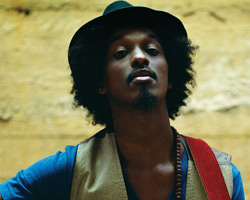
The World Cup is coming to South Africa and it needed a unifying and inspiring anthem. A song written by a son of Somalia and a survivor of its troubles was most suited to feed that sense of hope. K’naan, a Somali born Canadian musician was approached by sponsors to do the anthem and he obliged. Interestingly he had already written the song Waving Flag, it was the last song he wrote on his Troubadoure album. The song is melancholic and speaks of troubles and loss but always had the potential for being tweaked to inspire. Coca Cola, the World Cup sponsors, approached him and told him they wanted someone who could represent the African continent and not shy away from being vocal on its behalf. This was before they even knew about the song.
I met K’naan and his manager Sol Guy when he was on tour in London last May. Back then the whispers of the Coca-Cola sponsorship anthem had just begun. K’naan was back in London in transit last month en-route to Mozambique when I met up with him again. On both occasions he was most generous with his time. We spoke of his recent trip to Somaliland and how it has been instrumental in inspiring his music. He described his trip as necessary and as a ‘key to an artistic lock’ that hehad come up against.
During his recent travels across 18 African countries, K’naan saw that Africans “no matter the scenario, the difficulty, the hope and the beauty, …always expressed it through love …and music”. He is determined to make music to that feeling [of hope] and not just produce a “soundtrack to difficulty”.
Some have criticised the choice and argued that a ‘real’ African pop song should have been written and recorded on the continent itself. It should make no difference where it was written. If the diary of genocide survivor was published in Europe or North America it would not detract from the authenticity and the credentials of that survivor’s story. By the same token music written by a Somali artist enriched by his own experiences is a real African pop anthem giving real hope to real people, not least South Africans of Somali origin.
K’naan has been nominated for 3 Juno Awards [Canada’s answer to the Grammy’s] and the ceremony takes place on April 18th 2010. I have a sneaky suspicion he will be waving not a flag but a Juno, or two, or maybe even three.
Picture Courtesy of KnaanMusic.com
In the last week an internationally-sponsored agreement pertaining to Somaliland’s electoral process has been signed by the President and major opposition parties. Is delayed democracy in the de facto independent northern Somali State at last getting back on track?
The six-point agreement signed on Wednesday by President Daahir Rayaale Kaahin of the UDUB party, Ahmed Mahamed Mahmuud Siilanyo’s KULMIYE Party and Faysaal Cali Waraabe’s UCID, was facilitated largely by the Ethiopian Foreign Ministry which retains an interest in ensuring a peaceful political transition in Somaliland. The agreement reaffirms a commitment to the electoral process and the selection of a new Electoral Commission assisted by a team of ‘international experts’. The drawing up of the voter list by this new body will prove to be the most challenging aspect of the electoral process – a fact made clear by the Interpeace debacle earlier this year. The Ethiopian Foreign Ministry has released a glowing evaluation of the agreement though details on the ground as to a prospective timescale for the Committee selection, voter list creation and the election itself remain somewhat vague. A frequent charge leveled against the Somali political elite from civil society (Hargeisa is home to a large and vocal network of local non-governmental organisations) is that noble rhetoric is often a substitute for the logistical action necessary for facilitating the representative process and it remains unclear whether the intended ‘depoliticizing’ of the election date will ever be possible.
The week’s developments have also involved the British. Representative to Ethiopia, John Marshall, expressed his happiness at the signing of this ‘important’ agreement paving the way for Somaliland’s future elections. As the British government does not recognise Somaliland’s independence, diplomatic involvement is usually administered through Addis Ababa. It is a fascinating oddity of the international relations of the region that the British government can express support for the election of a Somaliland executive whilst maintaining an official recognition of united Somali sovereignty based in distant and chaotic Mogadishu. This strange state of affairs is certainly not lost on ordinary Somalilanders who often invoke Britain’s historical link with her ex-colonial territory as a plea for diplomatic assistance. Indeed, Somaliland’s very claim to legitimate independence is based on this colonial relationship: British Somaliland at independence in 1960 joined in union with Italian Somalia in the south to form what is now still portrayed on maps as the Somali nation state. A history of neglect and state violence directed against the North from the South resulted in Northern separatist intent when the centralised state crumbled in the early 1990s. This is a historical narrative which remains alive in Somaliland’s political culture through older generations who experienced the bombardment of Hargeisa by Siad Barre’s southern forces, and a younger generation which has no recollection of a united Somali state. Another international dynamic to this story continues in the United States where legal battles are ongoing to bring members of the former Somali state military to trial for war crimes perpetrated in the North.
Despite earlier dire predictions of political disintegration following President Rayaale’s successive contested extensions of office and subsequent civil unrest, a view from the streets of Hargeisa today confirms that Somaliland is somehow managing to continue along its relatively tranquil course of political development. As usual, this stands in stark contrast to the seemingly endemic violence of Somali politics in the South. Further fracturing of the self-proclaimed Islamist opposition Sheik Sharif Ahmed’s internationally recognized government continues to complicate factional politics and claim more lives.
Despite its relative stability the conundrum of Somaliland’s state of democratic and diplomatic limbo remains unresolved. Whilst it is unclear how the oddities of the unrecognised Republic’s international status will affect an (apparently) upcoming election, it is certain that these processes continue to shape Somaliland’s dynamic self-image and expectations for future political development.
For pictures of Hargeisa see my photojournal
]]>

Part of the fun of travel anywhere involves the matching of a preconceived image with a reality. The northern Horn of Africa is steeped in travelers mythology which dates back to Richard Burton’s famous, first footstep,in the mid 19th Century and stretches into popular modern imaginings of the, archetypical failed state, Somalia. Separating fact from fiction here isn’t always easy.
For a journey to Somaliland I’ve been in full tourist mode. I’m no Richard Burton – for one thing I’m pretty sure colonial-era explorers didn’t carry Lonely Planets. At the same time, as there are so few other foreign travelers in Eastern Ethiopia it is possible to pick up on that scent of adventure and sense of genuine wonder. The region has vast potential to develop as a location for independent travel and the beauty of the country would certainly warrant it. From cosmopolitan Addis Ababa the road stretches out through undulating green farmland and falls into a dusty interior populated by nomadic tribes people and their livestock. Beyond the savannah-like plains of Awash however, the road rises again into verdant highlands where the valleys sparkle with the reflected light of scattered tin-roofed settlements. This is chat country and the terraced hillsides are lined with this plant whose leaves when chewed (and they are, a lot) act as a mild narcotic. Chat is consumed throughout the Eastern Ethiopian and Somali Horn and the trade has developed into a massive and hugely influential regional industry – in many ways this little leaf ties these nations together. Afternoons in the ancient city of Harar are spent roasting coffee beans, downing multiple sugar laden cups of the rich brew and chewing the cud. Chat debris is strewn all over the floor and the cumulative stimulant effect is enough to set hearts palpitating to the same rhythm as the buses which bounce through in clouds of dust. Not that such intoxicants are really needed to get a kick out of a place like Harar where the nightly ritual involves the feeding of the local Hyenas. Skulking out of the darkened fields these magnificently scruffy animals howl and yap in deference to the old men who call them by name and hand over big chunks of meat.
From Harar I double back to the more modern town of Dire Dawa, the second largest urban centre in the country built up at the turn of the century for the new railway line running from Addis all the way to Djibouti and the
The tiny African country of Djibouti is definitely a Somali state, but is, at the same time, defined by a colonial history and modern geopolitics. Traditionally playing host to French legionnaires, Djibouti is now home to the Americans. It is from here that the Combined Joint Task Force Horn of Africa operates to conduct intelligence and military operations in the Horn. The G.Is on leave in downtown Djibouti city show off fierce crew cuts and a general lack of discernible necks, whilst the burly legionnaires sport their snazzy desert boots and short shorts combos. In the heart of the city the Somali market buzzes with the intensity of semi-organised chaos, whilst a five minute walk will take you to leafy colonial squares and air-conditioned supermarkets patronised by white families driving shiny SUVs.
Short of time, I elect to jump into Somaliland by plane and show up bright and early at the airport to catch my scheduled flight. After waiting around outside for an hour or so while all the airport staff arrive for work, I am duly informed that there will be no plane to Hargeisa today. Several ticket-holding passengers gather up their luggage and set off back into the city. I inquire at the airline office and find out that a, no plane today, can evolve into a, maybe later this morning, to finally a wonderful, oh look, there it is’. The best thing about the delay is getting some time in the departure lounge to drink overpriced cups of tea and watch the F-16s use the runway for takeoff.
So that’s the neighbours. It’s a superficial glance to be sure, but is one that might give you some sense of context for this de facto independent but diplomatically unrecognized modern nation state of Somaliland. Somaliland’s fledgling democracy, (excuse the phraseology) is apparently reeling in a protracted constitutional crisis. The most recent postponement of the presidential election, scheduled for September 27th, resulted in clashes on the streets, police shootings and several fatalities. Once again Somaliland’s hard won and oft-ignored stability was rocked by political violence. The previous instance occurred last year with Islamist-linked bombings in Hargeisa and Bossaso in largely autonomous Puntland, which targeted government buildings, the UN, and Ethiopian commercial and diplomatic interests.
To some, Somaliland is as a country on the brink. Democratic functioning (another of the Republic’s previous claims to fame) is faltering and the whirlwind forces of insurgency which plague Mogadishu and the South of the country, could conceivably expand into a vacuum brought by destabilisation Somaliland. The stakes are no doubt high though that in itself may be a moderating factor. Political crises come and go in this part of the world (as do the staff of some international organizations who are pulled out of the country as soon as any trouble is spotted on the horizon) and already political concessions have been made. Whilst not without controversy, Somaliland’s Guurti legislature has, in effect, confirmed an extension of President Rayaale’s term of office, and an election will be unlikely to take place this year. Does this represent a return to normality for a large proportion of the population who are more concerned about putting food on the table than elite political wrangling, or does it instead epitomise the perpetuation of an inherently vulnerable and potentially combustible status-quo? This is a question I hope to explore during my stay in this fascinating corner of the Horn of Africa.
For pictures visit my photojournal.
]]>
Having returned from a trip to Somaliland, I spent the last few days editing video footage and pictures.
I went there as a nostalgic ethnic Somali who hadn’t seen the land I left twenty years ago. Although my family come from Hargeisa I spent many of my formative years living in Mogadishu. This experience has left me with a deep affinity for both cities and a claim to both Somalia and Somaliland. It has been difficult for me to divorce Somaliland from Somalia. I found that in my vocabulary the two are like conjoined twins; two different individuals who are not quite separate. This is not helped by the fact Somaliland remains internationally unrecognised. To the outside world Hargeisa is just a city which lies in the northern part of Somalia and Somaliland is simply its northern region. To Somalilanders Hargeisa is the capital of their country. A country of which they are very proud.
I found one of the most offensive things you could say in Somaliland was to make the mistake of calling it Somalia. When I accidentally referred to the currency as Somali shillings in the market, I was quickly rebuked and corrected that it was Somali-LAND shillings. Although Somalis share the same religion, ethnicity and even language, Somaliland is now for all intents and purposes a separate country to its neighbour Somalia.
In the Somali people’s pre-colonial history, settlement and living was primarily a nomadic and pastoral one determined by the seasons and where one’s clan resided. The concept of borders was introduced by competing colonialists. Djibouti was formed by the French, Somaliland by the British and Somalia by the Italians. Two other regions were enveloped by Kenyan and Ethiopian borders. The Somaliland Republic reclaimed the old British name given to it and declared independence in 1991. While the debates on Somalia irredentism continue, so does life for ordinary Somalis wherever they reside.
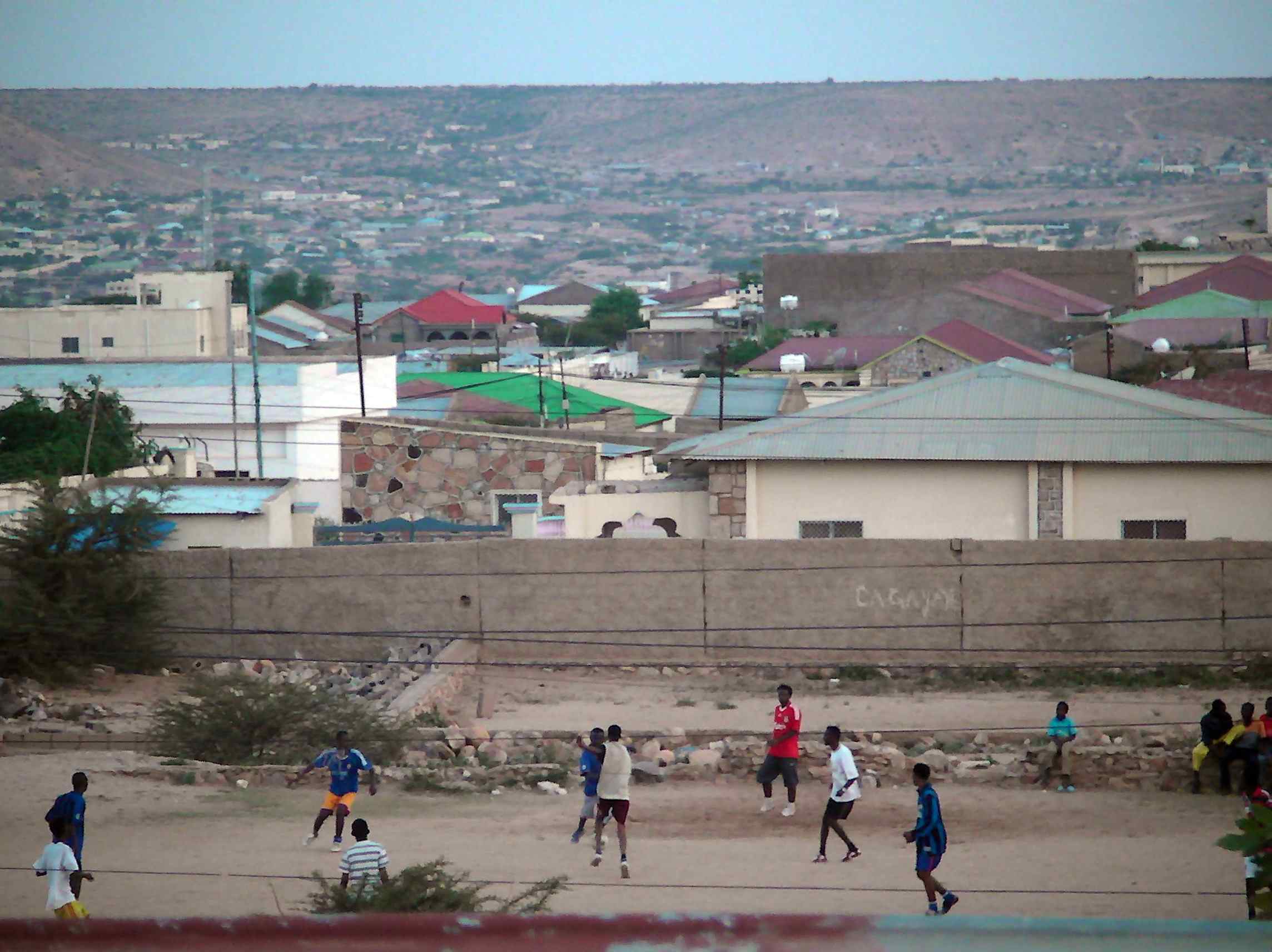
What the people of Somaliland have achieved, dubbed as Africa’s best kept secret, in a relatively short space of time is the envy of others. The country is a fully functioning relatively peaceful and bustling one. The markets open early in the morning with items from all over the world for sale. There are buses and taxis. Operating airports and a visible police force. There are schools and busy cafes. Children play football in the streets but they also beg on the same streets. The global economic crisis has had its ramifications in Somaliland. There is desperation as the cost of living has gone up and the current government is accused of corruption. The country is a growing haven for other ethnic Somalis escaping the violence in Somalia. Across Somaliland there are camps for IDPs (internally displaced people) who depend on aid.
The next posts will focus on the plight of some of those people as well as on the impending elections in Somaliland.
Photograph of of young people playing football in Hargeisa by me
]]>