But rapid urban growth is a challenge for cities everywhere – from the effects of climate change and natural disasters to mass migration, urban sprawl, pollution and lack of affordable housing.
During an evening of film screenings and discussion, we explore these tensions and what solutions can be found to make cities places that leave no one behind and that are a joy to live in for everyone.
The evening will begin with the screening of two recent films made by PLACE, the Thomson Reuters Foundation’s website covering land and property rights stories around the world.
Film 1 – Falling Freetown
“Falling Freetown” looks at Freetown, the capital of Sierra Leone in the wake of last year’s landslide that claimed the lives of about 1,000 people, a disaster many said was waiting to happen due to poor urban planning combined with rapid migration, deforestation, and freak weather events linked to climate change.
Watch the trailer here: https://vimeo.com/266505415/4f76fbd4df
Film 2 – Urban Nomads
“Urban Nomads” looks at the challenges facing Mongolia’s herding community and the mass migration from rural areas into the capital Ulaanbaatar as climate change and socio-economic changes force people into the city.
Watch the trailer here: https://vimeo.com/266537726
A panel discussion with urban experts will explore the themes raised in the films and discuss solutions that turn these challenges into opportunities for cities. The filmmakers will also be available to answer questions.
Chair
Astrid Zweynert is an award-winning journalist, editor of PLACE and social media specialist. Astrid drives coverage and production of Thomson Reuters Foundation’s global news services covering humanitarian crises, human rights and social innovation for the foundation’s website and the Reuters global newswire.
Speakers
Sarah Colenbrander is a Senior Researcher on urban issues at the International Institute for Environment and Development (IIED). Her areas of expertise include financing urban infrastructure, urban governance for inclusion and sustainability, and climate and energy policy in urban areas. She is also Global Programme Lead and Senior Economist at the Coalition for Urban Transitions, a network of research, government and private sector organisations. In addition to academic publications, she has contributed to World Bank, New Climate Economy and UN Environment reports and is Associate Editor for the journal ‘Environment and Urbanization’. She is also a guest lecturer at the University of Oxford, University College London and University of Manchester.
Anna Locke – Head of Programme of Agricultural Development and Policy at ODI (The Overseas Development Institute). Her work focuses on land governance and large-scale investment, biofuels and food security. She has in-depth experience working on market-led agriculture, analysing and advising on how to develop agriculture to promote sustainable growth and reduce poverty, based on principles of competitiveness, market access and inclusiveness.
Euphemia Sydney-Davies is a Sierra Leonean fashion designer and founder of the Sydney-Davies label who is passionate about ethical and sustainable fashion. Instead of outsourcing work to India or China, she set up a small tailoring workshop in Freetown, where she trains local men and women how to make garments for her clothing ranges. After the mudslide Sydney-Davies went home to help her people and raised funds in the UK, where she is based, to assist those most affected. She remains in touch with those who lost everything in the disaster and is critical of the government’s handling of the crisis.
Charles Landry is an author, speaker and international adviser on the future of cities. He is best known for popularising the Creative City concept. Its focus is how cities can create the enabling conditions for people and organisations to think, plan and act with imagination to solve problems and develop opportunities. He has chaired multiple urban innovation juries including The European Capital of Innovation Award – iCapital, New Innovations in the Creative Economy (N.I.C.E.) and Actors for Urban Change. He is a fellow of The Robert Bosch Academy in Berlin.


]]>
The future of water isn’t a simple topic – it is vast and can often be overwhelming. During the discussion we will explore how this topic can be made accessible through the power of storytelling and film.
We will premiere four short documentaries which were produced as part of the global sH2Orts film competition, organised by WaterAid in partnership with the Public Media Alliance’s WorldView project. Each film offers a unique insight into the global water crisis and urges us to think about how we can respond to it.
The discussion which follows will focus on climate change, innovation, urbanisation and inequality – and how they relate to the global water crisis.
Panelists
Mark Galloway, Director of International Broadcasting Trust (Moderator)
Before joining IBT, Mark worked as a journalist, current affairs producer and documentary filmmaker. He’s been a Channel 4 Commissioning Editor, responsible for Education and Features, and has made films for ITV, Channel 4, the BBC, Discovery and Al Jazeera, winning more than a dozen national and international awards including a Gold Medal at the New York Film Festival, a Peabody Award and a BAFTA. At IBT, Mark is responsible for the day to day running of the organization, overall strategy, research and relations with IBT’s members.
Alok Jha is a journalist, broadcaster and author of The Water Book. He is the science correspondent at ITV News. Before that, he spent a decade at the Guardian and made programmes for the BBC.
Bethlehem Mengistu has over 12 years experience in the development sector, with special focus on gender equality, human rights, good governance and provision of basic services. She has worked within senior roles for organizations such as WaterAid, Care International, Action Aid and notable grassroots women’s organizations in East Africa. Bethlehem has solid experience in programme management, strategic campaigning and advocacy and policy analysis. Her educational background is in Law and Sociology and is currently working at WaterAid as Regional Advocacy Manager for East Africa and Acting Country Representative for WaterAid in Ethiopia.
Menka Sanghvi is an innovation researcher and facilitator focusing on global health and wellbeing. At the Humanitarian Innovation Fund she leads a dedicated fund to improve water, sanitation and hygiene conditions for vulnerable communities. In her role she supports a wide range of project teams in building ideas, testing them out, and scaling to achieve better impact. Menka brings over a decade of experience in delivering innovation projects with organisations such as Oxfam, Unilever, Barclays Bank, Impact Hub, and with local communities. She serves as a mentor for the Global Sustainability Jam, and a judge for the UNDP Equator Prize.
Sarah Mosses is CEO of Together Films, a new consultancy working with social issue film content to reach new audiences. She helps filmmakers craft Impact Distribution Campaigns to increase both their social impact, audience reach and revenue potential. As an award winning Producer, Sarah’s debut feature documentary They Will Have To Kill Us First had its World Premiere at SXSW 2015 and European Premiere at London Film Festival 2015. Sarah is a mentor for Documentary Campus, Eso Doc, Sheffield DocFest, On Screen Manitoba, working with emerging producers to enhance their film narrative and distribution/marketing potential.
Film lineup:
PLACE OF SWEET WATERS
Directed by: Sven Harding
2015/South Africa
www.svenharding.com
Place of Sweet Waters will take us to the underground tunnels which run beneath the city of Cape Town, transporting millions of litres of water from Table Mountain directly into the sea. As South Africa grapples with its worst drought in more than 30 years, the film raises questions about why this urban water source is being ‘wasted’.

BLANKETED SNOWS
Directed by: Vardan Hovhannisyan
2015/Armenia
caucadoconline.com/projects/author/25
Filmed in a stunning mountain region of Armenia, Blanketed Snows will encourage the panel to think about how climate change affects water supplies and livelihoods, and how the two are inextricably linked.

AUTOMATIC TUBIG MACHINE
Directed by: Giselle Santos
2015/Philippines
twitter.com/sampunglitro
Automatic Tubig Machine is a fly-on-the-wall documentary about remote communities in the Philippines who are using an innovative water supply technology. During this observational film we are offered a unique and fascinating insight into how children and adults gain access to this vital resource.

THE HOIST
Directed by: Ibrahim S Kamara
2015/Sierra Leone
http://www.wateraid.org/film-competition/sh2orts2016/winners
Set in Sierra Leone, The Hoist looks at the ingenuity of a local young woman who wants to simplify the time-consuming and physical task of collecting water. The film raises questions about the role new technology and innovation can play in the face of the global water crisis.

On Monday 10 November, the Frontline Club hosted a preview screening of Liberia – Living With Ebola, the first episode in Al Jazeera’s latest series of Africa Investigates. The film documented the impact of Ebola on those at the front line of the disease in Liberia, focusing on the communities worst hit and the healthcare workers who run the Ebola Treatment Units (ETUs) and take away the highly infectious bodies of the dead.

The film was presented by Sierra Leonean reporter Sorious Samura, whose intimate understanding of the culture and people provided a glimpse into the fight against Ebola not explored by Western journalists.
The screening was followed by a Q&A with Samura, the film’s director Clive Patterson and the evening’s host, Channel 4’s Tom Clarke, who had himself recently returned from covering the Ebola story in Sierra Leone.
 “The strength of [the film], is it’s about Liberia living with Ebola. . . . The thing we forget is that the solution to it is how countries are living with it, managing it,” said Clarke in his opening statement.
One of the main issues that the film tackled was how the combination of corruption and government mistrust helped to fuel the outbreak.
“Millions of pounds have poured into that country to help build the health structure, the schools. Where has that money gone?” Samura asked. There were some tough questions about who was to blame for the aid black whole that left Liberia and Sierra Leone so unprepared for the outbreak.
“There is a level of negligence there on the part of Western donors who basically allowed Liberia to get away with the requirements when it came to healthcare,” said Patterson.
Naturally this raised questions about the postcolonial relationship between Africa and the West. What is the best way to tackle Ebola without falling into the discourses of old?
Ultimately the responsibility to tackle corruption lies with the people of Liberia and Sierra Leone, Samura told the audience. And he has started to see that change in how the people of Liberia have begun to ask questions in a way they never would have before.

“I grow up in Sierra Leone and we don’t look at people in their eyes when they talk. People of authority, we don’t ask questions. But now we have like emails from Sierra Leoneans asking questions,” Samura said.
But have we not learned anything from any of the other diseases that have afflicted Africa, an audience member asked?
“These governments that we have in place, first of all they were never prepared, they don’t know what to do when it came and they, perhaps, will not even know what to do when the NGOs have packed and left,” said Samura.
It is clear that controlling the spread of Ebola in Liberia and Sierra Leone is only the first part of the story, and once the initial crisis has passed there are a lot of questions that will need to be answered about why people still don’t trust their government, and why aid money still doesn’t make it to the ground.
]]>On Wednesday 1 October, several experts told a crowd at the Frontline Club about the unprecedented and horrific impact that the Ebola epidemic is having in West Africa.
The panel — moderated by Ade Daramy, chair and spokesperson for the UK Sierra Leone Ebola Task Force — tackled the international community’s response to the outbreak and assessed the situation on the ground during the Frontline Club’s First Wednesday: The Fight Against Ebola.

From left: Meinie Nicolai, Professor David Heymann, Ade Daramy, Colin Freeman, Dr Ike Anya and Dr Tim O’Dempsey in conversation at the Frontline Club. Photograph: Mackenzie Weinger
“This is an equal opportunity killer,” Daramy said.
In particular, the experts gathered at the Frontline Club’s discussion zeroed in on the damage the epidemic has inflicted on the health workforce.
Dr Tim O’Dempsey, who was seconded to WHO as clinical lead for the Ebola Treatment Centre in Kenema, Sierra Leone, this summer, told the packed house: “One of the things that probably isn’t on the radar at the moment in terms of the impact of Ebola is the impact on the health workforce and the loss of these very valued members of society.”
“Ebola,” he said, “has torn through the health infrastructure.”
And Meinie Nicolai — president of MSF Belgium and MSF’s operational directorate in Brussels, who recently returned from Liberia and Sierra Leone — called both the scale of MSF’s operations and the outbreak itself entirely “unprecedented”.
MSF is continually reinventing its Ebola response and has even done what they “never do”, which is to call for state actors to come in and get involved, she told the Frontline Club. “Throwing money is way too easy.”
The situation on the ground is absolutely devastating, she said. “People are dying at our front door”.
As for the media response, there have been few journalists on the ground covering this crisis, Colin Freeman, the chief foreign correspondent for the Sunday Telegraph, noted.
Freeman — who recently returned from West Africa and said his time on the ground offered “no shortage of dreadful horror stories” — put it down to the fears this particular virus has raised.
“Stories of this sort ring alarm bells in office health and safety managers because I’ve got to come home to the office and then go in and work in a building with 3,000 people. If I get a bullet wound, it doesn’t matter,” he said.
Still, the nature of Ebola does demand that a journalist do his or her job in a very different fashion, he added. “What you have to do is just make sure nobody comes too near to you, which is the opposite of what you normally do when you’re trying to report and get in people’s confidence,” Freeman said.
And Ebola isn’t slowing down.
“The frightening thing for everybody involved in this is the accelerated epidemic that we’ve seen occurring in Liberia,” O’Dempsey said. “That is likely to be mirrored with about a six-week lag in Sierra Leone.”
But there are areas that offer some hope, he said. “The survivors, I think, are going to be a great asset when it comes to the epidemic response.”
As the evening came to a close, Daramy took a moment to remind the crowd that, “Even in the midst of Ebola, people are making jokes.”
“In Sierra Leone, they don’t shake hands, they touch elbows — and they refer to it as ‘elbowla’,” he said, to laughter from the crowd. “And also, they’re saying in the last few days is that if you don’t want to get Ebola, it’s as easy as ABC, which is ‘Avoid Bodily Contact’. So, you know, people can still smile. They can still smile.”
Watch and listen again here:
]]>
At night, a group of young men and women gather on the street corners of Freetown, Sierra-Leone. These Freetown Streetboys, as they call themselves, have disabilities from childhood or as a result of the civil-war that ended 10 years ago. Abandoned by their family, ostracised by society and forced to live in the streets, they form a close-knit community, beyond traditional, tribal and religious dividing lines.
Without showing complacency or judgment, filmmaker Boris Gerrets closely follows the lives of this tight community. Filmed entirely at night, Gerrets‘s immersive observations result in sensitive and moving portraits. The film delves into the inner world of each character to reveal the dignity of humans surviving under inhumane conditions.
Directed by Boris Gerrets
Duration: 86′
Year: 2013
The total running time of the evening will be 85 minutes.
 Things I Heard on Wednesdays (Egypt)
Illustrated by family pictures and the personal stories of his relatives, filmmaker Abu Bakr Shawky takes us on a lively journey through modern Egyptian history. This photographic documentary shows the strong bond tying human lives with the history of the nation.
Director: Abu Bakr Shawky | Duration: 9′ | Year:2012
 Kiev (UA) President Yanukovych’s decision to pull out of a treaty with the EU in late November sparked anti-government protests in Kiev, Ukraine. Filmmakers Oleksandr Techynskyi and Aleksey Solodunov chronicled the increasingly tense protests on Independence Square. This is a raw account of the events on 20 and 21 February 2014. Directors: Oleksandr Techynskyi & Aleksey Solodunov | Duration: 5′ | Year: 2014

Aus Dem Auge (Germany)
An enormous concrete building constructed during the Nazi era reminds us of the architectural absurdity of national-socialism. This abandoned cathedral got lost and forgotten somewhere in a loophole of history. This cinematic and aesthetic film becomes a statement of critical analysis.
Director: Matthias Zuder | Duration: 11′ | Year: 2013
 30% (Women and Politics in Sierra Leone) (UK)
This oil-painted animation brings to life the stories of three powerful women in postconflict Sierra Leone. Anna Cady reveals the violence and corruption these women face as they fight for fairer representation in governing their country.
Director: Anna Cady | Duration: 11’| Year: 2013

Lost on the Roof of the World (US)
The Wakhan Corridor in eastern Afghanistan is tucked between the Hindu Kush mountain range, Pakistan, Tajikistan, and China. This territory is home to the Wakhi and Kirghiz people who lead lives virtually unchanged for centuries, battling an extremely rugged environment without roads or amenities. Director: Frédéric Lagrange | Duration: 20′ | Year: 2013
 Hear This! (NL) Ten-year-old Tristan loves football. His biggest wish is for his father to be his team’s coach. The club says his father would never be a good coach because he is deaf. Tristan thinks that’s nonsense. His father is a brilliant football player; he even plays for the Dutch national team for the deaf. Director: Soulaima El Khaldi | Duration: 15′ | Year: 2013

Sayadeen (UK) Forced to fish within a three mile sea frontier, the fishermen of Gaza are struggling to survive. While supplies are dwindling, they risk everything to feed their families.
Director: Murat Gökmen | Duration: 13′ | Year: 2013
]]>
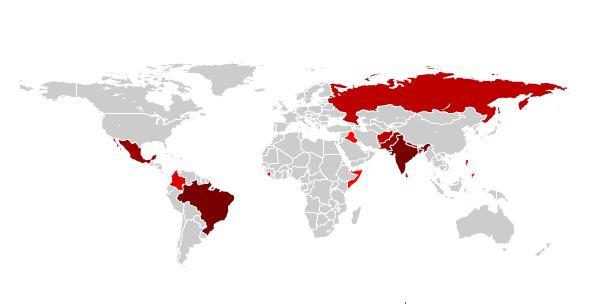
Iraq, Sierra Leone and Somalia are the most dangerous place for journalists according to the 2009 Imupunity index released by the Committee to Protect Journalists today. However, the report entitled Getting Away With Murder 2009, highlights worrying trends in South Asia, particularly in Sri Lanka and Pakistan,
]]>“We’re distressed to see justice worsen in places such as Sri Lanka and Pakistan. Our findings indicate that the failure to solve journalist murders perpetuates further violence against the press,” said Joel Simon, CPJ executive director. “Countries can get off this list of shame only by committing themselves to seeking justice.” link
"The situation in Pakistan is quickly eroding," [said Shawn Crispin, CPJ Asia programme consultant and a former foreign correspondent based in Southeast Asia.] "There are more and more journalists getting caught, not necessarily in the crossfire itself, but by competing groups. They don’t like the coverage of the journalist, they target the journalist." link
Getting from the airport to the city is, however, not much improved. The most direct way is still to take the helicopter operated by one of two companies. The choppers are Russian and so are the crews. It is an eight minute ride. You count every second till the wheels hit the tarmac at the Mami Yoko hotel. Eight days after we made the journey, one of the choppers, on its way back to the airport, crashed killing all but one of the 22 people on board. Most of the dead were soccer fans from a neighbouring West African state, in town for an Africa Cup of Nations qualifying match. It’s a speed boat for me next time.
It is seven years since Tony Blair’s decision to send a battalion of paratroopers to Freetown. I have never seen a country’s prospects turned around so immediately by a single bold and imaginative deployment. Eight hundred pairs of British boots on the ground and, almost overnight, a rebel offensive which threatened to engulf the capital, was over.
There remains something odd about it, seven years on. The then Defence Secretary, Geoff Hoon, repeatedly told the House of Commons that troops had been sent to evacuate British nationals and other foreigners as the security situation deteriorated, The truth (and why didn’t he say it?) was more ambitious and more noble. The British were there to intervene in a civil war, not as neutral peacekeepers but to take sides. Britain armed and trained the government army. It sent guns and ammunition. It sent helicopters to move men and hardware around the front lines. It sent a team of officers under the command of Brigadier (now General) David Richards, to take charge of the war. The point was not to end the war by making “peace” between “warring factions”; but to end it by winning it. Oh yes, this was a new kind of British foreign policy: bold, yes but also honourable. And it worked.
This is why Tony Blair is more popular in Sierra Leone than he is anywhere else in the world. The day before he flew in to Lungi (he wisely declined to get aboard the Russian chopper so missed the chance to see Freetown itself – though it would have been instructive) I put together a piece for the BBC’s Ten O’Clock News. In it I say something which I consider to be uncontroversial and indeed self-evident: that the government the British rescued seven years ago are still in power and have, ever since, presided over a system of entrenched corruption that keeps the political elite rich and the mass of the people very poor. This means that the two conditions that proved to be the seed bed for war – poverty and graft – remain in place.
The next day I wait for the Prime Minister’s entourage to arrive, surrounded by members of Freetown’s professional elite. They have all seen the report. I am, I find, rather less popular than Tony Blair. A beautiful and articulate young woman approaches me. She is a lawyer who is to chaperone Mrs . Blair while Tony is being made Paramount Chief. “Why do you do it?” she says. “Why do you go and film in the poorest parts of our city and show a false picture of our country? Why don’t you film our beautiful beaches and mountains?” Another man – more sympathetic – tells me “They are all talking about you. They are furious”. Tony Blair is on the ground for about five hours. There is no disputing his heroic status. But at the press conference which follows, there is a quiet and welcome reminder that for all its troubles Sierra Leone has one of the best educated urban populations and one of the freest presses in Africa. The first question is from a Sierra Leonean agency reporter: can the Prime Minister (who is standing beside the President of the republic) please explain what progress the President has made in embracing good governance? What is the nature of this progress? Where is it evident? Can the Prime Minister please be specific?
The Prime Minister is indeed specific. The progress is that the war is over and few expect it to come back. This generation of slum children will not be expected to fight one another. The signature atrocity of Sierra Leone’s conflict – the chopping off of limbs – is a thing of the past. One more thing. The very fact, the Prime Minister says to the brave reporter, that you are free to sit there and ask me that question in front of your president is evidence that this country is moving towards a strong and rooted democracy. Maybe so. A couple of weeks later, though, Mr Blair gives the same answer to an Iraqi journalist who asks the same question at a press conference in Baghdad. Harder there, I imagine, to argue that the freedom to put such a question is evidence of a secure and rooted democracy.
I get back to London to an e-mail from the man I’d sat next to on the flight into Freetown. On his way out he’d turned up at the Mami Yoko to take the helicopter back to the airport. He didn’t get on because there’d been a football match and the fans beat him to it. He took the ferry instead. It saved his life.
]]>