The greatest peril comes not from a lack of analysis but from a lack of imagination.”
– Sir William Patey, British Ambassador to Saudi Arabia (2007-10)
Is Saudi Arabia a kingdom in peril? This was the key question under discussion at a packed event held at the Frontline Club on Monday 27 April. Following the accession of King Salman and the ongoing conflict in Yemen, a panel, chaired by journalist Owen Bennett-Jones, discussed the potential destabilisation of the regime and the possibility for change within the country.
Robert Lacey, an author who has covered Saudi Arabia for almost 40 years, said that although talk of its imminent demise and the collapse of the House of Saud had been repeatedly anticipated, these predictions failed to take into account “the Saudis very sophisticated system” that operates extremely effectively within the country.
Carool Kersten, senior lecturer in the study of Islam and the Muslim world at King’s College London, agreed that while in the past the Saudi states have been threatened, the dynasty has always demonstrated an “elasticity” which has “enabled it to bounce back.”
For former ambassador to Saudi Arabia Sir William Patey (2007-10), it boiled down to a question of external perception versus a very different internal reality.
“From Whitehall it was almost a dialectical argument, that [Saudi Arabia] would collapse under its own internal contradictions. But Saudi Arabia is different [from regimes and systems like the Soviet Union]; namely that it is run by the Al Saud who have survival in their DNA. It’s a very cautious, a very slow moving system operating by consensus. But the times when they move quickly are when they are in peril.”
From dealing with the threat of Nasserism in the 1960s to the assassination of King Faisal and the siege of the Grand Mosque in the 1980s, which saw the regime develop a more Islamist approach, the Al Sauds have “a history of doing just enough, just in time,” said Kersten.
On whether there was the potential for regime change in the kingdom, Patey described his experience of the Iranian revolution. From a diplomatic view, the failure to anticipate the overthrow of the Shah “was not a failure of analysis but rather a failure of imagination. We failed to imagine what the Middle East would be like without him.”
In relation to the current context, Patey offered a note of caution: “just because we don’t like the look of the Middle East (and especially the Gulf) without the Al Saud, let us not close off our imagination to the possibility.”
Safa Al Ahmad, a Saudi freelance journalist, said that it is not a question of collapse but a question of peril. Saudi Arabia is entering a new phase of existence and will need to deal with the changing geopolitical and regional realities.
“Saudi Arabia at the moment is too big to fail,” said Kersten. “This is even the view of the population who have too much to lose to really rise up. I think the Al Saud are masters, and have been for 250 years, of playing to this fear and doing the right thing just in time.”
This is represented not only in the often contradictory suppression of opposition and internal dissent – be it of the Shia minority, liberals or online activists (Saudi Arabia has the highest number of Twitter users per capita in the world) – but also through the co-opting of Saudi citizens by the government who play on the turmoil of the Arab spring, which has seen Saudis less willing to take a risk with regime change.
For Kersten, the difference with many of the surrounding countries is that Saudi Arabia is not ruled by a single dictator but by “a dynasty with 3000 potential pretenders to the throne.”
“The country’s not called Saudi Arabia for nothing. It’s a Saudi State, there is no Saudi nation – rather five countries with regional and ethnic differences internally. The Al Saud have capitalised on that to present themselves as the only people who could hold it together.”
On the question of where and how change could originate, the panel were divided. Kersten suggested that it could come from the economic elite who have the means and influence but cannot develop under the Al Saud as they would in other countries, while Al Ahmad reasserted that “the worst case scenario is to have that change come from the outside.”
Citing post-Gaddafi Libya, Al Ahmad said that within Saudi Arabia “everybody wants reform but not to the extent of removing the royal family… the idea of the House of Saud not being there is the scariest option of all.”
For Patey there is no single thing that would bring Saudi Arabia down, but rather a combination of factors.
“There would have to be a perfect storm. A threat from political Islam, a regional crisis, and economic crisis, crucially a division within the Al Saud… all of those things could potentially produce Saudi Arabia in peril, but any one of them on their own is not enough.”
]]>“This started before Maliki and will go on long after Maliki.”
– Hayder al-Khoei

From left: Zuhair al-Naher, Dominic Asquith, Hayder al-Khoei, Ian Black and Zaid Al-Ali (via Skype).
Opening the panel discussion on recent developments in Iraq held at the Frontline Club on Tuesday 24 June, Ian Black, Middle East editor for The Guardian, asked why the international community and the government in Baghdad had been taken by surprise by the current crisis.
In introducing the panel, Black stressed the need to look at “Iraq itself, the nature of what is going on, the role and significance of ISIS (and whether it should indeed be called that), the sectarian element of the crisis, the legacy of the invasion of 2003, Iran, the US and our [the UK’s] own role in the current situation.”
Hayder al-Khoei, associate fellow at the Middle East and North Africa programme at Chatham House, began by analysing the potential for the crisis to quickly descend “within the next few weeks or even days” into an open Sunni–Shia conflict.
Citing widespread support from local civilians as well as other Sunni militias, al-Khoei stressed that for the most powerful of these insurgent groups their advance had “absolutely nothing to do with winning more rights for the Sunni Arab community . . . or even defending the Sunni Arabs in Iraq despite that being their narrative”.
“It’s much bigger than that. . . . It’s about overthrowing the Iraq government regardless of whether Maliki is prime minister.”
Arguing that while some have chosen to read the rise of ISIS as a direct result of the Iraq invasion, al-Khoei spoke of “a real sense [from talking to people throughout the country] that the jihadist groups and insurgents in Iraq have refused to acknowledge the post-2003 political order” where Shias hold the balance of power.
While acknowledging that Maliki had made mistakes, Zuhair al-Naher, spokesman for the Iraqi prime minster, corroborated this by suggesting that many Sunni politicians “cannot yet understand, or come to terms with the reality that they are a minority”.
While all on the panel agreed that secularism does have a role to play within Iraq, there was also a consensus that this is not yet, at least, a sectarian war. Al-Naher rejected the assertion, propagated in the media and through ISIS, that the Sunnis have been “repressed, downtrodden and marginalised”, citing the positions of power occupied by Sunnis in the military and government and claiming that this was a deliberate attempt by ISIS to define the parameters of the conflict. Most notably al-Khoei cited the objectives of the insurgent groups differing between the ultimate goal of an Islamic Caliphate, as envisioned by ISIS, and the return to a form of pre-2003 secular dictatorship of the Baathists.
https://twitter.com/nicolaannettek/status/481794885448904704
Zaid Al-Ali, a former legal advisor to the UN in Iraq, disagreed that the solution to Sunni unrest was increased “inclusivity in government” – but rather the need to tackle the problems of random arrest and torture faced by ordinary citizens.
Dominic Asquith, British ambassador to Iraq 2006–07, suggested that while insurgents such as ISIS – operating outside centralised urban control command centres – have been ever-present since 2003, the origins of Sunni extremism lay in the lack of any “unifying vision for Iraq”.
“Iraq’s leaders have never combined for something . . . but they have at times taken a united stand against something . . . and it looks as though there is a real risk we will go back to rebuilding a house of cards again.”
Asquith went on to name a potential three-part solution to the current problem. First was to contain ISIS, second was to install a new leadership in Baghdad – one that rejected sectarianism and perhaps embraced de-centralisation – and third was to change the narrative (including the relationship between Iran and the US towards Iraq) of aggressor and victim.
Touching on points by both Asquith and al-Naher, al-Ali agreed that while the responsibility for the crisis was not solely Maliki’s, his eight-year leadership of Iraq meant that there was a need for “a new leader to try their hand”.
Returning to an emerging sectarianism, al-Koehi said:
“Sometimes we over analyse and over read Shia–Sunni conflicts and whether there are regionally backed coup attempts or bribes or a variety of other conspiracy theories. But I genuinely believe sometimes the simplest explanation is the best and, as Zaid [al-Ali] mentioned, this is incompetence.”
To this, Asquith added:
“If you amass the various incompetent decisions taken early on after 2003, we are seeing the effect of those now in terms of creating a confessional system. There was confessionalism instituted right at the outset, there was in retrospect an utterly disastrous de-Baathification process which helped create that distrust between communities and there was a reliance on exiles who didn’t really understand [Iraq]”.
Agreeing that the ultimate aim of ISIS was to provoke an all-out sectarian conflict, the panel concluded by discussing the means by which this might be achieved.
Referencing the ‘hearts and minds campaign’ that ISIS have embarked on and which has emerged from various media outlets, al-Khoei qualified the group’s apparent attempt to moderate themselves as “not coming anywhere near being moderate – it just means they are slightly less extreme”.
For Zaid al-Ali, “it may be that ISIS have been trying to put on a more humanitarian face but they cannot succeed because they are pathologically wired to destroy, kill and terrorise”.
Catch up with the full event here:
]]>
Iraq is on the brink following the takeover of Mosul and other cities by the Islamic State of Iraq and the Levant (ISIS). Leaders from across the region and internationally are now faced with the challenge of how to halt the advancement of ISIS and steer the region away from sectarian conflict.
With a panel of experts we will take a view of events on the ground and the measures being taken by Iraq, its neighbours and the international community. Asking how ISIS has been able advance so quickly and what can be done to prevent further escalation of sectarian polarisation. We will also be looking at the new alliances that might be formed in this new front on the fight against extremism.
Chaired by Ian Black, The Guardian‘s Middle East editor.
The panel:
Hayder al-Khoei, associate fellow at the Middle East and North Africa programme, Chatham House.
Zuhair al-Naher, a spokesman for Iraqi prime minister Nouri al-Maliki’s Dawa party.
Dominic Asquith, has 30 years of Middle East experience earned in the British Diplomatic Service. He was deputy special representative and then deputy head of mission in Iraq in 2004, director of the Iraq Directorate at the Foreign and Commonwealth Office 2004–06 and Ambassador to Iraq 2006–7.
Zaid Al-Ali (via Skype), is a senior adviser on constitutional building for International IDEA and author of The Struggle for Iraq’s Future: How Corruption, Incompetence and Sectarianism Have Undermined Democracy. He was a legal adviser to the United Nations in Iraq from 2005 to 2010.
]]>CBS News’ Elizabeth Palmer led an expert discussion at the Frontline Club on 11 September regarding the latest crush of violence in Iraq.
The panel painted a portrait of a country desperately in need of peace, independence, rule of law, reconciliation with its traumatic past, and unity amidst hardening divisions along ethnic, class, and religious lines. Yet none of these needs are being met.
Professor Charles Tripp lamented Iraqis’ inability to trust their government, with a:
"Parliament that sat for 20 minutes in the whole of the year 2010 after being elected … a judiciary which seems to be completely in the pocket of the executive power, and of course a police that you have to be very wary of calling."
Tripp expressed sadness at a "hatred of the state" that he perceived fueling many Sunni and Shi’a attacks.
"The blowing up of people who are looking for employment … of a large number of people standing outside army recruiting or police recruiting. These are people who are just like [their killers] in some senses, these are, you know, sad people who are looking, desperate for employment."
Kamran Karadaghi, distinguished Kurdish Iraqi journalist, downplayed recent attacks as anything out of the ordinary.
"This was something that was meant to happen," he said. "There is always from time to time a wave of violence in Iraq … Iraqi people are very violent. Killing, getting rid of others, is something which sometimes is like a normal thing."
Different factions who make up the government, The Independents‘ Patrick Cockburn added:
"Sunnis, Shi’a, Kurds … none of these people like each other … [but] they all have quite a lot to lose if the present system collapses. So despite the very high levels of violence … in a way it has a sort of grisly stability."
Karadaghi agreed.
"Being an oil economy … everybody in Iraq wants to be a part of it. So this is why, despite … all the animosities … nobody actually left the government. They are all still in the government. This kind of arrangement will continue."
On one topic, however, the panel found optimism, Kurdish independence.
Karadaghi, as well as Tom Hardie-Forsyth, a senior adviser to the Prime Minister’s office, Kurdistan Regional Government (KRG), Northern Iraq, both touted the transparency and success of recent Kurdish oil contracts, a more stable and prosperous way of life in the region, and a stronger sense of unity and purpose among Kurds.
"They are the largest disenfranchised nation in the world. They deserve [independence]," Hardie-Forsyth said.
But are they ready for it?
Karadaghi smiled: "Not yet, but like Andy Murray said, getting closer."
]]>By Nicole Hunt
Following the Syria Action Group conference in Geneva on Saturday, UN Secretary General Ban Ki-moon and head of UN peacekeeping Herve Ladsous are due to address the UN Security Council in Geneva on Monday, where they are scheduled to deliver their recommendations for the future of the UN Supervision Mission in Syria (UNSMIS). The report comes on the same day that Syrian opposition members hold their long-delayed unity conference at the Arab League headquarters in Cairo.
The UN Conference on the Arms Trade Treaty kicks off in New York and is scheduled to last until 27 July. Conference delegates are meant to agree on the terms of a new international treaty which would regulate the global arms trade, a timely topic given recent concern over the flow of arms to Syria and Sudan.
France’s Court of Auditors presents its annual report on the state of the country’s public finances in Paris, which should give President François Hollande a better idea of what he’s dealing with – though, in a week packed with French economic news, it doesn’t give him much time to do anything about it.
The French Parliament opens an extraordinary, month-long summer session on Tuesday in order to push through some of the reforms promised by Hollande during his election campaign, including a pledge for a 75% income tax on earnings above €1m. Prime Minister Jean-Marc Ayrault opens the session with a policy statement outlining the government’s priorities for the session.
After such a long gap between previous P5+1 (E3+3) talks, discussions seem to be taking place almost weekly these days. However, while Tuesday’s discussions in Istanbul are in fact the fourth in as many months, they’re being held at technical-level only, as previous higher-level discussions failed to garner any significant progress or results.
The trial of over 40 NGO workers in Egypt – including 19 Americans, among them the son of US Transport Secretary Ray LaHood – resumes in Cairo on Wednesday. The accused are charged with failure to secure licenses to operate in the country and receiving foreign funding, and has threatened to create a rift in US-Egyptian relations. Two Americans returned to Egypt to participate in the last hearing, on 5 June.
Back in Paris, Ayrault is scheduled to present the government’s supplementary budget for 2012 to the President’s weekly cabinet meeting. The budget is rumoured to include over €7bn in tax hikes and job cuts in government ministries as the government tries to meet deficit targets without imposing severe austerity measures on the French population.
On Thursday, French civil aviation authorities publish their final report on the June 2009 Air France 447 disaster, which killed all 228 people on board when the plane crashed into the Atlantic Ocean on its way back to Paris from Rio de Janeiro. An interim report published last year suggested that pilots were not adequately trained to control the plane, a finding that was rejected by victims’ families.
Thursday also marks the climax of the annual Shia pilgrimage to the holy city of Karbala, Iraq, during which Shia Muslims celebrate the ninth century birth of Imam Muhammad al Madhi. In past years, the pilgrimage has been a target for extremist sectarian violence.
In Friday’s French news of the day, Paris is hosting the latest instalment of the Friends of Syria group, a meeting which was announced by President Hollande and Prime Minister David Cameron in the wake of the Houla massacre. As the names suggest, the meeting takes place under different auspices than the Syria Action Group, so it’s currently unclear how the outcome of Saturday’s meeting will affect discussions in Paris.
A court in Stuttgart, Germany is scheduled to deliver its verdict for former Baader-Meinhof Gang member Verena Becker, who has been o ntrial for the 1977 murder of Chief Federal Prosecutor Siegfried Buback, judicial office Georg Wurster and their driver Wolfgang Gobel. Becker previously served 12 years in prison for her involvement with the Red Army Faction.
Libyans go to the polls on Saturday to elect a Public National Conference, which will be tasked with forming an interim government and appointing a Constituent Authority to draft a constitution – a process that has not gone so well in neighbouring Egypt. The vote was delayed from 19 June after the electoral commission said it needed more time to complete voter registration and ensure that candidates had no links with Muammar Gaddafi’s regime.
Considerably less controversial elections are also taking place in Timor-Leste, where Prime Minister Xanana Gusmao’s CNRT and opposition leader Francisco ‘Lu Olo’ Guterres battle over 20 other parties for their share of the 65 seats in the National Parliament. The two parties attempted to create a coalition government after inconclusive 2007 elections, but failed to come to an agreement.
Tokyo hosts an international conference on Afghanistan on Sunday, with officials from over 70 countries and international organisations expected to attend. The conference, which was announced at the NATO Summit in Chicago, focuses on economic development and investment in the country.
We couldn’t end the week without another French story – Sunday marks the 50th anniversary of Franco-German reconciliation. In 1962, President Charles de Gaulle and Chancellor Konrad Adenauer attended a mass together in Reims, which signalled the end of hostilities between the countries after World War II. President Hollande and Chancellor Angela Merkel are expected to participate in events in Reims to mark the occasion.
]]>
"With our souls, with our blood, we would sacrifice anything for you Bahrain" people chanted on the streets of Bahrain. In February 2011, while the media glare was firmly focused on the uprising in Egypt, the Bahraini people were left to shout in the dark.
One of their rare witnesses was Al Jazeera’s May Ying Welsh, who went undercover, without the permission of the Bahraini government, to record the people’s desperate and unanswered calls for democracy which started in February last year.
Bahrain: Shouting in the Dark, as its tagline states, tells “the story of the Arab revolution that was abandoned by the Arabs, forsaken by the West and forgotten by the world.” It went on to win one of the most prestigious recognitions in journalism -2011 Foreign Press Association’s Documentary of the Year Award.
On his Twitter account Bahraini Foreign Minster Khalid Al Khalifa criticised Qatar, where Al Jazeera are based:
“It’s clear that in Qatar there are those who don’t want anything good for Bahrain. And this film on Al Jazeera English is the best example of this inexplicable hostility.”
The reaction of the regime is hardly surprising as Welsh has exposed all of the brutality which was, at least at the time, hidden from the eyes of the world.
We see unarmed people shot, beaten, teargassed. We see doctors and nurses, Sunni and Shia, in the Al Salmaniya hospital reduced to tears after treating injured protesters for 48 hours without a break, unable to comprehend what is happening to their country.
We see how the regime’s brutal crackdown against its own people gathers force with the introduction of martial law and media “witch hunts” – all with the help of the military forces from the Gulf states.
We see how the protesters are desperate for their revolution not be portrayed as some sort of sectarian violence between Shias and Sunnis, but as a unified call of all Bahrainis for the end of the authoritarian regime and the introduction of constitutional monarchy.
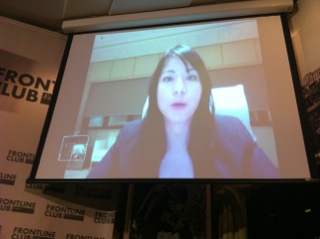
The film’s executive producer, Jon Blair, who moderated the Q&A, asked Welsh, who talked via Skype, to explain how did she found those months living and working in Bahrain.
“Because of the undercover aspect of the filming, I needed to leave the hotel system. I moved into an apartment where the details of my passport were not reported to the interior ministry.”
“I started being monitored by the government through the sim card in my phone so I had to take it out. I did have the police coming to my apartment, a large group of them. There were check points everywhere. I had to wear an abaya and hijab and put my camera in my feminine purse so I wouldn’t look like a foreigner or a journalist.”
When asked why the Western world decided to stand back, when they got involved in Libya for example, Walsh said:
“I think the reason is not being able to afford to upset Saudi Arabia, it’s not so much to do with the US Fifth Fleet presence. That is my opinion at least. If Bahrain were to have a real democracy, that would impact the eastern part of Saudi Arabia where all the oil is and we depend on that oil. Shias living in Bahrain are the same people, the same tribe, who live in that part of eastern Saudi Arabia, they would probably also rise up then and demand change.”
Present at the Q&A session was also an ex-Bahraini MP Ali Mahdi Alaswad who resigned in February 2011, along with 17 other Al Wefaq MP’s, in response to the brutal crackdown against pro-democracy demonstrations.
He said that the situation in his country has hardly improved since then.
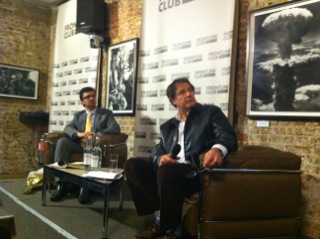
“The clashes are still continuing. If there are casualties, they still can’t go to the Al Salmaniya hospital. The situation is still the same."
“Most of the people who were interviewed in the film are still detained or are out awaiting trial, they cannot travel anywhere.
“The opposition politicians were talking to the Crown Prince, unfortunately he has no power now. People in Bahrain are still demanding. Their demands for reform are still increasing. But the authorities don’t want to upset the Saudis, as about 75 per cent of their income depends on them. The situation is very difficult. But the people are still demanding democracy and they won’t stop until it is achieved.”
With the anniversary of the first Pearl Roundabout protest coming up on February 14, one audience member who lived in Bahrain was worried that there might be another carnage on the horizon. Alaswad hinted that the people are certainly not going to let that day slip quietly.
“People in Bahrain are getting angry now. They don’t want to see politics, they just want to be outside, protesting, they want to express their feelings. Everybody in Bahrain is waiting for February 14. The regime in Bahrain are thinking what to do. We are planning many activities, but I can’t say more now”
You can watch the Shouting in the Dark Q&A here. Click here to watch Shouting in the Dark.
]]>