A descriptive portrayal of Indian political life and culture was painted by journalist and author Tarun J. Tejpal on Tuesday, 25 September as he discussed the background to his novel The Story of My Assassins.
Tejpal founded Tehelka, the news organisation that has become renowned globally for its aggressive public interest journalism. Explaining the differences between it and other mainstream media outlets he said:
"There is a kind of mood at Tehelka that when they join, they don’t look to chase film stars, they don’t want to chase fashion designers, they don’t look to chase sport stars, they get in there and they want to make a difference."
Tejpal‘s position as founder of Tehelka and as a former editor of India Today gives him a unique insight into the Indian press and legal system, what he calls "the belly of beast."
He describes his reasoning for setting up Tehelka, which indirectly lead to an assassination attempt on his life following the breaking of an arms procurement and government corruption story ‘Operation Westend’.
"You had a sense of personal agency in that decade, that was extraordinary, you felt you were at the heart of things and you were actually doing what journalism was meant to do which was to inflect public policy, inflect public decision making in a huge way. And in the 1990’s I felt we had lost that totally."
"When you live in a country as big as india, even if you sell a million copies it’s a drop in the ocean, its nothing. But if you can convince one politician, one public figure, one minister to take one right decision – that, can impact tens of millions of people."
Tejpal‘s philosophy behind Tehelka is aligned with India’s founding fathers. He wants to help many of the 1.25 billion people in India who live in poverty.
]]>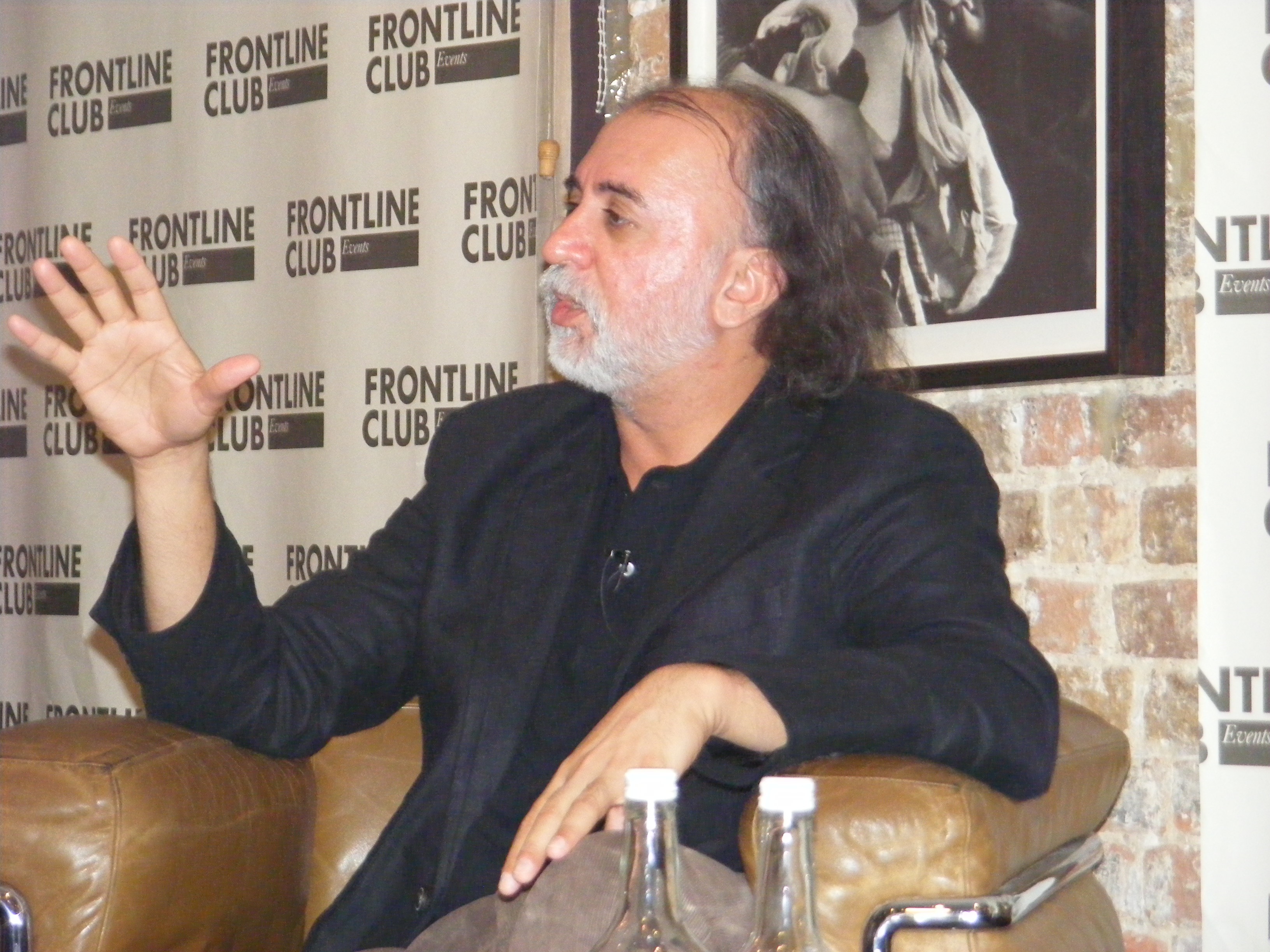
Tarun J. Tejpal, founder of India’s news organisation Tehelka, famous for its public interest investigations, shared its inside story and his thoughts on Indian journalism in a discussion with the BBC World Service’s Shahzeb Jillani on 25 September at the Frontline Club.
Tejpal related details of some of Tehelka’s most high-profile investigations, including ‘Operation West End‘, a 2001 sting to expose corrupt arms procurement at India’s Ministry of Defence. Reporters posed as weapons salesmen and used secret cameras to record bribe-taking by officials. Not long after the story broke, an attempt on Tejpal’s life by hired hitmen was foiled by the police, an event which became the inspiration for his most recent novel, The Story of My Assassins.
Tejpal also touched on Tehelka’s investigation into the Gujarat killings of 2002:
“In 2007 we sent a reporter to Gujarat and he went underground for six months and took footage of mass murderers talking on camera about the Gujarat killings. It was picked up by the Supreme Court of India and three weeks ago they nailed three key figures in the killings, one was given a 30-year sentence … The Gujarat judgment was a great vindication for us – when we broke it [the original story] we were attacked [for doing so].”
Jillani challenged Tejpal on whether he personally “took the glory” for work carried out by his reporting team. Tejpal replied that many journalists from Tehelka had gone on to “build fabulous careers for themselves” while equally “a lot who have built huge reputations at Tehelka have left and never done anything good again”. He put this down to something in the organisation’s DNA, saying:
“There is a mood at Tehelka, people don’t look to chase fashion designers and sports stars, they want to make a difference and crack stories. Our job is clear – not to seduce two million readers but to affect public policy. If you can convince one politician, one public figure, to take the right decision, you can affect the lives of millions of people. Whether we do it through shaming them, arguing with them, moralising with them, it doesn’t matter.”
Responding to a question from the floor on how Tehelka manages to fund six-month-long undercover investigations despite its sometimes precarious finances when well-funded British news organisations expect reporters to file every day, Tejpal said:
“We go the extra mile relentlessly and so far we manage to keep going. I don’t see how you can get your teeth into game-changing stories unless you give them time and space.”
The weight of public policy change should be aimed “at just one constituency – the poor”, Tejpal added, he called India’s inequality levels “absolutely hysterical”.
“Forty-seven per cent of India’s children below five suffer from malnutrition. [Yet] you have this fantasy of being a superpower, a nuclear power. The social contract in India was, the more you have, the more you have to give back. In the last 25 years we have forgotten that. What is gorgeous about India is its founding vision – Gandhi … a picture of nobility and compassion, who comes from great wealth and elitism and spends his life battling poverty. We fight for that idea of India.”
Watch the event here:
]]>
A lively audience gathered at the Frontline Club as a distinguished panel grappled with the factors driving change in India. Leaving the country’s recent growth wobble aside, the panellists unravelled the economic revolution that has thrust India to the front of the global stage.
The discussion began on a positive note as travel writer and author Oliver Balch recounted stories from his latest book India Rising. His optimism for the future of India lays in his belief that young Indians can now realistically aspire to a professional career.
“For the first time if you’re the son of a carpenter, who’s the son of a carpenter, you don’t necessarily have to be a carpenter. That is a dramatic change… For the Indian youth to have the chance to be something else, that’s what the economic story has given.”
Balch’s positivity was complemented by the cautious optimism of second speaker Dr. Ruth Kattumuri, co-Director of the India Observatory and Asia Research Centre at LSE. Stating that India has improved vastly in the past 40 years and remains a work in progress, Kattumuri praised the strength of India’s plural democracy.
“The fact that people have a voice to say what they want, to go and demonstrate in the streets, the fact that Anna Hazare is able to influence certain things in the country, that’s what makes India dynamic.”
Moderator Shahzeb Jillani, South Asia Editor at BBC World Service News then brought in Abhik Sen of the Economist Group and the discussion moved towards doubts over the sustainability of India’s rise.
“For everything that is true about India, the opposite is true as well. For every great entrepreneurial success story that Oliver’s written about, there are thousands if not millions of possible success stories that have been stymied by all kinds of forces beyond the control of individuals.”
Sen cast doubt on the popular idea that India is a land of inventive entrepreneurs, stating that many Indians have to show a street wise cunning in order to survive.
“This entrepreneurial spirit that we talk about, it’s not something that’s been plucked from Mars. It is something that all Indians have to be to get through daily life. You have to be an entrepreneur of sorts to get a gas connection or a phone connection. You have to be innovative and inventive to make sure that you’ll have food on your table.”
Robert Wallis of the Panos photo agency added another sceptical voice as the lights were dimmed and the audience treated to a multimedia piece. The short piece detailed the impact of mining activity on agrarian communities in Jharkhand state.
“Most of these mining operations are highly industrialised so there’s very little employment for former farmers. The only employment that results for the people whose land this once is usually a type of scavenging.”
In a lively Q & A session, the panel debated the above issues without reaching a consensus although they agreed that the implementation of people’s rights is an important step for India.