Shrinking editorial budgets have resulted in journalists increasingly turning to aid agencies to cover stories. At the same time, aid agencies are being pushed to be more media savvy in order to get their message out and to support advocacy and fundraising efforts.
In conflict and disaster zones, aid agencies often have the local knowledge and access to affected communities. Journalists need these stories, while aid agencies are equally in need of the media coverage. Although it appears to be an ideal partnership, this kind of embedded journalism raises significant editorial and security questions.
We will be joined by an expert panel of journalists, security experts and humanitarian workers to examine the editorial complexities and security risks presented by these partnerships. The media and aid agencies have long had a symbiotic relationship; we will be looking at how that is developing.
Chaired by Ben Parker who has worked in media and humanitarian response for over 20 years. He is the co-founder and CEO of IRIN.
The panel:
Polly Markandya is the head of communications at Médecins Sans Frontières (MSF).
Lisa Reilly is the executive coordinator of the European Interagency Security Forum (EISF). She has 20 years experience in the development and humanitarian response sector, working overseas in a variety of programme management roles in both Africa and Asia.
Michelle Betz is a former journalist who now does media development work with UN and aid agencies in conflict and post-conflict countries.
Siobhan Sinnerton is the commissioning editor for news and current affairs at Channel 4.
Photo: Fabio Basone/MSF. MSF doctor, Dr Javid Abdelmonemin, adjusts his goggle camera equipment during filming for the BBC Panorama documentary ‘Ebola Frontline’ at MSF Case Management Centre, Kailahun, Sierra Leone.
This event is in partnership with the European Interagency Security Forum.


This event is off the record, please refrain from filming and reporting the discussion.
The scale of journalist and aid-worker kidnappings in Syria has raised questions about government policies on paying ransoms and the use of media blackouts.
In the US, President Barack Obama has ordered a comprehensive review of US policy governing efforts to free American hostages, but has made clear he is still opposed to the payment of ransoms, in contrast to some of his European counterparts.
There have long been questions within the news industry about whether the use of media blackouts are effective. The head of the Committee to Protect Journalists, Joel Simon, has now said he believes they are “no longer an effective strategy”.
We will be bringing together a panel to debate the current policies towards ransom and blackouts. We will be asking if they need to be reformed, and if so, what they should look like in the future.
Chaired by Richard Sambrook, professor of journalism and director at the Centre for Journalism, Cardiff University. He is a former director of Global News at the BBC where he worked as a journalist for 30 years as a producer, editor and manager. He is the chairman of the International News Safety Institute (INSI).
The panel:
Anthony Loyd is an award-winning correspondent and writer. He is currently roving foreign correspondent for The Times and author of My War Gone By I Miss It So.
Joel Simon (via Skype) is the executive director of the Committee to Protect Journalists (CPJ). He has written widely on media issues and is author of the recently published The New Censorship: Inside the Global Battle for Media Freedom.
Carl Newns, head of media office and press secretary to the foreign secretary at the Foreign and Commonwealth Office (FCO).
Diane Foley (via Skype) is the mother of James Foley, a journalist who was killed by ISIS in August 2014.
An adviser from Terra Firma Risk Management.
]]>
This interactive workshop will explore the pitfalls, the logistics, the security issues and ultimately, the impact, of using hidden camera footage in documentary filmmaking. We will discuss its role as an advocacy tool and what responsibility, if any, filmmakers have to distribute this sort of footage beyond the scope of the film.
The workshop will feature a conversation between Oren Yakobovich, co-founder of Videre, and Orlando von Einsiedel, director of Virunga. They will share their respective experiences of working with communities to gather undercover footage of human rights violations and corruption; discussing the process in its entirety from initial scoping through to effective distribution.
The workshop will be moderated by Jess Search, chief executive of BritDoc.
Spaces are limited. To apply to attend this free event please send an email to info@videreonline.org with your name, credits (if applicable) and a brief (no more than 50 words) answer to the following question:
Why are you interested in knowing more about hidden camera footage? If your interest relates to a specific project, please tell us about it.


On 8 March 1971, the night of the legendary boxing match between Muhammad Ali and Joe Frazier, eight ordinary citizens broke into an FBI office in Media, Pennsylvania. The members of the self-proclaimed Citizens’ Commission to Investigate the FBI picked the lock on the door, took every file in the office, loaded them into suitcases and walked out the front door.
Mailed anonymously, these documents started to show up in newsrooms, unleashing fierce debates on whether or not to publish them. Despite demands by the Nixon administration to suppress the story, The Washington Post went to press, uncovering the FBI’s vast and illegal regime of spying and intimidation of Americans exercising their First Amendment rights.
For the first time, the members of the Citizens’ Commission come forward and speak out about their actions. Through a combination of exclusive interviews, rare primary documents from the break-in and investigation, national news coverage of the burglary and dramatic reenactments, filmmaker Johanna Hamilton tells the story of the Citizens’ Commission. This is a story with haunting echoes to today’s questions of privacy in the era of government surveillance.
Directed by Johanna Hamilton
Duration: 79′
Year: 2014
The moral dilemma of being compliant in the ill-treatment of terror suspects was tackled at the Frontline Club with a preview screening of the feature-length TV drama, Complicit, on Monday 11 February.
The audience watched a compelling account of the complexities faced by British intelligence services in their attempt to foil terror plots.
The drama, a production by Many Rivers Films, charted the investigations of a MI5 officer Edward, (David Oyelowo) who believed his suspect Waleed (Arsher Ali) was planning large scale terrorist attacks in the UK. He followed his suspect from the streets of London to farmlands in the Middle East and found himself battling the moral quandary of whether or not to use torture to extract a confession.
The screening was followed by an engaging debate between the audience and members of the panel which included director Niall MacCormick (The Long Road to Finchley), writer Guy Hibbert (Blood and Oil, Five Minutes of Heaven and Omagh), actor Arsher Ali (Four Lions) and producer Kevin Toolis (The Cult of the Suicide Bomber).
The discussion started with Hibbert’s deliberate choice of the genre of drama as oppose to documentary to tell the story. He explained:
“Drama has an advantage of getting to the emotional truth. . . . If you are doing a documentary you will come out saying that ‘Yes, torture is unequivocally wrong.’ It’s shocking and corrupting, but with drama you can go in more interesting areas . . .”
In answer to a question about whether people do have a choice in matters of torture MacCormick said:
“The film is not just about torture, its about how extraordinarily tempting it is if you are in that situation and also how, categorically, it doesn’t work.”
When questioned about the alleged involvement of the British government in torture, Toolis explained:
“The important thing is to say that [the British government] does not systematically practiced torture. Britain is a democratic nation. The most awful thing about incidents like this is Britain stepping off the pedestal . . .”
Giving an account of a writer’s research Hibbert commented:
“We talked to MI5, MI6 . . . and they told me that life as an MI5 officer was very boring and I was quite interested in that because I was determined to write something that was different or what I perceived to be cliches of secret service life.”
Playing the character of the terror suspect, Ali said:
“I never felt I was playing a terrorist. It felt like I was playing someone who was vain, a bit arrogant, too cocky, holds extreme beliefs. . . . For me the whole thing was that he wan’t doing anything illegal.”
A member of the audience suggested:
“Defining terror was the ‘not knowing’ and that to me was the key to the whole film – that nobody knew their own direction. They were all trying to play the game to be somebody. . . . I found that incredibly moving . . . in a way you can’t go forward to take a stand, in a way you have to stand still.”
Commissioned by Channel 4, Complicit is scheduled for the UK TV audience on 17 Feb at 9pm.
]]>A packed audience filled the Frontline Club forum on 23rd October to hear a panel tackle the question: In whose hands should internet governance be entrusted? Chaired by the Chief Executive of Index on Censorship Kirsty Hughes the event, in association with BBC Arabic, featured: Icelandic MP Birgitta Jónsdóttir; developer for The Tor Project, Jacob Appelbaum; independent media technology consultant, Karl Kathuria and director at the Cyber Security Centre Dr Ian Brown.
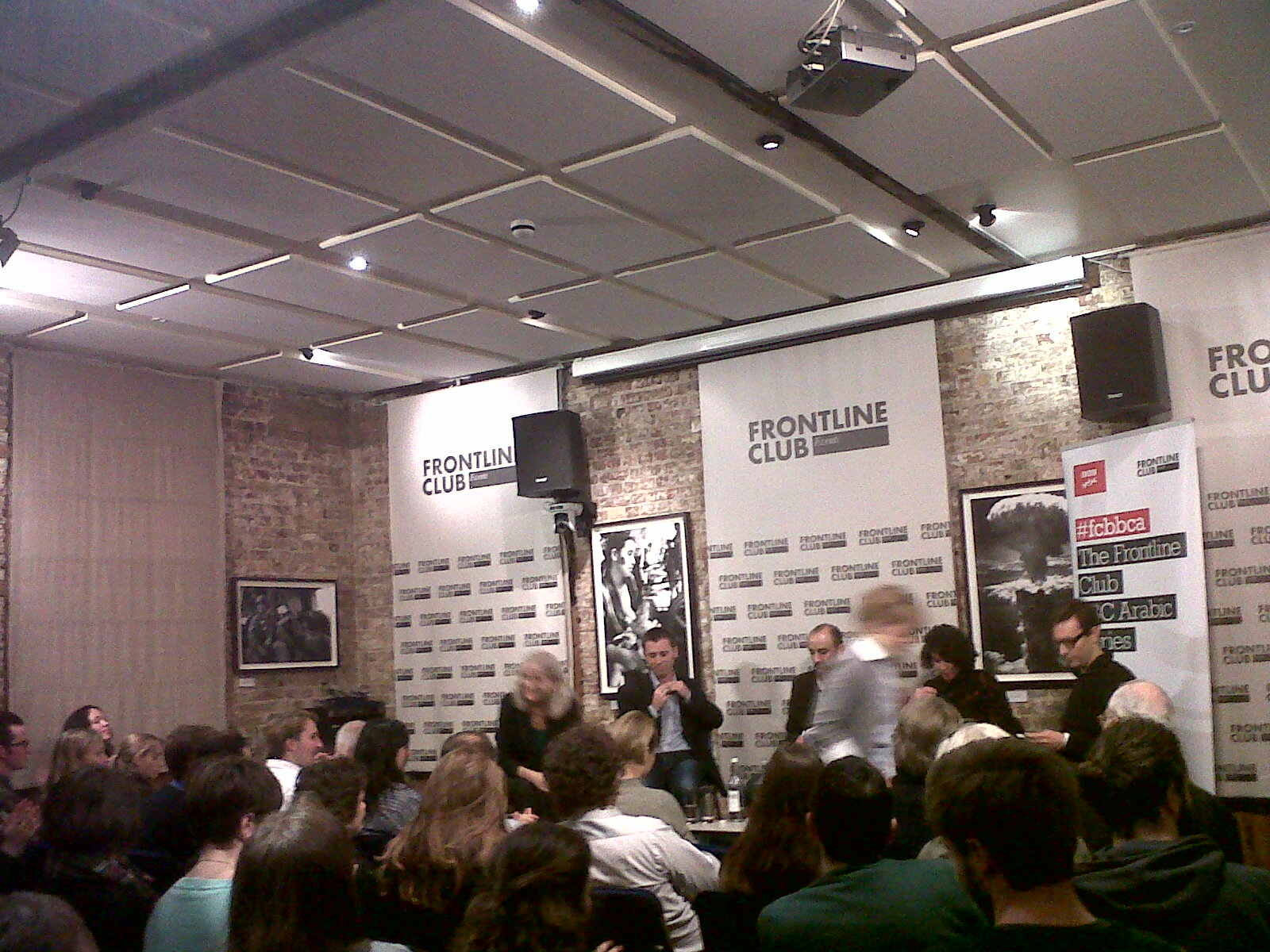
Dr Ian Brown kicked off proceedings by describing the distribution of power over cyberspace. Referring particularly to ICANN (Internet Corporation for Assigned Names and Numbers) which runs the international domain name system and although it is a “international facing” it is governed by US laws.
“Is it fair that this one powerful country the US should have such say over something that is a global resource?… Since so many large internet companies; the Googles, the Facebooks, the Twitters and so on, that are becoming increasingly important in internet governance debates, are headquartered in the US or at the very least have significant exposure to the US, and US law and case law has very firmly said that the behaviour of companies… with any assets exposed to the US had better watch out when it comes to their behaviour elsewhere in the world because there have been a number of US laws applied to the behaviour of these companies elsewhere in the world”
Karl Kathuria then moved on to discuss the censorship of information by governments from a more optimistic viewpoint, describing his time at the BBC on access to users in Iran and China:
“People were still able to get access to that content anyway, people are always looking for the content… its average everyday people who are reaching out.”
Birgitta Jónsdóttir has misgivings on calls for further global internet governance:
“Shouldn’t we have a global freedom of information act?… it is impossible… it would destroy the internet as it is today… maybe we need to start to look at this differently.”
Jacob Appelbaum, a core member of the anti snooping software Tor described the rise of cyber snooping and the oppression it can bring:
“Surveillance is a support system for violence.”
“What we see is a massive expansion of authoritarianism across the globe, even in so called free countries… the mere fact that it has gone so far and the American government has become so brazen.. is an incredibly bad sign, because in a lot of ways the US has led the world in these matters.”
“Freedom from suspicion is part of the necessity for feeling free… we should look at Facebook as stasi-book, and we should look at human data as human data-traffic. It is not a problem of over there-istan, it is a problem over here.”
Birgitta Jónsdóttir discussed the Iceland Modern Media Initiative as a solution to internet governance and excessive cyber snooping, and its uptake by the Icelandic Government to turn Iceland into a “safe haven” for freedom of information.
“Take the same concept as if you were to create a tax haven, so why not create the same for a freedom of expression and speech haven… if you have one country that sets the standard [other countries will rise to it]. I have a dream for a ‘Scandinavian Shield’… as the Scandinavian countries now have a good idea of the importance of these rights to bring the laws into the 21st century.”
Dr Ian Brown finished on a note about public uptake of new technology that can divert around any governmental snooping, “encouraging people to use the tools that already exist is the first step”.
View reaction to the debate on Twitter: #fcbbca, or watch the debate as it happened below.
]]>By Thomas Lowe
It could have made no sense.
But with a gently-gently approach to explaining new apps and why they exist, the gap between the journo geeks and the journo technophobes was momentarily bridged – with a little help from the BBC’s technology correspondent Rory Cellan-Jones.
Empowerment:
Former photographer for the dailies, Christian Payne, went on vacation in 2005 to spend time with the Kurdish Peshmerga. Here he says how new technology at the time allowed him to “bypass the mainstream media.”
“I was a photographer for the dailies and I got frustrated with the amount of editors between my images and the final piece of work. So I decided to go to Iraq for a holiday.
“Every time I was blindfolded and taken to a new place I would look down and write secret base 1… I had a dumb phone, but by texting my coordinates home I knew that my last position would always be noted.”
So, technology can empower journalists in far off places where it can provide some form of security. But what about when it comes to daily, non-stop use of social media? Tom Barfield, site editor and community manager at Demotix, a citizen journalism new wire, says new technology is a journalist’s bread and butter:
“I think this is absolutely what [they] should be doing and what [they] have always done is develop contacts and developed relationships and trusted sources of information.”
Yet apps, and the technology that goes with them, are not just the preserve of journalists. Ryan Schlief, program manager for Witness says the important issue is practical application:
“it’s not about hi-fi or low-fi, it’s about ‘wow’ this is a really great tool that’s going to help someone out with the specific purpose they have in mind.”
He nodded to an example in Cairo where Witness trained some members of a community living in a slum there how to use cameras. This, he says, allowed them to take their message “into their own hands.”
Privacy:
The panel agreed on the need to protect sensitive or personal information. Payne says risks come with the benefits of using new methods of communication:
“I think technology’s moving faster than peoples’ awareness of how valuable and dangerous it can be… It only took the regime in Syria to upload pictures of protestors on Facebook for people to start tagging their friends.”
Sam Carlisle, developer of the Sukey app, a tool for protestors following demonstrations in real time, says the basic fault lies with the phone manufacturers:
“The makers of these [phone] devices haven’t necessarily considered your privacy or empowerment through setting up their devices – it’s not a concern for them.”
“They want to create profit… It’s really people jail-breaking and working to create after-market community tools that are allowing you to do something different with the platform other than what it was originally created for.”
Luddites:
To the question you can always rely on: whereto for professional journalists in these hyper-connected times? Payne again:
“…If they can’t get their stories out there quicker than the man on the street… with their phone in their pocket, they should be sitting to receive it going “ok, let’s do something long form around it and let’s add some credibility to [it].”
A positive note to end on with no mention of the moderator’s famous pink socks.
]]>No one who attended last night’s discussion at the Frontline Club on the safety of journalists was under any illusion that the issue was not an important one, but few there could have anticipated that it would be so topical.
News of the death of Sunday Times journalist Marie Colvin, a regular at the Frontline Club, and French photographer Remi Ochlik in a shelling in Homs has shocked and saddened the journalist community.
The reports of the respected journalists’ deaths came after the Committee to Protect Journalists released their annual report highlighting the risks journalists take in order to shed light in dark places.
Attacks on the Press was presented by CPJ executive director Joel Simon, alongside a panel including Colin Pereira, head of safety and security at ITN; Maziar Bahari, a journalist who was detained in Iran in 2009, and chaired by award-winning journalist Jenny Kleeman, who has been working with Channel 4’s Unreported World since 2007.
The report outlines the impact the events of 2011 had on news crews all over the world, with hundreds of journalists being imprisoned, censored, supressed and exiled around the world.
“How can you protect journalists when they are close to the action? A certain amount of risk is inevitable, but we have to embrace it. Information is important, valuable, and sometimes it is worth taking a calculated risk for,” said Simon.
It plays a pivotal role in our lives.
“You can’t control the risks – but you can control the people you send,” added Pereira. “But like any machine we get very tired. Our resources are depleted. What is becoming apparent to major broadcasters is that the real risk is not [having] foreign news crews parachuting in to countries, it’s the local journalists.”
Last night, CPJ casualty figures for 2012 stood at six. Last year, over forty journalists were killed. These figures lie in stark contrast to the two journalists killed in World War I.
The terrain journalists cover has changed. From being seen as neutral observers bearing witness to events, they are increasingly being targeted in a bid to silence unfavourable reports against governments.
The tumultuous events of 2011 has seen ‘crackdown’ become a buzzword among press freedom organisations. In Egypt, where documenting the unrest can be seen as highly damaging to the regime, journalists have reported being targeted and attacked. In Iran, threats by the government have extended to the harassment of journalists’ family members.
The panel believed one of the reasons the number of journalists killed has rocketed over the past years is because of a reigning culture of impunity.
“Governments think they can get away with kidnapping, murder and targeting,” said Bahari.
“Frontline news gatherers are increasingly local, online and freelance journalists, and are victims of violence and repression because they work without the same support that journalists with media organisations have,” said Simon.
He urged media organisations and support groups to come together to fight censorship or information and the reigning culture of impunity.
“We need to create a global coalition against censorship, a community of global citizens. [Censorship is] something I feel is an emerging threat and needs to be challenged.”
]]>
Over 40 journalists were killed during a tumultuous year of political unrest last year. Hundreds more remain imprisoned, censored, suppressed and exiled around the world.
Increasingly pressured into self-censorship through intimidation, fear and legislation, journalists are facing increasingly dangerous times. Such danger are compounded by repressive governments and violent criminal groups.
Join us at the Frontline Club for the first in a series of events, screenings and workshops examining the challenges to safety faced by journalists around the world.
We will be discussing the dangers faced by journalists today and the impact on journalism of a world more and more people are demanding their rights to equality and justice. What more can be done to protect journalists in their work?
The event will also mark the launch of the Committee to Protect Journalists’ Attacks on the Press report which will be presented by CPJ executive director Joel Simon.
Chaired by Award-winning journalist and reporter, Jenny Kleeman, has been working with Channel 4’sUnreported World since 2007, reporting from locations as diverse as the Amazon rainforest, the slums of Liberia and most recently Afghanistan. She writes regularly for the Guardian, Sunday Times and Independent.
With:
Joel Simon, executive director of the CPJ, under which they launched the ‘Global Campaign Against Impunity’ and established the ‘Journalist Assistance program’ which provides help to journalists in distress.
Iranian-Canadian journalist Maziar Bahari who was detained in Iran during the uprising following the 2009 disputed election. He is author of Then They Came for Me: A story of injustice and survival in Iran’s most notorious prison.
(via Skype) Libyan contractor turned fixer, Suliman Ali Zway who was recently awarded the Martin Adler prize alongside Osama Alfitory for their dedication and bravery in reporting the conflict in Libya. They are known to international journalists as ‘The A-Team.’
Colin Pereira, head of safety and security at ITN, he is responsible for the security of ITN operations in high risk environments. Previously he was deputy head of the BBC High Risk Team. He has advised on thousands of deployments around the world, ranging from the London riots to deploying crews to downtown Mogadishu. He is also head of high risk for 1st Option Safety, specialising in production and freelance safety.
In association with CPJ

]]>
By Nicole Hunt
Monday looks to be the biggest day of what should be an interesting week internationally. Kicking off with the ongoing EU debt crisis, German Chancellor Angela Merkel hosts French President Nicolas Sarkozy in Berlin to iron out amendments to the new EU fiscal stability treaty that was agreed last month.
Italian bank Unicredit opens its €7.5bn rights issue, having discounted shares by about 43 per cent in a bid to raise funds. Investors will be watching the sale closely to gauge market support for European banks.
South Korean President Lee Myung-bak begins a three-day visit to China at the invitation of President Hu Jintao. Discussions are expected to focus heavily on regional security in the wake of the death of North Korean leader Kim Jong-il.
Malaysian opposition leader Anwar Ibrahim’s sodomy trial, which has dragged on for nearly two years, finally comes to an end as the jury is scheduled to deliver its verdict in Kuala Lumpur. In addition to Ibrahim’s freedom – he faces up to 20 years in prison if found guilty – the verdict will also determine who will run against Prime Minister Najib Razak in the country’s next elections, which are not due until June 2013 but look increasingly likely to be called this year.
Attentions turn Stateside on Tuesday as New Hampshire Republicans cast their ballots in the presidential primary. Following the 3 January Iowa Caucus, in which Mitt Romney beat Rick Santorum by just eight votes, Michelle Bachman announced that she was dropping out of the race.
In Washington, the Bulletin of Atomic Scientists announces whether to move the minute hand on the Doomsday Clock, which represents how close humanity is to ‘catastrophic destruction’. The last time the clock was moved, in January 2010, the BAS’ outlook was somewhat positive, moving the minute hand back one minute from five to six minutes before midnight.
Tuesday also marks the 10th anniversary of the arrival of the first detainees at the Guantánamo Bay detention centre.
The High Court in London is expected to rule on Wednesday whether the Occupy London protesters can remain in their camp outside of St Paul’s Cathedral. Despite legal action from the City of London Corporation, the camp has been in place since 15 October.
The World Economic Forum releases its annual Global Risk Report ahead of the Davos Forum, which opens on 25 January. Last year’s report found that the financial crisis had ‘drained’ the world’s ability to deal with shocks.
The European Central Bank’s Governing Council meets in Frankfurt on Thursday to decide whether to raise, lower, or maintain the euro area’s interest rate. After last month’s meeting, during which the interest rate was decreased to 1 per cent, ECB President Mario Draghi announced major refinancing operations to support bank lending and market activity.
Alleged al Qaeda member Umar Farouk Abdulmutallab, who pled guilty in October to attempting to set off an explosive device in his underwear on a Detroit flight on Christmas Day in 2009, is sentenced in Detroit.
India is hoping to celebrate a milestone anniversary on Friday. If no new cases of polio are reported between now and then, the country will mark its first-ever year without any new cases. The World Health Organisation considers a disease to be eradicated when no new cases are reported for three consecutive years. Apple is set for a massive sales boost as the iPhone 4S goes on sale in China and 21 other countries in South America, the Caribbean and Africa.
Apple is set for a massive sales boost as the iPhone 4S goes on sale in China and 21 other countries in South America, the Caribbean and Africa.
Saturday marks the one year anniversary of the resignation of Tunisian President Zine El Abidine Ben Ali, whose 23-year rule was ended after nearly a month of protests dubbed the Jasmine Revolution. The success of protests in Tunisia spurred similar movements across the region, with widely varying results in Egypt, Libya, Bahrain, Yemen, Algeria, Morocco and Syria.
In Taiwan, voters go to the polls to elect a new President for a four year term. Incumbent Ma Ying-jeou faces challenges from China-sceptic Tsai Ing-wen and pro-Beijing James Soong.
Elections also take place in Kazakhstan on Sunday, following President Nursultan Nazarbayev’s snap decision to dissolve Parliament on 16 November. The vote is expected to see at least one opposition party enter Parliament, usually dominated by Nazarvbaeyev’s Nur Otan party, though that party is likely to be close ally Ak Zholl.
]]>