
Producer James Brabazon talks about Tim Hetherington’s life and legacy
“Why do young men go to war?” was asked again and again at the Between the Lines follow-up screening of Which Way is the Front Line From Here? The Life and Time of Tim Hetherington on Thursday 17 October at the Lexi Cinema. It was a question that occupied Hetherington during his lifetime and a question that director Sebastian Junger and producer James Brabazon aimed to discover about Tim in this powerful and moving film.
A very candid Q&A with the producer Brabazon followed the film – which covered the late Tim Hetherington’s career as a war photographer – whose honest revelations added an extra dimension to the screening.
“The essential issue is that young men find comfort in war. One of the unspeakable truths is that it’s fun. You can see at the start of the film, every single man is laughing,” Brabazon points out, referring to the opening scene where amongst the heat of the fires burning in the Libyan corridors there is a sense that the men who run around with their AK-47s are doing something fun. “That’s uncomfortable,” he adds.
“Somehow water always finds its course and there is something about the theatre of war that bonds young men like you don’t see anywhere else. Tim was interested to see why young men go to war. . . And did he need to be there? No.
“But yet he finds himself at the front line, having a good time. It’s that vortex of violence.”
When an audience member asked Brabazon if Tim’s death compelled him to leave war reporting, we were even given a glimpse of his reasons for going. Contrasting himself to director Sebastian Junger, who decided to stop going in to report conflict, he confessed he felt he had a duty to show people what was going on.
“The way that [Junger] feels is that when you’re working in war, you think you’re putting yourself at risk, but in fact what you’re doing is endangering and putting at risk the lives of those people around you, that love and care for you.
“I felt that after Tim died, I really couldn’t stop. I felt somehow stopping would constitute a betrayal of our friendship,” he admitted.
“I’m not really very good at much,” he said after a searching pause. “There are lots of things that I can’t do. There is this one thing I can do, and when I get it right, I’m not bad at it. But I feel all we do after all is tell other people’s stories, and if you can tell people’s stories who live at the ragged, violent margins of society and you give those people a voice in a way that is translated so that other people can understand it – if you don’t do it, then who will? Because someone needs to, and I feel I can.”
His admission is something also seen in Hetherington throughout the film and you witness the intensity with which he interacts with the people he photographs and brings out the truth. “He made work to be seen,” said Brabazon, when asked about Hetherington’s legacy. “And he wanted to affect change.”
Sebastian Junger has gone on to found RISC Training – “Reporters instructed in saving colleagues” – as a response to a lack of medical knowledge among frontline reporters.
Between the Lines was a three-day festival that took place at Rich Mix from 1 to 3 March co-organised by DocHouse and the Frontline Club. In a series of follow up events we continue to explore the challenges facing documentary makers, investigative journalists and citizen reporters in the new media landscape.
]]>Director Sebastian Junger and producer James Brabazon screened Which Way is the Front from Here – The Life and Time of Tim Hetherington, on the 7th October 2013 at the Frontline Club. Tim Hetherington was not only a close friend to both Junger and Brabazon, but also one of the Club’s founding members and a former speaker. The screening was followed by an emotional and heartfelt Q&A.

Director Sebastian Junger (left) with James Brabazon. Photo: Pete Ford
According to the HBO synopsis, the film ‘traces Hetherington’s work across the world’s battlefields, to reveal how he transcended the boundaries of image-making to become a luminary in his profession.’
Covering his life from childhood, to self-discovery in India, to finding his photo-journalistic focus in Liberia, to his last moments in Libya, the film is a moving and loving tribute to a close friend of Junger and Brabazon. Using Hetherington’s own footage, it offers an not only an insight into his progression as a journalist, but also into the reasons why did he what he did. As he put it:
“I probe this idea: the who am I, what am I doing?”
In the Q&A session that followed the screening the question of the film’s focus was asked, with Junger replying that:
“I didn’t want it to be a film about Tim’s death. I wanted it primarily to be a film about his incredible life.”
Brabzon said that he saw there being a legacy for this film:
“I have lost count of the number of young photographers who say they got into this because they saw Tim’s work. If the work in this film inspires other people to approach their work in the same way, and the same spirit as Tim did, then for us that is a small success.”
The harrowing footage of Hetherington stepping in to save the life of a suspected spy in Liberia raised the debate on whether a journalist can ever justify participating in the events they are reporting.
Hetherington’s attitude to this is clear throughout the film, with him at one point stating that: “I’m a big white guy, I’m in your country, and for me to pretend otherwise is just stupid”. Brabazon added:
“The point is not whether you are being objective, but whether your work is credible and authentic.”
While Junger has stopped filming in war zones as a direct result of Hetherington’s death, Brabazon reached a “diametrically opposed conclusion…[feeling] somehow that it would be a betrayal of what Tim and I did together, to stop.”
Junger has gone on to found Risc Training – “Reporters instructed in saving colleagues” – as a response to a lack of medical knowledge among frontline reporters.
The film will be released in cinema’s across the UK on 11 October. More information about the film or details about upcoming screenings can be found the Facebook page, and you can view the trailer here:
]]>On 20 April 2011, photographer and filmmaker Tim Hetherington was killed by mortar fire in the city of Misrata, Libya. He bled out in the back of a pick-up truck on his way to the hospital.
In his work Hetherington focused on the experience of war from the perspective of the individual. Through his photographs, writing and films, he offered new ways to think about human suffering as a result of war. He captured the perspective of the soldiers and the civilians, caught up in the many conflicts he reported. The work he did throughout his ten-year career has established him as one of the most important photojournalists of his generation.
Colleague and co-director of the Academy Award-nominated documentary Restrepo, Sebastian Junger thoughtfully portrays Hetherington’s life and work. At a time when greater numbers of journalists are losing their lives covering conflict, the film also addresses the high risks taken by war journalists.

Directed by Sebastian Junger
Produced by James Brabazon
Duration: 79′
Year: 2013
Between the Lines was a three-day festival that took place at Rich Mix from 1 to 3 March. In a series of follow up events we continue to explore the challenges facing documentary makers, investigative journalists and citizen reporters in the new media landscape.
Presented by:


Supported by:


On 20 April 2011, photographer and filmmaker Tim Hetherington was killed by mortar fire in the city of Misrata, Libya. He bled out in the back of a pick-up truck on his way to the hospital.
In his work Hetherington focused on the experience of war from the perspective of the individual. Through his photographs, writing and films, he offered new ways to think about human suffering as a result of war. He captured the perspective of the soldiers and the civilians, caught up in the many conflicts he reported. The work he did throughout his ten-year career has established him as one of the most important photojournalists of his generation.
Colleague and co-director of the Academy Award-nominated documentary Restrepo, Sebastian Junger thoughtfully portrays Hetherington’s life and work. At a time when greater numbers of journalists are losing their lives covering conflict, the film also addresses the high risks taken by war journalists.
Directed by Sebastian Junger
Produced by James Brabazon
Duration: 79′
Year: 2013
]]>

The Frontline Club will be hosting the first RISC (Reporters Instructed in Saving Colleagues) training course in the UK. The four-days of training will end with a Group Show that is open to everyone on Wednesday 9 October at 7pm, to register to attend see HERE.
RISC offers a four-day course in emergency medicine to freelance journalists working in dangerous areas. The course is completely free for qualified journalists working in all media – photography, print, radio and video. RISC covers instruction fees and accommodations (if needed). Each graduate is provided with a comprehensive medical kit to take with him or her back into the field.
RISC is a nonprofit organisation based in New York City. It was founded by journalist Sebastian Junger after the death of his friend and colleague, Tim Hetherington, in Libya in 2011. Hetherington’s wound, though very serious, may not have been fatal had one of the journalists or rebels around him had the right medical training. Surviving a gunshot or shrapnel wound is often a matter of doing the right thing in the first few minutes, and RISC training focuses on that brief, critical period of time.
]]>In the most dangerous place in Afghanistan, the violently contested Korengal Valley, a platoon of fifteen American soldiers fight a seemingly endless war against an Al-Qaeda stronghold. Told through the voices of the soldiers themselves, Restrepo takes the viewer on a harrowing journey through the lives of the men serving abroad without the interjection of the vox populi usually heard on the news.
]]>
In the most dangerous place in Afghanistan, the violently contested Korengal Valley, a platoon of fifteen American soldiers fight a seemingly endless war against an Al-Qaeda stronghold. Told through the voices of the soldiers themselves, Restrepo takes the viewer on a harrowing journey through the lives of the men serving abroad without the interjection of the vox populi usually heard on the news.
The platoon, named after a medic who was killed during an insurgence, explore the remote countryside of their post in attempts to win the hearts and minds of the valley’s native Afghan people. At every step, however, the threat of bombs and snipers looms as the soldiers try to push forwards into no-mans land. A personal story of loss, tactic, isolation, and the human cost of war, the film explores one of the most hotly debated and discussed military actions in the past decade.
On April 20, 2011 while covering the conflict in Libya, Tim Hetherington was killed by Libyan forces in a mortar attack on the besieged city of Misrata.
Directed by Tim Hetherington and Sebastian Junger
Duration: 93 mins
Year: 2010
2011 Oscar Nominated
2010 Winner Grand Jury Prize Documentary Sundance
]]>
Seeing as we’re coming to the end of the year I thought I’d pick out a few of the ‘best’, ‘most interesting’, ‘memorable’ or simply ‘random’ links on various topics from among the 530.
In this post, I’ve selected from those that are also tagged ‘war reporting‘.
1. Sebastian Junger remembers Tim Hetherington
In April, photojournalist Tim Hetherington was killed while reporting from Misrata in Libya. Colleague and friend Sebastian Junger reflects on his life and death:
"That was a fine idea, Tim—one of your very best. It was an idea that our world very much needs to understand. I don’t know if it was worth dying for—what is?—but it was certainly an idea worth devoting one’s life to. Which is what you did. What a vision you had, my friend. What a goddamned terrible, beautiful vision of things."
2. Libya conflict: journalists trapped in Tripoli’s Rixos hotel
"It’s a desperate situation," [the BBC’s Matthew] Price told Radio 4’s Today programme. "The situation deteriorated massively overnight when it became clear we were unable to leave the hotel of our own free will … Gunmen were roaming around the corridors … Snipers were on the roof."
3. War, too close for comfort
Simon Klingert talks to some people on a train about his life as a photojournalist:
““So have you ever seen someone die?” It was about two minutes into our conversation when the question had popped up. The question. Not that I minded though. After all, it seems like a natural question to ask when you tell people you’re trying to make a living as a war correspondent and it dawns on them you actually like what you are doing..”
4. The hazards of war reporting from behind a desk
BBC journalist Alex Murray reflects on reporting the conflict in Libya from his computer screen:
"But the war has been very close to me, too close sometimes. Viewing them [videos from Libya] in a corner of the newsroom on a screen with nobody else sharing the experience at that moment is a dissociative experience. The process of analysing it, effectively repeatedly exposing myself to the same brutal events, does not make it easier."
5. Image of the child of fallen soldier trends on Facebook
I typed ‘Afghanistan’ into the Kurrently search engine one day and noticed that this photo was being passed rapidly around Facebook in the United States. I find the photo jarring and unsettling: the artificial neatness of a homely, yet staged photograph here represents the tragic consequences of a chaotic, complicated and distant battlefield.
]]>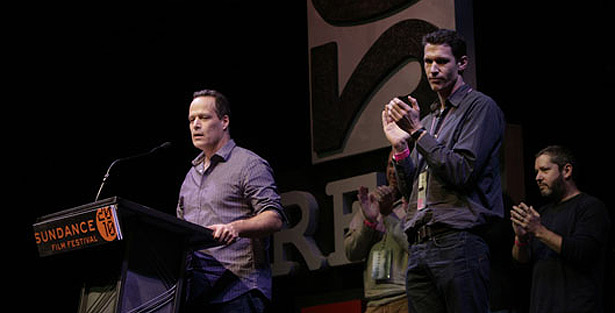
A huge congratulations from the Frontline Club to member Tim Hetherington and Sebastian Junger for their incredible success at this year’s Sundance Film Festival. Their documentary Restrepo won the Grand Jury Prize in the U.S. Documentary Comptetition.
Restrepo is an incredible documentary that chronicles the deployment of a platoon of U.S. soldiers in Afghanistan’s Korengal Valley – considered one of the most dangerous postings of the war. The film puts politics aside to get to the heart of the experience these soldiers face over the course of a year.
This year’s judges for the Grand Jury U.S. Documentary Comptetition were filmmakers Greg Barker, Dayna Goldfine, Morgan Spurlock, Ondi Timoner and Wired senior editor Nancy Miller.
Restrepo wasn’t the only film with a British director to do well at Sundance, Enemies of the People by Rob Lemkin and Thet Sambath won the Special Jury Prize in the World Cinema Documentary Competition and Lucy Walker’s win for Wasteland added to her incredible achievement of having two documentaries at the festival, the other being Countdown to Zero.
My review of Restrepo for The Documentary Blog and Sundance coverage can be found here.
I also want to add a congratulations to the filmmakers of films shown at the club nominated for this year’s Oscars. China’s Unnatural Disaster: the Tears of Sichuan Province has been nominated in the Documentary Short category. Jon Alpert and Matthew O’Neill kindly came and gave a wonderful Q&A a few weeks ago and we wish them the best of luck on March 7th.
Burma VJ and The Most Dangerous Man in America: Daniel Ellsberg and the Pentagon Papers are both nominated in the Documentary Feature category, congratulations to filmmakers Anders Østergaard, Lise Lense-Møller, Judith Elrlich and Rick Goldsmith.
For more information about Restrepo, the website is here.
Full List of Awards in the Sundance Documentary Competitions:
U.S. Documentary Competition
Grand Jury Prize – Restrepo
Directed by Sebastian Junger and Tim Hetherington
Special Jury Prize – Gasland
Directed by Josh Fox
Directing Award – Leon Gast for Smash his Camera
Cinematography Award – Laura Poitras and Kirsten Johnson for The Oath
Editing Award – Penelope Falk for Joan Rivers: A Piece of Work
Audience Award – Waiting for Superman
Directed by Davis Guggenheim
World Cinema Documentary Competition
Grand Jury Prize – The Red Chapel
Directed by Mads Brügger
Special Jury Prize – Enemies of the People
Directed by Rob Lemkin and Thet Sambath
Directing Award – Christian Frei for Space Tourists
Cinematography Award – Kate McCullough and Michael Lavelle for His & Hers
Editing Award – Joëlle Alexis for A Film Unfinished
Audience Award – Wasteland
Directed by Lucy Walker