One summer morning in 2011, London’s Metropolitan Police pulled over Mark Duggan– a young, black, British man– and shot him dead. His killing sparked what became known as the Tottenham riots, and set off a chain reaction of arson and looting across the country.
Images of burning buildings and hooded men breaking windows filled television screens, but the media rarely reported on the riots in more depth. Why had this happened? What lessons should have been learned?
George Amponsah’s documentary The Hard Stop, which showed at The Frontline Club on July 8, picks up the story from where the media left off. It follows Duggan’s childhood friends Marcus Knox-Hooke and Kurtis Henville as they deal with the aftermath of his death, and offers a portrait of two men often misrepresented by the headlines.

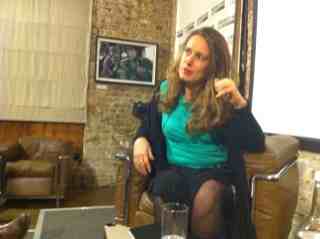
At a Q&A session with all three after the screening, Amponsah highlighted how the media had wrongly reported Duggan’s death as part of a shoot-out. He said: “One of the things that propelled me to make the film when I met Marcus and Kurtis, was a desire to find out what I didn’t feel like I got from the media…and that’s just simply the humanity of the victim.”
“In terms of media distortion…there’s a very iconic image of Mark that went out to a lot of newspapers and media outlets, which was him seemingly scowling out at the camera, and at the same time being labelled as a gangster. That image has become quite famous because when you see the whole picture, it’s actually Mark at the graveside of his daughter who died at stillbirth and he’s holding a love-heart. The initial image that was used to portray him as a gangster is actually a picture of a father suffering bereavement.”

Knox-Hooke added: “When I felt offended by what they were saying about my bro (Mark), I felt like we just had to do something to shed some light on who he was as a person.”
One audience member questioned whether the media should be held responsible for reporting on the basis of what the police had told them. Amponsah replied by acknowledging that some outlets, particularly The Guardian, had produced excellent analysis of the riots. Many other outlets, however, had opted for the knee-jerk demonisation that many young black men from communities like Tottenham say they experience at the hands of police.
“I think it is important that police officers see this film, because as far as I’m concerned, it’s really just a film about humanity,” said Amponsah. “Since 1990, there’s been 1500 deaths in police custody or following a police contact, but not one conviction of a police officer for murder. That doesn’t represent any kind of ability on the police’s part to change in terms of making themselves accountable.”
Knox-Hooke described what it was like growing up on Broadwater Farm, an estate notorious for rioting and the murder of PC Blakelock in 1985, adding that tensions with the police have continued to simmer under the surface ever since.
“It’s a war,” he said. “Growing up, they (the police) always used to chase us, run us down for no reason… Mainly they just wanted the satisfaction of seeing us frightened and seeing us crying. As you get older, that fear turned to anger and bravery, so when they pull up you challenge them. You’re not running anymore.”
Amponsah added: “Personally I suspect that Mark Duggan might still be with us if he was white and not from Broadwater Farm.”
An audience member asked Knox-Hooke and Henville whether the recent verdict on unlawful killing in the Hillsborough disaster gave them any hope for a fresh inquest into Duggan’s case.
Knox-Hooke replied: “I’m hoping that the officer that shot Mark will come forward after some time and say, I did make a mistake… or tell us what happened. I’ve got a little bit of hope, still.”
He added that making The Hard Stop had had a positive impact on his life, and said the group had plans to screen it around the country, particularly in schools and colleges.
“We want this film to reach the children,” he explained.
“The lifestyle that I used to live to how I’m living now is just two different lives. George helped me make that transition. At the beginning of the film, I was very negative, very angry. Now, I’m at peace with myself, especially when I see the reaction of the audience to the film… I believe we achieved what we set out to do.”
Listen to the recording of the event on soundcloud:
The Hard Stop trailer:
]]>
On Friday 20 May, the Frontline Club hosted a screening of ‘He Named Me Malala’, an insightful and emotional portrait of Malala Yousafzai, that usher us into Malala’s life; both now and before she was shot by the Taliban while campaigning for Pakistani girls’ right to education. The screening was followed by a panel discussion moderated by BBC journalist Sima Kotecha, with Gulwali Passarlay, an author and Afghan political refugee, Philippa Lei, Director or Policy and Advocacy at Malala Fund, and Elin Martinez, researcher in the Children’s Rights Division at Human Rights Watch. The panel discussed the right to education for refugees, all contributing their individual expertise.
A constant theme throughout the evening was lack of access to education for refugees around the world, whether in refugee camps in Jordan, or in foster care in the UK, and what barriers need to be overcome for this to change. Passarlay arrived in the UK when he was 13 years old, after travelling for one year, through ten countries. He initially found it very difficult to access education, and describing it as “the key to freedom”. All panel members agreed that education was vital for all refugee children, with Lei commenting that many governments do not spend enough money on an infrastructure to facilitate providing education to all refugees, and that rich countries should be providing more resources to those countries that are hosting the majority of the world’s refugees, stating that: “…governments have a financial responsibility to provide an education for every child”.
The panel all dismissed the financial argument that educating and housing refugees will use up their resources, with Martinez observing that “resources can be found when they want to be”. Passarlay stated that these arguments, which create an “us and them” are unfair, asking
“Why are we blaming refugees [for austerity]? We should see refugees not as a burden, but as an investment”
And stating that, as Malala has said before, “we have a voice in the West but we take it or granted”. In agreement, Lei observed that “Malala is using her voice to bring some of that moral conscience back”, when she is not scared to ask difficult questions and talk about the issues that matter to her.
In answer to an audience member asking what do refugee children need the most, Passarlay, with agreement from the other panel members, told her that “What is in short supply is dignity, human value…understanding and compassion. Education is important, but, they are traumatised, before that they need love”.
For more information about any future screenings of ‘He named me Malala’ and the work of the Malala Fund, visit https://www.withmalala.org/
]]>In 2011 the law ‘On Access to Public Information’ was adopted in Ukraine. This new law made it possible to request information from state authorities, revealing information that was previously inaccessible.
In the same year, five people from different parts of the country tried to invoke the law to reveal corrupt and frustratingly bureaucratic government officials.
Open Access brings together these five stories, told by five directors, all illustrating the lack of transparency, indifference, dominance of private motifs and lack of responsibility by the country’s leaders.
Directed by Volodymyr Tykhyy, Serhiy Andrushko, Jeanne Dovhych, Dmytro Konovalov and Dmytro Tiazhlov
Duration: 98′
Year: 2013
Tuesday 30 July 2013, 7:00 PM – Side by Side

For almost one hundred years there was only one way to make a movie: photochemical film. Over the last two decades a digital process has emerged to challenge this initial form of filmmaking. At a moment when digital and photochemical filmmaking coexist, Side by Side explores what has been gained, what is lost, and what the future might bring.
Tuesday 6 August 2013, 7:00 PM – The Pirate Bay: Away from Keyboard

The largest and most famous torrent website in the world, The Pirate Bay, quickly became one of many antagonists of the entertainment industry. The three Swedish founders face $13 million in damage claims by the media establishment. TPB-AFK chronicles a historic drama beyond the copyright debate and tells a human story torn by cyberwar.
Tuesday 20 August 2013, 7:00 PM – The Human Scale FULLY BOOKED

The Human Scale: it’s a ticking time bomb. In the next 40 years the number of people living in cities will nearly double. There is not enough time to build the necessary infrastructure to accomodate all of us. According to revolutionary Danish city planner Jan Gehl, even the largest of megacities must be re-thought, re-designed and re-sized to the human scale.
This screening will be followed by a Q&A with director Andreas M. Dalsgaard
Tuesday 27 August 2013, 7:00 PM – Google and the World Brain FULLY BOOKED
 Google and the World Brain connects the central story of Google Books with fundamental issues related to the Internet – privacy, copyright, data-mining, downloading and surveillance. Through interviews with experts from across the world we learn about the implications of one of the most ambitious and simultaneously controversial projects ever conceived on the Internet.
This screening will be followed by a Q&A with director Ben Lewis.
Tuesday 3 September 2013, 7:00 PM – Rewind This! BOOK NOW

Home video changed the way the world consumed films. Low cost equipment and the rise of VHS created unprecedented opportunities for the film industry. Rewind This! looks at media consumption, zero budget filmmaking, unchecked global piracy and an exploding film industry, through the rise and fall of VHS. Developments that laid the foundation for today’s digital culture.
Tuesday 30 July 2013, 7:00 PM – Side by Side
Tuesday 6 August 2013, 7:00 PM – The Pirate Bay: Away from Keyboard
Tuesday 20 August 2013, 7:00 PM – The Human Scale BOOK NOW
[vimeo clip_id=”67638874″ width=”400″ height=”225″]
Tuesday 27 August 2013, 7:00 PM – Google and the World Brain BOOK NOW
Tuesday 3 September 2013, 7:00 PM – Preview: Rewind This! BOOK NOW
]]>Women leaving Moldova and crossing the border into Romania and then on to European countries to work illegally has become a mass phenomenon that is tearing families apart.
Bordering Romania and the Ukraine, Moldova is the poorest country in Europe, with an unemployment rate of 80%. Mamma Illegal follows three women between 2004 and 2011 as they work illegally in Europe to earn money to provide their families with a better life.
Vienna 2004 – Auralia is making a living illegally cleaning in Austria. As she watches a video of her family back home the demands of being so far away are made clear. She cries as she sees her children missing their mother.
She has chosen to leave her family and work in Vienna in order to send money home. As the film progresses the strain that this is putting on the women and the families is evident. They start to wish they had never let their loved ones go.
Auralia’s family is not a one off – footage of a Moldovan school shows a classroom of crying children, pleading to the camera for their parents to return home. The teacher speaks to the camera saying, “They leave in order to work and hopefully they will be better off afterwards”. Nearly all of the children present in the class have a mother working abroad, some have both parents working in separate countries. The result is a generation of children left behind, being brought up by their grandparents and remembering their parents only through distant memories.
As the years progress the effects on the women become more noticeable. Natasha, a Moldovan woman living in Italy, is very obviously struggling to cope. “I left because I had to, I couldn’t see any other way out”. She refuses to return home. When he receives a letter stating she has to leave the country; she is visibly distressed, fainting when leaving the immigration office. Her messages to her 10-year-old daughter are of love, yet she insists on staying rather than returning to be with her.
“You mustn’t judge me because I left you at such a young age, I am doing this for you”. This reason for their mothers leaving them is repeatedly drilled into the children. As the children grow up into young adults, though, it is interesting to see that they would not make the same decisions as their parents – “I would not leave if I had children of my own, this is my home”.
It becomes clear that the women see what kind of life they could have and when they do finally return home they view their homes as dirty and poverty stricken, the pressure this puts on their marriages could not be made more heart-rending. When Auralia’s husband commits suicide, she shouts at his coffin “why did you leave us?” The film’s Producer, Arash Riahi, took questions after the screening and explained that Auralia’s husband could not face her leaving for Vienna again and suicide was his last, desperate attempt to force her to stay at home with her children.
The film leaves you reflecting on what you would do if you were in the same situation – it is in the human condition to want to better yourself and your situation, but at what price?
]]>
A lot has changed in the years since 9/11. The date itself has become emblematic of a change in attitudes towards Islam, perhaps most notably in the country which bore witness to the infamous attacks that day. Popular opinion has shifted, and the land of the free has become an increasingly hostile environment for Muslims. American Muslim: Freedom, Faith and Fear examines what it means to be a Muslim in America today and the consequences of the fact that, for many, the words Islam and terrorism are now permanently intertwined.
The documentary, featuring Karen Zarindast from BBC Persian and Samir Farah from BBC Arabic TV, was screened at the Frontline Club. The team travelled across the length and breadth of the United States in order to examine the lives and experiences of a vast range of American Muslims. They discovered a country in which fear and confusion surrounds Islam, and where politicians and the media often foment unrest in order to further their own objectives. What was once a thriving cultural melting pot where Muslims were welcomed has now developed into a nation over which a sinister and pervasive Islamaphobia has taken hold in the last decade.
A question and answer session followed, during which Darius Bazargan, the film’s producer, Azadeh Moaveni, the author of Lipstick Jihad, and Zarindast discussed the film and some of the key themes that emerged. One of the most important issues was the impact of American foreign policy, as Bazargan suggested in response to the question of whether or not American Muslims will ever be able to escape the dogma associated with 9/11:
“I don’t think there’s any chance of going back to the quiet life, especially because of the impact of American foreign policy in Islamic countries; either through the involvement with Israel or elsewhere. It will be less resonant if there are fewer coffins coming home, and there will be fewer coffins coming home if American foreign policy changes.”
The panel also talked about some of the difficulties faced when filming, including budgetary and time constraints, as Bazargan made clear:
“We had editorial difficulties, you’re a slave to the road in these kinds of documentaries. There were lots of interesting people we had to drop from the final cut simply because they popped up at the wrong point in our journey and didn’t fit the arc of discovery."
As the evening ended somewhat acrimoniously, with conflicting views being raised from the floor over what is clearly an emotive issue to many, Zarindast did offer a consolatory take on her experience:
]]>“I asked people if they would leave the country. They said no. I think it was fascinating, because I spoke to people in Birmingham after some of the recent trouble and they had never been to Pakistan or Bangladesh but they said that they would leave England in an instant. Nearly everybody I spoke to in America said no… this is their country.”
THIS EVENT IS OPEN TO THE PUBLIC
Ten years after 9/11 and a year before what are likely to prove deeply divisive Presidential elections, BBC Global News sent a combined team from BBC Persian and BBC Arabic TV on an epic road trip across the USA to find out what it is like to be a Muslim in America today. America's complicated relationship with Islam is examined through the eyes of two reporters - Karen Zarindast who grew up in Iran and Samir Farah who grew up in Lebanon.
]]>THIS EVENT IS OPEN TO THE PUBLIC
Ten years after 9/11 and a year before what are likely to prove deeply divisive Presidential elections, BBC Global News sent a combined team from BBC Persian and BBC Arabic TV on an epic road trip across the USA to find out what it is like to be a Muslim in America today. America’s complicated relationship with Islam is examined through the eyes of two reporters – Karen Zarindast who grew up in Iran and Samir Farah who grew up in Lebanon.
In a country where Freedom of Worship is guaranteed by the Constitution, the team travelled from New York to Texas to California and points in between. They met American Muslims from all walks of life: from a High class fashion designer in Manhattan, to a Muslim rapper in California, from a Pakistani born Texan "cowboy" to the Imam of the country’s largest mosque in the city of Dearborn — serving a Muslim population of some 30,000.
To a man and woman, all were grateful for the opportunities and freedoms provided by the USA and many were intensely patriotic. Yet set against a backdrop of politically motivated Islamophobia, stoked by some partisan media outlets, many in the American Muslim community now feel under more scrutiny than ever before: they are constantly having to justify their faith and prove their loyalty to their homeland."
]]>
By Rosie Scammell
After nearly a decade in the making, Tears of an Afghan Warlord had its UK premiere on Friday night, with director Pascale Bourgaux on hand to tell the story behind the screen.
The following week we will be launching a series of discussions, screenings and workshops examining the risks faced by journalists around the world.
The award-winning, genre-bending documentary filmmaker Mads Brügger launches our new masterclass series, and Tweets from Tahrir is the first of our Screenings from the Frontline with Al Jazeera.
February’s #FCBBCA will bring together a distinguished panel to discuss Iran’s internal power struggle and its turbulent relationship with the West.
We will also be examining the rebuilding of Libya and Fawzia Koofi will be discussing why she wants to become President of Afghanistan, while Matt Frei will be joining us to look back on his career.
Follow us on Twitter and catch up on any events you missed on the Forum blog or download our podcasts on iTunes.
ALL EVENTS ARE OPEN TO THE PUBLIC
]]>
Followed by a Q&A session.
]]>