The civil war in Syria is never far from our front pages and minds, particularly with the continual images and stories of refugees dominating the media and political agenda. It is a story we all think we are familiar with.
But what is it like to grow up in exile? How do the Syrian children see their situation, and how has it affected them?
Mani Benchelah’s new hour-long documentary This is Exile, realised with the support of Save the Children UK, takes a unique view – the life of a Syrian refugee, told entirely from a child’s perspective.
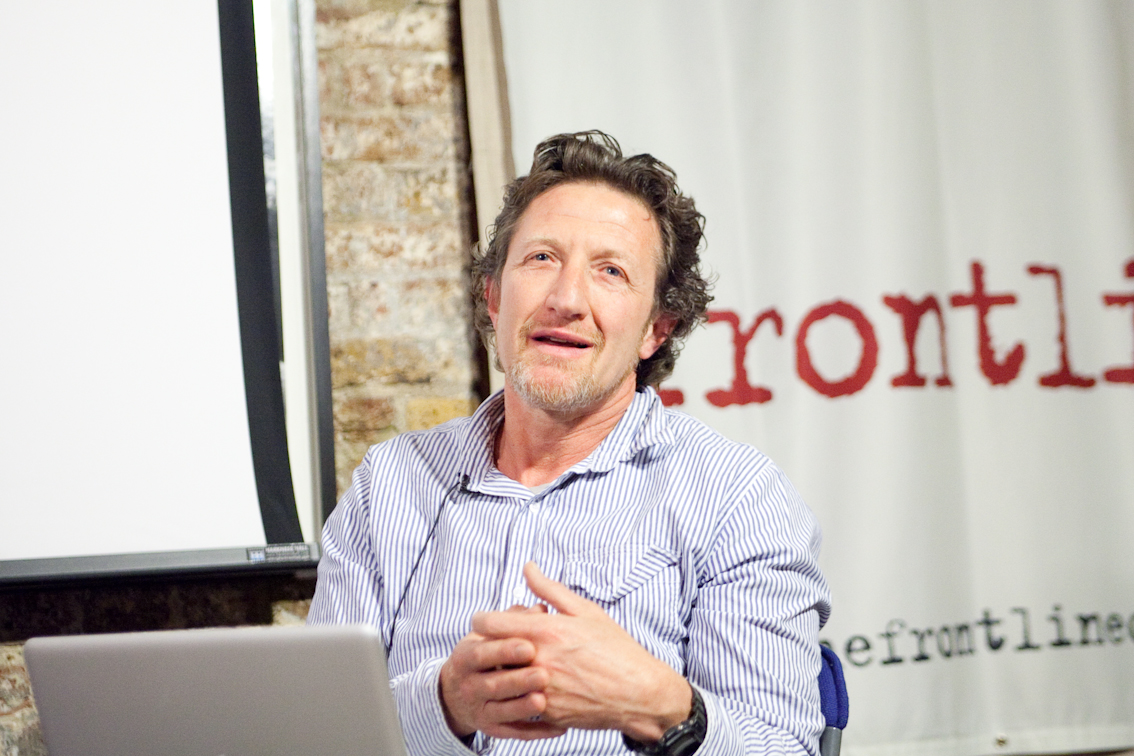
The Frontline Club held a special screening of the film on Monday 4 April, which was followed by a Q&A with Benchelah, Save the Children’s Jess Crombie, filmmaker Julia Kirby-Smith and Syrian humanitarian aid worker Ahmer.
“I was reporting on the situation in Syria for Channel 4 News and I found that children were approaching me and wanted to express what they are experiencing,” said Benchelah, who started filming for the documentary in 2014. “Their family members had been affected, killed or maimed and their schoolmates had also been killed. So the idea of making a film about Syrian refugees, children specifically, was discussed with Save the Children.”
With children amounting to half of the refugee population in Lebanon, the film follows a few living in Lebanon over the course of two years. They talk about what it is like to be a refugee, and what they think of their own futures and that of their home country.
“It’s not easy to interview children who have been through trauma, or have experienced what is war,” said Benchelah, who was a primary school teacher before he became a documentary filmmaker. “There is a question among the journalist community whether it is ethical to interview children, particularly in situations of trauma… Sometimes I had to decide not to interview the children.”
@frontlineclub one of my fave places in London for this new doc #SaveSyriasChildren pic.twitter.com/ygUUgNxcig
— Becca Dove (@becdove) April 4, 2016
Ahmed, who is Syrian and has worked with children in Syria for UNICEF, described how the film reflected the reality on the ground. “The film tries to show the reality of what people, especially children, are going through. Nearly three million children are out of school.
“Thousands of children have been born stateless because they don’t have papers – they are going to school and they don’t speak the language. But the good thing about children is they adapt.”
As Save the Children’s Director of Creative, Jess Crombie commissioned the film and explained to the audience why they wanted to do something a little more innovative: “This was the first full length doc we’ve ever made; we usually make short films.
“We wanted to make it because at the time when we commissioned it in 2013, public engagement had dropped and we wanted to bring the situation to people’s attention and give them a different perspective. We wanted to… give a truth to the situation, so it wouldn’t be so overtly political. What a child will give you is a perspective that it not mired in their own political views, but about the reality of what they are experiencing.”
Filmmaker Julia Kirby-Smith pointed out that the children also shine a light on the wider context. “It’s interesting that although children can speak a bit more openly than the adults can, at the same time you can see they are a little filter for what their parents and adults are all saying to them.”
Benchelah elaborated on this point, and told the audience about one child he captured on film who seemed to have strong pro-Assad views: “It’s interesting because although the parents know about what the regime is doing, and about the atrocities, they teach the younger kids to be really pro-regime.
“They want to come back to Syria, but they are afraid that if they are saying anything wrong against the regime to their children, they are afraid that when they grow older, they will become in opposition to the regime – they don’t want that.”
Watch the trailer for the film here.
]]>On Thursday 24 April, the Frontline Club welcomed a full house to a screening of Aleppo. Notes from the Dark. It was followed by an insightful Q&A with directors Michal Przedlacki and Wojciech Szumowski, which touched on the misrepresentation of the conflict in Western media and the possibility of a foreign peacekeeping intervention.
The unique and powerful film aims to document, in the words of Przedlacki, the “fate of ordinary people in extraordinary, dreadful times”, and gives voice to an assortment of Aleppo residents experiencing the daily hardships of life in a war zone.
Created from over 200 hours of footage, Aleppo. Notes from the Dark paints a complex and unique portrait of the Syrian people through a panorama of personal accounts, including those of a doctor at a makeshift field hospital and an Islamic cleric devoted to the pursuit of zakat (alms). Filmed over a period of 44 days, the film communicates the position of its subjects with regard to the state of the Syrian Revolution, their lives prior to the conflict and their expectations and hopes for the future of their homeland.

From left to right: Marta, Wojciech Szumowski andMichal Przedlacki
Humanitarian aid worker and photographer Przedlacki and filmmaker Szumowski commented on the film’s origins, born out of a mutual desire to provide evidence of the extensive bloodshed inflicted on the Syrian people:
“We decided to take the risk and go together to Aleppo. Not for news, not for three days, not for a week, but to stay there for two months in order to properly document and follow the fate of ordinary people. . . . We decided that we had to tell this story . . . there was too little information about Syria.”
An audience member questioned the lack of screen time dedicated to the narratives of Christian Syrians, Szumowski responded (with the help of a translator):
“We think that it would not be optimal to put Christians and Muslims in opposition, I think this is a mistake that we make in the West. Christians amount to 6% of Syrian society, and in the film we have shown the (positive) attitude of Muslims towards Christians. Both Muslims and Christians are Syrian citizens, and we would not like to divide them.”
A second audience member enquired as to whether the conflict in Syria had the potential to radicalise those involved, and the extent to which this would pose a threat to the West. Przedlacki responded:
“To understand why we have seen the influence of foreign extremists we need to understand the despair that Syria has faced, . . . the Syrians have a feeling that the world is letting them burn. . . . We are now ‘drinking the beer that we brewed ourselves’.”
The question of the West’s role in supporting a resolution to the conflict was likewise raised. Szumowski proposed the following:
“The first thing that the West can do is to tell an honest story. I have been following the information that has been in the media about Syria very closely, and I have the impression that there are some deformations of the real situation…. Placing terrorism in the headlines is already a sort of lie… and giving it precedence over everything else distorts the situation… So first it would be to tell the truth, and second it would be to use solidarity”
Przedlacki added:
“Our film is a protest against the ‘civilisation of indifference’. . . . Each one of us can do something. We made a film . . . some of you can write about the film, or can support Save the Children or a humanitarian organisation. . . . This is not some imaginary world. All of this has happened.”
Another audience member warmly thanked the filmmakers for bringing such a pressing situation to light, and enquired as to the extent of Russian involvement in the eyes of the opposition fighters. Szumowski recalled interactions with residents of the Syrian city:
“The people that we met in Aleppo kept talking about Russian mercenaries. . . . We heard tales that some of the aircrafts are being piloted by soldiers from North Korea. . . . It is almost as if the war is not between Syrians but between other nationalities as well.”
Szumowski likewise commented on outsider interests, highlighting the Russian base with access to the Mediterranean Sea as a clear motive for their involvement.
The filmmakers were asked to detail the extent to which the residents of Aleppo that they came into contact with demonstrated support for the suggestion of a Western military intervention.
Przedlacki offered a response and articulated his proposal for a peaceful resolution to the fighting, drawing on his work with humanitarian response programmes in diverse regions, including Afghanistan, Chechnya, Somalia and Pakistan:
“Every option should be considered in order to stop the bloodshed in Syria. . . . We have a dictator that is creating a bloodbath for his own Syrian nation. . . . If diplomatic means are not working then there should be an initiative of the Arab countries to intervene, and the Western role would be to support such an initiative. . . . I don’t really believe that we would see American boots on the ground.”
An audience member pressed Przedlacki on which Arab countries would be involved in this initiative:
“The Arab League itself. In 2012, they agreed to have a peacekeeping operation, which was then stopped by the Russians. . . . Imagine how many people could have lived . . . if this had happened.”
Szumowski expressed greater concern at the extent of mis-information in the West, and demonstrated a reluctance to endorse Przedlacki’s backing of foreign military intervention:
“I am an artist, a creator, not a politician. I think that force is the absolute last resort. I think the most important thing is informing the society openly and honestly about what is going on in Syria.”
Szumowski closed the discussion by recalling the inaction of Allied troops during the Second World War with regards to intervening to prevent the atrocities committed during the Holocaust, pointing out the West’s current complicity in the situation in Syria owing to its failure to act:
“We are committing a similar sin now when we are not talking about Syria. This is something that neither me, nor my friend (Przedlacki) can accept.”
To find out more about Aleppo. Notes from the Dark, the film’s Twitter page is available here.
Interview given by Przedlacki to BBC World News about Aleppo. Notes from the Dark, on 25 April 2014. Courtesy of BBC:
[vimeo clip_id=”92959490″ width=”630″ height=”354″]
View the trailer of Aleppo. Notes from the Dark here:
[vimeo clip_id=”88060806″ width=”630″ height=”354″]
This screening was supported by the Polish Cultural Institute London.
]]> By Sally Ashley-Cound
Wednesday 21st November saw the World Photography Organisation hold the first PhotoTALK event at the Frontline Club; a new series of talks which will take place around the world.
Chaired by Stuart Smith of SMITH design, the panel for PhotoTALK with WPO: The Funding Game consisted of Canadian photographer Donald Weber who recently won first prize in Current Affairs for the 2012 Sony World Photography Awards; World Photography Organisation Academy member photojournalist Carol Allen Storey and World Press Photo winning photojournalist Laura Pannack.
Weber started things off by talking about how applying for grants has changed the way he works:
“It’s turned me into a writer, I certainly wouldn’t call myself a writer but writing about my work has forced me to articulate my ideas in a stronger way… If I’m able to say exactly what I’m doing not only does it allow me to get a grant or apply for a fund but it also allows me to contact a magazine, or a gallery and say this is what I’m doing, this is why I’m doing it and this is why frankly you should be giving me money to go and do it.”
Pannack who has worked with charities such as Save the Children then spoke about making the most of the time that she was given access to people on a trip to South Sudan with Oxfam International
“I knew they were funding my trip so I really wanted to take advantage of it and I really wanted to work with them and just go out there and find more stories. When you’re given that access and given that funding you just have to run with it and be like ‘wow, I’m out here I just have to find everything.’”
Allen Storey, who left her job as Creative Vice-President of Worldwide Marketing for Chanel six years ago to take up a career in photography and now works with NGOs, spoke about how access was the most important thing for her when she was starting out:
“I knew I was going to fund it myself and the most important thing was access so that’s how I got started… I would not have been able to get commissions [with Save the Children and UNICEF] which allows me further access to the kind of work which I want to make without having a portfolio of work showing and illustrating that I’m prepared to bust my ass to go out there and work hard.”
A discussion then stemmed from questions put forward to the panel from the room and on Facebook.
Allen Storey answered the question ‘How do you know who to approach for funding if you’re a fine art photographer?’
“You have to also ask yourself ‘Who else would be interested that I could share this with?’… And that’s really important because at the end of the day publishers will say to you…’Who is going to buy this book?’…How you approach that, how you put your body of work together, how you organise it and the story behind it is all part of how you’re going to position it and get it out there. The most important thing to have in your own mind when you’re talking to people… is that they’re going to ask you ‘Why should I support this project?’ And you should be able to respond to that in a very sincere and convincing way.”
But there are less structured routes to funding, as Weber found whilst on an expenses only trip to Kosovo in 2009 with the Organisation for Co-oporation and Security in Europe:
“It was a six week assignment to go and photograph the first independent elections of Kosovo…’We’ll pay for your flight, you’re food’ that’s essentially all it was. I still wanted to do it because I wanted to go to Kosovo…but I needed to find a way to make a little bit of money. I was driving by [the National Library of Pristina] and thought that’s an archive, this is a brand new country, what’s the point of an archive, it’s about history… So I went in there, I said this is who I am, this is what I’m doing, this is what the project’s about. I’d made some cheap prints at the local print shop and gave it to them and said you guys should really own this because this is a part of Kosovar history… I ended up selling 12 pictures.”
Pannack:
]]>“I think that for me defines funding…I don’t think there’s an answer to funding. As photographers, if we want to shoot something we’re going to go and shoot it and we’ll find the money, we’ll work in a bar or do what ever we want to do. I think what Donald is saying is that he used his initiative. He looked at the main question: who does this interest? Who is this going to benefit? Is it going to benefit a museum, is it going to benefit a world organization, is it going to benefit a major brand and then approaching those people and saying ‘look, I have something that you might want and I need some dollar to pay my rent right now so lets do an exchange.”
Images and text by Sophia Spring
Photographers Liz Hingley and Gideon Mendel speaking about their work at the Frontline Club.
Diana Smythe, deputy editor of the British Journal of Photography, was last night joined by Save the Children’s Chris Wellings, and photographers Liz Hingley and Gideon Mendel to discuss the depiction of poverty within their work.
Both photographers have explored this concept through divergent approaches. While Liz has documented communities living in the UK, Gideon has predominantly spent the last 2 decades photographing the spread of AIDS, and more recently climate change, and its impact amongst some of the world’s poorest people.
Liz Hingley’s slideshow of her project ‘Under Gods: stories from Soho Road’ started proceedings (http://www.lizhingley.com/
This ongoing project centres on the Jones’, a white British family of seven living in a three-bedroom house in Wolverhampton. Taking us through the images Hingely talked of her “initial shock” at their living conditions. Over time she has acclimatised to the environment, and now sees it as a place full of a “lot of love”. She has forged close relationships with the members of the family, celebrating “Christmas and birthdays” with them. Hingley insists that these relationships are very important as her “engagement with people” and the “collaborative process” that stems from this is central to her work. As a result her photographs humanely capture the everyday existence of those living in poverty, without veering into the terrain of stereotypes or reductive representation.
She says of the experience, “it has really opened my eyes…the issues are always in the background (concerning money)…they’re constantly there”.
Up next was Gideon Mendell who acknowledged that depicting poverty is a “problematic concept” and one that has forced him to question his role as a photographer. After years of covering AIDS and natural disasters he began to feel that he “had nothing left to say”.
This has led him to “engage in the field of collaborative photography” in his most recent project ‘3EyesOn’ (http://www.3eyeson.org/). Pupils at Kingsmead School in Hackney, one of the UK’s most deprived areas, were given cameras to capture their daily lives. “No photographer can access the lives of poverty like a poor kid can themselves” said Mendell.
Photographer Gideon Mendel speaking about his work at the Frontline Club.
According to Chris Wellings from Save The Children poverty in the UK is “a phenomenon that’s not particularly apparent”. Hingley agreed that it is very “hard to translate this issue in images”, and Mendell assented that it is far easier to depict poverty in the third world where there is “clear deprivation”. Here in the UK he said, it manifests itself in less obvious ways, such as poor diet.
In light of this, Mendell and Hingley find that a collaborative approach achieves an “access and intimacy” that allows poverty to be photographed in a nuanced way. Chris Wellings hopes that photographs like theirs can “create a case” and a “demand for change” leading to the reduction and eventual elimination of child poverty.
]]>Those who aspire to a career in photojournalism and photographers established in the industry often hope to do the lion’s share of their work abroad, covering war zones and absorbing foreign cultures.
Multicultural Britain has plenty to offer by way of contrasts and acute social issues for photojournalists to explore though. Save The Children has brought together a collective of British photographers to put the spotlight on poverty in the UK. An eye-opening presentation of photographs will be accompanied by a discussion with two photographers. Liz Hingley and Gideon Mendel will speak about their experiences of working in the UK, covering issues on their doorstep. What are the challenges photojournalists face at home compared to overseas? Problems of access, media interest and legal issues will all be covered.
This event will be moderated by Diane Smyth, deputy editor of the British Journal of Photography. She has written about photography for Aperture, PDN, Guardian.co.uk, Thetimes.co.uk, The Telegraph’s Telephoto site, Creative Review and Philosophy of Photography.
Liz Hingley ‘s photography intimately documents political and social issues, with a particular interest in alternative modes of community living. Hingley graduated from Brighton University with a first class BA Honours in Editorial Photography in 2007. Her work has been exhibited internationally, her recent awards include being selected for PND’s top 30, The Eugene Smith award, the Ian Parry scholarship and Canon female photographer of the year. Dewi Lewis Publishing launched her book Under Gods: stories from Soho Road in March 2011.
Liz Hingley‘s work for Save the Children has been made possible through the generous support of Fuji film.
Gideon Mendel is a South African photographer based in the UK and has won six World Press Photo Awards, the Eugene Smith Award for Humanistic Photography and the Amnesty International Media Award. The bulk of his work is for NGOs overseas, but he stayed in the UK for one of his recent projects, Kingsmead Eyes, developing the photographic talents of children from the deprived area around the Kingsmead Estate in Hackney. The project was part of the 3EyesOn project which Mendel developed with fellow photographer Crispin Hughes. Mendel spoke at the Frontline Club in 2008 about nearly 20 years of photographing HIV in Africa and raising awareness of the problems AIDS sufferers face. In his current practice he is addressing the issue of climate change through developing a body of work on the global impact of flooding on the world’s poorest people.
]]>