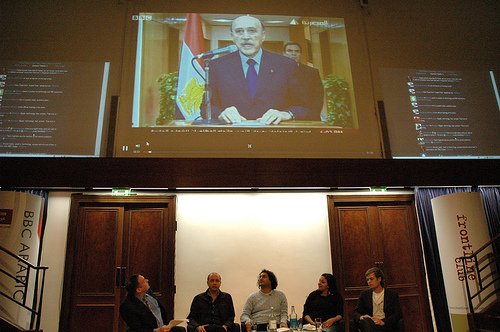
During a conversation with BBC Arabic’s Samir Farah on 15 October, the BBC’s former Middle East Bureau Chief Paul Danahar gave the audience at the fully-booked Frontline Club a first-hand regional snapshot of the post-Arab Spring Middle East.

He believed things might have turned out different if July’s coup that led to the removal of Morsi had been stopped.
“The easiest way of getting rid of the Muslim Brotherhood would have been to not have a coup at all, to allow them to fail. Then people wouldn’t have voted for them again and they would have lost credibility.”
Farah then moved the conversation on to recently escalated events in Syria, where the international community is currently inspecting and destroying the country’s chemical weapons.
“When I went to Damascus in 2012, people still talked about the possibility of reconciling with each other. . . . It’s too brutal and too bloody today and has gone beyond the point of returning as an entity.”
Another question to @pdanahar tonight at the @frontlineclub: What has the West done for the Arab uprisings?
— Sam Farah (@SamirGFarah) October 15, 2013
A member of the audience asked about America’s reluctancy to get involved with boots on the ground.
“The US public thinks ‘We don’t want to fight on someone else’s territory anymore.’ Obama promised to get out of war, the Americans want to be left alone. People are worried about the economy and their pay-checks now.”

If you missed the event watch it back here:
A lot has changed in the years since 9/11. The date itself has become emblematic of a change in attitudes towards Islam, perhaps most notably in the country which bore witness to the infamous attacks that day. Popular opinion has shifted, and the land of the free has become an increasingly hostile environment for Muslims. American Muslim: Freedom, Faith and Fear examines what it means to be a Muslim in America today and the consequences of the fact that, for many, the words Islam and terrorism are now permanently intertwined.
The documentary, featuring Karen Zarindast from BBC Persian and Samir Farah from BBC Arabic TV, was screened at the Frontline Club. The team travelled across the length and breadth of the United States in order to examine the lives and experiences of a vast range of American Muslims. They discovered a country in which fear and confusion surrounds Islam, and where politicians and the media often foment unrest in order to further their own objectives. What was once a thriving cultural melting pot where Muslims were welcomed has now developed into a nation over which a sinister and pervasive Islamaphobia has taken hold in the last decade.
A question and answer session followed, during which Darius Bazargan, the film’s producer, Azadeh Moaveni, the author of Lipstick Jihad, and Zarindast discussed the film and some of the key themes that emerged. One of the most important issues was the impact of American foreign policy, as Bazargan suggested in response to the question of whether or not American Muslims will ever be able to escape the dogma associated with 9/11:
“I don’t think there’s any chance of going back to the quiet life, especially because of the impact of American foreign policy in Islamic countries; either through the involvement with Israel or elsewhere. It will be less resonant if there are fewer coffins coming home, and there will be fewer coffins coming home if American foreign policy changes.”
The panel also talked about some of the difficulties faced when filming, including budgetary and time constraints, as Bazargan made clear:
“We had editorial difficulties, you’re a slave to the road in these kinds of documentaries. There were lots of interesting people we had to drop from the final cut simply because they popped up at the wrong point in our journey and didn’t fit the arc of discovery."
As the evening ended somewhat acrimoniously, with conflicting views being raised from the floor over what is clearly an emotive issue to many, Zarindast did offer a consolatory take on her experience:
]]>“I asked people if they would leave the country. They said no. I think it was fascinating, because I spoke to people in Birmingham after some of the recent trouble and they had never been to Pakistan or Bangladesh but they said that they would leave England in an instant. Nearly everybody I spoke to in America said no… this is their country.”
THIS EVENT IS OPEN TO THE PUBLIC
Ten years after 9/11 and a year before what are likely to prove deeply divisive Presidential elections, BBC Global News sent a combined team from BBC Persian and BBC Arabic TV on an epic road trip across the USA to find out what it is like to be a Muslim in America today. America's complicated relationship with Islam is examined through the eyes of two reporters - Karen Zarindast who grew up in Iran and Samir Farah who grew up in Lebanon.
]]>THIS EVENT IS OPEN TO THE PUBLIC
Ten years after 9/11 and a year before what are likely to prove deeply divisive Presidential elections, BBC Global News sent a combined team from BBC Persian and BBC Arabic TV on an epic road trip across the USA to find out what it is like to be a Muslim in America today. America’s complicated relationship with Islam is examined through the eyes of two reporters – Karen Zarindast who grew up in Iran and Samir Farah who grew up in Lebanon.
In a country where Freedom of Worship is guaranteed by the Constitution, the team travelled from New York to Texas to California and points in between. They met American Muslims from all walks of life: from a High class fashion designer in Manhattan, to a Muslim rapper in California, from a Pakistani born Texan "cowboy" to the Imam of the country’s largest mosque in the city of Dearborn — serving a Muslim population of some 30,000.
To a man and woman, all were grateful for the opportunities and freedoms provided by the USA and many were intensely patriotic. Yet set against a backdrop of politically motivated Islamophobia, stoked by some partisan media outlets, many in the American Muslim community now feel under more scrutiny than ever before: they are constantly having to justify their faith and prove their loyalty to their homeland."
]]>The first half of the evening at the Royal Institution of Great Britain, considered the role of technology in the Egyptian revolution and the panel resoundingly downplayed the role of Facebook, Twitter and even the Internet.
"I guess [the] audience could tell we didn’t really want to talk about media and tech rather we wanted to talk revolutions"