How have cuts within the industry and the turn to online readership impacted the phenomenon of ‘fake news’? And how can journalism maintain its integrity in a time when unverified information circulates on social media under the guise of fact?
Readers across the political spectrum are calling for new standards of accuracy and impartiality. In a monthly series of exclusive talks hosted by media analyst Roy Greenslade, we are bringing together today’s leading news editors to discuss the new challenges facing the online journalism industry. For the first of these talks, we will unpack the ‘fake news’ debate.
Host:
Roy Greenslade is one of Britain’s foremost media teachers. He is a leading commentator and columnist on the media, and currently blogs for The Guardian. As a journalist he rose to the highest levels of management in a career taking in The Sun, the Sunday Times, and culminating in the editorship of the Daily Mirror.
Speakers:
Ben de Pear is Editor of Channel 4 News. Previously Head of Foreign News, has led an award-winning team of foreign correspondents, including those that produced the BAFTA-winning coverage from the 2011 Japan earthquake. He also led the programme’s investigation into the end of Sri Lanka’s civil war which has prompted a UN investigation and global calls for a war crimes tribunal.
Rory Cellan-Jones has been a BBC reporter on business and economics for nearly 30 years. For the last decade he has been the BBC’s Technology Correspondent, charged with widening the Corporation’s coverage of the impact of technology on business and society. He has also presented a number of Radio 4 documentaries, including The Secret History of Social Networking and The Force of Google, an investigation into the power of Google’s search algorithm.
Madhumita Murgia is a prize-winning journalist and editor with expertise in the fields of technology and science. As the FT’s European tech correspondent, she reports on major news, trends and innovations in global technologies, and their impact on Europe. She was formerly head of the Telegraph’s technology section, where she wrote a weekly column on the business of technology, and has written features about data privacy, security and digital health for publications such as Wired, Newsweek and BBC Future.
Owen Bennett is Deputy Political Editor of The Huffington Post UK and a critically acclaimed author. His second book, ‘The Brexit Club: The Inside Story of The Leave Campaign’s Shock Victory’ was published in 2016, and was described as “a riveting inside account” of the referendum by The Observer. Bennett is a regular contributor to the BBC and Sky News and has also written for the New Statesman website and other political blogs.
]]>
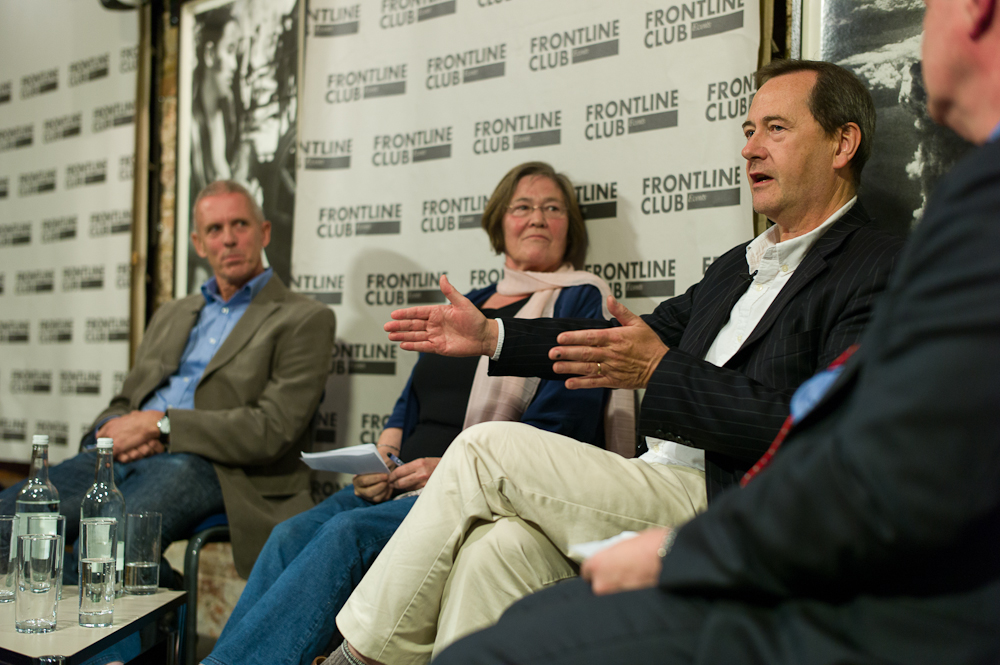
Ten years on from the publication of the September dossier, Kevin Marsh, former editor of the Today programme, spoke at the Frontline Club on 18 September about the political firestorm in the aftermath of the Radio 4 show’s "sexed up" comments made by former Defence Correspondent Andrew Gilligan.
The insider story of what happened at the BBC during the fallout, documented in Marsh’s new book, Stumbling over the Truth, fills in a “massive piece of history” said discussion chair Roy Greenslade, media commentator and Professor of journalism at London’s City University. The book details the “turning of the wheels” at the BBC in the run up to and in the wake of the Hutton Inquiry, set up to investigate the circumstances surrounding the death of weapons expert Dr. David Kelly, who was identified as Gilligans’ unnamed source. The controversy cost the BBC its Chairman and Director General.
Marsh pointed out that there was a daily deluge of complaints and denials of facts and figures from Downing Street, with the first few complaints about Gilligan’s comments from then communications chief Alastair Campbell aimed at his lack of knowledge about the way intelligence works:
“[Alastair Campbell] thought at the time that Gilligan’s story was just a rehash of old stories … this notion that he was outraged from the very beginning, it is complete nonsense, as he recalls in his own diary,” he said.
Though agreeing that Campbell’s agenda was to stay on top of the news and that the communications office did try to “point to the truths that suited”, Lance Price, former BBC political correspondent and director of communications for the Labour Party, said that characterising the barrage of complaints as a daily event was an exaggeration and remarked that at the time the BBC show appeared biased:
“I felt that John Humphrys [presenter on Today Programme], Andrew Gilligan and by implication the programme itself, had made up their minds that Tony Blair and the new Labour government were untrustworthy people and that came through to me,” he said.
Responding to a question about whether the media failed to tell the British public the truth and hold power to account, Richard Tait, Professor at Cardiff University and chairman of INSI UK as well as former BBC Governor and Trustee, from 2004 to 2006 and 2007 to 2010 respectively, said that journalists were too focused on reacting to the government’s agenda and that the challenge is to look beyond the daily battle:
"What happened to the BBC and other organisations during this period is that they got stuck into a very detailed aspect of the story … and at the end … you have a situation where David Kelly commits suicide because he gets caught up in a knife fight between the BBC and Alastair Campbell, which he was [ill-equipped] to deal with.”
Also on the panel was Clare Short, who resigned from the government over the Iraq war and has since authored her own account of events. She noted that the media’s failure should be seen in a larger context and reminded the audience that the Iraq Inquiry, headed by Sir John Chilcot, is yet to issue its final report.
“I hope and expect Chilcot in very calm language to say all our institutions failed and need some correcting … What do we have to do to make these decisions more carefully and consider the evidence more carefully from inside government?” Short said.
Concluding the discussion, Greenslade reminded the audience that in spite of Hutton, British people believed the BBC more than the government and turned the floor over to audience questions, many of which focused on the situation today. Can the public now trust reports on WMD in Iran or the volatile situation in the Middle East? In general there was agreement on the panel that the effects of Hutton on today’s reporting are negligible though it did reinforce the power held over journalists who faced being cut out of the loop if they didn’t tow the line. There is no doubt, however, that cynicism over the affair continues to the present day.
Greenslade said:
At the end of the book …[is] a straightforward-ish transcript … of John Humphrys interviewing Blair in which he scores about five key points to show that Blair’s whole way into war was founded on a set of…”
Lies?” said an audience member.
Propaganda,” finished Greenslade.
Photo courtesy of Chris King, Frontline Club member and photographer
Watch the full event here:
]]>
Tonight we’ll be discussing the ongoing MP Expenses scandal in the UK and whether or not the story was a triumph of journalism or the chequebook. Roy Greenslade chairs the discussion tonight 8 June and we start at 7:30pm GMT. As usual, if you can’t make it to the Club in person you can watch the discussion and join in the chat live on the Frontline Club broadcast channel, on this blog post or on the Club events pages,
With each new tranche of revelations about MPs expenses the Daily Telegraph has continued to put on sales and gained kudos for its good old fashioned journalistic scoop. With a story that has shaken Westminster to its foundations the Daily Telegraph has been able to set the news agenda, releasing its revelations ahead of the 10pm news bulletins. The daily diet of scoops is said to have boosted newspaper sales by tens of thousands and web traffic has also increased and no doubt will, in financial terms at least, justify the cost of obtaining the information. But what does the expenses scandal tell us about journalism today? link
On the panel we have Andrew Pierce, assistant editor at The Daily Telegraph, Stephen Tall, editor at large with the Liberal Democrat Voice, the journalist Heather Brooke, author of ‘Your Right to Know’ and Frontline favourte Roger Alton, the editor of The Independent.
]]>Greenslade told Journalism.co.uk, that he hopes to take up topical issues raised by the people who live in the diverse community: “And I expect to open a dialogue with the city’s councillors who represent the area. What do they do? Who are the community police officers, and how do they operate?”
Before another week passes here’s a round up of the first event I organised for the Frontline Club. For the past month or so I’ve been finishing my time at Press Gazette – before Wilmington closed down the operation – and working part time at the Frontline, so it’s perhaps not surprising that former colleagues were heavily represented.
A former Press Gazette editor Ian Reeves chaired what proved to be a very forensic examination of the health of the local and regional media. Media commentator Roy Greenslade, Deloitte’s William Yarker, Keith Sutton a former president of the Society of Editors and Jon Slattery, former deputy editor of Press Gazette and now prolific blogger on the press took part in the examination, diagnosis and attempt to find a cure.
You can watch the event above. And for further reporting, journalism.co.uk look at the panel’s take on the social impact of disappearing newspapers; How local media management is stifling digital innovation and why the Society of Editors and Newspaper Society’s plans on competition rules for local newspapers are ‘bonkers’.
]]>We’ll be discussing the fate of the regional press at the Frontline Club tonight. Taking part will be Roy Greenslade, Commentator and Columnist, Jon Slattery, Freelance journalist, William Yarker, Director in Deloitte’s Media Consulting Practice and others. We get started at 7pm GMT /11am PST. If you can’t make it to the club in person, you can join in on the Frontline Club live channel. We’ll also be streaming the discussion on the Events page and in the video pane above,
]]>Following in the footsteps of GMG and The Manchester Evening news the Daily Mail group cut 1000 jobs from their regional arm this week. Could regional news soon be a thing of the past or can the industry find ways to survive?
In a recent House of Commons debate on the issue Culture minister Barbara Follett said the government would “work tirelessly to secure news for local communities” but is this even within the government’s capabilities?
Is there a long term future for the regional press? Can it weather the storm and how important is it that it does so? Is the current crisis an indication that it’s time to find new models to guarantee its survival? link

The Guardian’s Roy Greenslade will be posing questions to Robert Thomson, Editor of The Times, at the Frontline Club tonight and, in a very Web2.0, crowd sourcing, wisdom of the oiks manner, he’s looking for your questions. Some questions already coming in,
Do you think think that Rupert Murdoch’s influence over the news media should be increased or decreased? Second question: How much does News International save by its tax avoidance scemes? In tabloidspeak: How many police officers, schools, or hospital beds is it? What would it work out per year per Times reader for instance? Third Do you think we’ll ever see a newspaper again of the quality of the pre-Murdoch Harry Evans Sunday Times? link
And here’s a clip from the Q&A at the club – which at the time of going to blog – is one of the most watched videos on YouTube. 8,136 views (so far) in little over a day.
]]>