By Nicole Hunt
The day after the Bahrain Grand Prix, 21 Bahraini activists, including hunger striker Abdulhadi al Khawaja, are due in court in Manama on Monday to hear the outcome of their appeal against life sentences handed down in June 2011 for conspiring to overthrow the government during last year’s protests. The decision to schedule the hearing after the Grand Prix was a controversial one, as al Khawaja’s deteriorating health two months into his hunger strike raised the very real possibility that he could die before the race took place. UK supporters said al Khawaja’s death would be a ‘stain on Bahrain’.
Burmese democracy leader Aung San Suu Kyi is set to take up her seat in the Pyithu Hluttaw (House of Representatives), following a landslide victory by her National League for Democracy in 1 April by-elections, though there have been suggestions that NLD MPs will boycott the opening over an oath of allegiance that forces them to swear to safeguard the constitution. Suu Kyi’s parliamentary debut comes amid news that she may travel to the UK and Norway in June, where she would be able to see her grandchildren for the first time and finally pick up her Nobel Peace Prize, awarded in 1991.
The late Malawian President Bingu wu Mutharika, who died of a heart attack on 5 April, is laid to rest at his family farm in Thyolo. There is speculation that close ally Robert Mugabe and Sudanese President Omar al Bashir could be among attendees at the state funeral; Malawi came under fire from the International Criminal Court last year when it failed to arrest Bashir during a visit to the country for a regional summit. Bashir is wanted by the court for alleged war crimes in Sudan’s Darfur region.
All eyes stateside on Tuesday as a pre-trial hearing begins at Fort Meade, Maryland, for Private First Class Bradley Manning, who has been charged with a variety of offences, including aiding Al Qaeda, for his alleged role in leaking sensitive military material to WikiLeaks, among which was a video which later became WikiLeaks’ Collateral Murder film.
In New York, Secretary of State Hillary Clinton is due to give the keynote speech at the Time 100 Gala Dinner, being held in honour of those named to Time’s 100 Most Influential People list on 18 April. In addition to Clinton and President Barack Obama, this year’s list also included the likes of Syrian President Bashar al Assad, North Korean leader Kim Jong-un, Italian Prime Minister Mario Monti and, of course, Kate and Pippa Middleton.
And, just for good measure, Republican primaries also take place in New York, Pennsylvania, Rhode Island, Delaware, and Connecticut, though now that everyone is agreed that Mitt Romney will win everything, it’s a less exciting race.
Why will journalists be fighting for a place at the Scottish Parliament’s Economy, Energy and Tourism Committee meeting on Wednesday? Because US property tycoon Donald Trump – who at one point pictured himself being the focus of those Republican primaries – is scheduled to appear to give evidence on government plans to build an offshore windfarm near his £1bn golf resort. In written evidence submitted ahead of his appearance, Trump said the plan would destroy Scotland’s countryside and coastline, and was tantamount to ‘committing financial suicide’ – a jibe that would have stung even more after the controversial Skintland issue of the Economist.
Charles Taylor’s nine-year war crimes case comes to a head on Thursday as the Special Court for Sierra Leone announces its verdict. While media coverage in the summer of 2010 suggested that perhaps Taylor was on trial for giving Naomi Campbell a diamond or two, the former Liberian President has actually been tried for crimes against humanity, violations of Article 3 of the Geneva Convention, and other serious violations of international humanitarian law – including, of course, allegedly giving Sierra Leonean rebels arms in exchange for so-called ‘blood diamonds’.
In a less groundbreaking trial – though one that receives headlines whether models are involved or not (and they frequently seem to be) – former Italian Prime Minister Silvio Berlusconi returns to court in Milan on Friday to face charges of paying for underage sex. While the trial is now over a year old and coverage has been relegated to the Italian press for some time, recent hearings have reignited international interest as the lurid details of Berlusconi’s ‘bunga bunga’ parties have been disclosed.
EU High Representative for Foreign Affairs Catherine Ashton begins a three day trip to Myanmar on Saturday, where she is scheduled to meet with government officials and opposition members (including Aung San Suu Kyi) and is expected to open the EU’s new embassy in Yangon. Her visit follows a meeting on Monday of EU foreign ministers, during which they are expected to relax sanctions on Myanmar in the wake of recent political improvements.
Guinea-Bissau had been scheduled to hold its presidential run-off vote on Sunday, following first round polls on 18 March, but as front-runner Carlos Gomes Junior was arrested as part of a military coup d’état on 12-13 April, the election will not be going ahead. The military junta has announced a two-year timeframe for new elections, which has been agreed by opposition parties but not Gomes’ ruling party.
Sunday also marks the 20th anniversary of the beginning of the Los Angeles riots, which left 53 people dead and over 2,000 in three days of violence following the acquittal, by an all-white jury, of four police officers who were videotaped beating black motorist Rodney King. The anniversary comes amid heightened racial tensions in the US following the delayed arrest of George Zimmerman for the murder of Trayvon Martin.
]]>
By William Turvill
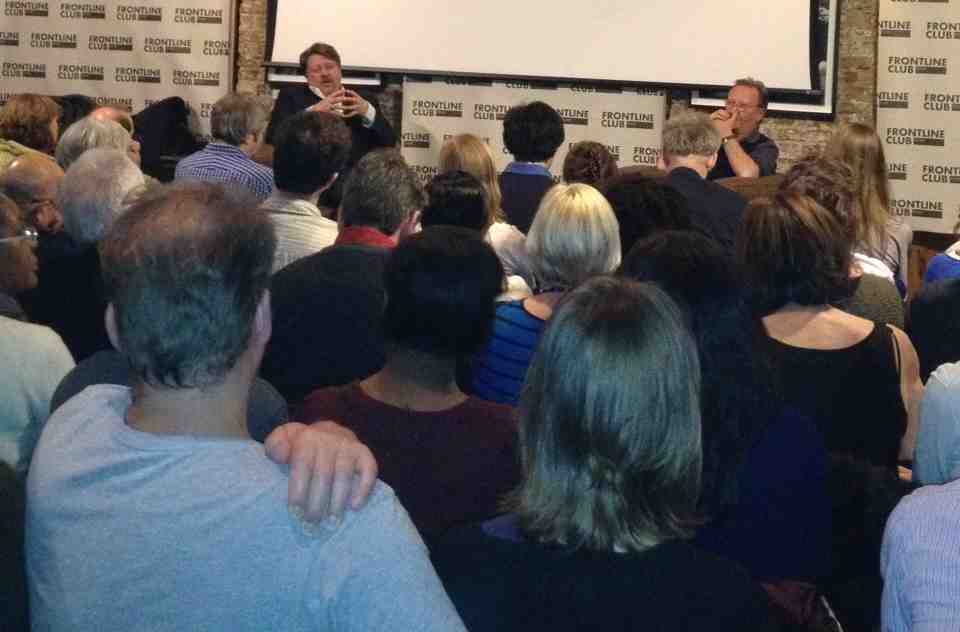
A sell-out crowd last night gathered at the Frontline Club for an exclusive screening of Robert Mugabe… What Happened?, followed by a question and answer session with the film’s director and producer.
The documentary, which premiered at last year’s Encounters South Africa International Documentary Festival, gives a historical account of Mugabe and his role as leader of Zimbabwe.
As the title suggests, its main aim is to discern how this once promising leader of 1980, who played a huge role in the liberation from white majority rule of the country, became the violence-inciting dictator of 2012.
The first question put to the duo, by the Frontline Club’s documentary programmer Sophia Loukaides, was why they had chosen to make this film.
“Well,” said director Simon Bright, “I came from an unusual minority – I was white Zimbabwean and was against the colonial, white supremicist government of Ian Smith. When the Rhodesian war started I had to leave the country, but was given the opportunity to go back when Mugabe came into power – he was my hero.
“I went back to work for the ministry of agriculture and it was an incredibly exciting time – rebuilding the new Zimbabwe. The place was really humming."
“But by 2004, I was stuck in prison. I had to ask the question: what happened? What happened to this dream? I personally blame Mugabe for destroying an African renaissance.”
The movie made clear the views on this matter by many Zimbabweans who experienced Mugabe’s rule from the outset, 32 years ago. Quoting one of the film’s interviewees, a member of the audience asked: “Do you agree that Mugabe has only ever been interested in power?”
Michael Auret, the film’s producer, said: “I feel like he had the preconditions to become a psychopath. He had a tough childhood and then he wasn’t allowed to attend the funeral of his own child."
“He had to fight for power during the Rhodesian war. For me, I would have believed he was a hero turned villain if it weren’t for Gukurahundi, which proves he’s been slaughtering people since 1982.”
With several people in the audience who had experienced Mugabe’s rule first hand, including ninenty-year-old Lawrence Vambe who had been at school with the leader, there were several questions about relevant aspects of history that weren’t included in the film.
When asked why the roles of the Catholic Church, the British government and the early colonisation of the country were not explored further in the film, the pair were frank and honest.
“The editing of the film took a lot longer than it should’ve done,” explained Auret. “I was obsessed by historical accuracy, but we also needed to get a dramatic narrative structure.”
Bright added: “I can see your points – they are important factors, but you can’t cover everything in a film.We already had trouble squeezing in as much as we did.”
]]>In 1980 when Zimbabwe became one of the last African countries to win independence, smart and charming Robert Mugabe seemed poised to lead the country through a smooth transition from white minority rule.
He impressed leaders and people around the world with his intelligence, articulate speeches, and was deemed one of the great African leaders.
For the first 15 years the country enjoyed growing prospertity.
Fast forward to 2012. Mugabe is a controversial figure known for his ruthless response to any oppositon and there is little trace of the leader that brought hope to an entire country and region.
Director Simon Bright takes us on a journey through Mugabe’s difficult childhood, his role in opposing the white-minority rule goverment of Ian Smith and his imprisonment for 10 years before his rise to power. The film asks why Mugabe is so reluctant to leave power and sets out to piece together the answer to the question…"what happened?"
Director: Simon Bright
Producer: Michael Auret
Year: 2011
Length: 84′
]]>The following week we will be launching a series of discussions, screenings and workshops examining the risks faced by journalists around the world.
The award-winning, genre-bending documentary filmmaker Mads Brügger launches our new masterclass series, and Tweets from Tahrir is the first of our Screenings from the Frontline with Al Jazeera.
February’s #FCBBCA will bring together a distinguished panel to discuss Iran’s internal power struggle and its turbulent relationship with the West.
We will also be examining the rebuilding of Libya and Fawzia Koofi will be discussing why she wants to become President of Afghanistan, while Matt Frei will be joining us to look back on his career.
Follow us on Twitter and catch up on any events you missed on the Forum blog or download our podcasts on iTunes.
ALL EVENTS ARE OPEN TO THE PUBLIC
]]>
Former Egyptian President Hosni Mubarak returns to court on Monday. Along with his sons Alaa and Gamal he appears charged with premeditated murder in connection with the deaths of protesters during the 25 January revolution.
Monday also sees the publication of Japan’s Q2 stats. The country’s GDP shrank 3.7 per cent in Q1, largely attributed to the 11 March disasters, and a similar decline is expected as the country copes with power shortages following the nuclear crisis.
It’s the turn of Europe to brace itself for GDP figures on Tuesday, with the official publication of the euro zone GDP figures. Publication comes amid recent fears growing over the global economy and the recent agreement to give Greece a second bailout.
Eyes are drawn to the International Criminal Court on Wednesday, as former UN employee Callixte Mbarushimana appears charged with five counts of crimes against humanity in the Democratic Republic of Congo in 2009. Mbarushimana is also believed to have been involved in the Rwandan genocide, but has never been charged over the atrocities.
Angola also hosts a summit of the Southern African Development Community in Luanda on Wednesday. The two-day affair is expected to focus on Zimbabwean President Robert Mugabe and his refusal to fully implement the Global Political Agreement, as well as the recent fuel protests in Malawi.
Pope Benedict XVI makes an apostolic journey to Madrid on Thursday, to attend a gathering of Catholic youth to mark World Youth Day. Visit includes a Holy Mass at Cuatro Vientos Airport on 21 August.
In the UK, thousands of students learn what their future holds when A Level results are published on Thursday, and students scramble for (often) oversubscribed university places.
Friday sees the last day in office for Romanian Health Minister Attila Cseke, who tendered his resignation earlier this month following a dispute over funds for his brief. Under Romanian law Cseke had to continue his post for 15 days at a maximum until Prime Minister Emil Boc nominated a successor.
On Saturday the UN Panel of inquiry, led by former New Zealand Prime Minister Geoffrey Palmer, is expected to release its report. The report has been delayed several times, most recently from 27 July, and could well be postponed again.
The 2011 Homeless World Cup begins on Sunday, giving homeless and socially marginalised players from across the world the opportunity to represent their country at the beautiful game.
On Sunday a national memorial service takes place in Norway, commemorating the 77 people who were killed in the 22 July Oslo bombing and Utoya shootings. Ceremony takes place in Oslo Spektrum and was announced by Prime Minister Jens Stoltenberg ‘to take care of each other and show compassion’.
]]>Zimbabwe’s leaders have been locked in a shaky power sharing coalition since opposition leader Morgan Tsvangirai was sworn in as Prime Minister in January 2009. This agreement followed a period of violence and turmoil after the 2008 elections, which Robert Mugabe is widely believed to have stolen.
President Mugabe is now pressing for fresh elections in 2011, despite MDC leader Tsvangirai saying that they could not take place without reforms and constitutional review.
Analysts fear that Zimbabwe could be marred by violence in a repeat of 2008, when Mugabe lost the popular vote, but forced a win in a runoff election. With the military, police and state apparatus on his side there is little chance that Mugabe would allow a remotely free or fair election would likely ensure his removal from power.
Join us at the Frontline Club with a panel of experts to discuss what the coming year holds for Zimbabwe – could there be a fair election, or will violence and intimidation again escalate?
Chaired by Gerry Jackson, founder of SW Radio Africa – the independent Zimbabwean radio station that broadcasts to Zimbabwe on shortwave and worldwide via the internet. She has been reporting on Zimbabwe for over 25 years.
With:
Geoff Hill, bureau chief in Johannesburg for The Washington Times and author of The Battle for Zimbabwe and What Happens After Mugabe?;
Chofamba Innocent Sithole, Zimbabwean journalist and community organiser;
Blessing-Miles Tendi, author of Making History in Mugabe’s Zimbabwe: Politics, Intellectuals and the Media;
George Shire, cultural theorist, political analyst and reviews editor for “Soundings”, a journal of politics and culture.
]]>There has been a huge amount of interest by the international community, diplomatic and media, and by the general public, in the Zimbabwe crisis in the past three weeks. Much of the reporting has been very good. Some has been extremely poor. All of us, pretty much without exception, were caught up in the euphoria in early April when it became clear that the MDC had swept the board, and Mugabe was "finished". Well, that was a mistake, wasn’t it?
It might be a good idea to start with the reasons why Mugabe is so unlikely to step down quietly. There are around 500 people for whose benefit Zimbabwe is currently run. Perhaps it’s a thousand. Certainly it is less than a tenth of a percent of the population. They are senior members of the ruling party, of the armed forces and security establishment, and a select few around those key members. Imagine, if you like, that Zimbabwe is a village, with a chief; a Dare, or council of elders; and a few hundred villagers.
There are then several thousand goats, and chickens, and head of cattle, and guinea fowl. And there are a few million stalks of maize, and soya, and Marula trees. The livestock and the crops are more or less disposable. The village can’t survive if there are none at all, but no individual goat or stalk of maize isnecessary to the well-being of the village.
On the other hand, all the five hundred inhabitants know each other, are connected to each other, and although sometimes there are falling outs, they all look after one another when necessary. This is not just an Orwellian metaphor. It is quite clear that the elite, the five hundred, or a thousand, have no more sense of responsibility to the people than a farmer does to his chicken, or his corn. Of course, he’ll look after it up to a point; but he’ll have no compunction about cutting its throat or taking a scythe tothe field if that’s what’s needed.
These five hundred, or a thousand, surround Mugabe. They are his entire constiuency. They ensure that he hears only two messages from his people: "The country will be colonised again if you don’t keep fighting" and "Everything is fine and everybody loves you." It’s a Potemkin State. There’s a lot of talk about the economy bringing Mugabe down. This pre-supposes that those in charge need to preside over what we would consider to be a functional economy. I don’t think this matters to them. They are quite happy to run an economy that is primarily based on subsistence agriculture.
Hungry peasants have always been Zanu PF‘s primary constituency. Aspirational middle class urbanites are always going to want freedom and a functioning economy. So these are the choices facing those who are not connected to the system; They can retreat to the villages, and pray there is enough rain and cow shit to grow a crop to feed their family. Or they can leave their families behind, and sell newspapers at the traffic lights in Jo’burg. Or work as a gardener in Botswana, or a taxi driver in Luton. Any way to earn real money, which they can then send backto keep their families alive.
There are two ways to do this. You can either send money through the banking system, pay a thousand Rand or Pula or Pounds into a bank account in Zim, and have your relatives withdraw it in Zim dollars (it is virtually illegal to draw – or own, or spend – foreign currency within Zimbabwe). If you use the bank, you will be reimbursed at a rate of 60,000 Zimbabwe Dollars (ZWD) to the Pound. The alternative is to use the black market, where the rate is better. A lot better. Two thousand times better, to be precise, this week. On the black market a pound fetches 120 million ZWD.
Unfortunately, the elite controls at least 75% of the black market in cash. So as long as they can take a hundred Rand, or a thousand Pounds, and exchange it for bundles of worthless paper that could easily be printed on a photocopier, they will get richer. The only way they can lose is if people refuse to accept Zim dollars, and insist on what we call "real money". The elite can stop this happening (they do stop this happening) by making it a criminal offence to own foreign currency. So if you want to buy a loaf of bread – currently 30 million ZWD you can either change at the official rate of ZWD 60,000 to the Pound, which means it costs £500, or you can change your money on the black market rate of ZWD120 million to the Pound and pay 25p for it – thereby keeping the elite in the manner to which they have become accustomed.
This works well for them, obviously. It works even better when they can go to the Reserve Bank and buy their US dollars for the official rate – in other words, pay one fifth of a cent for each dollar they buy. There’s not quite enough money in the Reserve Bank to go round, as the economy falters. But there’s certainly enough to pay off a loyal lackey with fifty thousand pounds to buy a new Mercedes every now and again – for which he pays £25. Yes, that is TWENTY FIVE POUNDS, for a new Merc. Tax free, of course. Just the promise of this possibility is enough to keep most of them quiet. Sorry. To keep ALL of them quiet.
The big multinational mining companies that run the Platinum mines and the Gold mines pay a royalty to the government – rumoured to be a million Poiunds a day, directly to the President’s office, for the Impala ZimPlats Platinum mine at Ingeze. That pays for Isreali communication intercept equipment and water canon, and Chinese AK 47 bullets and spare parts for the APC’s, and South African fuel for the President’s motorcade. A tiny bit of this also goes to schools and hospitals and fixing the roads and keeping Air Zim in the air and sewerage and electricity and everything else that a functioning state is supposed to provide forits people.
But it is a vanishingly small amount. Most gets poured into the trough. Even the hundred and fifty thousand percent inflation doesn’t interrupt this vicious circle. Prices increase at the rate the Zim dollar collapses. So though a loaf of bread was two hundred dollars fifteen months ago, and is now thirty million, it is still 25p in "real money". So long as the economy is kept alive by Zimbabweans in the diaspora earning "real money" and using the black market to get that money home to their dependents, the purchasing power of that diaspora income doesn’t really change. The relatives back home still get to buy the loaf of bread. The elite still get to keep the “Real Money”. The elite have had their snouts in the trough for so long that they have failed to notice the way the masses have turned against them.
So they have been as astonished this past three weeks by th
e surge of political dissent as those village farmers I referred to earlier would be if the field of corn rose up against them. It is inconceivable to them. For ten years ZANU PF loyalists have convinced themselves that the MDC and the democratic opposition was a creation of the British, the Americans, and the white farmers. Any black member of the MDC is a sell-out and an Uncle Tom.
Zanu have rigged the elections over the past few years, but they’ve never had to rig extensively, and they were pretty sure that this time they’d fixed the problem for good. Therefore they were absolutely flabbergasted when, three weeks ago today, the people of Zimbabwe rose up and threw them out. For three or four days they reeled. Emissaries were sent to Tsvangarai’s people, sounding out options for a government of national unity. Bob’s wife and kids left the country – probably accompanied by the families of most of the top leadership.
There were suddenly fewer new luxury 4×4’s on the road. Building worked stopped on the huge palaces going up around Borrowdale and Hogerty Hill. But then they rallied. It started, it seems, with a group of senior generals – what is known as the JOC – the Joint Operations Command, amusingly the same name given to the military/civilian crisis committee that ran Rhodesia during the Bush War.
Although Mugabe is probably immune from international prosecution, and therefore from domestic legal process, many of his senior military people are not. Mugabe can’t be sent to The Hague tribunals, because they are only for Sierra Leone and Yugoslavia. The International Criminal Court only has jurisdiction on crimes committed after the Court’s inception in 2002. So unless you count Murambatsvina, which was a disgrace but arguably not a Crime against Humanity, Bob is in the clear.
It is his legacy that he worries about, not his freedom. Since then, they have adopted a two-pronged strategy. On the one hand they are frantically stuffing ballot boxes in a secret location – probably within the military headquarters (which is still called "KG6" – though I suspect no one in the security establishment knows that this stands for King George VI, and was so named back in the fifties) in the hope that they can get enough false ballot papers in the boxes to avoid a re-run. And on the other hand, they have turned on their people.
They are aware that widespread killing is not going to be defensible, even among their allies in the Africa Union and beyond – China, North Korea, Iran, and Cuba, (though two MDC activists have been killed in the past week). China in particular has enough problems with human rights activists at the moment. But they are beating and brutalising and burning huts across the country to try to "encourage" people not to vote for the opposition should there be a run-off.
The MDC is utterly hamstrung. Never particularly good at showing courageous leadership when it is most needed, they have cowered and squabbled and acted like rabbits caught in the headlights of a juggernaut. We think Morgan is in exile, though he hasn’t admitted it yet. The MDC has argued that any sign of public dissent will be used by the regime as an excuse to declare a state of emergency, and smash them down. But this is what is happening anyway. Had the MDC brought a hundred thousand people out onto the streets at the beginning of April, we would probably have a handful of martyrs, and a new government. But they had neither the courage, the wit, or the organisational skill to move when there was a chance. Now they cannot get more than three people together without the police and army descending on them. I fear that the moment has passed.
My fear at the moment is that Mugabe and his cohorts are looking at the examples of Burma, China, and North Korea, where over the past fifty years there has been a brutal suppression of democratic popular dissent, coupled with Maoist "back to the land" socio-political policies, and the hegemony of the one-party state.
And despite all these states being roundly condemned for these policies by their neighbouring states and by the international community, they have all survived. It is forty years since Mao’s "Great Leap Forward" led to the deaths of millions through starvation, imprisonment and the criminalisation of free thought. Yet thirty years after Mao died, the Communist party he founded is still in unchallenged power, opposition activists are routinely jailed and beaten, and Mao’s picture hangs in every government office and school. But it is Burma that is probably the best parallel.
In 1988 the military dictatorship which had been in power since 1962 was confronted by a popular uprising against economic collapse and political repression. The military dictator Nhe Win crushed the rebellion with great brutality, and in 1992 felt sufficiently confident to hold an election, which was won by the democrats under Aung San Suu Kyi. This was not the Generals’ preferred outcome. So instead of respecting the result they threw all the opposition leaders in jail – where they mostly remain today – retroactively rigged the result, declared a state of emergency, and have ruled brutally and largely unchallenged ever since.
The outburst of protest in September last year was crushed, several hundred were killed, and despite a little ritual hand-wringing the world turned it’s back. That, I believe, is the calculation that Mugabe and his senior ministers and generals are making today. They reckon that if they can get over this current "inconvenience" they will be able to re-engineer the country to make it a Zanu state for ever – at least in political terms, where "forever" is the next five decades.
What I find most frightening is that already the opposition and elements of the international community are subsiding back into apathy. Already I am hearing people saying, "Well, you know, he’ll get away with it this time, but he won’t last forever, and there’ll be another chance in five years." There won’t be. If he doesn’t go, there will not be another chance.
There will not be another election in five years time unless Z-PF is the only party contesting. There will be no MDC – everyone who opposes Zanu-PF will be in jail or in exile. This is not a game of football. I think we should all remind ourselves this, everyday. There is a rapidly narrowing window of opportunity. This month. Perhaps next. After that, the country will be stolen from us for good.
]]> We woke early on the promise that the Zimbabwe Electoral Commission (ZEC) would be starting to announce the official results as of 6am. In fact it announced one parliamentary seat, Mutasa South which went in favour of the Tsvangirai faction of the Movement for Democratic Change (MDC-T) by more than 8,000 votes to 3,000 and some for Zanu-PF.
It is very frustrating to know that the count was finished on Sunday, all the tallies reported to the various command centres and from them to the national command centre, but that process of “verification” at the NCC is taking forever.
Of course many Zimbabweans think there is a sinister reason for this: “You know they’re delaying revealing the results so they can fix them, don’t you?” asks Jules rhetorically.
The absence of concrete facts, ensures that rumours fly from lip to lip. “The army chief of staff has given orders to the ZEC to hold the results for 24 hours to allow him to deploy his men – why would they do that?” The assumption is that the army will either crack down on any protests over the obvious rigging of the presidential election result, or they will stage a coup if the real result, a Tsvangirai win, is announced.
“Justice Minister Patrick Chinamasa has lost his seat.” “Elliot Manyika, the MP for Bindura has lost his seat and shot his driver dead because his driver showed he was happy that the MDC-T candidate had won.” True or not, these snippets are passed from person to person, fuelling the feeling of nervousness.
“You forget we have been down this road before. Three elections – 2000, 2002 and 2005 where it was clear that the MDC had won, but Zanu-PF somehow was announced the victor.”
“Our only hope this time is that, in spite of the gerrymandering, the postal vote, the problems with the electoral roll and so on… that the transparency of the vote and count in each ward, the public posting of the results for all to see and verify in person, will make it impossible for them to steal the election again.”
I have decided to move on from Harare into Matabeleland. I want to see how things are in Bulawayo, Hwange and Victoria Falls. All day yesterday I received text messages from friends in those areas gleefully recounting the results. It seems that Morgan Tsvangirai has swept the board, to the shock and dismay of the Arthur Mutambara faction of the MDC.
One of the things that never ceases to amaze me here is how efficient and well-organised Zimbabwe can be, compared to so many of its neighbours. I call the local reservation number for Air Zimbabwe 575111, choose option 7 for reservations, and speak to a charming and friendly-sounding lady who happily makes a booking for me and gives me my reference.
One day later, I turn up at the international side of Harare airport to the Air Zimbabwe ticket office, state the reference, am told my seat is indeed confirmed, pay up and within minutes am issued a ticket which I then take the 50 metres or so to the domestic terminal where I check in within seconds. It takes a few more seconds to put my bags through the scanner and walk through security into a pleasant and spotlessly clean departure lounge.
Interestingly, there is a group of four or five café-style tables with chairs in an area adjacent to a café-bar, currently closed, all taken by white people. The remaining passengers, white, brown or black slump in the usual plastic bucket-seat rows of a departure lounge.
Boarding is quick and efficient, the staff aboard the aircraft courteous and friendly. We are even given a snack and hot drink on the flight, which barely lasts an hour. Once on the ground, a quick walk across the apron and straight through the domestic arrivals gate and I am outside. I mentally compare and contrast to the nightmare of transiting London Heathrow and chalk up a few more brownie points for Zimbabwe.
My taxi ride from the airport meets with a police checkpoint – the first I have seen in several days. The policeman and my driver exchange a few words, two 10million Zim dollar notes are surreptitiously passed from my driver’s hand into the policeman’s hand under the pretext of an African reverse handshake “so he can have a drink” and then we are allowed on.
“Usually they stop us to check if we have currency we shouldn’t have, or goods we shouldn’t have, then they would confiscate them”, the driver says.
Then he shakes his head sideways and smiles: “but they are paid peanuts and I’m sure they too are hoping for good news today.”
He means the announcement of the election result, which pretty much all of Zimbabwe is hoping will mean a regime change and the start of a new phase of development that will restore harmony and prosperity to this beautiful country.
Time to go out on the roads and see what is happening here in Matabeleland.
]]>
Since breakfast time we have been criss-crossing the city, looking at the results posted on each polling station wall and talking to people who have been getting results from elsewhere in calls and text messages sent by relatives.
It’s becoming clear that the MDC has won a landslide victory in Harare and indeed in many of the provinces.
It is rumoured that Robert Mugabe and his family have left the country for Malaysia.
At Belvedere School which had two polling stations, A and B, we spoke to a man who had just come from church. He said Moab’s cousin attends his church and confirmed the rumour to him. Hard to tell if this is true, but he was middle-class, well-educated, well-dressed and seemed plausible enough.
At Belvedere A Tsvangirai won 222 votes to Mugabe’s 45 and Makoni’s 51. At Belvedere B Tsvangirai won 215 to Mugabe’s 35 and Makoni’s 51.
We drove to nearby Strathhaven – there Tsvangirai had 342 to Mugabe’s 63 and Makoni’s 79.
As we talked to the police guarding the polling tent, who were all affable but hungry (so my companion bought them some bread rolls) a truckload of young men went by, singing away… as they passed they put up their hands in the MDC open-palmed gesture, then putting thumbs up. The policemen smiled but didn’t respond.
We asked what they were hearing… is the city calm all over, how safe are we (as white women)? They smiled and reassured: “No my sister it is all calm, all peaceful, we are all Zimbabweans together, never fear.”
At the Marimba shopping centre it was a similar scene: people flocking up in ones, twos and groups to see for themselves the result of yesterday’s vote. All over the country people are doing the same thing and then passing on the news to their friends and family. Like the breeze stirring the long grass, the news is slowly passing from one area to another. Broad smiles, thumbs up, the open-palmed wave are everywhere.
“Oh madam, chinja at last”, says the driver in the car that pulls up next to us at the traffic lights. “What are you hearing?” everyone asks. We swap information: a text from an MDC worker in Bulawayo says there are reports of mayhem at the Zimbabwe election commission after clean sweep for the MDC-Tsvangirai faction in 5 or more districts.
Will has been up all night, collating incoming reports as MDC observers report back on the count results at each ward polling station. He texts: “Former Zanu strongholds like Bindura, Mutoko, UMP, Chivu, Goromonzi, Whedza, Rusape and Masvingo have changed hands.”
More rumours: the Zanu-PF MP of Bindura, Elliot Manyika, has lost his seat and shot someone. An MDC member named Sikhala has stabbed someone in Chitungwiza.
Victoria Falls town as a whole has voted MDC-Tsvangira: “Pasi nawagushunge! Pamberi nema bhunu!” comes a text message.
We meet Simbarache and Prince coming from church – they say Mugabe’s home district of Zvimba has turned against him. “The Lord has blessed us, the Lord has blessed us,” says Simbarache.
“It has never been like this in other elections I have known since 2000,” says Nik. It is so cool people acting like this, going out to check the results for themselves, completely without fear. It’s amazing.”
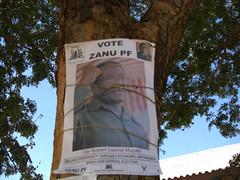
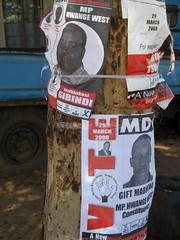
Along the road leading back towards the city centre all the Zanu-PF election posters pasted to the lampposts in the central reservation have been blotted out with yellow paint – the work of Simba Makoni supporters perhaps? His campaign colour was yellow, red for the MDC-Tsvangirai, green for Zanu-PF.
Makoni has been coming third everywhere we have seen, and everywhere we have heard of. But he has been taking votes from Mugabe and Zanu, that much is clear. Everywhere I go, on foot and by car, people are smiling, starting to dare to believe that maybe this time it really is going to work.
“Can we start to celebrate?” someone asks. “No, not yet, don’t provoke anything,” answers another. It appears the electoral commission warned against premature celebrations. There is quite incredible self-discipline. No triumphalism is betrayed, just nervous satisfaction.. nervous because they still have to wait for the ZEC official result announcement. Until then, nothing can be taken for granted.
Back in Chisipite, I encounter a self-professed Zanu-PF supporter reading the blue result announcements in disbelief. Tendai says he cannot believe that Mugabe has lost Zvimba: “it must surely be propaganda” he says. But what about here, does he believe this result is propaganda?
He speaks in rapid Shona to the police guarding the voting tent, on which the four blue sheets of paper tallying the count are attached.
“No, it is right. Here these were the votes, this is what was counted here, the police confirm it and to be honest I expected this area to be pro-MDC-Tsvangirai faction.”
Among the surprises so far, it appears independent MP Margaret Dongo has lost her Senate seat. A huge surprise is that Matabeleland, which was thought to be the heartland of MDC-Mutambara faction, has voted massively for Tsvangirai. The Mutambara faction is said to be in shock as some of their leading members have lost their seats. Only David Coltart, a white Senator, is said to have been re-elected safely.
]]>
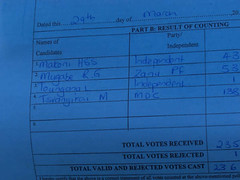
At 7am we went to check the results posted on the wall of the tent that served as the Chishawasha Junction polling station. Only 236 votes had been cast (they had expected 300, so 64 ballot papers were unused) and 138 of them were for Morgan Tsvangirai, against just 53 for Robert Mugabe and 43 for Simba Makoni. Langton Towungana got one vote.
It was the same margin of victory in the Senate, parliamentary and council elections, the Tsvangirai faction of the MDC romping home by a mile. People drifted up to check for themselves, singly and in groups, with broad smiles breaking out, thumbs up signs and the open hand wave that is a symbol of support for the MDC.
“This time we got him good,” said Andy. “I phoned relatives in Gweru and Kwekwe this morning and the MDC is still leading in both and I am thinking that we really got him this time.”
We drove around the almost rural back roads of this north-eastern suburb of Harare finding everywhere an atmosphere of hopeful anticipation. And at every stop we found yet another person who tried to go and vote on Saturday but was denied because their names had disappeared from the electoral roll.
Micky was one of them. “I went first to Newmarch Farm to vote but they couldn’t find my name, so I tried the other polling stations in my ward, but they didn’t have me listed either.”
Yet the African Union observer mission accredited to the ‘2008 Harmonised Election’ has discovered widespread evidence of ‘ghost voters’, including 8,450 voters registered to an empty field in north Harare.
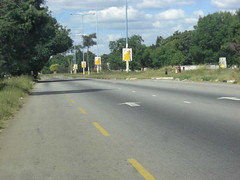
Everyone I talk to comments on how there have been no police road blocks on any of the roads all weekend. Usually a drive from the suburbs downtown is interrupted several times as police check for contraband or cash.
“When Operation Sunrise was announced – that’s when they knocked three zeroes off the bank notes and we all had to surrender the old money – we were stopped regularly by police hoping to confiscate cash”, Julie told me. “It’s the same story with people coming in from the countryside with a sack of mealie they’ve grown that they’re hoping to sell in the city. The police would stop them and seize their stuff on a pretext. We started to believe that this was sanctioned from the top as a way of keeping lower-ranking police paid and fed.”
I had heard similar stories all through Matabeleland. Ross told me that in the markets it was the police chiefs who were selling grain and sugar.
“If someone else comes to sell their stuff, they take it from them, because only they can sell.”
I have also heard plenty of cautionary tales about police brutality, especially at the feared Harare Central station. Yet late on Saturday night, at the close of the polls when I went to see how things were at one of the northern polling stations, the policeman from Harare Central posted outside the tent was warm and friendly.
After the usual African reverse handshake, he talked about how orderly things had been throughout the day, that almost everyone had voted by mid-afternoon. At 7pm the chief polling officer gave a little speech to the assembled election officials, party observers, independent observers and a small group of South African journalists, to explain how things would proceed and with that the count began and we left them to it.
The MDC was already predicting it would win by a landslide nationwide. In an attempt to pre-empt fraud the MDC said it would collate results from each of the 9,400 polling stations and announce them itself.
President Mugabe, however said he would definitely win a sixth term and rejected the rigging claims, saying preposterously:
“We are not in the habit of rigging… We don’t rig elections. I cannot sleep with my conscience if I have rigged,” he said.
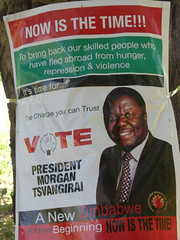
But with the latest figures showing inflation is running at 165,000% even in his own rural heartland, people are waking up to the reality of economic disaster and growing hardship and hunger.
This morning I went out to the local farms that have not been seized by ‘warvits’ (the so-called war veterans who were Zanu-PF’s shock troops in the land grab from 2000 on) to find that a single egg bought at cost price on the farm is 5 million Zimbabwe dollars (ZD).
Time now to go eat that egg before we set out to find out what we can about the results from elsewhere and gauge the mood on the streets.