A compelling Frontline Club event on Wednesday 25 June showcased film and photographic work from across the globe that revealed both the depth of suffering and the strength of human spirit in some of the world’s most devastating internal conflicts.
Featured at the event was a series of photographs from Tim Freccia in South Sudan, Alvaro Ybarra Zavala in Venezuela, Eman Mohammed in Gaza and Daniel Berehulak in Afghanistan, curated by multimedia photojournalist and filmmaker John D McHugh.
The event culminated in a screening of Ground Zero Syria, a dramatic film by Robert King featuring unprecedented footage of the brutal conflict in Syria, and an impassioned interview with King by The Times journalist Anthony Loyd that offered some chilling conclusions about the future of the conflict.

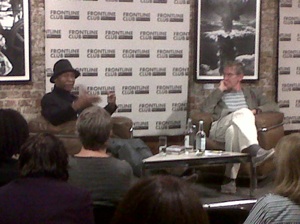
Robert King and Anthony Loyd at the Frontline Club.
All of the showcased work shared a common theme: that of the determination of each journalist to bring to light the plight of people facing oppression or armed struggle in their home countries, and to reveal the characters of those individuals caught up in some of the world’s most dangerous conflicts.
Among Freccia’s work was a set of portraits of soldiers from the White Army, a ruthless militia group fighting alongside former Vice President Riek Machar in his campaign against the government of South Sudan.
In Freccia’s unique portraits, presented against a white background, he aimed to show through the expressions and postures of his subjects the “humanity present in these characters, for good or bad, which is often neglected”.
Zavala’s photographs were captured in Caracas and San Cristobal in February and March this year as the protests against Venezuela’s government escalated.
A picture of a woman slumped over the coffin of a lost loved one revealed the sacrifices made by the protestors, while another featured a combatant in plastic protective glasses making Molotov cocktails to take into the fray.
Mohammed took up photojournalism at the age of 19. In a narration of her photographs, she explained how she had to overcome cultural barriers to a woman pursuing such a career.
“I thought I had what it took to be a career photographer,” she said. “I was wrong. To gain acceptance in a male dominated field was next to impossible.”
Covering the war in Gaza in 2008-09 and under fire from aerial bomb attacks, the ground “shaking like a swing beneath us”, Mohammed was abandoned by the two male journalists with whom she was travelling. “Terrified, humiliated and feeling sorry for myself”, she learned a valuable lesson.
Mohammed‘s career has been characterised by a constant tension between capturing her own agony and that of others:
“You can freeze, but your camera cannot. If you don’t document history, it never happened.”
Her work included touching portraits of Mohamed Hodr, who along with 22 members of his family lived for several years beneath the rubble of what was once his home.
The only surviving remnant of what was to be a retirement retreat was a jacuzzi, which he hauled up to the roof of his shattered home so that each morning he could give his children a bubble bath.
Berehulak’s work focused on the terrible impact that the rapidly rising use of heroin in Afghanistan is having on the local population. One in 10 urban households in the country has at least one drug user, and in rural areas heroin use is as high as 30 per cent.
A set of photographs of one hospital ward that was admitting 200 children a month for severe malnutrition featured pictures of young children so wrinkled with starvation that they looked more like the elderly than the newly born. At a year-and-a-half, Mohammed weighed just 10 pounds.
“Nearly every potential lifeline is strained or broken here,” said Berehulak in his narration. “Women are kept away from everyone except those in their immediate family.
“Farmers can’t grow crops because of mines, and doctors can’t get to children until the situation is already severe. Women can’t nourish their own children [because of the heroin use].”
At the country’s premier children’s hospital in Kabul, a five-year-old boy weighing just 20 pounds was being treated on a bench because the infusion line wouldn’t reach to a bed. The drug problem, said the director of demand reduction at the ministry of health, is a tsunami for his country.
Ground Zero Syria
Screened in the second half of the event, King’s film gave a unique insight into the fighters of the opposition Free Syrian Army (FSA) in their efforts to survive the brutal attacks of Bashar al-Assad’s regime.
“For six to seven months we didn’t even think about picking up weapons,” said one.
“We started out with olive branches, but [in the end] the only option was to take up arms and put him [Assad] out of office.”
At a field hospital in Al-Qusayr, southwest of Homs near the border with Lebanon, a young boy looked forlornly up at the camera with a single streak of blood spilling from the corner of his mouth. Across the ward, another child’s guts were bursting through his sundered stomach.
“If I die when I help people it is good for me,” said a doctor at the hospital. “I’m a doctor, I must help people.”
At the Dar al-Shifa field hospital in Aleppo, Dr Osman, a physician at the hospital, explained how he had nightmares about amputating children’s limbs, but each day resisted the urge to return to normal life because there was no one else to help these people.
According to Osman, about 80 per cent of the patients at Dar al-Shifa are civilians. At the time of the interview, the hospital had already been bombed five times, with another 15 bombings nearby.
“The Syrian regime considers medical staff as a perfect target, as a military target,” he said. “When you kill one doctor it is better than killing a thousand fighters.”
In November 2012, King was there when the hospital was hit yet again, but still hope was not vanquished.
“Dar al-Shifa is not a building, it’s not a machine; it’s people, it’s doctors, nurses,” said Osman, speaking amidst the rubble.
“We will continue. We will build this hospital again and we will work again.”
In one striking scene, Dr Abaman, a former veterinarian working as an assistant physician at the hospital, appealed directly to the camera, emotion cracking his voice:
“We have enough shown TV. Do something. Do something. We are suffering here alone.”
The film also featured the tragic burning of Aleppo’s market, a world heritage site and one of the world’s best-preserved souks.
King asked Ahmed Alhaji, who had witnessed the fire, to explain what he had seen.
“I saw a lot of things that make me cry,” he said. “I saw Assad destroy our history. My heart is broken, I was crying blood.”
Towards the end of the film, King asked an FSA fighter what he thought of the West’s Syria policy. The West’s inaction before – and even after – evidence came to light of the use of chemical weapons in Syria, he said, was a sign to Assad that:
“Whatever you want to do, go ahead and do it. You want to kill 100,000 people that’s okay; you want to drop 100,000 tonnes of bombs that’s fine. Chemical weapons? Just keep 20–30 per cent of them.”
Most of the characters featured in the film, said King, are now dead.
Beyond the obvious perils of filming during an almost constant artillery bombardment, King faced his own challenges in shooting the film, not least the very lack of engagement from the West and its media that was alluded to by the film’s characters.
“I had to reassess why I was risking my life to cover slaughter,” said King in the Q&A with Loyd.
“I’d been there for four months and had photographed 5,000 dead bodies and nobody cared. No one would buy my photographs, so I started shooting video.”
The politics within Syria were also a source of frustration for King. He saw a shipment of powdered milk he had helped facilitate first held up in customs and then less than welcomed by those who had been benefiting from the black market in the product.
Those people who had helped him gain access to the country started to try to influence his material and, when he refused, banned him from going back.
“In the first year I figured that their politics were holding up the medical needs of the community,” said King. “Then they wanted to control the message.”
Asked by members of the audience whether his work could be used to try the perpetrators of the violence, King expressed his frustration with the absence of a more effective international legal system:
“If there was an international court of law that could hold people accountable for their war crimes . . . but why give my stuff to some organisation that fantasises that it can prosecute people?”
Loyd and King agreed that the future for the country is bleak and the potential fallout dire.
“The war launched against Al Qaeda was one thing,” said Loyd, wearing a cast around his leg after sustaining gunshot injuries in the latest of many reporting trips to Syria.
“Now something far worse [Islamic State in Iraq and Al-Sham (ISIS)] has taken up a huge block of the Middle East running almost to the Mediterranean, and the West is aghast as to how to deal with the situation.
“Syria has raised a huge question mark and nobody knows what to do.”
King is convinced that chemical weapons have been smuggled out of Syria and have already reached Western European capitals. Asked whether he was planning to go back to Syria, he said:
]]>“I don’t have to go to Syria. It’s done. It’s here. It’s over. I’m going to sit and wait.”
Made over 15 years by club founders Vaughan Smith and Richard Parry the film is an intimate journey with war photographer Robert King, following his ambition to win the Pullitzer Prize for photography in the most dangerous warzones of the late 20th and early 21st centuries.
]]>
Made over 15 years by club founders Vaughan Smith and Richard Parry the film is an intimate journey with war photographer Robert King, following his ambition to win the Pullitzer Prize for photography in the most dangerous warzones of the late 20th and early 21st centuries.
———-
‘Completely blown away by it. It’s beautifully put together, and by far the best war doc I have seen … It’s beautifully constructed with the reveal of his wife and son at the end, and his development as a character works so well. I dread to think of the work and time that went into it but it is a brilliant film…’
Nick Broomfield, Filmmaker.
‘Following the progress of photographer Robert King from hapless hopeful to hardened hack, this gripping chronicle of the wars of the last two decades manages to be funny, shocking and an uncomfortable insight into the lives of war correspondents. I loved it!’
Christina Lamb, Author and war reporter
‘The innocent, the naive, the kind, the clumsy – none of these people live long in war. Which makes Robert King’s survival all the more surprising, and this film all the more remarkable. Listen carefully to the story of this dirty faced angel from Tennessee. Then have him shot at dawn. The world is too ugly to allow such honesty to live.’
Anthony Loyd, Author and war reporter
]]>By Thomas Lowe
Robert King was freed in 2001 after spending 29 years in solitary confinement in Louisiana state penitentiary ‘Angola prison’. Convicted for the murder of a prison guard, his trial was fraught with inconsistent evidence and clouded by the racism of the Deep South.
Clive Stafford Smith, founder and director of Reprieve spoke to King about growing up in Louisiana, solitary confinement in Angola prison and the importance of supporting prisoners with little recourse to justice.
‘I saw racism in the raw’ King told us leaning back in his armchair, black brimmed hat placed low on his head. ‘But we found ways to show our dissent.’
‘As kids, we used to take this (coloured people) sign and put it all the way up to the front of the bus, and the white people wouldn’t go beyond that sign. […] Whites would get on the bus and they would not sit behind (it)!’
There was only one black member of the jury when King was sentenced for murder. He is scathing about justice in the US judicial system.
‘Legality and morality, especially in the courtroom; they don’t meet.’
A member of the Black Panther Party at the time, King was considered a threat and placed in solitary confinement.
Yet he saw himself as being ‘more than an organisation […] I saw myself as a person who had really joined the struggle. The prison recognised this.’
‘You’re in the cell for 23 hours a day, sometimes 24 […] It did not make any difference if it was Monday or Sunday, if it was Easter or Christmas, you know it’s still the same day for me […] One day followed the next.’
Politically tuned-in, King turned to the courts and succeeded in limiting the gratuitous, humiliating process of cavity searches. Fighting injustice on the inside was a lifeline in itself.
‘We did some things in prison to kind of […] bring things along. We consoled ourselves with the fact that we were able to help ourselves and that we had people on the outside who were also willing’.
Support from the outside remains crucial to people on death row.
‘I’ve seen a letter save the lives of a lot of people […] a letter from a loved one has probably stopped them from committing suicide.’
Since his release in 2001 Robert King has focused on helping the remaining two of the Angola 3, Herman Woodfox and Albert Wallace, to gain their freedom. A civil suit that will soon go to trial aims to set a precedent that would outlaw long sentences for solitary confinement.
Sceptical of any success in the US Supreme Court, Clive Stafford Smith points out that seeking out international support may well be the best way forward.
‘I am so angry! But I’m not speechless’
He may be angry, but Robert King has a powerful voice. His book ‘From the Bottom of the Heap: the Autobiography of Black Panther Robert Hillary King’ is out now.
]]>Robert King will be joining us at the Frontline Club in conversation with founder and director of Reprieve, Clive Stafford Smith to recount his personal story of injustice and how his life’s focus now is to campaign against abuses in the criminal justice system and for the freedom of Herman Wallace and Albert Woodfox who are now serving their 40th year in solitary confinement
In May 1972 Robert King entered Angola prison, the state penitentiary of Louisiana after being convicted of an armed robbery he denied committing.
Along with Herman Wallace and Albert Woodfox he was later convicted of murder in Angola prison; Wallace and Woodfox for the murder of Angola prison guard Brent Miller and King for the murder of fellow prisoner August Kelly.
Known as the Angola 3, the men have always proclaimed their innocence, saying that they were framed and targeted by the prison authorities for their activism as members of the Black Panther Party. Through their activities they successfully organised prisoners to improve conditions; reducing sexual assault, improving food quality and tackling racism – all condoned by prison security.
Between them King, Wallace and Woodfox have spent more than 100 years in solitary confinement in Angola’s maximum security Closed Cell Restricted (CCR) block in cells 2 x 3 metres for up to 23 hours a day.
All three were sentenced on insubstantial evidence and contradictory eye witness reports, they fought their convictions and in 2001 King was freed after 29 years in solitary.
In 2008, Woodfox’s conviction was overturned after a federal court ruled that his core constitutional rights had been violated at his original trial. But Louisiana attorney general Buddy Caldwell contested the decision and Woodfox, aged 64, was returned to Angola. Herman Wallace and Albert Woodfox remain in solitary confinement, conditions which they are legally challenging as being a violation of the US Constitution prohibiting cruel and unusual punishment.
Robert King will be talking about his mission to fight the cruelty of the prison-industrial complex challenge the systemic injustices involving class and racism that lead people to unjust incarceration and the human rights violations that prisoners must endure.
]]>Blood Trail, the documentary film produced by club member Richard Parry along with club founder Vaughan Smith, is showing at the True/False film festival in Columbia, Missouri until March 1. The film documents 15 years in the life of war photographer Robert King – from naive beginner to accomplished professional. Robert and Richard are in Missouri promoting the film and talked about it to an audience at the festival recently. Robert had some advice for one wannabe reporter,
]]>“Everybody wants to rewrite history,” King said. “If we have proof, they’re not going to get away with it. … We’re not anti-government. We just want to hold people accountable.”
One audience member asked the panelists for advice. Dan Parris, a 24-year-old from St. Louis, is heading to hostile areas in Africa this summer to work on his own documentary project.
“Don’t go,” King joked, but only half-heartedly. He’s had friends die covering combat in Africa.
Parris said the warning didn’t faze him. “I see the footage and hear what they have to say, but it’s not real to me yet,” he said. “He mentioned being young and idealistic. That’s me. I want to make a difference in the world.” link