"With our souls, with our blood, we would sacrifice anything for you Bahrain" people chanted on the streets of Bahrain. In February 2011, while the media glare was firmly focused on the uprising in Egypt, the Bahraini people were left to shout in the dark.
One of their rare witnesses was Al Jazeera’s May Ying Welsh, who went undercover, without the permission of the Bahraini government, to record the people’s desperate and unanswered calls for democracy which started in February last year.
Bahrain: Shouting in the Dark, as its tagline states, tells “the story of the Arab revolution that was abandoned by the Arabs, forsaken by the West and forgotten by the world.” It went on to win one of the most prestigious recognitions in journalism -2011 Foreign Press Association’s Documentary of the Year Award.
On his Twitter account Bahraini Foreign Minster Khalid Al Khalifa criticised Qatar, where Al Jazeera are based:
“It’s clear that in Qatar there are those who don’t want anything good for Bahrain. And this film on Al Jazeera English is the best example of this inexplicable hostility.”
The reaction of the regime is hardly surprising as Welsh has exposed all of the brutality which was, at least at the time, hidden from the eyes of the world.
We see unarmed people shot, beaten, teargassed. We see doctors and nurses, Sunni and Shia, in the Al Salmaniya hospital reduced to tears after treating injured protesters for 48 hours without a break, unable to comprehend what is happening to their country.
We see how the regime’s brutal crackdown against its own people gathers force with the introduction of martial law and media “witch hunts” – all with the help of the military forces from the Gulf states.
We see how the protesters are desperate for their revolution not be portrayed as some sort of sectarian violence between Shias and Sunnis, but as a unified call of all Bahrainis for the end of the authoritarian regime and the introduction of constitutional monarchy.
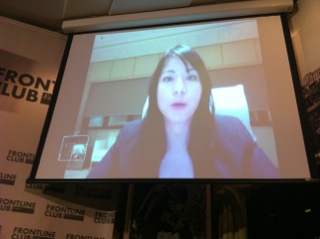
The film’s executive producer, Jon Blair, who moderated the Q&A, asked Welsh, who talked via Skype, to explain how did she found those months living and working in Bahrain.
“Because of the undercover aspect of the filming, I needed to leave the hotel system. I moved into an apartment where the details of my passport were not reported to the interior ministry.”
“I started being monitored by the government through the sim card in my phone so I had to take it out. I did have the police coming to my apartment, a large group of them. There were check points everywhere. I had to wear an abaya and hijab and put my camera in my feminine purse so I wouldn’t look like a foreigner or a journalist.”
When asked why the Western world decided to stand back, when they got involved in Libya for example, Walsh said:
“I think the reason is not being able to afford to upset Saudi Arabia, it’s not so much to do with the US Fifth Fleet presence. That is my opinion at least. If Bahrain were to have a real democracy, that would impact the eastern part of Saudi Arabia where all the oil is and we depend on that oil. Shias living in Bahrain are the same people, the same tribe, who live in that part of eastern Saudi Arabia, they would probably also rise up then and demand change.”
Present at the Q&A session was also an ex-Bahraini MP Ali Mahdi Alaswad who resigned in February 2011, along with 17 other Al Wefaq MP’s, in response to the brutal crackdown against pro-democracy demonstrations.
He said that the situation in his country has hardly improved since then.
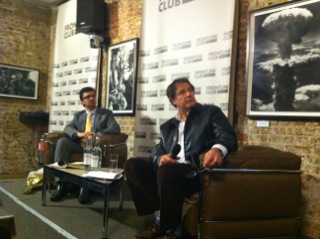
“The clashes are still continuing. If there are casualties, they still can’t go to the Al Salmaniya hospital. The situation is still the same."
“Most of the people who were interviewed in the film are still detained or are out awaiting trial, they cannot travel anywhere.
“The opposition politicians were talking to the Crown Prince, unfortunately he has no power now. People in Bahrain are still demanding. Their demands for reform are still increasing. But the authorities don’t want to upset the Saudis, as about 75 per cent of their income depends on them. The situation is very difficult. But the people are still demanding democracy and they won’t stop until it is achieved.”
With the anniversary of the first Pearl Roundabout protest coming up on February 14, one audience member who lived in Bahrain was worried that there might be another carnage on the horizon. Alaswad hinted that the people are certainly not going to let that day slip quietly.
“People in Bahrain are getting angry now. They don’t want to see politics, they just want to be outside, protesting, they want to express their feelings. Everybody in Bahrain is waiting for February 14. The regime in Bahrain are thinking what to do. We are planning many activities, but I can’t say more now”
You can watch the Shouting in the Dark Q&A here. Click here to watch Shouting in the Dark.
]]>
By Nicole Hunt
European leaders gather in Brussels on Monday for an informal meeting of the European Council, during which discussions are set to focus on jobs and the new fiscal stabilisation treaty agreed at their controversial meeting last month. Leaders are planning to iron out the details of the treaty at the meeting, in hopes that it’ll be ready to sign by the time they meet again on 1 March.
While all eyes are on Brussels, two big trials are before the courts in South Africa. In Ventersdorp, Chris Mahlangu and an unnamed teenager are back on trial for the April 2010 murder of Afrikaner Weerstandsbeweging (AWB) leader Eugene Terre’Blanche, postponed from October to allow more time for hearings.
Meanwhile, Henry Okah, former Movement for the Emancipation of the Niger Delta (MEND) leader, goes on trial in Johannesburg on terrorism charges in connection with the October 2010 Independence Day bombings in Abuja, Nigeria, which killed 12 people.
Monday is also the 40th anniversary of Bloody Sunday.
Spanish Magistrate Baltasar Garzon’s abuse of power trial resumes on Tuesday, with the judge himself expected to begin testifying if some preliminary matters are cleared up earlier in the day. There is speculation that the verdict for Garzon’s illegal wiretapping case – which was head on 17 January – could be delivered before Tuesday’s hearing.
The annual Herzliya policy conference kicks off in Jerusalem. Speakers throughout the three-day conference include Israeli President Shimon Peres, World Bank President Robert Zoellick, Israeli Defence Minister Ehud Barak, former Greek Prime Minister George Papandreou, and German Foreign Minister Guido Westerwelle.
Wednesday is all about Supreme Courts. Wikileaks founder Julian Assange begins a two-day hearing at the UK Supreme Court in London, appealing a 24 February, 2010 decision to extradite him to Sweden to face questioning on charges of sexual assault. The court is expected to reserve judgement after the hearing wraps up on Thursday, meaning the legal saga won’t quite be over yet.
In Islamabad, Pakistani Prime Minister Yousuf Raza Gilani is back before the Supreme Court, which is looking into his government’s decision not to investigate corruption among politicians after passing a controversial amnesty law in 2007 known as the National Reconciliation Ordinance. Gilani appeared before the court briefly on 19 January.
A North Korean prisoner amnesty begins on Wednesday, as part of celebrations to mark the 70th anniversary of the birth of recently-deceased Kim Jong-Il in February and the 100th anniversary of the birth of Kim Il-Sung in April.
NATO Defence Ministers begin a two-day meeting in Brussels on Thursday. Discussions are expected to focus on Afghanistan and security transition following the 20 January attack on French troops by an Afghan soldier, which killed four.
Kuwaitis go to the polls to elect 50 members to Parliament. Emir Sheikh Sabah al Ahmad al Sabah dissolved Parliament by decree on 6 December, 2011 citing ‘deteriorating conditions in the country’. 50 members are elected for four-year terms. Four women were elected for the first time in the country’s last elections, which took place in 2009.
On Friday, The Extraordinary Chambers in the Courts of Cambodia hears the appeal for Khmer Rouge Special Branch Chief Kaing Guek Eav, aka Duch, who was convicted of crimes against humanity and grave breaches of the Geneva Conventions in July 2010. Duch, who was head of the infamous Tuol Sleng prison camp, was sentenced to 35 years in prison over the deaths of up to two million people during the 1975-79 Khmer Rouge regime.
The three-day Munich Security Conference begins Friday; though there’s no word yet on this year’s attendees, the guest list always features the great and good of international politics and defence (or at least the important). The MSC is often the site of important policy announcements, so is well worth looking out for.
Anti-Kremlin groups are scheduled to hold their latest protest in Moscow on Saturday, this one timed to coincide with the two-month anniversary of disputed parliamentary elections on 4 December, and with one month to go until presidential elections on 4 March almost certainly see Vladimir Putin return to the helm.
The month and a half long Rugby 6 Nations tournament begins, with France, Engand, Ireland, Scotland, Wales and Italy hoping to end up in the 17 March final. England won the tournament in 2011.
The week closes with the runoff for the Finnish presidential race, following a first round vote on 22 January. Former Finance Minister Sauli Niinisto, who won 37 per cent of the first vote, faces off against Green party candidate Pekka Haavisto, who won 19 per cent of the vote.
]]>By Nicole Hunt
EU and Ukrainian officials meet in Kiev on Monday for the annual EU-Ukraine Summit, with rumours abound that President Viktor Yanukovych is planning to skip the meeting in favour of the EurAsEC summit taking place in Moscow on the same day. Yanukovych’s planned visit to Brussels in Octoberwas delayed after opposition leader Yulia Tymoshenko was convicted and sentenced to seven years in prison on what the EU says are politically motivated charges.
The Gulf Cooperation Council holds its annual summit in Riyadh, the first formal meeting of leaders since the beginning of the Arab Spring last year. The meeting begins on the same day that the UN Security Council is scheduled to discuss sanctions against Iran and receive a briefing from Jamal Benomar, Special Adviser to the Secretary-General on Yemen.
Leaders from the Commonwealth of Independent States meet in Moscow on Tuesday to celebrate the organisation’s 20th anniversary. The CIS was formed out of the dissolution of the Soviet Union; the initial agreement was signed by Belarus, Russia and Ukraine on 8 December, 1991, while eight more former Soviet republics joined on 21 December.
In Tripoli, Tuesday marks the deadline issued by the government and the Tripoli Council for rogue, non-Tripoli based militias to disarm and leave the city. Despite the announcement of the deadline on 6 December, clashes between militias and security forces have continued unabated.
Pending the confirmation of election results by the Supreme Court of the Democratic Republic of Congo on 17 December, President Joseph Kabila is scheduled to be sworn in for a second term in Kinshasa. International observers have raised concerns about the validity of the country’s 28 November election.
The long-awaited verdict in the ‘Government I’ genocide trial at the International Criminal Tribunal for Rwanda is handed down on Wednesday in Arusha. Former Interior Minister Edouard Karemera and former President of the MRND political party Mathieu Ngirumpatse are accused of recruiting and arming the Interahamwe militia and disseminating Hutu Power propaganda.
The European Central Bank holds the first of two 36-month longer-term refinancing operations announced by ECB President Mario Draghi on 8 December as part of a series of measures to support bank lending and market activities. The LTRO comes on the same day that Italy releases Q3 GDP figures; the preliminary figures had been due in November, but were not released amid political turmoil.
Palestinian leaders meet in Cairo on Thursday, with Palestinian Authority President Mahmoud Abbas expected to chair the first meeting of what would be a unified Palestinian decision-making body in place until elections are held in May 2012. Members of the Palestinian National Council, the Palestinian Liberation Organisation’s executive boards and the directors-general of various Palestinian factions are scheduled to attend.
Amid weeks of protests against the recent parliamentary elections, Russian President Dmitry Medvedev gives his annual state of the nation address in Moscow.
On Friday, the South Korean military is set to turn on the lights on three giant steel Christmas trees placed at points along the country’s border with North Korea. Pyongyang has reportedly called the trees a form of ‘psychological warfare’ and has threatened ‘unexpected consequences’ if the lighting goes ahead.
Activists in Russia have planned another mass protest against the 4 December elections on Saturday, after an estimated 50,000 people turned out for the 10 December demonstration, which was organised on Facebook. The tens of thousands already signed up to attend have clearly not been swayed by President Dmitry Medvedev’s pledge to investigate allegations of electoral fraud.
Sunday is, of course, Christmas Day. While millions worldwide will be focusing on egg nog, Christmas pudding and what Santa’s left under the tree, Pakistani cricketer-turned-politician Imran Khan will be addressing a rally in Karachi, where he is said to be launching a ‘revolutionary manifesto’ ahead of elections in 2013.
Sunday also marks the 20th anniversary of the resignation of Mikhail Gorbachev, who had been President of the Soviet Union from October 1988. Gorbachev’s resignation came a day before the USSR was formally dissolved on 26 December, 1991.
]]>By Nicole Hunt
US President Barack Obama hosts Iraqi Prime Minister Nuri al Maliki for talks in Washington on Monday, with discussions focusing on strengthening the ‘strategic partnership’ between the two countries. The summit comes ahead of a looming 31 December deadline for the withdrawal of US troops from Iraq.
Following last week’s European Council meetings, the focus early this week is, predictably, still the euro zone debt crisis. Experts from the IMF, the European Central Bank and the EU begin their sixth review mission to Athens, hoping that this time around they’ll be able to stick around until the scheduled end of the visit on Friday.
The venue changes but the topic stays the same on Tuesday, with Spain, Italy and France in the limelight. Spain’s Congreso de los Diputados convenes for the first time since elections on 20 November, though new Prime Minister Mariano Rajoy won’t formally take up his post until he’s sworn in by King Carlos later this month.
In Rome, Parliament is scheduled to begin debating Prime Minister Mario Monti’s austerity measures, which he issued by decree on 4 December. MPs are expected to approve the measures well before the 60-day deadline.
Meanwhile, French unions have planned a nationwide day of protests against their government’s austerity measures. Thousands are expected to take the streets in Paris, where the largest demonstration takes place outside of the Assemblée Nationale.
Under Egypt’s complicated election laws, another parliamentary vote is held on Wednesday, with polling taking place in nine governates, including Giza and Suez. The elections on 28 November, which were held despite violent protests only days before, covered nine provinces, including Cairo and Alexandria. A third round of voting takes place on 3 January.
In New Orleans, the Bureau of Ocean Energy Management holds the first oil and natural gas lease sale in the Gulf of Mexico since the April 2010 Deepwater Horizon disaster.
A Paris court is expected to issue its verdict on Thursday in the long-running corruption trial of former French President Jacques Chirac. Chirac is accused of misusing public funds and creating false job contracts during his time as Mayor of Paris. He settled a €2.2m civil suit with the city of Paris in August 2010.
Thursday also sees two meetings taking place which will be viewed very differently by Russia. President Dmitry Medvedev attends the EU-Russia Summit in Brussels, but the visit will be coloured by expressions of concern from the EU over allegations of unfair voting practices in Russia’s 4 December parliamentary elections, which saw Medvedev’s United Russia party win a majority despite heavy losses.
Over in Geneva, the World Trade Organisation holds its eighth Ministerial Conference, where delegates are expected to hold a long-awaited vote on Russian accession to the WTO.
TIME Magazine announces its annual Person of the Year on Friday. Facebook creator Mark Zuckerberg was 2010’s winner; leaders in this year’s online poll (which don’t have any bearing on the final choice) include Turkish Prime Minister Recep Tayyip Erdogan, footballer Lionel Messi, The 99%, Anonymous, Steve Jobs, and the Arab Youth.
The US army begins an Article 32 hearing for Private First Class Bradley Manning, which is expected to last just over a week. The hearing is to determine whether there is enough evidence to proceed with a court martial against Manning, who is accused to leaking a 2007 video to WikiLeaks which showed a military operation in Baghdad in which two Reuters reporters were killed.
As Saturday happens to be Manning’s 24th birthday, an international day of solidarity has been organised, with protests planned worldwide. Occupy London protesters have already pledged to take part.
Though it hardly seems possible as Egypt works through elections and protests and killings rage on in Syria, Saturday also marks the one year anniversary of the self-immolation of Tunisian fruit and vegetable seller Mohamed Bouazizi, an event that has been singled out as the catalyst for the Arab Spring movement as it kicked off Tunisia’s Jasmine Revolution.
]]>By Nicole Hunt
The International Atomic Energy Agency (IAEA) Board of Governors meets in Vienna on Monday, with Iran likely to be high on the agenda following last week’s report expressing increased concerns over ‘undisclosed nuclear related activities’ in the country.
Bouthaina Shaaban, political adviser to Syrian President Bashar al Assad, is in Moscow, where she is scheduled to meet with Foreign Minister Sergey Lavrov and hold a press conference for international media. Shaaban was one of three Syrian officials slapped with sanctions by the US Treasury Department at the end of August.
The African National Congress is expected to wrap up disciplinary proceedings against controversial ANC youth leader Julius Malema on Tuesday, having recently moved the hearing from the ANC headquarters at Luthuli House to an undisclosed location in Johannesburg following violent protests last week. Malema is accused of bringing the ANC into disrepute and sowing divisions within ANC ranks after he encouraged the overthrow of Botswana’s government.
In Brussels, the OECD publishes its annual Education at a Glance report, analysing the education systems and performances in member states. For the first time, this year’s report also looks at education in Brazil, China, India, Indonesia, Russia and South Africa.
The European Court of Human Rights in Strasbourg hears a complaint on Wednesday brought by four people who say they were illegally deprived of their liberty without justification while they were held in a police ‘kettle’ during the 2001 May Day protests in London.
In New York, the UN Security Council holds a debate on drought-stricken Somalia, where security issues have compounded problems as aid struggles to get into the country and people struggle to get out.
Parliamentary elections take place in Denmark on Thursday. Recent polls say Helle Thorning-Schmidt could be the country’s next Prime Minister, as her opposition Social Democrat party looks poised to win the most seats.
A court in The Hague is due to rule on Apple’s application to ban sales of Samsung’s Galaxy phones. A temporary injunction banning sales and distribution throughout much of Europe was issued on 11 August, but is not due to come into effect until 13 October.
Following debates this week in several European parliaments on new powers for the European Financial Stability Fund, European finance ministers begin a two-day meeting on Friday.
The International Criminal Court in The Hague holds a confirmation of charges hearing for Callixte Mbarushimana, a former UN employee charged with crimes against humanity and war crimes in the Democratic Republic of Congo in 2009. Mbarushimana is alleged to have been the executive secretary of the Democratic Forces for the Liberation of Rwanda and directly responsible for at least 32 deaths in Rwanda during the 1994 genocide while still employed by the UN, but has never been charged.
Libyan schools are scheduled to re-open on Saturday, with a brand new curriculum devoid of Gaddafi-era subjects such as the Green Book.
At the Dead Sea in Israel, photographer Spencer Turnick stages another mass nude photoshoot, hoping to bring awareness to the fact that the famously salty lake is drying up.
The week wraps up with state elections in Berlin, the sixth in Germany this year. The regional elections have generally proven disastrous for Angela Merkel’s CDU party, which has suffered losses country-wide to the Social Democrats, a trend that many expect to continue into the 2013 federal election.
]]>Filmmaker John D McHugh will take part in a Q&A following a double-bill screening of Endgame, which looks at the US presence in Afghanistan and Bahrain: Fighting for Change, which was filmed in late February and documents the uprising in the country. We will also be showing a double-bill by Director Rodrigo Vazquez, Child Miners and Teenage Miners, follow the story of poverty-stricken children forced to work in Bolivia’s tin mines.
There are still tickets available for September’s First Wednesday Special discussing the impact of 9/11 on our world today and how it will continue to shape our future. Full details will be announced tomorrow.
Follow us on Twitter and catch up on any events you missed on the Forum blog or download our podcasts on iTunes.
ALL EVENTS ARE OPEN TO THE PUBLIC
]]>
The week starts off with two high-profile court hearings on Monday. Former Egyptian Interior Minister Habib al Adly is scheduled to go on trial in Cairo on charges of ordering the deaths of protesters, but the hearing has been twice postponed so far, sparking angry demonstrations.
In Perugia, the long awaited report on a review of DNA evidence in Amanda Knox’s murder appeal is presented to the court.
Contentious land issues are the theme of the day on Tuesday, as new Pakistani Foreign Minister Hina Rabbani Khar arrives in New Delhi for two days of highly anticipated meetings with her Indian counterpart SM Krishna.
Meanwhile, the UN Security Council in New York holds an open debate on the Middle East, the bulk of which is expected to focus on Palestinian plans to seek UN recognition in September.
UN business continues in the same vein on Wednesday, with the Panel of Inquiry into the 31 May, 2010 Gaza flotilla due to publish its report. Turkey’s representative to the Panel, Ozdem Sanberk, said it’s the ‘last chance’ to re-establish good political relations between Israel and Turkey.
On Thursday, new Peruvian President Ollanta Humala takes office following his 5 June defeat of Keiko Fujimori, daughter of imprisoned former President Alberto Fujimori.
In the Syrian town of Al Bukamal, a 10-day deadline issued by the Armed Forces expires. Residents have been told to hand over weapons and submit to Government control by today or face a full military assault.
Two small developments in the phone hacking scandal are set for Friday, with Jonathan May-Bowles (aka Jonnie Marbles) scheduled to appear in a London court to face charges related to him throwing a shaving foam pie at Rupert Murdoch during the 19 July culture, media and sport committee hearing. BSkyB’s preliminary results are also released.
In Nigeria, the High Court is expected to deliver its verdict in the case of four men charged over last October’s independence day bombings in Abuja, which killed 12 people. One of the defendants is Charles Okah, brother of alleged leader of the Movement for the Emancipation of the Niger Delta (MEND) Henry, who is facing trial in South Africa for masterminding the bombing.
Friday also marks the one year anniversary of the beginning of the Pakistan floods, which went on to cover over a fifth of the country, killing nearly 2,000 people.
The Lebanese government has until Saturday to arrest persons named in the indictment issued by the UN Special Tribunal for Lebanon on 30 June, or to inform the Tribunal of the measures taken to attempt arrest. If arrests are not made, the STL may order a public advertisement calling on the accused to surrender, which would mark the first time Rafik al Hariri’s alleged assassins have been publicly named.
On Sunday, US hikers Josh Fattal and Shane Bauer are expected to go on trial in Tehran on charges of spying for the US. Sarah Shourd, who was arrested alongside them, was released in September 2010. You can watch the Frontline Club event last year looking at Iran’s record on detainment , which was attended by Bauer’s mother, Cindy Hickey here
]]> 
There is not much to do in Midan Tahrir for the revolution, now less than ever. This is what most of the Egyptian opposition forces seem to realise in these dramatic days of chaotic protests. The Midan falling back into some kind of surreal ‘normality’ is certainly not the result of the Army’s violent, ruthless comeback, neither of a loss of revolutionary fervour by the forces of the opposition. It is a sign, hopefully of change.
On Thursday morning, soldiers and volunteers in downtown Cairo were planting flowers in the Midan and painting walls and pavements in white and black, as if covering the written signs of a country in uprising would make people forget about how much they have achieved so far.
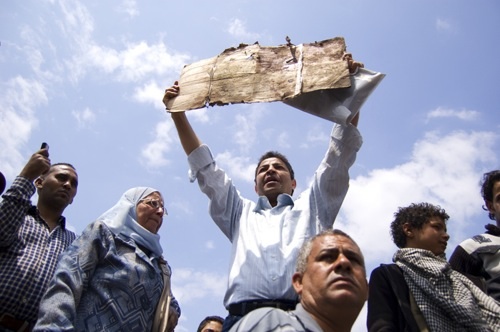
Last Saturday, two desperate parents wandered crying around Tahrir for hours, showing people a bloodstained piece of carton carrying the dimm el-shaheed, the blood of their martyred son killed in the Midan on Friday, while the Army was reportedly shooting in the air in order to frighten what they still want people to think is only a small group of violent dawdlers. Will I ever forget those crying faces?
Sharif, one of the shebab temporarily opposing protests in Tahrir, says there are three different kinds of people:
There are people who work for the revolution, people who work against the revolution, and people who sit at home, watching television and believing whatever the news says.
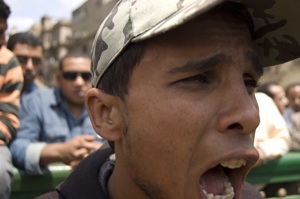
One of the Army’s strongest points lies in the power of a dialectic, enforced by media still subjugated by a corrupted political system, aiming to divide those in favour of the revolution, keeping them at home and turning them into sceptical observers from afar. They say the people in Tahrir are baltageya, professional thugs whose job is to throw the country into anarchy and chaos, occasionally selling hashish during breaks.
The baltageya is indeed an actor on stage, but is a double-edged one. Even two inveterate supporters of the baltageya like Hosni Mubarak and former Interior Minister Habib el-Adly committed their last, fatal mistake by ordering the opening of state prisons on 28 January. The sight of “pro-Mubarak” supporters riding camels and storming into the crowd to beat peaceful demonstrators made protesters squeeze up.
Even those who already made up their minds and wanted to allow Mubarak to stay until September elections, suddenly found themselves shouting for his ouster. Almost three months after those events, the baltageya‘s double-edge is still a highly destabilising factor in the country, fully exploited by those reactionary forces willing to thwart the country’s path towards political normalisation.
But this is not enough. As a small number of Army officials joined demonstrators and refused to take off their uniforms last Friday, many protesters smelled a rat. This intrusion disclosed a glaring sign of division within the Army, but at the same time it legitimised the intervention of security forces.
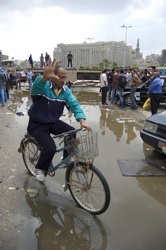
After seeing them shooting in the crowd and clearing out the Midan, many protesters still fool themselves into thinking that the Army is the people’s only guardian, and that those who cleared out Tahrir were mercenaries paid by Mubarak’s personal friend and business Ibrahim Kamel. Even in this case, where was the Army when the people needed protection? Egyptians have to realise that the time – if there was ever one – when the people and the Army were iid wahda (one hand) are now definitely over, and handing over power to a civil presidential council is the only solution for the time being.
Here we come to the point. The recent escalation of violence is a sign that the Army’s divide and rule agenda is being successfully put forward. This urged the opposition to wisely call for a suspension of demonstrations, and for the cancellation of Friday’s milioneya, the march of the million calling for the Supreme Council of Armed Forces (SCAF) to step down. This does not mean that revolutionary forces are satisfied with the Mubaraks’ or Kamel’s – fake – prosecution. “Our revolution is not against Mubarak,” one of the activists involved in the movement for the ‘Protection of the Revolution’ reminded me. “Our protests aim at a reversal of the 1952 coup d’état and the institution of a civil Presidential council”. Indeed, Field Marshall Mohammed Hussein Tantawi is a military man, like Mohammed Naguib, Gamal Abdel Naser, Anwar Sadat and Hosni Mubarak before him.
When I asked an Egyptian friend for a definition of the baltageya, he told me “a baltagy is either someone who pushes you to do something you do not want to do or someone who prevents you from doing what you want to do.” Suspending protests this Friday means avoiding that open (and suicidal) confrontation the Army has been looking for since they mingled with those violent enemies of the people’s rightful demands.
The revolution has been played out in many other fields, but Midan Tahrir still remains the battleground for the protesters’ main political demands. Celebrating a new Friday of protests with an empty Midan Tahrir amounts to an important step towards the realisation of the revolutionary agenda, and shows that the revolution is gaining ground on, and understanding of, an increasingly chaotic panorama, remaining loyal at the same time to its peaceful character and refusing to bow heads in front of the SCAF’s cosmetic adjustments.
Davide Morandini is an Italian freelance photojournalist based in Cairo, Egypt. He reports for the Egyptian online newspaper Bikya Masr, and his personal blog is called caironichles.
]]>Download this episode
View in iTunes
Watch the event here.
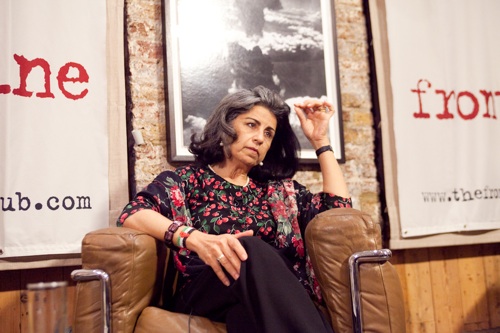
The revolution in Egypt was “a moment whose time had come” said author and commentator Ahdaf Soueif at the Frontline Club on Wednesday.
The author of the bestselling Map of Love told BBC News presenter Mishal Hussein how she had been in Jaipur in India at a literary festival on 25 January when the first protests took place but returned in time for the Friday “day of anger” on 28 January.
We were waiting, [in Embeba] basically loitering near the small mosque there and the preacher went on forever at the end. Before he finished a shout went up, it was one of the young men on the shoulders of another one or two and all in all it was about 15 people.
The sound was that mix between a shout or a chant or cheer that you must have heard if you were following the Egyptian revolution. It’s very rousing and makes your heart go with it. We started moving through the streets and the idea was that this core group goes through the neighbourhood and the particular chant that was used was one that was designed to attract people and make them come down from their homes and join the protest.
-thumb-350x233-2615.jpg)
Soueif described how groups had been “hanging about” in several locations in Cairo and elsewhere in the country, waiting for the right moment at the end of Friday prayers. The scale of the protests had surprised everyone, she said.
What had begun as a young people’s movement was joined by “everybody” said Soueif who added that “four generations” and all sectors of society took part, from those who worked for daily wages to those “who parked their Mercedes by the opera” to join protests. Rural and urban people were also represented by delegations sent by other cities and towns.
It was accepted that decisions would come out of Tahrir and so they were there to give it legitimacy and be part of the process of decision making.
In those 18 days in Tahrir square people formed circles on the ground and by evening time you would see 150 people sitting talking about politics and ideas and when a group agreed on something it would pass over to other groups and eventually there was a central point, what they called ‘Broadcasting House’ where there was a microphone with people in charge of it.
An idea, if it was good enough, would reach the microphone and would be broadcast and it would be either booed or cheered and hence rejected or adopted.
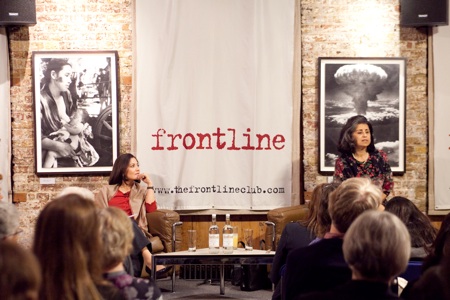
The decision to send in “the cavalry and the one camel that was supposed to defeat the revolution” was “completely strange” and made the people in the Square even more determined, said Soueif.
They resented how the regime claimed that they were not ready for democracy and that without the regime to “sit on our necks permanently, then you’re going to get a society so fanatic, so extreme, so violent, there will be rivers of blood that will wash across Europe”
The Egyptian people had been pleased to “find themselves” and “re-find their image and redefine it and declare it, said Soueif:
Suddenly we go from a progressive people who know what they want and are demanding dignity and freedom to being attacked with camels in best Orientalist Daniel Pipes fashion.
Fiction and film had allowed people to “exercise their muscles of empathy” towards the Egyptian people and that partly explained why there was so much support for them and their protest.
Another thing is that the spectacle of the revolution was done with such grace, it was so relaxed and it was so nice to look at and if you understood the jokes it was funny, yet it could raise its game and defend itself when they came at it with bullets or with stones.
On the night they attacked, the peripheries of the Square were fighting a battle, a very efficient and ferocious battle against the paramilitaries and in the heart of the Square there were stand up comics.
What you saw in Egypt was humanity in diverse forms at its best and that was very attractive, and not because it’s Egyptian, but because it’s a human spectacle. It’s humanity at its best in diverse forms.
Picture credit: Sophia Spring
If you want to hear more about the revolution in Egypt there is a fantastic opportunity to hear some of the key players at tonight’s event at the British Institution Protest, technology and the end of fear.
]]>As an editor for Global Voices Online, a site which monitors and aggregates social media and blogs, had it not been for an online project to report on the protests, as well as the presence of fellow Frontline Club bloggers, things would have been very different indeed.
Despite lagging behind Armenia and Azerbaijan in terms of the quality and quantity of blogs, the work of the GIPA Journalism School in Tbilisi, as well as that of Matthew Collin and Guy Degen, set new standards for the use of citizen media in the region during times of political upheaval.
In contrast, the use of blogs, forums and online video sharing sites in Armenia during last year’s presidential election might have countered government-controlled media, but was just as tainted by misinformation and propaganda. They also pretty much regurgitated or mirrored partisan press reports anyway.
However, the past two days in Tbilisi,has illustrated how the media can be strengthened by such tools in the hands of the right people. Although the international media did cover the protests, it was the GIPA Journalism School blog that was updating readers more frequently online.
In particular, special mention has to be made of Frontline Club blogger Guy Degen who really showed how much power just one man with a mobile phone can wield covering protests live. Using Twitter, Utter, Qik and 12 Seconds, his work was unprecedented in the South Caucasus.
Read the rest of the post on Onnik Krikorian’s blog.
]]>