 "He was there!" Director Thomas O’Connor said of English author and journalist Graham Greene (1904-1991), the subject of his documentary Dangerous Edge: A Life of Graham Greene, which was viewed by a full house at the Frontline Club on 1 October.
"There, you know, for 70 years, from one place to another, in these hot spots."
Greene – whether meeting with the Pope, giving a speech to Gorbachev’s Kremlin, conversing with Latin American rulers, or journeying in the 1930s through the hinterlands of Mexico or Liberia – had his finger on the very pulse of the 20th century: its crimes of foreign policy, the inner angst of its inhabitants.
In his own life, Greene left his wife and two daughters early on, indulged in drugs, prostitutes and affairs, suffered from bipolar disorder, and fought powerful suicidal urges, often admitting to his own yearning to die.
"Dear Vivien," he wrote to his wife, "the fact that must be faced, dear, is I have been a bad husband. You see, my restlessness, moods, melancholia, even my outside relationships, are symptoms of a disease, not the disease itself. Unfortunately, the disease is also one’s material. Cure the disease and I doubt whether a writer would remain."
"He was a tremendously courageous writer and journalist," O’Connor reflected, sharing that a driving motivation to make the film was that he "worried about journalism [today]," that future generations would lack voices as brave and voluminous as Greene’s.
"Some writers write their novels," O’Connor said, "and then every once in a while a letter to the Editor. Greene had a whole book of letters to the Editor!"
His eyes searing with intelligence and sensitivity, Greene asked readers to see more deeply into the world around them. He challenged the injustices of big business, globalization, Soviet totalitarianism, and British and American interventionism.
"I would go to any lengths to put my feeble twigs into the spokes of American foreign policy," Greene wrote.
His 1955 novel The Quiet American paired the damage done by a naive American idealist with that by a cynical English journalist like himself, both living in Saigon and desiring the same Vietnamese woman. The work so touched a nerve that, as O’Connor highlighted, even George W. Bush could not help mentioning it in a 2007 speech to American war veterans.
O’Connor wished Greene had been alive to challenge the narrative that led to the latest invasion of Iraq.
]]>"We still need writers," he argued, "as [Greene] famously said, ‘with a sliver of ice in their heart,’ and willing ‘to be a piece of grit in the state machinery.’"
In Mexico over the past decade, several dozen journalists have been killed, abducted, and tortured. Crime flourishes, and ties between cartels and politicians are deeply intertwined.
Yet journalist Lydia Cacho has persisted in uncovering these networks, risking her life to tell the stories of their victims and reveal the businessmen and politicians involved.
She was raped and beaten in 1999, an act alleged by some to be retaliation for her reporting; she was abducted and tortured by police for 20 hours in 2005; her car wheels were tampered with in 2007, nearly leading to a fatal crash; and she has received numerous death threats, the most recent of which appeared to come from a very high-level military or cartel source.
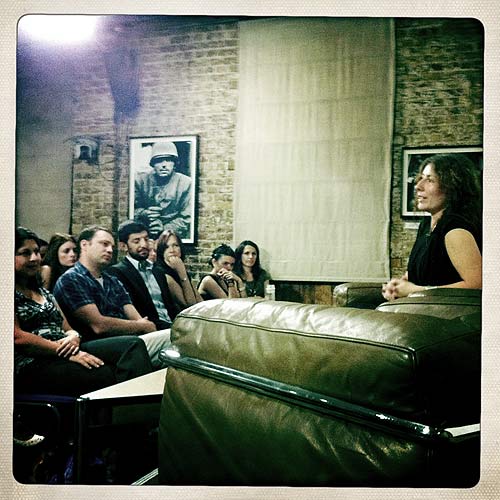
On Friday evening, she came to the Frontline Club to discuss her latest book: Slavery Inc.: The Untold Story of International Sex Trafficking.
Cacho spent five years documenting the global sex trade, at times playing roles such as a nun, prostitute, pole dancer and client.
“I found it incredible how similar the culture in Vietnam is to the culture of Mexico,” she reflected. “Families that are living in extreme poverty … [coming] from generations of people that have never had a real chance, they never had a break.”
The story seemed universal: sex traffickers promising poor families to employ their children as maids in a big city, giving them an education, income, and chance at a better life.
“Which parent wouldn’t want that to happen?” Cacho asked.
But the price that sex workers pay – giving up their sexual subjectivity, and with it their integrity, to a clientele of mostly older and more powerful men – Silvio Berlusconi famously among them – is nearly always demanded when they are too young, and too deprived, to recognize the transaction taking place.
Throughout the world, Cacho lamented:
“People are becoming commodities … trained that it’s alright to become an object, [because] you know, this is just a business.”
On 30 April of this year, Cacho’s friend and fellow journalist Regina Martinez was found beaten to death in her home in Xalapa. Martinez, too, had made a career of exposing crime and corruption in Mexico. Still, Cacho continues.
“I know my job is useful,” she explained. “Sometimes it’s hard. And sometimes it’s really good, when you get a [criminal] sentence, or when you get the time to go salsa dancing, and have some tequillas, and just laugh about everything, including the death threats, and just remember that there are a lot of good things in life: love, and good sex, and all that. Then you just combine the whole thing.”
“One thing I learned after I survived jail and torture was … I would never give these Mafias my happiness.”
As the event concluded, Cacho was met with a standing ovation.
Watch the event here:
]]>
For Argentina’s poor, the reality is even starker. Kids busking at red lights or juggling on the metro is common enough. People going through the rubbish (known as ‘cartoneros’) has also become a part of daily life since the country’s own, private financial implosion at the end of 2001.
Statistics published recently suggested poverty figures had crept back up to the levels they were just before the last crisis: i.e. around 11.8 million people (around 32% of the population).
Numbers are easy to ignore though. Less simple to pass over is a news item that I saw in the local La Nacion newspaper today. Apparently, children as young as eight years old are prostituting themselves for food.
The case involves up to 200 children between eight and thirteen years old, who sell themselves for sex in Buenos Aires’ Central Market. In exchange, their clients (other shoppers) provide them with something to eat.
SofÃa Kordecki, who’s responsible for child rights for the local municipality, admits that the problem is difficult to contain.
It’s harder still without the cooperation of the unions operating in the market. “They won’t admit the need to work with consumers [in the market]”, she says.
“What’s clear is that the children won’t prostitute themselves if there are no clients”, she adds. ]]>