https://soundcloud.com/frontlineclub/insight-with-nick-davies-hack-attack
In July 2011, revelations that journalists from The News of the World hacked the phone of murdered schoolgirl Milly Dowler created public outrage. But we were soon to learn this was just the tip of the iceberg. The revelations that followed revealed a scandal that has since engulfed Fleet Street, Scotland Yard and Downing Street.
The man behind that story, and the years of investigative work that came before it, was Nick Davies. In his new book Hack Attack: How The Truth Caught Up With Rupert Murdoch, Davies recounts his painstaking investigation and exposes the inside story of what went on in the newsrooms and the corridors of power.
Nick Davies will be joining us in conversation with Stewart Purvis, to talk about the investigation, the revelations and the future of press regulation. We will be asking how the press have changed in a post-Leveson world and whether they have really reformed.
Nick Davies writes investigative stories for The Guardian, and has been named Journalist of the Year, Reporter of the Year and Feature Writer of the Year in British Press Awards. He has written five books: White Lies, Murder on Ward Four, Dark Heart, School Report and Flat Earth News.
Stewart Purvis is professor of television journalism at City University. He is a former editor-in-chief and CEO of ITN, Ofcom’s Partner for Content and Standards, and author of When Reporters Cross The Line: The Heroes, the Villains, the Hackers and the Spies.
]]>Following the publication of Lord Justice Leveson’s 2,000-page report last week, the Frontline Club hosted a panel of media experts on 3 December.
The talk was chaired by BBC media correspondent Torin Douglas, he was joined by: Martin Moore, director of the Media Standards Trust and one of the founders of the Hacked Off campaign; former Daily Star reporter, Rich Peppiatt; Mick Hume, editor of the online magazine Spiked and Kirsty Hughes, of Index on Censorship.
The discussion began by considering Leveson’s proposal for an independent regulatory body underpinned by statute. Were the government to fail in following through on this, Martin Moore set out the alternative:
“Let’s say you don’t do the independent verification process, let’s say you just let the press get on with it and do it themselves. What would happen is the leading figures within the biggest news organisations, the biggest nationals, particularly Lord Black and Paul Dacre, with the help of Lord Hunt, will put together a new self regulation system of their own.”
Mick Hume was opposed to the view that the press needs to be regulated further, a suggestion he views as an assault on freedom of expression. He told us how puzzling he found it that many left-wingers today are in favour of further press regulation:
“It’s quite shocking that something that was once the great cause of the radical politics in this country, to free the press, that those who would think of themselves as being on the left and liberal minded have now become those who are now the most forceful advocates of some kind of statutory involvement and regulation of the press. I find that a bit shocking.”
He also spoke of what he saw as threats to investigative journalism, calling it “a very dangerous step.” This was something that Kirsty Hughes agreed with:
“How are we going to have decent investigative journalism, how are we going to get whistleblowing if we’ve got everything monitored or recorded?”
Rich Peppiatt’s argument was that our modern society is incomparable to the era that Hume evoked, as the power structures are very much different:
“You had a huge powerful state and you had a small press that was rebellious, that was trying to speak for the little man, but that’s not the modern world, our democracy is fairly weak compared to the corporate power that exists. That’s the real power in our society: corporate power, these days. The press is part of that corporate power.”
Peppiatt then pointed towards several people within the media showing bias in their argument:
“Those with the biggest guns always want the least gun regulation. Of course you have these big corporate interests that want the least regulation because they want the biggest megaphone.”
The discussion then opened up to the floor, which was fairly divided in its views. One thing everyone did agree on, however, was Torin Douglas’ observation that in Leveson’s report, the police and politicians seem to have got off lightly compared with the press.
Watch highlights from the discussion here:
]]>Lord Justice Leveson’s 2,000 page report into the culture, practices and ethics of the press has been met with mixed reactions from the press, politicians and the public. The most divisive suggestion, that the press should have an independent self-regulatory body underpinned by statute has spilt the government.
Join us for a reactive debate to discuss the findings and examine what action may be taken, and what implications it would have on the future of the British press.
Chaired by Torin Douglas, BBC media correspondent.
With:
Martin Moore, director of the Media Standards Trust and a founder of the Hacked Off campaign.
Rich Peppiatt, writer, broadcaster and former journalist at the Daily Star. His One Rogue Reporter has just shown at the Soho Theatre.
Mick Hume, editor-at-large of the online magazine Spiked and author of There Is No Such Thing As A Free Press …and we need one more than ever.
Kirsty Hughes, the Chief Executive of Index on Censorship – an international freedom of expression non-governmental organisation.
In association with Index on Censorship

Shadows of Liberty is an in-depth examination of the media crisis in the United States, where 166 newspapers have folded and 230,000 jobs have been lost since 2008.
Shadows of Liberty returns to the fabrications and cover ups that demonstrate just how the news we read is shaped by big business and government agendas. Mixing revealing interviews, reconstructions, animation, archive material, and insider accounts, director Jean-Philippe Tremblay explores the state of the U.S. media today and asks if the dominance of commercial interests makes unbiased reporting impossible to find.
The film’s title is borrowed from a Thomas Paine quote: "When men yield up the privileged of thinking, the last shadow of liberty quits the horizon."
Tremblay puts forward well-researched case studies of journalists who refused to let go of stories to the detriment of their careers, including former CBS reporter Roberta Baskin who exposed NIKE sweatshops in Vietnam. Also appearing in the documentary are, among others, Dan Rather, Bob McChesney, Daniel Ellsberg, Julian Assange, Danny Glover, Chris Hedges, Norman Solomon and Amy Goodman.
Director: Jean-Philippe Tremblay
Duration: 93′
Year: 2012
What impact has the decline of the newspaper industry and the growing influence of a few corporate giants had on objective news reporting?
Shadows of Liberty is an in-depth examination of the media crisis in the United States, where 166 newspapers have folded and 230,000 jobs have been lost since 2008.
Shadows of Liberty returns to the fabrications and cover ups that demonstrate just how the news we read is shaped by big business and government agendas. Mixing revealing interviews, reconstructions, animation, archive material, and insider accounts, director Jean-Philippe Tremblay explores the state of the U.S. media today and asks if the dominance of commercial interests makes unbiased reporting impossible to find.
The film’s title is borrowed from a Thomas Paine quote: “When men yield up the privileged of thinking, the last shadow of liberty quits the horizon.”
Tremblay puts forward well-researched case studies of journalists who refused to let go of stories to the detriment of their careers, including former CBS reporter Roberta Baskin who exposed NIKE sweatshops in Vietnam. Also appearing in the documentary are, among others, Dan Rather, Bob McChesney, Daniel Ellsberg, Julian Assange, Danny Glover, Chris Hedges, Norman Solomon and Amy Goodman.
Other panelists to be confirmed.
Director: Jean-Philippe Tremblay
Duration: 93′
Year: 2012
]]>
 The ‘post-Leveson’ question becomes ever more pressing, as identified at yesterday’s University of Westminster conference, attended by a range of international media researchers, as well as regulation and legal specialists.
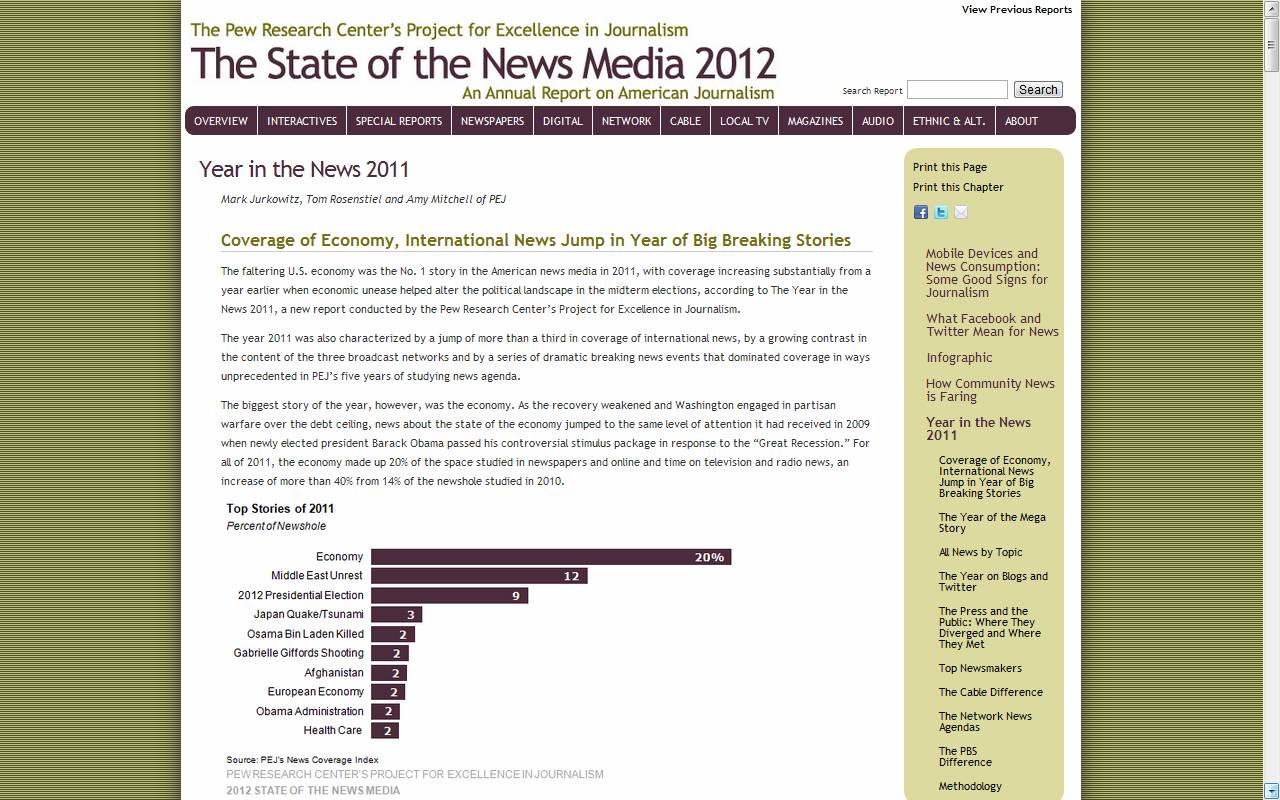 One section of the report offered a comprehensive understanding of which stories and topics were regarded as newsworthy by American journalists and included data for news being shared by bloggers and Twitter users.
Screenings next week include U.N. Me, an investigation into incompetence and corruption at the heart of the UN and an exclusive preview of Clint Eastwood’s J. Edgar which will be held at Warner House in Bloomsbury.
You are also invited to a private view of the Frontline Television News Exhibition – an opportunity to learn more about the thrilling history of the agency and the work of the pioneering cameramen and women. Tickets are free, but you must register if you would like to attend.
Follow us on Twitter and catch up on any events you missed on the Forum blog or download our podcasts on iTunes.
ALL EVENTS ARE OPEN TO THE PUBLIC
Join us this evening with veteran war correspondent Martin Bell as he reflects on a career that has seen him report from more than 80 countries and 11 wars since he joined the BBC in 1962. Tomorrow we will be discussing the situation in Somalia, a country caught between political instability, conflict and famine.
Screenings in the week ahead include When China Met Africa, exploring the ever-shrinking world in which we live and a preview screening of Kissinger.
Next week the only free member of the Angola 3, Robert King will be in conversation with director of Reprieve, Clive Stafford Smith, and for October’s First Wednesday we will be discussing Afghan perspectives on the past ten years of occupation.
JOB OPPORTUNITY: The Frontline Club Charitable Trust is looking for a documentary and workshop coordinator as, sadly, after two and a half years at the Frontline Club, our documentary programmer Charlotte Cook has left. Details of the job description and how to apply can be found here.
]]>
A chapter I wrote . . .
So-called “embedding”, the term for the practice by which journalists have been allowed to accompany allied troops in the Iraq and Afghan wars, is not just a way for the military to manage information but is an unspoken compact with the media that helps sustain the conflicts themselves.
It is easy to find British journalists like myself who criticise the practice of embedding but jump at every opportunity to accompany British troops at war. Space with the British army is at a premium and so if you can get there you won’t face too much competition. Compared with other foreign trips it is relatively easy to acquire strong stories supported by exceptional pictures. One can win awards.
Embedding costs very little money. The military provide food and tents. The press can often use military communications and the British army will fly you out and back for free. As an independent video journalist, I should make a profit on an embed. The army will also lend you a flak jacket and helmet. Even better, the soldiers will protect you from danger and deliver excellent first aid if they don’t. The risks are less than they appear. Easy pickings really.
It’s not just me being careful with the pennies. News budgets are at an all time low and foreign news acquisition is increasingly priced out of reach. Reporting foreign stories is much more expensive than covering domestic ones. As news organisations have tried to realise their duty of care the cost of covering foreign conflicts has further increased. Reducing risk is very expensive, often requiring extra insurance, equipment and the retention of bodyguards or other safety personnel.
Most now rely on cheaper wholesale agency material and whatever they can source from locals or other non-media sources. This includes material filmed or reported by army combat camera teams and blogs by military press officers. There are too few sources of information and even fewer reliable ones. But agency material, being shared with competitors, doesn’t promote the news brand nearly as well as the correspondent or television network reporter, so the opportunity for a newspaper or broadcaster to get people out on an action-packed foreign story on the cheap can be irresistible.
Army management of news output
While it is true that journalists have been accompanying armies and navies in wars for at least 150 years, in the past the military has been better at denying access rather than using the press to get their message out. Allied forces are now very sophisticated in managing news output. The effort is well funded and employs many ex-journalists. Lots of reporters have no difficulty crossing over from journalism to PR, leaving a trade that seems to lose its calling as quickly as it loses its funding.
The sign on top of the British media office tent in Camp Bastion in Helmand, Afghanistan, says “Media Operations’. As soon as you walk through the door as a journalist you understand that you are a sort of target, albeit treated much more gently than the Taliban. It is not about public accountability. News management has become an integrated part of the war effort, aiming to maintain public support for the conflict nationally, while winning the information war abroad.
Embedded journalists are normally accompanied by press officers during their visits. Servicemen or women trained in press management. The stakes are high for the press officer as getting it wrong can ruin their military career. With the British army, both sides are guided by a publication called the Green Book that lays out the rules of the press embed. It was put together by the Ministry of Defence, but in consultation with media organisations. It delivers editorial independence for embedded journalists subject to the needs of operational security. It also includes the reasonable provision in my view that the names of casualties should not be revealed until their next of kin have been informed. The conditions set out in the Green Book are progressive when compared with the restrictions that the press experienced, say, in Northern Ireland in the 1970s and 1980s or the Gulf War of 1991.
When soldiers and journalists bond
Press officers normally work hard to help journalists get stories on their embeds, organising transport and interviews. It would be hard for most of the media to find their way around these battlefields without them and a good working relationship normally develops. Journalists often develop strong relationships with their subjects. Those bonds can be strongest during a tough assignment when discomfort is shared and embedding often puts reporters with frontline troops under stress.
Certainly, having journalists embedded into units where they can get to know soldiers and share their experiences rewards the military with friendlier reporting. But the primary control exerted by the military is through determining who actually gets embedded. Unfavourable reporting is not often rewarded with further opportunity.
The military cannot reasonably be expected to take all the journalists that might want to accompany them. Thousands of journalists descended on Kosovo in 1999 and Afghanistan in 2001. The numbers are far too great. There have been instances when more journalists have applied to go to outposts in Afghanistan than there are soldiers stationed there. But numbers are kept very low, particularly when the military are feeling sensitive about what is happening. Whole operations can go unreported by independent journalists on the ground.
During the recent Operation Moshtarak, in Helmand in February 2010, there were only about 10 members of the press with the whole British force in Afghanistan. The Ministry of Defence will often favour popular commentators, like Ross Kemp, over critical journalists, or try to develop a relationship with tabloid newspapers when it thinks that favourable coverage can be widely achieved.
Valuable pool places to regional newspapers
Valuable places are given to regional newspaper reporters who are less likely to be critical, often there to do soft stories on a military unit local to the paper. Even regional newspapers can afford to send correspondents on embeds. But journalists are not allowed to bring their own vehicles, and being compelled to rely on the military for logistics makes it impossible to access the local population independently. If the military don’t want you somewhere, you are unlikely to get there.
Unfortunately, even if American and European journalists could have all the access they wanted to the military, these days they would deliver less than we need from them. The news industry does not look like it did in the 1960s during the Vietnam war. Most war reporters these days don’t really know much about war, in the way that say, sports journalists know about sport. War reporters are rarely students of conflict nor are they
normally ‘defence’ correspondents who might need to develop a broader knowledge of military affairs.
Over the last two decades the news industry, particularly television news, has developed a culture that rewards the more self-obsessed operators, pushing them to lead their reporting from a personal perspective to make it more accessible to the audience. Reporting becomes as much about promoting the correspondent, the brand representative, as telling the story. As the industry gets starved of funds the reports get weaker and the branding stronger.
The military and their political masters believe that images of dead or wounded allied soldiers, particularly, have the potential to sap public support for the war at home. The lesson from the conflict in Somalia in 1993, when pictures of dead US soldiers being paraded around Mogadishu were shown around the world, was that such images also risk delivering a propaganda victory to the insurgents abroad.
Casualties – the most sensitive issue
This makes allied casualties the most sensitive issue after operational security to the military. With the British army you are prevented from filming dead soldiers and will only be allowed to film or broadcast pictures of wounded soldiers if you have their permission. There are obvious practical difficulties getting this sort of permission from soldiers who suddenly find themselves in agony and struggling to stay alive. Most soldiers say no if they are fit enough to address the question, which is not easy to ask in the circumstances. Doing so invites a negative answer, which of course is why the requirement is there in the first place.
In theory a cameraman or photographer is allowed to film first and ask questions later. But attempting it will seriously raise the pulse of your military minder and soldiers you hadn’t noticed before suddenly become remarkably poor at keeping out of the way of your shot. As a consequence, embeds rarely show the suffering of war but instead offer up a dramatic but sanitised version of it. One that most journalists sex-up to present themselves as well as possible and in doing so normally treat the domestic audience to comforting messages of heroism and military strength.
Limiting the public’s real understanding of the cost of the war in human suffering actually betrays those unfortunate young men who become its casualties. Many are teenagers and some lose multiple limbs. A public that is poorly informed is unlikely to show these men the compassion and respect that they deserve. For all the proximity of the journalists and the cameras, the reporting has been contained, serving to distance the audience from the reality of war and any great feeling of ownership of it. The wars merge into the background and go on and on.
The current Afghan war has lasted for longer than the US military engagement in Vietnam in the 1960s and appears to a significant number of clued-up observers to have no greater prospect of success. But the US and the British public remain firm. British reporting is heavily informed by the tragedy of dead servicemen coming through Wootton Bassett. But it is not an image the soldiers who come home unscathed identify with. They are mystified when those they meet feel sorry for them. They do not see themselves as victims in the way that the press portrays them. They want public empathy; they get – to their dismay – public sympathy.
Presenting war to fit the grand, Hollywood-esque narrative
It is easier to ignore a war if it is soldiered by hero-victims. But the soldiers are us. They are our professional killers who sometimes enjoy it. But we want more distance from it than that. So we manufacture something else that doesn’t seem to require us to take any responsibility. An eroded and underfunded news industry compresses, simplifies and pasteurises, presenting war to conveniently fit into a grand narrative that owes more to Hollywood than the real experience.
Perhaps all parties – politicians and the military, the media, campaigners for forces support groups like Help for Heroes and even the public themselves – have an interest in sustaining this comforting way of seeing it. But news management is a risky business. Though it might maintain a level of support for the war that support becomes more brittle for the deception.
Every now and then a particularly disturbing story breaks through that becomes more shocking for being unexpected and is amplified for running contrary to the narrative the nation is being fed. Faith in our armed forces is imperiled. On the whole, generals, admirals and air marshals have enjoyed considerable public respect in Britain since the 1930s. There are signs that this is eroding.
News management, or spin, creates cumulative damage to us all by undermining our trust in the institutions that engage in it and subverting the quality of our conduct more widely in society. We are paying for these wars with more than blood and treasure.
]]>
The furore over police attitudes to protesters and police during the G20 protests in London at the start of this month rages on, with clear sides beginning to emerge in the debate.
If the police had hoped the focus on their tactics would abate as the dust settled on the protests, the death of Ian Tomlinson and the almost daily emergence of videos showing the rough treatment of journalists and photographers has hasd the exact opposite effect.
Two journalists whose work documenting protest I highlighted here before the protests, photographer Marc Vallee and film-maker Jason N Parkinson, are at the forefront of the evidence-gathering.
Several of Parkinson’s videos have been published by The Guardian online. While he put himself into the melee to document the protest, the strict policing meant he also came away with plenty of footage of police advancing on the assembled press, with occasionally violent results.
Read the rest of this post on Adam’s blog.
]]>