All Governments Lie will change the way you look at mainstream media. Spotlighting the work of iconoclastic rebel journalist I.F. Stone, this eye-opening documentary lays bare the need for adversarial alternatives to the mainstream.
Giant media conglomerates are increasingly reluctant to investigate or criticise government policies – particularly on defence, security and intelligence issues. They are ceding responsibility for holding governments and corporations accountable to the independent journalists and filmmakers who risk their careers and their freedoms to expose the truth.
With government deception rampant, and intrusion of state surveillance into private life never more egregious, independent voices like Glenn Greenwald, Jeremy Scahill, and Amy Goodman are crucially important. All three are inspired by I. F. Stone, whose fearless, independent reporting from 1953 to 1971 filled a tiny 4-page newsletter which he wrote, published, and carried to the mailbox every week.
Stone is little known today, but All Governments Lie will reveal the profound influence he’s had on today’s independent journalists.
Directed by: Fred Peabody
Produced by: White Pine Pictures
Country: United States
Year: 2016
Runtime: 90′
Twitter: @AllGovsLieDoc

Rifkind addressed a full house at the Frontline Club on Monday 21st Novemeber at a discussion about the future of conflict. Rifkind was joined by fellow panellists Paul Rogers, a professor in the department of Peace Studies at Bradford University, Julia Ebner, a Policy Analyist at Quilliam, and Julian E. Barnes from the Wall Street Journal, chaired by Jenny Kleeman, a British film-maker and journalist.
Paul Rogers identified a key issue in current conflict: ‘we’ve entered into an era of a revolution of frustrated expectations globally’, where people’s living standards are not rising with their expectations.
Julia Ebner believes a ‘global jihadist insurgency’ and a ‘far-right renaissance in Western countries’ are provoking a ‘phenomenon of reciprocal radicalisation’, where each party’s actions (such as anti-Muslim hate crimes and fundamentalist terror attacks) feed into the other’s grievances. For Ebner the solution lies in tackling those grievances and in tackling the ‘black-and-white narratives that are propagated from both sides’ which result in a worldview of the West and Islam being at war with each other.

Ebner was particularly concerned by the impact of fake news sites, as well as the echo chambers that are all too prevalent on the social media landscape in what she termed our ‘post-factual society’. Rifkind expressed similar concerns about social media, saying it ‘stimulates extremism, people… wind each other up and they get amplified… it’s hugely problematic in terms of stimulating extreme identities’. Barnes pointed to the ‘explosion of encryption technology and the ability very easily for groups or individuals to get very high-powered encryption that’s very difficult for intelligence services in the UK or the US to break.’
Although all of the panellists agreed that the so-called ‘war on terror’ has failed, Barnes said we should expect to see more of a focus on this under Trump, with Russia as a potential ally. Continuing the war on terror may be playing into the hands of Islamic terrorists who want war: Rogers argued that ‘if they present themselves as the true guardians of Islam under attack by crusader Zionist forces, then essentially it helps to be attacked’.
The panellists emphasised the importance of preventative work against conflict; but how do we get politicians to realise earlier that conflict is not the answer and to act early when politicians’ interests naturally lie in short-term success? Rifkind pointed out that ‘foreign policy is often about crisis management, it’s often about reacting rather than anticipating’, citing the Gaza conflict as a key example of this. Ebner, meanwhile, argued that the solution does not lie in politics at all, but within civil society, where we should ‘tell better stories than extremists are telling’.

IS is funded partly by Western Gulf states, and Barnes wonders if we might expect Trump to cut business from such countries ‘we very much could see more pressure [on allies which are known to fund terrorist groups] on this transactional approach’. However, IS campaigns are relatively cheap to run, and is able to maintain taxation within the territory, so a decline is as likely to come from a lack of appeal. None of this solves the underlying problems of the Arab world that made it so popular (the ‘revolution of frustrated expectations, as Rogers put it), such as unemployment. The underlying problem of marginalisation is here to stay, according to Rogers, who also named climate change as a major cause of future conflict and migration. Ebner added that uniting against climate change ‘could be part of the solution – it could also provide civil society with a common cause, an abstract enemy…rather than human beings fighting against human beings’.
Will World War III be mankind versus climate change? One can only hope.
]]>
This screening will be followed by a Q&A with reporter Abi Austen, director Will West and producer Shoaib Sharifi.
Reporter Abigail Austen is a former Parachute Regiment officer, the first British army officer to change her gender. Together with director Will West, she returns to the battlefield at the invitation of her former Afghan colleagues. Austen served four years alongside the US Army in Kandahar, Afghanistan. Austen has secured unique and extraordinary access to a turning point in the battle against ISIS and the Taliban across Helmand and Kandahar provinces, and are the first television crew to re-visit Camp Bastion since the British army withdrew. Now the battle’s at a pivotal stage.
Following the end of Coalition combat operations at the close of 2014, Afghans have been leading the fight against ISIS and a resurgent Taliban. In 2015, just one year, the Afghan army has lost ten times more soldiers than the British lost in fifteen years. The Taliban now control over half the country.
Austen and West fly with the helicopters of the Afghan Air Force, crucial to bringing in reinforcements and carrying out the wounded and dead. The bases they fly to are completely surrounded by the Taliban and helicopters are the only way in or out.

Back in Kandahar, Austen visits wounded troops in the military hospital where no western television journalists have ever been allowed access. She finds wards full of severely injured men. In Afghanistan, there’s no pension or Help for Heroes. Many of the wounded are the sole breadwinners for their families.
Austen meets the Head of the Air Wing, General Sherzai, who admits that the military situation is critical. The Unreported World team flies with him to Helmand and visits the site of the former Camp Bastion, now empty and no use to the Afghans despite intense ongoing fighting. On her return to Kandahar, Austen is given bad news. Other towns including Musa Qala have fallen to the Taliban. The news means everything the British fought for in Northern Helmand is now in Taliban hands.
Austen and West join another helicopter mission to Khas Uruzgan, one of the last bases left. It’s completely surrounded by the Taliban, and the fighting is hand-to-hand. As the helicopter lands, the pilot Salim spots a Taliban position above. A battle rages overhead as a few desperate souls try to get on board and take the only way out.
An Afghan army that the West spent billions to create is beginning to fall apart. Kandahar City, the Taliban’s birthplace, is now within their sights. If the Taliban is successful, the Afghan Government is unlikely to survive.
Channel 4, 7.30pm, Friday 9th April
For more information visit: www.channel4.com/unreportedworld http://www.facebook.com/unreportedworld #UnreportedWorld
Directed by: Will West
Reporter: Abi Austen
Producer: Shoaib Sharifi
Runtime: 24′
Country: United Kingdom
At a time when the US tech sector outpaces the overall growth of the employment market, CODE: Debugging the Gender Gap asks the important question: where are all the women? This revealing and uplifting documentary examines the reasons why more girls are not seeking opportunities in computer science and explores how cultural mindsets, stereotypes, educational hurdles and sexism all play a role in widening this employment gap.
Director Robin Hauser Reynolds opens by pointing out that in the early days of programming, women dominated the field. This was in no small part because male engineers thought this “soft” work was relatively trivial compared to building machines. In the decades that followed, more and more women entered computing; by the mid-1980s, women made up more than 35 percent of computer science graduates. Then began a falloff that persists to this day, with women making up only 15 percent of computer science majors in the U.S.
Expert voices from the worlds of technology, psychology, science, and education are intercut with inspiring stories of diverse women who are engaged in the fight to challenge complacency in the tech industry and to have their voices heard. CODE aims to inspire change in mindsets, in the educational system, in startup culture and in the way women see themselves in the field of coding.
Director: Robin Hauser Reynolds
Producers: Robin Hauser Reynolds, Staci Hartman, Christie Herring
Year: 2015
Running time: 80′
Dr. Sue Black was named one of the top 50 women in tech in Europe in 2015 and is an award-winning computer scientist, radical thinker and passionate social entrepreneur. She has regular tech columns in both The Guardian and The Daily Mirror.
]]>Foreign fighters are travelling to Syria and Iraq on an ‘unprecedented scale’ according to a recent United Nations report, which finds that 15,000 people have travelled to fight alongside the Islamic State (ISIS) and similar extremist groups.
The British and other governments are now left with the difficult decision of how to treat these individuals if they do return. A new Counter-Terrorism and Security Bill proposing new counter-terror powers, including temporary exclusion orders and the powers to seize passports of terror suspects, has been met by concern that it threatens civil liberties.
We will be joined by a panel of experts to debate this new bill and the measures it sets out. We will be examining the problem faced by the UK and others governments, and discussing long term solutions.
Chaired by CBS News foreign correspondent, Clarissa Ward.
The panel:
Shiraz Maher is a senior research fellow at the International Centre for the Study of Radicalisation and Political Violence (ISCR) at King’s College. He is currently coordinating the centre’s research on the Syrian and Iraqi conflicts. He also researches the development of Salafi-Jihadi ideology, and jihadist organisations in the broader Middle East.
Moazzam Begg is one of nine British citizens who were held at Camp X-Ray, Guantánamo Bay by the US government. He was released on January 25 2005 without charge. He is the director of Cageprisoners and author of Enemy Combatant. This year he was imprisoned by the British government on charges relating to Syria, his case was later dropped.
Richard Barrett is the senior vice president for special projects at the The Soufan Group. He is a former British diplomat and intelligence officer who from March 2004 to January 2013 headed the United Nations Monitoring Team concerning Al-Qaida and the Taliban.
]]>
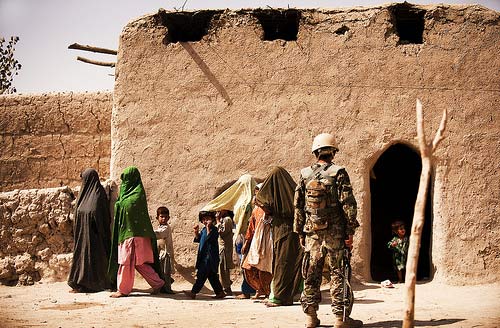
Conversation among decision makers who gather in London’s private dining rooms has turned from Afghanistan to Libya. Over rare beef and fine wine, they voice concern that Western governments have again embarked on a rushed military adventure, in a far away place, on a vague premise, with no clearly defined goal, and no apparent exit point. What is the end game, ask some of the most influential men and women in the country. Do our leaders know what they are getting us in to? Have they learned nothing?
Afghanistan, it seems, has become the object lesson.
David Miliband, Britain’s former foreign secretary, has joined the chorus singing from the hymn sheet of a political solution to the Afghanistan conflict, a new recruit to the latter-day wise who claim, after ten years and two-and-a-half thousand body bags, to recognise a military quagmire when they see one.
Afghanistan is set to become the ‘forgotten war’, overshadowed in the public and political consciousness by events in the Middle East. Nothing could be worse for the Afghan people, exhausted as they are by war, poverty, corruption, and decades of being fought over by the well-meaning and the venal, each equally difficult to determine from the other.
The road to hell is paved with Afghans’ patience, endurance and hopes for peace, and recent shocking events in Mazar-i-Sharif – where United Nations employees were set upon and murdered by a mob – should be seen as a warning that progress in the margins of a bureaucrat’s ledger is meaningless to a man who cannot go to bed at night secure in the knowledge that his door will not be kicked down, by either side of those fighting for his heart and mind.
US Army Lt General William Caldwell, arguably the most important man in Afghanistan today, recently breezed through London to tell anyone who would listen about his efforts to build Afghanistan’s security forces. Withdrawal of Western troops from Afghanistan depends on the success of General Caldwell’s mission to build an army that can keep insurgents at bay, and a police force that can fairly enforce laws backed by a credible judicial system.
The mob attack in Mazar, where the police seemed incapable of controlling the situation, showed there is still a long way to go. But General Caldwell does not have the luxury of failure as an option. And London’s chattering classes, who accept the commitment to Afghanistan is a fait accompli, want him to succeed. They just don’t have the stomach for another war with no end.
Picture credit: United States Marine Corps Official Page via a creative commons licence.
]]>