In late 2008, Daily Telegraph correspondent Colin Freeman and Jose Cendon, a Spanish photographer travelled to Somalia to investigate the recent spate of piracy attacks that were terrorising shipping in the Gulf of Aden. Their aim was to track down some of the pirates and secure an exclusive interview.
They were double crossed by their body guards and what followed was a nightmare 40 days in captivity. Force-marched into the desolate hills they were held in a succession of caves by a gang of armed men, all paranoically high on the amphetamine-like local plant, khat. The gang’s hideout was attacked by rival pirates, Freeman was subjected to mock execution by one of his captors and the threat of being handed over to Islamists who would undoubtedly execute him was constant lingering fear.
Colin Freeman, who is now chief foreign correspondent for the Sunday Telegraph will be joining us at the Frontline Club to discuss his new book Kidnapped: Life as a Somali pirate hostage in which he recalls the experience.
Chaired by Inigo Gilmore, award winning journalist and filmmaker who has worked across the world, with extensive experience in the Middle East, Africa and Asia. He won the Royal Television Society Award in 2011 for his work in Haiti last year, following earthquake.
]]>There are still a few tickets left for this Saturday’s unique opportunity to hear WikiLeaks editor-in-chief Julian Assange in conversation with renowned Slovenian philosopher Slavoj Žižek. The discussion, which will be moderated by Democracy Now!’s Amy Goodman, will focus on the ethics and philosophy behind the work of WikiLeaks and its effect on political institutions globally.
Next week Colin Freeman will be recounting his experience of being kidnapped by Somali pirates and Peter Greste who has recently been in the country for BBC’s Panorama will be talking about the Somali people’s struggle to forge a life in a lawless land.
For July’s First Wednesday, a panel of experts will be discussing the expansion of kill/capture missions in Afghanistan, their effect on the ground and how they level with counter-insurgency hearts and minds strategy.
Follow us on Twitter and catch up on any events you missed on the Forum blog or download our podcasts on iTunes.
ALL EVENTS ARE OPEN TO THE PUBLIC
]]>
There are still a few tickets left for this Saturday’s unique opportunity to hear WikiLeaks editor-in-chief Julian Assange in conversation with renowned Slovenian philosopher Slavoj
]]>Short film screening of Deadly Catch, followed by a discussion with an expert panel and audience Q&A.
One of the single biggest factors in ocean degradation is overfishing. Fish stocks have declined dramatically, with as much as 90% of big fish gone in some parts of the global ocean. More than one billion people rely on fish as their main source of protein globally. As catches decline and quotas and rules are tightened in response, there has been a huge increase in illegal, unreported or unregulated (IUU) or “pirate” fishing.
Pirate fishing is estimated to make up almost one-fifth of the global catch, and respects neither national boundaries nor international attempts to manage ocean resources. The recent seizure of £4 million worth of seafood in the Spanish port of Las Palmas, allegedly caught illegally in west African waters and headed for dinner tables in Europe, serves to highlight this growing criminal trade, which exploits lax regulations at ports and on the high seas, and often involves serious human rights infringements.
The evening will reveal the extent of the problem of pirate fishing, which takes place in both the developed and developing world. Discussion will focus on the many issues surrounding pirate fishing, including its dramatic impact on poorer coastal states, where hundreds of thousands of people rely on fish for food and livelihood. How EU subsidies are still benefitting illegal fishing operations, and how port states are being seen as the frontline in combating this activity. We will be exploring possible solutions and the importance of the role of the media in exposing the impacts of pirate fishing as a crime, comparable to international drugs smuggling.
This is the second in a series of events in 2011 at the Frontline Club focussing on the global ocean.The first event, “Death of the Oceans” took place May 11th and discussed all the stressors threatening ocean health and abundance. The video can be viewed here.
With:
Chaired by Tom Clarke, science correspondent Channel 4 News. Tom Clarke’s beat varies from the pharmaceutical industry to climate change. Since joining Channel 4 News in 2003, he has covered energy and the environment in from the Arctic Circle, seen some of the world’s most endangered whales in Russia’s far East, and followed the growing pains of the UK’s landmark Climate Change Bill. Tom started out as a scientist studying insects in the America’s deep south. After leaving the lab, Tom trained in journalism in New York. He worked as a science producer for American National Public Radio before returning to the UK to work for the science magazine Nature.
Domitilla Senni, policy adviser to the Pew Environment Group since 2006, began her work with environmental NGOs in 1987 when she joined Greenpeace as the Italian coordinator for the international Antarctic campaign. She then moved to become political coordinator of Greenpeace International Mediterranean campaign. She coordinated the International NGOs Steering Committee on Food during the 1996 FAO Food Security Summit. She then served as Executive Director of Greenpeace Italy from 1997 to 2004. She also worked as a consultant to WWF, the Third Millennium Foundation and Oceana. She has been a member of the Italian Ocean Commission and the National Council for the Environment established by the Ministry of Environment, and policy advisor on multilateral environmental agreements to the former Minister of Environment, Edo Ronchi.
Andy Hickman is the Oceans Campaigner at the Environmental Justice Foundation (EJF) and coordinates EJF’s community surveillance project in Sierra Leone, working with local fishing communities to document illegal, unreported and unregulated fishing. He is also the Project Coordinator for an EU funded programme to support the development of co-managed Marine Protected Areas in West Africa. Prior to joining EJF, Andy worked as a secondary school teacher on the Teach First program. He studied social sciences at King’s College London, has a postgraduate law degree, and has worked as a freelance journalist focusing on environmental issues including ship breaking, water mismanagement and fisheries.
John Pearce is a Senior Consultant at MRAG Ltd. He has over nearly twenty years experience in fisheries management, the problems of illegal, unregulated and unreported fishing and related options for monitoring, control and surveillance. His experience covers both practical and theoretical elements of the IUU problem. On the practical side this has included the planning, training and implementation of various MCS activities such as port state control programmes, fisheries patrolling, observer programmes and vessel monitoring systems. On the theoretical side, his work has included the development and implementation of risk assessment systems to assess the chance that products of illegal fishing may enter the supply chain, the EU funded COBECOS programme (Costs and Benefits of Control and Operating Strategies) and the first study to undertake a world-wide analysis of illegal and unreported fishing. His experience covers a wide variety of fisheries both inside and outside EU waters including tuna fisheries in the Atlantic and Indian Oceans, fisheries in the Antarctic and high seas deep water fisheries. In this capacity he has worked as part of the UK delegation or as an invited expert to IOTC, ICCAT, WCFPC, bilateral UK Fisheries Commissions and the Marine Technical Advisory Group of the International Commission for Land Use and Ecosystems at which he chaired the Illegal, Unregulated and Unreported Fishing subgroup.
EJF is a UK charity working internationally to protect the natural environment and human rights. We work with grassroots environment and human rights campaigners in some of the world’s poorest countries, such as Sierra Leone, where we build local capacity to protect the environment upon which communities depend.
EJF also campaigns internationally, producing award winning films and high quality advocacy reports to increase awareness of links between environmental degradation in the developing world, to decisions taken by consumers, companies and policy makers here internationally, hence our campaigns on illegal fishing in West Africa, on cotton and shrimp production, and on pesticides.
Highly commended as Campaigner of the Year in 2010 by Ethical Corporation Magazine, EJF is a small, dynamic and extremely cost-effective charity that makes a big impact. In our first decade our campaigns have attracted support from many high profile individuals including artists (Rachel Whiteread, Damien Hirst), fashion designers (Christian Lacroix, Luella Bartley), and actors (Johnny Depp, Ashley Jensen). EJF’s patron’s include Rachel Whiteread Emilia Fox, Iain Banks and Benedict Allen.
Picture credit: Environmental Justice Foundation.
]]>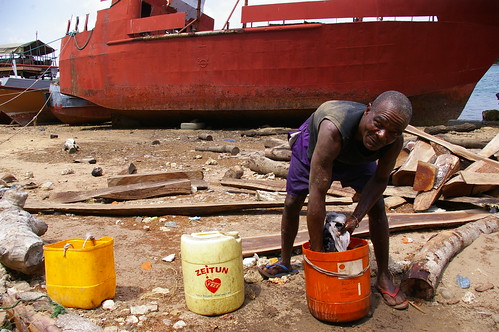
Kenyan fisherman. Photo by David Axe.
by DAVID AXE
When the Somali government collapsed in 1991, so too did Somalia’s ability to police its waters and regulate foreign vessels. For corporate fishing fleets from Asia and Europe, that meant rich shark and tuna fisheries suddenly wide open for exploitation. And boy did they exploit. Tales abound of foreign vessels stripping the fish from once-rich waters, and chasing away small-time Somali fishermen.
The problem got so bad that many displaced Somali fishermen picked up AK-47s and began boarding foreign vessels to demand “fees.” Thus Somali piracy was born. No wonder pirates are so popular — and untouchable to police — in many Somali fishing towns.
Today these small-time pirates have been bought out by large pirate bands that amount to seaborne organized crime. But that doesn’t mean that the illegal fishing has stopped. There are still legit fishermen in Somalia, and they’re still being squeezed by the foreigners. “Fishermen at Eyl district in Nugal region in the semi-autonomous state of Puntland are seriously complaining about foreign vessels,” our correspondent Mohamed Omar Hussein writes.
“There are several times when we have been chased by the foreign vessels, which are illegally taking our sea resources. And we have submitted our complains to our authority, but so far our authority has not done anything on this issue,” Abdifatah Mohammed, a senior fisherman in Eyl district, told Hussein. Puntland’s government lacks the resources and influence to change the behavior of billion-dollar industrial fishers.
Illegal fishing will continue. And it will continue providing legitimacy to pirates who these days are mostly just sea thugs.
Related:
State Department Praises Self-Defense against Pirates
Canadians Catch, Release Suspected Somali Pirates
Somali Insurgents Claim Boost from Yemen
Shipper Hires Mercenary Pirate-Fighters
Ship-Protection Firm “Looking at” Former Blackwater Pirate-Fighter
Pirates Surge in Gulf of Aden
A.U. Air Defenders Could Block Eritrean Arms
Maritime, Air Roles for A.U. Peacekeepers in Somalia
Puntland Scraps Makeshift Pirate-Fighting Force
Regaining the Initiative against Somali Pirates
World Politics Review: Counterpiracy Mission Targets Seafarers’ Hearts and Minds

by DAVID AXE
After a year of rapid growth, the international naval force assembled to combat Somali piracy has stabilized at what will probably be its permanent level. There are around 20 vessels and a handful of land-based aircraft from some dozen navies, organized into three major flotillas plus independent patrols. The U.S.-led Task Force 151, NATO’s Maritime Group 2 and the European Union’s Operation Atalanta represent the bulk of the forces, with India, China, Japan, South Korea, Russia and Iran sailing alone.
This diverse force coordinates its efforts through an ad-hoc "deconfliction board" that makes sure ships’ patrol areas aren’t overlapping. "We try to avoid the little-kid-soccer syndrome, where there’s one skiff and all the nations go after this one ‘ball,’" said U.S. Navy Rear Admiral Scott Sanders, from U.S. Central Command. "We stay spread out."
Sanders described a recent operation against a pirate skiff, to illustrate the results of this teamwork. "We had a Japanese P-3 [patrol plane]. It detects something. At that point, the Republic of Korea navy launches a helicopter for support. At the same time, we have a German and a Greek warship that [each launch] helicopters. We end up getting a Norwegian fast craft. It finds the skiff and boards it, and find weapons. That’s two task forces, plus two independent nations.
There have been fewer major pirate hijacking this fall, compared to last. Should we attribute this to more effective military patrols? Yes and no, said Royal Navy Capt. Keith Blount. "I think the success were seeing out here is for a number of reasons. … The military aspects are working better together than they ever were." But the commercial shipping industry’s internal reforms might be the biggest factor, Blount said:
They’ve been very robust in the countermeasures they’re using: not letting pirates on board, maneuvering the ship very hard, repelling boarders with fire hoses, putting razor wire at access points, locking the doors at the superstructure area. That very well may deter pirates and they just pull away. If the pirates are being particularly persistent, it buys time for military units to get there. Because of the larger number of military units, we can get there pretty quickly now. Put those things together and put in the powerful cooperative aspect, and the number of successful pirate attacks is driven down.
I’ll be joining the NATO counter-piracy force next week. You can support my coverage with a donation.
(Photo: U.S. Navy)
Related:
Building the Somali Navy, 500 Guys at a Time
French Propose “Stupidity Tax” for Pirate Victims
After Rain Break, Somali Piracy Set to Return
Dilbert Does Somali Pirates
Coast Guard: Secret Weapon in the War on Piracy
Nigerian Crew Outwits Somali Pirates
Sam Jackson to Portray Mysterious Kenyan Piracy Expert
Somali Pirates Trained in the Soviet Union? You Betcha
Pirates Have Stingers? Probably Not …
NATO Frigate’s Pirate Catch-and-Release
Video: Navy, Coast Guard Grab Pirates
NATO Back in the Pirate-Fighting Business
Somali Insurgent’s Tips for Fighting Pirates
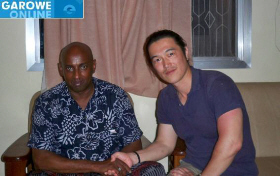
Given the utter chaos within Somalia, outright danger for journalists and the fact that freelancers Amanda Lindhout and Nigel Brennan remain hostages some 9 months after they were kidnapped outside Mogadishu, I was somewhat surprised to learn about Kenji Goto. He’s a journalist working for the "Independent Press" It appears he hooked up with a driver in Las Anod and travelled the 120km stretch of road to Garowe, arriving in the Puntland captial on Monday evening,
"I took a flight from Tokyo on Apr. 30 and spent a layover in Djibouti. I arrived in Berbera on Sunday," Kenji explained.
From Berbera, he hired a vehicle that transported him to Las Anod. Both towns are under the control of authorities in Somaliland, a peaceful region in northwestern Somalia that seeks complete independence from the rest of the country.
"Do you understand that this land [Puntland] has laws and security forces?" Planning Minister Dhala asked.
Kenji’s answer was as surprising as his trip: "Yes, Mr. Minister. But I wanted to go to the pirates place." Apparently, Somaliland authorities had misinformed him that Puntland is the "pirates place…"
"…I want the people of Japan to know the truth about this [piracy]," Kenji told me. "The world is sending warships…but I believe the world should send medicines and food to Somalia." link
Goto is staying in the Hotel Maka al-Mukarrama where he now has some protection from Puntland Special Protection Unit. I doubt the two American journalists with The New York Times journalists who are staying in the same hotel were allowed to travel in quite the same way as Goto.
]]>
Anjinho Mourinha is a lieutenant commander in the Portuguese navy. It made sense for his commanders to send him to USS Nashville for Africa Partnership Station. Some of the nations on Nashville’s route are Portuguese-speaking — Sao Tome and Principe, for instance — and Portugal retains strong diplomatic and economic ties with these countries as a leftover from the colonial era.
Mourinha teaches courses on fisheries protection for his African students, teaching them to know and enforce local laws regarding what, and how much, can be fished in a given region. For many West African communities, fish are the foundation of their income and “food security.” In that way, fisheries are a major security concern. “If these countries lose some of their alimentary security that come from fisheries, it is likely that maybe some of the populations will engage in other kinds of activities that can damage security,” Mourinha said.
Take Somalia, for instance, where today hundreds of pirates threaten world sea trade passing through the region. “The story in Somalia started with population trying to stop illegal fishing,” Mourinha said. Aggrieved fishermen levied unofficial fees on boats fishing illegally in Somali waters, because there was no government entity doing it for them. These “do-it-yourself” Somali fisheries enforcers realized they could apply their “board and fine” model to passing commercial vessels. Viola, piracy.
It’s Mourinha’s job to make sure that doesn’t happen in West Africa. It’s fisheries enforcement as conflict prevention, by way of APS.
(Photo: David Axe)
]]>Some 15 warships (sometimes as many as 20) in the Gulf of Aden have failed to prevent the pirates plundering the seas. They have simply switched tactics. Maritime officials in Kenya say they are now attacking further afield and in synchronised waves so as to stretch the defences. They have also become more agressive this year as they tackle crews prepared to use fire hoses or ships decked with barbed wire to keep the gangsters at bay.
The rewards on offer are tempting. My friend Sahal Abdulle travelled bravely to the pirate lair of Hobyo to see how multimiliion dollar ransoms are transforming sleepy fishing communities
For hundreds of years the harbour village of Hobyo was famous for one thing: the sharks caught in the azure waters of the Indian Ocean, which would be dried and shipped to Kenya.
Generations of children followed their fathers to sea and a lucrative career in fishing. They still want to go to sea. Only now they dream of being pirates. “I want be a pirate, they have cool cars and lots of money,” said a boy, 13, staring out to sea.
]]>
It looks like The Faina, hijacked by Somali pirates in September with 33 Russian tanks destined for South Sudan, is finally being freed for a record $3.2-3.5m ransom. No definitive confirmation from the Yanks who have been keeping a close eye on the ship. Lt Nathan Christensen said: "We have all indications that the ransom was paid yesterday regarding the Faina. Our ships continue to remain on station." But the AP is reporting that pirates have begun disembarking from the Faina.
Fourteen gunmen and the pirates’ commander disembarked from the MV Faina, which has been held by the pirates for five months, said Aden Abdi Omar, one of those who left the ship. Omar spoke to The Associated Press by satellite phone from the central Somali coastal town of Harardhere, not too far from where the MV Faina is anchored.
I’m told to expect "televisuals" of ransom being dropped by parachute. And may post tomorrow on what a total nightmare it is to write a story based on an interview with someone who speaks no English via a satellite phone, that may or may not be on a ship in (or perhaps nowhere near) Somali waters, or may or may not be in a Somali fishing harbour/pirate haunt.
]]>