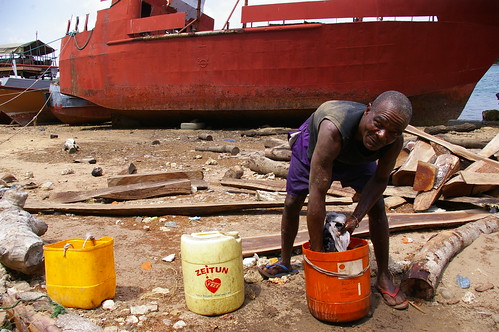
Kenyan fisherman. Photo by David Axe.
by DAVID AXE
When the Somali government collapsed in 1991, so too did Somalia’s ability to police its waters and regulate foreign vessels. For corporate fishing fleets from Asia and Europe, that meant rich shark and tuna fisheries suddenly wide open for exploitation. And boy did they exploit. Tales abound of foreign vessels stripping the fish from once-rich waters, and chasing away small-time Somali fishermen.
The problem got so bad that many displaced Somali fishermen picked up AK-47s and began boarding foreign vessels to demand “fees.” Thus Somali piracy was born. No wonder pirates are so popular — and untouchable to police — in many Somali fishing towns.
Today these small-time pirates have been bought out by large pirate bands that amount to seaborne organized crime. But that doesn’t mean that the illegal fishing has stopped. There are still legit fishermen in Somalia, and they’re still being squeezed by the foreigners. “Fishermen at Eyl district in Nugal region in the semi-autonomous state of Puntland are seriously complaining about foreign vessels,” our correspondent Mohamed Omar Hussein writes.
“There are several times when we have been chased by the foreign vessels, which are illegally taking our sea resources. And we have submitted our complains to our authority, but so far our authority has not done anything on this issue,” Abdifatah Mohammed, a senior fisherman in Eyl district, told Hussein. Puntland’s government lacks the resources and influence to change the behavior of billion-dollar industrial fishers.
Illegal fishing will continue. And it will continue providing legitimacy to pirates who these days are mostly just sea thugs.
Related:
State Department Praises Self-Defense against Pirates
Canadians Catch, Release Suspected Somali Pirates
Somali Insurgents Claim Boost from Yemen
Shipper Hires Mercenary Pirate-Fighters
Ship-Protection Firm “Looking at” Former Blackwater Pirate-Fighter
Pirates Surge in Gulf of Aden
A.U. Air Defenders Could Block Eritrean Arms
Maritime, Air Roles for A.U. Peacekeepers in Somalia
Puntland Scraps Makeshift Pirate-Fighting Force
Regaining the Initiative against Somali Pirates
World Politics Review: Counterpiracy Mission Targets Seafarers’ Hearts and Minds

by DAVID AXE
The Navy’s shipbuilding strategy hinges on buying at least 55 copies of the 3,000-ton Littoral Combat Ship, a vessel supposedly optimized for near-shore warfare, with a shallow draft and improved maneuverability.
But the Navy’s not waiting around for the delayed and over-budget LCS. USS Donald Cook, a 9,000-ton Burke-class destroyer designed for open-ocean combat, braved outdated charts and her fairly deep draft to perform her own littoral combat mission in recent weeks, when she patrolled just a mile and a half from Somali pirate camps soon after deploying to East Africa this summer.
In nautical terms, a mile is pretty damn close. In pushing so close to the pirate camps, “DC” Captain Derek Granger hoped to send a clear message to potential sea bandits. “If they’re sitting on the beach, wondering if they should make an, ahem, sojourn, and they see the Donald Cook … they may rethink.”
DC took the opportunity to gather intel for her NATO commodore. “My crew loved it,” Granger says. “In there close, providing video and photographic info back to the boss … it’s useful.”
During her near-shore patrol, DC sent out two boarding teams to investigate suspect skiffs. Turned out they were both legit fishing boats. But Granger didn’t know that when he ordered his people to travel a mile away in Rigid-Hull Inflatable Boats — too far for DC to provide quick support. That, and not the shallow water, was the most stressful thing, Granger says.
(Photo: David Axe)
]]>
by DAVID AXE
A year into the “global war on piracy,” naval operations have settled into a comfortable routine. The world’s maritime bodies have agreed on a 50-mile-wide “security lane” connecting the Gulf of Aden to the Indian Ocean. Commercial ships are encouraged to travel inside that lane. Each of the roughly 20 NATO, E.U. and U.S. coalition warships in the region is assigned a squarish portion of the security lane to patrol. Recon aircraft from Djibouti crisscross the skies, spotting suspected pirates and directing the warships to investigate. Merchant ships also spot possible pirates and radio in their locations.
This is a “surveillance-driven” model, in the words of Commodore Steve Chick, senior officer of the five-ship NATO force. It has its disadvantages. The surveillance model is mostly reactive, and it’s aimed at interdicting pirates in the terminal phase of a potential attack — that is, when the pirates are already close enough to represent a danger. For this reason, the counter-piracy fleet often counts on stalling tactics to keep merchant ships safe until warships can respond. Merchants are instructed to sail fast, zig-zag and use their hoses to keep pirates at bay while warships and helicopters race to the rescue.
There’s another, potentially better, way of countering pirates, Chick explains. He calls it an “intelligence-driven” model that relies on a better understanding of pirates’ infrastructure and attitudes. By this method, a warship might sail a circuit within sight of a pirate port. The vessel’s presence is meant to bottle up pirates, while also creating an impression of overwhelming power that hopefully would deter future pirates from every setting sail, even after the warship has left.
USS Donald Cook — “DC” to her crew — has already tested out Chick’s new intel method, and other ships might do the same, as counter-piracy operations evolve. “There’s a bit of hearts and minds there, as well,” Chick says, adding that a visible warship presence can encourage the vast majority of Somalis who oppose piracy, but have been cowed by the sea bandits’ wealth and aggression. DC routinely sends boarding teams to talk to friendly Somali fishermen, “asking what they’ve seen and what they know” regarding pirates, Chick says. As the intel approach gains acceptance, this kind of interaction will only grow in importance.
(Photo: David Axe)
]]>
by DAVID AXE
In three months there’s been just one successful pirate attack in the Gulf of Aden. The same time last year, there were 17. Piracy off the Somali coast is apparently on the decline, big-time.
Commodore Steve Chick, the senior officer for the five-ship NATO counter-piracy task force, has a theory. He says the decline is a combination of three factors. First off, "merchant ships are taking better self-protection measures." Chick recalls flying in his Lynx helicopter along the security lane through which vessels are encouraged to sail. Looking down, he saw ships with fire hoses at the ready and barbed-wire on their rails.
Also, the "military are doing better," Chick adds. In Somali waters there are 20 warships belonging to three international flotillas — NATO’s, the E.U.’s and the American-led Combined Task Force 151 — plus another 20 ships from Russia, China, India, Japan, South Korea and Iran. All the forces, expect Iran, send reps to a monthly meeting in Bahrain to dole out patrol areas. The three flotillas take turns as chair of the assembled fleet, with veto power during any dispute over who sails where. So far, Chick says, there haven’t been any arguments. Officers on USS Donald Cook, part of the NATO force, describe sitting in the destroyer’s Combat Information Center listening to sailors from a dozen nations checking in.
Finally, something is giving in Somalia. Piracy has its roots in lawlessness on land. Where law takes hold, pirates can’t. The governments of three Somali nations — the Republic of Somalia, Puntland and Somaliland — have all stood up new naval forces, with help from the U.S., NATO and the U.N. While these forces have few boats, they don’t necessarily need them, Chick says. Rather, they should focus on beachfront security. As governments crack down, "piracy is becoming less socially acceptable" in Somalia, Chick says.
"Let’s not under-estimate pirates," Chick cautions. They might adapt, and strike back. But with extensive international infrastructure now in place to address the threat, the world is well-positioned to keep up with any new piracy methods. "What we have here is a template," Chick says.
(Photo: David Axe)
]]>
by DAVID AXE
After a year of rapid growth, the international naval force assembled to combat Somali piracy has stabilized at what will probably be its permanent level. There are around 20 vessels and a handful of land-based aircraft from some dozen navies, organized into three major flotillas plus independent patrols. The U.S.-led Task Force 151, NATO’s Maritime Group 2 and the European Union’s Operation Atalanta represent the bulk of the forces, with India, China, Japan, South Korea, Russia and Iran sailing alone.
This diverse force coordinates its efforts through an ad-hoc "deconfliction board" that makes sure ships’ patrol areas aren’t overlapping. "We try to avoid the little-kid-soccer syndrome, where there’s one skiff and all the nations go after this one ‘ball,’" said U.S. Navy Rear Admiral Scott Sanders, from U.S. Central Command. "We stay spread out."
Sanders described a recent operation against a pirate skiff, to illustrate the results of this teamwork. "We had a Japanese P-3 [patrol plane]. It detects something. At that point, the Republic of Korea navy launches a helicopter for support. At the same time, we have a German and a Greek warship that [each launch] helicopters. We end up getting a Norwegian fast craft. It finds the skiff and boards it, and find weapons. That’s two task forces, plus two independent nations.
There have been fewer major pirate hijacking this fall, compared to last. Should we attribute this to more effective military patrols? Yes and no, said Royal Navy Capt. Keith Blount. "I think the success were seeing out here is for a number of reasons. … The military aspects are working better together than they ever were." But the commercial shipping industry’s internal reforms might be the biggest factor, Blount said:
They’ve been very robust in the countermeasures they’re using: not letting pirates on board, maneuvering the ship very hard, repelling boarders with fire hoses, putting razor wire at access points, locking the doors at the superstructure area. That very well may deter pirates and they just pull away. If the pirates are being particularly persistent, it buys time for military units to get there. Because of the larger number of military units, we can get there pretty quickly now. Put those things together and put in the powerful cooperative aspect, and the number of successful pirate attacks is driven down.
I’ll be joining the NATO counter-piracy force next week. You can support my coverage with a donation.
(Photo: U.S. Navy)
Related:
Building the Somali Navy, 500 Guys at a Time
French Propose “Stupidity Tax” for Pirate Victims
After Rain Break, Somali Piracy Set to Return
Dilbert Does Somali Pirates
Coast Guard: Secret Weapon in the War on Piracy
Nigerian Crew Outwits Somali Pirates
Sam Jackson to Portray Mysterious Kenyan Piracy Expert
Somali Pirates Trained in the Soviet Union? You Betcha
Pirates Have Stingers? Probably Not …
NATO Frigate’s Pirate Catch-and-Release
Video: Navy, Coast Guard Grab Pirates
NATO Back in the Pirate-Fighting Business
Somali Insurgent’s Tips for Fighting Pirates

Given the utter chaos within Somalia, outright danger for journalists and the fact that freelancers Amanda Lindhout and Nigel Brennan remain hostages some 9 months after they were kidnapped outside Mogadishu, I was somewhat surprised to learn about Kenji Goto. He’s a journalist working for the "Independent Press" It appears he hooked up with a driver in Las Anod and travelled the 120km stretch of road to Garowe, arriving in the Puntland captial on Monday evening,
"I took a flight from Tokyo on Apr. 30 and spent a layover in Djibouti. I arrived in Berbera on Sunday," Kenji explained.
From Berbera, he hired a vehicle that transported him to Las Anod. Both towns are under the control of authorities in Somaliland, a peaceful region in northwestern Somalia that seeks complete independence from the rest of the country.
"Do you understand that this land [Puntland] has laws and security forces?" Planning Minister Dhala asked.
Kenji’s answer was as surprising as his trip: "Yes, Mr. Minister. But I wanted to go to the pirates place." Apparently, Somaliland authorities had misinformed him that Puntland is the "pirates place…"
"…I want the people of Japan to know the truth about this [piracy]," Kenji told me. "The world is sending warships…but I believe the world should send medicines and food to Somalia." link
Goto is staying in the Hotel Maka al-Mukarrama where he now has some protection from Puntland Special Protection Unit. I doubt the two American journalists with The New York Times journalists who are staying in the same hotel were allowed to travel in quite the same way as Goto.
]]>
Anjinho Mourinha is a lieutenant commander in the Portuguese navy. It made sense for his commanders to send him to USS Nashville for Africa Partnership Station. Some of the nations on Nashville’s route are Portuguese-speaking — Sao Tome and Principe, for instance — and Portugal retains strong diplomatic and economic ties with these countries as a leftover from the colonial era.
Mourinha teaches courses on fisheries protection for his African students, teaching them to know and enforce local laws regarding what, and how much, can be fished in a given region. For many West African communities, fish are the foundation of their income and “food security.” In that way, fisheries are a major security concern. “If these countries lose some of their alimentary security that come from fisheries, it is likely that maybe some of the populations will engage in other kinds of activities that can damage security,” Mourinha said.
Take Somalia, for instance, where today hundreds of pirates threaten world sea trade passing through the region. “The story in Somalia started with population trying to stop illegal fishing,” Mourinha said. Aggrieved fishermen levied unofficial fees on boats fishing illegally in Somali waters, because there was no government entity doing it for them. These “do-it-yourself” Somali fisheries enforcers realized they could apply their “board and fine” model to passing commercial vessels. Viola, piracy.
It’s Mourinha’s job to make sure that doesn’t happen in West Africa. It’s fisheries enforcement as conflict prevention, by way of APS.
(Photo: David Axe)
]]>
Yesterday the American crew of the container ship Maersk Alabama successfully fought back against Somali pirates attempting to seize the vessel. The ship’s captain was kidnapped during the fighting and now the FBI is helping negotiate his release.
For Esquire.com, I surveyed five pirated crews who didn’t fare nearly so well, including:
Ekawat Nava 5, 16 souls (November 2008)
This small Thai trawler was carrying fishing supplies to Yemen when pirates sneaked up. After just a few hours of captivity, the captured crew perhaps felt a rush of hope as the lights of an Indian warship, Tabar, appeared in the night sky. But then something went horribly wrong. According to the Indian navy, a pirate shot at the warship. “Tabar retaliated in self-defense and opened fire on the mother vessel,” the navy reported, referring to pirates’ tactic of using trawlers as “motherships” for the smaller skiffs. Ekawat Nava 5 went down in flames, pictured, taking fifteen of her crew. The Indian navy insisted that the trawler matched the description of a known pirate ship.
(Photo: Indian navy)
]]>
A Korean crewman aboard a ship sailing on the Indian Ocean was shot in the head by Somali pirates but survived, the AP reports. Despite the surge in East African piracy in the past 18 months, only two people have died as a result of pirates’ actions, by my count. One was the Russian captain of the MV Faina, a cargo ship seized last fall. That man died of natural causes, perhaps exacerbated by stress, while in captivity. Also last year, a member of the Puntland security forces in northern Somalia was killed during an operation to re-take a seized ship from pirates.
In contrast to their kin in many other parts of the world, Somali pirates are not known for being particularly bloodthirsty. They are more interested in ransoming a crew than hurting them. But the act of seizing a ship is, nevertheless, a violent one. And as seafarers get better at resisting pirates, using hoses, Molotov cocktails and other methods, the pirates will escalate their use of force. Cruise ship owners worry that a small band of pirates trying to capture a liner carrying potentially thousands of people might find themselves so overwhelmed that they just open fire.
]]>
After a year of escalating piracy off the Somali coast, during which pirates seized more than 100 large vessels, in early 2009 the rate of attacks decreased markedly. On Feb. 22, pirates captured a Greek-owned vessel carrying coal. Despite this, the first two months of the new year represented a “lull” in piracy, according to the NATO Shipping Center near London.
The question is, why? And how long will the lull last?
In January, U.S. Navy Rear Admiral Terry McKnight, commander of Combined Task Force 151 (pictured) — a U.S., British and Danish counter-piracy force — chalked up the decrease in attacks to a combination of weather and the deterrent effect of naval patrols. There are now some 20 warships from more than a dozen nations patrolling East African waters, which experiences monsoon winds as high as 15 knots during the winter.
“These skiffs that the pirates have are not much bigger than a Boston Whaler, so when the weather picks up, they tend to stay at home and not out here,” McKnight said from his flagship during a teleconference with reporters. The U.S.-based Boston Whaler company is most famous for its 13-foot fishing boats.
“But I think the combination of the coalition working together and the maritime community has decreased the pirate activity dramatically over the last couple of months,” McKnight added.
Piracy expert Martin Murphy, from the Center for Strategic and Budgetary Assessments in Washington, D.C., agrees with McKnight’s assessment, but adds a note of caution. He says there’s “a fair degree of posturing going on” among the nations and alliances battling piracy, a club that has expanded to the U.S., the European Union, NATO, China, Russia, India, Yemen, Kenya, Japan, South Korea and others.
The E.U. force — four frigates from four nations — was launched in December at a cost of $11 million.
“It’s going to be interesting to see how long they stay, in next few months,” Murphy says of the pirate-fighting groups. “They’re all significantly time-limited.”
Read the rest at Offiziere.ch.
(Photo: U.S. Navy)
]]>