The Tim Hetherington Trust invites you to celebrate the lives of Tim Hetherington and Chris Hondros with a review of new work by friends, colleagues and others who are continuing the mission to share important stories powerfully told.
April 20th marks the fourth anniversary of the mortar attack that took Tim and Chris’ lives. Tonight’s program will demonstrate their living legacy with an array of new work that will stimulate and provoke in the style we came to expect from them. Starting with Tim’s earliest experiments in multimedia the evening will unfold to show projects recently completed and work still in progress by recognised names and emerging talent, accompanied by discussion of how to harness the media for more effective communication.
Topaz Adizes, filmmaker, will talk about some astonishing film projects that he was developing with Tim in 2011 and how his creative work has since evolved.
Paul Halliday, friend and collaborator with Tim during his time with The Big Issue and now a lecturer at Goldsmiths College, will introduce the forthcoming “Urban Encounters” festival at Tate Britain and how Tim’s work will find a place nearly 20 years on.
Geoff Johnson, artist, curator and studio partner with Tim in the 90’s will talk about “Manorism” a current exhibition of international graffiti art and will describe the discussions behind Tim’s Liberian war graffiti and its continuing relevance.
Eline Jongsma & Kel O’Neill, winners of the inaugural Visionary Award from the Tim Hetherington Trust, will talk about their practice that is evolving to include filmmaking, interactive media and virtual reality media.
Guy Martin, photographer, friend and thinker will show some current work and discuss it in the context of contemporary documentary practice. How has Tim’s thinking influenced the picture and how is it developing?
Daniel Meadows, Tim’s teacher at the Centre for Journalism Studies at Cardiff University will recount his last phone conversation with Tim which re-inspired his commitment to training and the importance of basic principles even as the industry changes.
We expect a provocative evening of images, ideas and words so please come to listen and share as we look back a their lives and forwards to what’s coming next.
Photo: Finbarr O’Reilly. Photographer and filmmaker Tim Hetherington works at a rally in the rebel stronghold of Benghazi in Libya.
]]>


The shortlist for the second edition of the Prix Pictet has been announced, showcasing serious and thought-provoking photography about the state of our planet.
Conceived as a prize to highlight environmental photography, the Prix Pictet has quickly become one of the world’s most presitigious and lucrative photographic prizes.
The Prix Pictet is the world’s first prize dedicated to photography and sustainability. It has a unique mandate – to use the power of photography to communicate crucial messages to a global audience; and it has a unique goal – art of the highest order, applied to the immense social and environmental threats of the new millennium.
The projects and photographs who have made it onto this year’s shortlist – theme: Earth – were produced by photographers who have the time, vision and backing to express themselves. There are some extremely stark and arresting images.
The shortlisted artists are:
Darren Almond, UK; Christopher Anderson, Canada; Sammy Baloji, Congo; Edward Burtynsky, Canada; Andreas Gursky, Germany; Naoya Hatakeyama, Japan; Nadav Kander, UK; Ed Kashi, USA; Abbas Kowsari, Iran; Yao Lu, China; Edgar Martins, Portugal; Chris Steele-Perkins, UK.
The shortlisted works will be exhibited in London and Paris later this year before the overall winner is announced.
Photo: Nadav Kander via Ft.com
]]>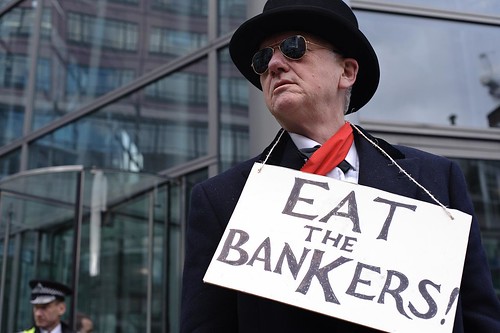
The furore over police attitudes to protesters and police during the G20 protests in London at the start of this month rages on, with clear sides beginning to emerge in the debate.
If the police had hoped the focus on their tactics would abate as the dust settled on the protests, the death of Ian Tomlinson and the almost daily emergence of videos showing the rough treatment of journalists and photographers has hasd the exact opposite effect.
Two journalists whose work documenting protest I highlighted here before the protests, photographer Marc Vallee and film-maker Jason N Parkinson, are at the forefront of the evidence-gathering.
Several of Parkinson’s videos have been published by The Guardian online. While he put himself into the melee to document the protest, the strict policing meant he also came away with plenty of footage of police advancing on the assembled press, with occasionally violent results.
Read the rest of this post on Adam’s blog.
]]>
The furore over police attitudes to protesters and police during the G20 protests in London at the start of this month rages on, with clear sides beginning to emerge in the debate.
If the police had hoped the focus on their tactics would abate as the dust settled on the protests, the death of Ian Tomlinson and the almost daily emergence of videos showing the rough treatment of journalists and photographers has hasd the exact opposite effect.
Two journalists whose work documenting protest I highlighted here before the protests, photographer Marc Vallee and film-maker Jason N Parkinson, are at the forefront of the evidence-gathering.
Several of Parkinson’s videos have been published by The Guardian online. While he put himself into the melee to document the protest, the strict policing meant he also came away with plenty of footage of police advancing on the assembled press, with occasionally violent results.
On his blog this weekend Parkinson wrote that he had suffered three days of concussion after being hit repeatedly over the head by baton-wielding police. He also claimed to have been jabbed in the kidney by a police medic.
The rest of the day panned out as most protest journalists imagined, hence many experienced photographers and video people using the now mandatory improvised safety equipment – helmets and arm and leg padding – something in itself that says a lot about policing these days. Others were not so ready for the brutal onslaught brought down into the streets by the infamous Metropolitan police force and the notorious black-clad, storm-trooper unit, the Territorial Support Group (TSG).
Writing on the Guardian’s Comment is Free blog, Vallee points out that those journalists and photographers caught on the frontline were only doing what they felt was right and necessary:
At the same time it is important to note that many media workers, at some risk, went to work over these two days to document what was taking place. With the wholesale cutting of picture rates and jobs in the media due to the recession, the internet, mismanagement or in my view a mixture of all three, it was no surprise to me that the press were under huge pressure not only to come up with important and stunning pictures and footage but also to make sure this content got sold.
The left-leaning Guardian and its sister Sunday newspaper, the Observer, are natural homes for this kind of debate. But while those papers have led the reporting, the death of Ian Tomlinson catapulted the issue of police tactics onto a wider stage. Newspapers of all political stripes are now reporting and debating the issue.
Today’s London Evening Standard quotes a former top Scotland Yard commander’s withering view of modern polciing:
Officers are trained to be on guard against attack, to regard every situation, no matter how seemingly benign, as a threat situation. The lesson is that the public are your enemy. That mindset appeared to dominate the G20 protests.
And the conservative Daily Telegraph, no friend of protest movements, points to a key change in public attitudes in an editorial calling for a “new broom” at the Metropolitan Police:
Significantly, middle-class opinion now regards the police with intense suspicion. Most British citizens are law-abiding; but the middle classes break fewer laws than any social group and have traditionally reposed enormous trust in the country’s police forces. Not any more.
Photographers and film-makers, by the very nature of their work, will more often than not find themselves caught in the middle of unfolding and unpredictable events in the years to come.
The ever-blurring lines between the “professional” and “amateur” photographer/journalist appears to be confusing the police, who are flailing and flapping much like newspaper owners seeking a revenue model in the internet age.
I admit it must be confusing, in the midst of an event, trying to distinguish between all those full-time pros and interested voyeurs.
Why doesn’t someone draw up some guidelines, maybe invent a press card? Oh, hang on…
UPDATE: Great minds appear to think alike. Alastair Campbell has also found himself pondering this subject today, and makes a plea on his blog for balance in coverage of this issue. His point is fair and valid – the police are today’s favoured targets. But I stick by my point – officers and commanders seem bewildered by the changes happening on the streets in front of them and how the nature of protest and media coverage is changing.
]]>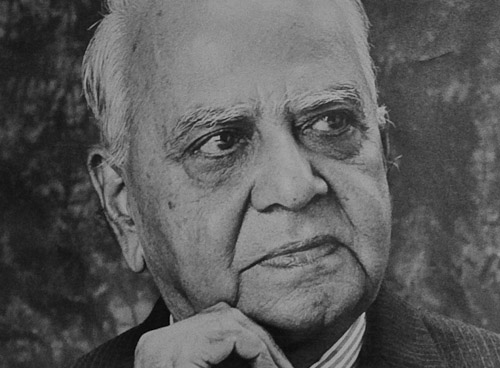
"I have begun to despise politicians and their ways. At my age, I don’t want to photograph any of them unless Barack Obama visits India."
As India goes to the polls at the start of its rather overwhelming general election, the words of TS Satyan, a revered photojournalist who has spent his life chronicling India and Indians, offer a glimpse of how the modern world seems to those who have watched it age with them.
I came across TS Satyan on a recent visit to Mumbai. India’s newspapers were filled with tittle-tattle in the build-up to its election – which begins today, 16 April. The leading paper, The Times of India, placed a modest banner headline at the top of each broadsheet page of coverage, branding the 2009 election a "Dance of Democracy".
Amid low-level election scandal (centring on an anti-Muslim rant by Varun Gandhi, another member of the Nehru-Gandhi dynasty), there was a revealing interview with Satyan in the pages of Time Out Mumbai.
Answering questions as an exhibition of his life’s work opened at the Institute of Contemporary Indian Art in Mumbai, Satyan – now 85 and a veteran of the Deccan Herald, Illustrated Weekly, Time and Life – described the pressures on photojournalists in India in depressingly familiar terms.
Those wanting to take to this profession must consider it carefully. You have to know more and work harder to earn less than in many other professions. You need the strength of a packhorse to carry around all the equipment. You must develop resourcefulness, ingenuity and adaptability to solve assignment logistics. Most important, you must stay healthy, always. You have to be your best self. The expectations of editors and readers are high.
News photography in modern times is not only fatiguing, but also dangerous and calls for alertness and dedication. In India there is not much money for those wanting to work for the print media. No wonder more and more young persons are branching out to other areas like advertising, industrial and fashion photography.

Exhibited in the quiet confines of the ICIA, Satyan’s body of work was impressive. The common theme in the work hung in the gallery was of a quiet, knowing peek inside of India itself. He chronicled rituals, personalities and intimate moments often unseen by outsiders. His images were beautifully composed and lit with a delicate and natural touch.
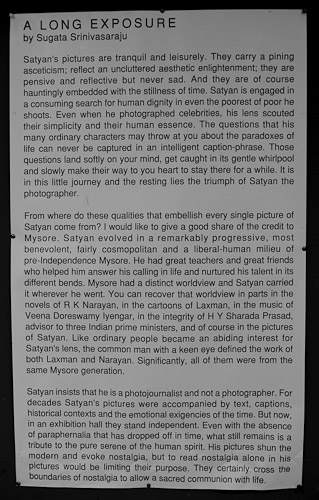
The literature at the ICIA included an introduction to Satyan, highlighting the influence on his work of his home, the educated, literate, princely state of Mysore – home, too, to one of India’s greatest writers, RK Narayan.
And while Satyan in Time Out claimed he was most proud of those of his photographs with an artistic quality, the introduction stresses his roots in news photography. "Satyan insists that he is a photojournalist and not a photographer."

But the photographer himself appears to lament the fast pace of modern journalism, telling Time Out he feels there is now a lack of interest in the work of what he terms "the concerned photographer".
Indian editors are not bothered about him and his work. They are not visually thrilled. They don’t seem to realise that in its own way, a picture can activate the conscience of the reader. They don’t realise that without being preachy the photographer can sensitise, motivate and subtly show us the need to search our own hearts. It is unfortunate that rank commercialisation of the mass media has worsened the situation.
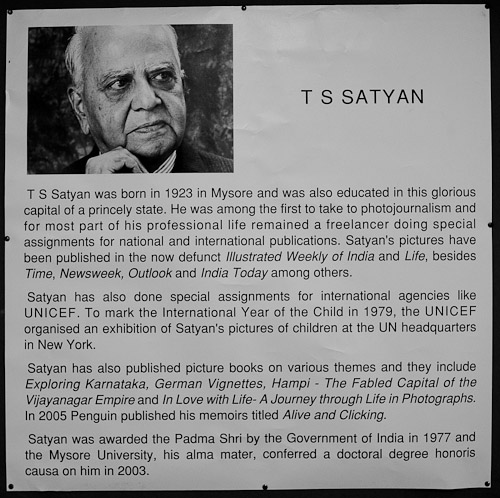
There appears to be no Wikipedia entry for TS Satyan (the best Wikipedia’s search engine can offer is "Satan"), so I have posted below my photographed copy of his biographical details, along with the introduction to the recent Mumbai retrospective.
TS Satyan’s photographs reproduced from Time Out Mumbai
]]>

A sobering and substantial piece of work by London-based photographer Abbie Trayler-Smith seems to have made an instant impression in the city this week.
An exhibition of her stark images of rejected asylum seekers still living in the UK has opened in the capital’s Host Gallery, winning both publicity and acclaim for the photographer. Among the highest-profile showcases, the BBC featured a selection of her images in an online gallery.
A high-quality video to accompany the show, featuring the still photographs and testimonies from the subjects, has also been released on Vimeo and elsewhere.
Still Human Still Here; Refused asylum seekers in the UK. from Anna Stevens on Vimeo.
As Kate Day writes in her photography blog for the Telegraph:
The exhibition exposes the hidden lives of those who are trapped in an impossible no-man’s-land, unable to return home but prevented from working to support themselves. They can only wait and hope their lengthy appeals are successful.
Abbie spent many months volunteering at a drop-in centre for asylum seekers before she started taking pictures. She explained that building a relationship with each individual she photographed was vital, not least because she did not want to "be a vulture" and exploit their vulnerability.
The trust she clearly developed with those she photographed has enabled her to shine a light on the drudgery of daily existence for these people. Cheap canned food heated directly on a gas stove in a squat in Leeds, the blackened feet of a figure lying on a shabby mattress, footprints in the snow in North London. Abbie’s pictures take us right to the heart of these immigrants’ lives and sensitively expose the hopelessness of their predicament.
The photographs are availalabe through Panos, which represents Trayler-Smith (a former Telegraph photographer of some repute), and are notable for their lighting and colours, with the overall look and feel of each frame complementing the often truly saddening tales they tell.
What also strikes me as interesting is the sheer depth and intensity of the project. As noted above, the photographer spent "many months" in research and, doubtless, many more actually shooting.
In today’s world of quick deadlines and shrinking opportunities, it’s heartening to see that those at the top of their game still find the backing to work on projects like this.
Dominick Tyler, a close friend of Trayler-Smith’s who blogs at photojournalism.co.uk (good address!) has asked her to blog about her experiences working on the project and putting on the show. It should be an interesting read.
Photograph: Abbie Trayler-Smith/Panos
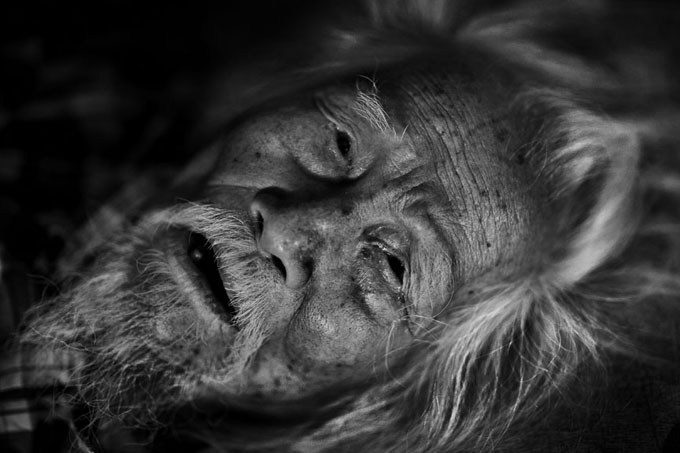
]]>But above this furniture store that looks as similar as the other 20 furniture stores on that block is some one beautiful. The sounds and smells drift in as an iconic man quietly sleeps. He has witnessed every change Vietnam has gone through during the past century.
Photographer Vo An Ninh, now 103 years old, lays practically motionless on a small mattress while his great grandchildren instant message friends on their computers. He looks like a small invalid child with an incredibly weathered face. But this man is one of the pioneering photographers of Vietnam, and he has seen more in his life than I can ever hope for.
His photographs caught the essence of the Vietnamese people during the early years of photojournalism. His work during the French occupation and Vietnamese famines serve as historical records for the his nation. His access to Ho Chi Minh during war times as a photographer was impressive.
In 1972, American b-52 bombers continuously hit Hanoi. Hanoians called this time the “Sleepless Nights”. Despite government curfew orders during the air raids, many photographers stayed out to photograph.
Vo An Ninh was one of those photographers. He was said to be very calm, riding a bicycle at a leisurely pace, with a helmet hanging from one handle bar and a canvas saddle bag on the other.
His camera of choice, the Super Ikonta A – A Japanese 120 film rangefinder introduced in the 1950’s. Many photographers offered him newer cameras but he would just laugh and ask, “Why would I use one of those when I have this one?”
I sat next to Vo looking into his solid black eyes, watching him watching me. So confused he was. Trying to decide whether to say hello to me in English or in French. So he simply said them both. I asked how he was in Vietnamese and he said jokingly that he was going to die soon. Everyone in the room laughed but I could only muster an awkward smile in the corner of my mouth.
I think all stages of life are beautiful.
If you are lucky enough to live through every one, then you pretty much leave this life the same way you enter. You hope that your loved ones are around to help you enter your new journey into death. But as a photographer what happens next? The photographs that are the most important to me in history are the ones that have lasted the test of time. You hope that one day you can contribute some thing to history.
In 1991 Vo published his first and only book simply titiled: Vo An Ninh’s Photos. One of the saddest things I think is that he no longer a copy of his own. It is out of print and he had given them all away. So my girlfriend’s father, Bac Trai, and I set out on motorbike in search of Vo An Ninh’s Photos.
I imagined a quirky French song playing as the aging Bac Trai went from used book store to used book store searching for Vo’s book. The imaginary video that would play along with the music would show cut after cut of the store owners shaking their heads with a look that said, “Who is Vo An Ninh?”
I had hoped to find a copy to give back to him but we came up empty handed. I will continue to search for the portfolio before it is too late.
For his contributions to photography in Vietnam, Vo An Ninh has been awarded the Anti-US Order, Second Class; the Labour Order, Second Class; the Independence Order, Third Class and most recently, the coveted Ho Chi Minh Award.
I will remember Vo An Ninh. I’m glad that I found him.