
Investigative journalist Nick Davies treated the Frontline Club to a detailed insight into his new book, and into the saga that dominated seven years of his life – uncovering the hacking scandal at News of the World.
One thing that he makes clear in the book, Hack Attack, is that the investigation uncovered far more than just illegal activity at one of Britain’s top newspapers – it also shed light on the power a media mogul had accumulated. As the subtitle of the book asked: Has the truth caught up with Rupert Murdoch?
Asking this question and many more was City University lecturer and former editor-in-chief and CEO of ITN, Stewart Purvis, who did not let The Guardian journalist off lightly, diving straight into some difficult questions about Davies’ own ethics and background.
In the wake of the revelations, Davies has faced a barrage of often vitriolic criticism. Purvis asked whether, in the face of so much over-whelming hostility, Davies ever thought of calling it a day. “I’ve read you elsewhere saying that underlying all your journalism is some deep-seated need to hit back at all who take power and abuse it”.
Davies agreed that part of his journalistic drive over such a long investigation came from a desire to speak out against abuse, but it also came from the necessity to defend his own credibility:
“Because [News International] kept attacking us, I couldn’t let the story drop. It wasn’t just a question of putting out a story and telling the truth, we had to defend our credibility.”
Purvis also raised the point that it fell to “little old you” to fully expose the hacking scandal when the trial of Goodman and Mulcaire in 2007 clearly pointed back to the paper. Davies‘ role in the story has been held as both an indictment to the failings of the free press and also as a validation of the strengths of the press. Was there a simple explanation?
“First of all you have newspaper failings: they’re owned by Murdoch, they’re up to the crimes themselves, they’re Tory supporters – all really worrying things that are influencing so-called ‘news judgment’. Beyond that, you have the PCC that I would say was, in certain important respects, intellectually corrupt. And beyond that you have the thing that makes this story worth writing about. . . . It’s about power and the way that power works.”
The media mogul of Davies‘ book generates fear in two ways: first by exposing people’s personal lives, hurting and humiliating them, and secondly, through organisational fear:
“If you are trying to get your party elected and you see your campaign being destabilised by hostile newspapers, you can’t run your organisation. What I think is interesting is that like a bully, once they have beaten up a few kids, people will start to tiptoe around the bully and placate him.”
Referring to this later on, Purvis pulled out a comment from The New York Times review of Hack Attack by David Carr, who wrote that “despite the book’s title, the truth never catches up with Rupert Murdoch.”
So has it? Almost. Davies said that during the summer of 2011, there was a chain reaction of disgust building on the emotional impact of the Milly Dowler story, The Telegraph‘s revelations that families of the victims of the London bombings had had their phones hacked, as had families of soldiers killed in Afghanistan. Suddenly nobody wanted to be Rupert Murdoch’s friend and everyone was changing sides.
“There was a moment when the truth caught up with him. But . . . slowly the power comes back.”
A member of the audience asked, “As in the context of big stories and big exposes, where does this one rank?” to which Davies answered with a story:
“I was at university when the Watergate scandal broke . . . and the idea that these two guys, Woodward and Bernstein, armed only with notebook and pen, could bring down the most powerful politician in the world because he was abusing his power, was just sensationally exciting. So I thought, ‘Okay, I’ll go and be a reporter.’ . . . [Then after the phone hacking scandal exploded] the phone rang one night and I picked it up and a gravelly voice said, ‘This is Carl Bernstein – I just want to say well done,’ and it brought tears to the eyes! It was like God calling!”
Watch and listen back here:
]]>https://soundcloud.com/frontlineclub/insight-with-nick-davies-hack-attack
In July 2011, revelations that journalists from The News of the World hacked the phone of murdered schoolgirl Milly Dowler created public outrage. But we were soon to learn this was just the tip of the iceberg. The revelations that followed revealed a scandal that has since engulfed Fleet Street, Scotland Yard and Downing Street.
The man behind that story, and the years of investigative work that came before it, was Nick Davies. In his new book Hack Attack: How The Truth Caught Up With Rupert Murdoch, Davies recounts his painstaking investigation and exposes the inside story of what went on in the newsrooms and the corridors of power.
Nick Davies will be joining us in conversation with Stewart Purvis, to talk about the investigation, the revelations and the future of press regulation. We will be asking how the press have changed in a post-Leveson world and whether they have really reformed.
Nick Davies writes investigative stories for The Guardian, and has been named Journalist of the Year, Reporter of the Year and Feature Writer of the Year in British Press Awards. He has written five books: White Lies, Murder on Ward Four, Dark Heart, School Report and Flat Earth News.
Stewart Purvis is professor of television journalism at City University. He is a former editor-in-chief and CEO of ITN, Ofcom’s Partner for Content and Standards, and author of When Reporters Cross The Line: The Heroes, the Villains, the Hackers and the Spies.
]]>Following the publication of Lord Justice Leveson’s 2,000-page report last week, the Frontline Club hosted a panel of media experts on 3 December.
The talk was chaired by BBC media correspondent Torin Douglas, he was joined by: Martin Moore, director of the Media Standards Trust and one of the founders of the Hacked Off campaign; former Daily Star reporter, Rich Peppiatt; Mick Hume, editor of the online magazine Spiked and Kirsty Hughes, of Index on Censorship.
The discussion began by considering Leveson’s proposal for an independent regulatory body underpinned by statute. Were the government to fail in following through on this, Martin Moore set out the alternative:
“Let’s say you don’t do the independent verification process, let’s say you just let the press get on with it and do it themselves. What would happen is the leading figures within the biggest news organisations, the biggest nationals, particularly Lord Black and Paul Dacre, with the help of Lord Hunt, will put together a new self regulation system of their own.”
Mick Hume was opposed to the view that the press needs to be regulated further, a suggestion he views as an assault on freedom of expression. He told us how puzzling he found it that many left-wingers today are in favour of further press regulation:
“It’s quite shocking that something that was once the great cause of the radical politics in this country, to free the press, that those who would think of themselves as being on the left and liberal minded have now become those who are now the most forceful advocates of some kind of statutory involvement and regulation of the press. I find that a bit shocking.”
He also spoke of what he saw as threats to investigative journalism, calling it “a very dangerous step.” This was something that Kirsty Hughes agreed with:
“How are we going to have decent investigative journalism, how are we going to get whistleblowing if we’ve got everything monitored or recorded?”
Rich Peppiatt’s argument was that our modern society is incomparable to the era that Hume evoked, as the power structures are very much different:
“You had a huge powerful state and you had a small press that was rebellious, that was trying to speak for the little man, but that’s not the modern world, our democracy is fairly weak compared to the corporate power that exists. That’s the real power in our society: corporate power, these days. The press is part of that corporate power.”
Peppiatt then pointed towards several people within the media showing bias in their argument:
“Those with the biggest guns always want the least gun regulation. Of course you have these big corporate interests that want the least regulation because they want the biggest megaphone.”
The discussion then opened up to the floor, which was fairly divided in its views. One thing everyone did agree on, however, was Torin Douglas’ observation that in Leveson’s report, the police and politicians seem to have got off lightly compared with the press.
Watch highlights from the discussion here:
]]> The ‘post-Leveson’ question becomes ever more pressing, as identified at yesterday’s University of Westminster conference, attended by a range of international media researchers, as well as regulation and legal specialists.
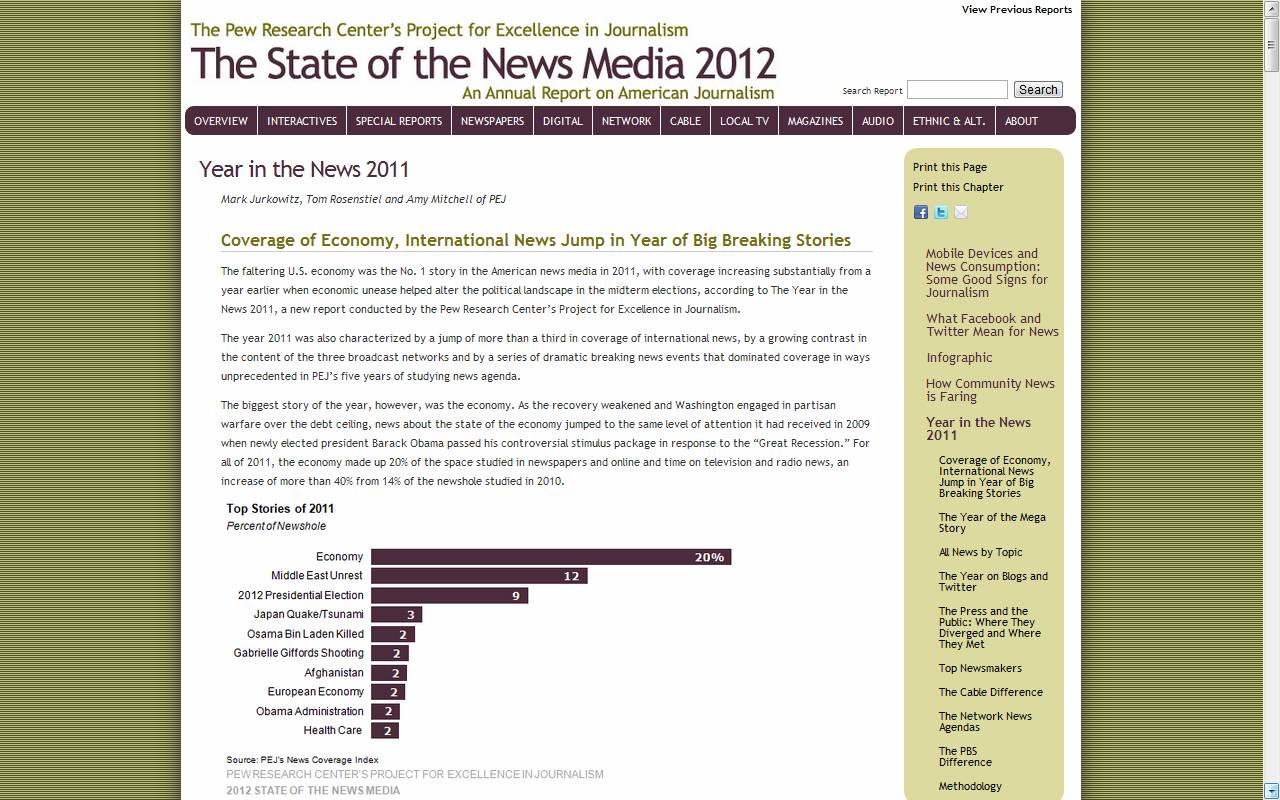 One section of the report offered a comprehensive understanding of which stories and topics were regarded as newsworthy by American journalists and included data for news being shared by bloggers and Twitter users.
We have now opened the survey up to the public and we would very much like to encourage you to participate by clicking here. We intend to publish more results later in the month, and will be using the contributions as part of a report that we will be submitting to the government select committee that has been assembled to gather evidence on the future of investigative journalism.
Of those who have so far responded to the survey, a majority believe:
* The phone hacking scandal will not fundamentally change the relationship between politics and journalism (Yes 18%; No 45%; Too early to tell 36%)
* Phone hacking was a widespread practice used by more media groups than just News International (Yes 82%; No 0%; Don’t know 18%)
* Illegal practices such as blagging, bribery etc. were accepted as common practice in journalism (Yes 91%; No 9%; Don’t know 0%)
*That the Press Complaints Commission should not be scrapped, but instead restructured (Yes 9%; No 9%; It shouldn’t be scrapped, but it should be restructured 73%; Don’t know 9%)
A majority of members also said they:
* Had confidence in the Media Ethics inquiry committee not to harm press freedoms (Yes 64%; No 18%; Don’t know 18%)
* Did not believe the introduction of new statutory powers over the press was the best solution (Yes 0%; No 82%; 18%)
* Felt David Cameron’s reputation and leadership has been harmed by the scandal (Yes 73%; No 18%; Don’t know 9%)
* Unanimously agreed that the industry of journalism should implement a new code of ethics, similar to a Hippocratic oath (Yes 100%; No 0%; Don’t know 0%)
Asked to propose a change to media regulation in the UK, contributions included:
* I would change the libel laws, which currently prevent journalists from reporting important issues which are in the public interest (eg: Trafigura case). There needs to be a way of separating out the exposure of corruption/wrong-doing by a company such as Trafigura and the exposure of some footballer’s sexual habits. The latter is not necessarily in the public interest, unless he has a campaign to tell young people to be faithful to their spouses or somesuch. The former is.
* The fit and proper test applied to owners, editors and board members.
* Improve the right to privacy. France’s privacy laws are tougher than those in the UK but France remains a thriving democracy, even if we Brits don’t like to admit it.
* Hold the press accountable for incorrect or malicious reporting.
* Create an independent regulator that is neither for or against the press, but is genuinely independent.
* To have a [regulatory] body with more ability to act – more teeth.
Asked what function investigative journalism serves for society, respondents wrote:
* To watch the watchers and expose wrongdoing and hypocrisy.
* Its function is to reveal the truth, to root out facts many people often want to keep hidden, to re-establish fairness, to shine light in dark places. Good investigative journalism is journalism’s strongest suit.
* Investigative journalism should call the powerful to account, and expose corruption. It is important in any democracy. It has nothing to do with prying into the private lives of celebrities – that’s a separate matter. Journalists may need some subterfuge to carry it out, but this is not the same as hacking into the telephones of celebrities to get gossip.
* Journalism can hold individuals and institutions accountable in the way that elections every five years or AGMs do not. Its purpose should be to uncover that which others might wish to remain hidden. Preferably issues that affect society, not the issue of which slapper Giggsy is shagging.
Asked how the phone hacking scandal would end, answers included:
* With the weakening of News International, and diminution of Rupert Murdoch’s power in British politics. I also think the tabloids may be ‘tamed’ to some extent but the danger is that important investigative reporting in the public interest will be caught in the same net.
* There will be a lot of early retirement (on full pensions of course) of many older hacks, of many more papers than have been implicated right now. There will be some calls for an independent press. Give it two months and it will all be forgotten.
* News Corp ousting the Murdochs, a few policeman and Coulson in jail.
* It will be old news at some point. Old scores will have been settled and new ones started. It will be referred by the sanctimonious to grab moral high ground when it is useful. Although it is extremely serious, it is being treated as a drama which devalues the important ethical implications.
* Cameron is brilliant; he can charm his way out of a crisis and turn on the head of a pin, so I don’t think it will bring him down – though it could. I think it will inevitably lead to greater press regulation which is why we need to ensure our voice is heard soon and with strength and conviction.
* In 24 months we will have forgotten all about it.
If you would like to participate in the survey, you can do so here. It will be open until 12pm on 10 August, after which time the final results will be published alongside full statistics.
]]>Watch the event here.
Rupert Murdoch’s positive contributions to the British press as well as the negative effects of his influence were discussed by a Frontline Club panel on phone hacking last night.
Although some of the panelists concluded that the positives might even outweigh them, the negatives are “awfully negative”, said chair Jon Snow, presenter of Channel 4 News.
Ever since the phone hacking scandal exploded earlier this month after the revelation that the News of the World hired an investigator to hack into murdered schoolgirl Milly Dowler’s phone, Rupert Murdoch’s influence has been unanimously decried.
Much reflection on the value of a reportedly dying empire has followed.
Panellist David Banks, a former Daily Mirror editor who also spent 14 years working for News Corp, said:
He begat a whole generation of journalism that we may not approve of. He pushed boundaries. I can divorce Rupert Murdoch from his power base. I rather like the man.
Without Murdoch quality papers like the Times and the Sunday Times would not exist today, added panellist Toby Young, a journalist for the Spectator and Daily Telegraph Snow pointed out the role Murdoch played in promoting premiership football and bringing satellite TV to millions of homes.
However, Jane Martinson, women’s editor at the Guardian, who until recently was media editor, said she Murdoch should not be discussed in extremes:
Rupert Murdoch as a bogeyman has not been the case for some years. [But] I wouldn’t go as far as to say the man is a saviour.
After many years in thrall to the Murdoch empire politicians finally called both Rupert and his son James Murdoch to account last week. Martin Moore, director of the Media Standards Trust and founder of the Hacked Off campaign, said politicians felt able to speak against Murdoch only after the revelations about Milly Dowler emerged.
When we went with the Dowlers to see the party leaders. They were remarkable, dignified … You could see the leaders [more] emboldened than they were before. They believed it was wrong and they had the public behind them.
The panel also discussed what had created the culture that led to widespread illegal activity. David Banks said the disappearance of the old, grey-haired editor-in-chief with a pipe and a strong moral code had resulted in a more reckless culture:
It is no coincidence that the last four or five editors of the Sun have all come from the showbusiness route. They have been quite young. No ethical background. No sense of someone behind them saying, ‘you can’t do that’.
In response to the panel’s comments about tabloid newsroom culture, James Anslow, a fomer News of the World employee who was in the audience,said the phone hacking scandal had surprised him.
“The idea that this is a culture that has been infected is hyperbole. I know of no ‘don’t ask, don’t tell policy’,” he said.
The role of press regulation has come under much scrutiny as a result of the phone hacking revelations. However, there was concern about the future of newspaper journalism if statutory regulation moving towards statutory regulation would be detrimental to journalism, argued Toby Young:
If journalism becomes wholly professionalised it becomes much harder to speak truth to power. We are not going to have quite such an energetic, rambunctuous media.
But Martin Moore said rather than statutory regulation a more “concise privacy law and first ammendment-style defense” should be developed. Such a stronger public interest defense would embolden journalists and solve the problem of what do when private or sensitive information is published online.
Review by Rebecca Omonira-Oyekanmi
]]>
The closure of the News of the World following further revelations that schoolgirl Milly Dowler's phone was allegedly hacked by private investigators has failed to draw a line under the growing crisis.
The print media has long defended its freedom from outside regulation. Is there a future for statutory regulation of the press or is it time for the Press Complaints Commission to be scrapped as actor and recent privacy crusader Hugh Grant has claimed?
Join us at the Frontline Club with an expert panel to discuss this ever-deepening scandal, as we consider what 'hackgate' might mean for the future of British journalism.
]]>View in iTunes
The closure of the News of the World following further revelations that schoolgirl Milly Dowler’s phone was allegedly hacked by private investigators has failed to draw a line under the growing crisis.
The print media has long defended its freedom from outside regulation. Is there a future for statutory regulation of the press or is it time for the Press Complaints Commission to be scrapped as has been called for by actor and recent privacy crusader, Hugh Grant?
The scandal poses massive questions — and not just for journalists. With Rupert Murdoch’s takeover bid for BSkyB in tatters, for instance, where do the events of the past two weeks leave Murdoch’s empire? And as more allegations surface concerning former NotW editor Andy Coulson, are Labour backbenchers right to call for prime minister David Cameron — who employed Coulson as his communications chief — to resign?
Join us at the Frontline Club with an expert panel to discuss this ever-deepening scandal, as we consider what ‘hackgate’ might mean for the future of journalism, politics and power in Britain.
Chaired by Channel 4 News presenter Jon Snow.
With:
David Banks, former editor of the Daily Mirror and editorial director of Mirror Group Newspapers. Worked in London, New York and Sydney over a thirteen-year career with Rupert Murdoch’s News Corp during which he edited two papers in Australia. Now a columnist and regular broadcaster.
Jane Martinson, women’s editor of the Guardian and former media editor;
Martin Moore, director of the Media Standards Trust, an independent charity that looks for ways to foster high standards in news and a founder of the Hacked Off campaign;
Toby Young, freelance journalist and associate editor of The Spectator, where he writes a weekly column. He also blogs for the Daily Telegraph and is the author of How to Lose Friends & Alienate People and The Sound of No Hands Clapping.
]]>Focusing on issues of privacy, justice and journalistic ethics, we will be asking whether the current system of law and regulation is - or is not - in need of reform.
]]>When more details about the News of the World phone hacking scandal were revealed earlier this year, there were calls for greater regulation of the press. At least 90 well known public figures allegedly had their voicemails listened to by journalists at the paper, prompting a discussion about celebrities’ right to privacy.
At the same time, the use of super-injunctions (or ‘gagging orders’) by celebrities to stop the press revealing details about scandals has also been called in to question. The issue, which has been debated heavily in the past, flared up again when details of celebrities who had allegedly taken out super-injunctions were posted on Twitter in May.
Some say super-injunctions are necessary to protect the private lives of public figures, but others argue they are an example of discriminatory justice used predominantly by men who are rich and famous.
Join us at the Frontline Club where we will be focusing on issues of privacy, justice and journalistic ethics and asking if the current system of law and regulation is – or is not – in need of reform.
Chaired by Clive Coleman, BBC Legal Affairs Correspondent.
With:
William Bennett, a barrister who specialises in defamation and privacy law. He is based at 5RB, the leading media law chambers;
David Allen Green, a lawyer and writer. He is head of media at Preiskel & Co and was selected as one of the “Hot 100 Lawyers” for 2011 by The Lawyer. He is also legal correspondent of the New Statesman and was shortlisted for the Orwell Prize in 2010 for his “Jack of Kent” blog;
David Aaronovitch, writer, broadcaster, commentator and regular columnist for The Times;
Peter Oborne, the Daily Telegraph’s chief political commentator.
In association with BBC College of Journalism.
]]>After Assange gave his acceptance speech, there was time for a question and answer session. He spoke in depth in reponse to many questions, giving insight into his position on everything from the role WikiLeaks may have played in the uprisings across the Arab world, to his opinion of the News of the World phone hacking scandal.
You can now find the first half of our edited transcript of the Q&A below.
*****
What role did WikiLeaks have in the creation of the Arab Spri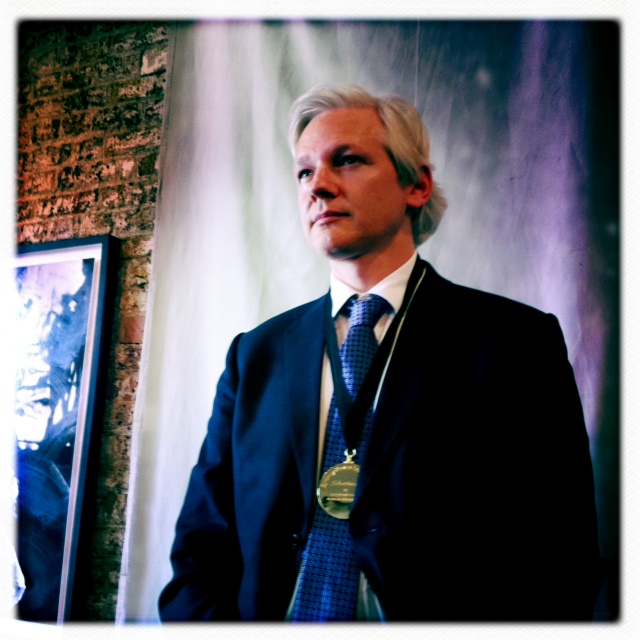 ng?
ng?
Yes it does appear that there was a significant role. I saw a documentary recently interviewing professors and people in the street in Tunisia outlining some of what that role was. We tried very hard to release as much material relevant to that part of the world back in early December. A wonderful Lebanese newspaper by the name of al Akhbar took alot of our material and translated it to Arabic. And other sites also translated it to French and that material then spread. al Akhbar, for its efforts, was attacked and redirected to a Saudi website for 24 hours. It was then attacked by computer hackers using denial of service attacks and then increasingly sophisticated denial of service attacks, and finally, very sophisticated hackers that I attribute to the state intelligence went in and wiped out their entire publishing operation for months. Approximately one month ago, they started publishing again.
In relation to Egypt, I think our most significant role there was to concentrate on the information to do with [former army general Omar] Suleiman and [former president] Hosni Mubarak. Suleiman you may remember was posited as being a vice president who would somehow take over the role of Mubarak. And he … was a long term partner with Israel and the United States. He was a trusted pair of hands as far as they were concerned in relation to the relationship between Egypt and Israel. [He was] involved personally, it is alleged, in the torture of a number of rendered people.
So, by bringing all that information out on a consistent basis when no one else was willing to do so, we made it very difficult for the west to be able to posit Suleiman as an alternative power structure within Egypt […]
We must remember [American] vice-president [Joe] Biden said on the one hand that I was a high tech terrorist and on the other hand that Mubarak was not a dictator.
What do you think about Australia’s hypocrisy championing freedom of speech during the [Arab] revolutions but denouncing yours; and what would you say to detractors who accuse you of hypocrisy, and say you’re all for transparency unless it’s turned on you (in terms of accusations of ego or your court cases)?
There’s a comment I saw on a newspaper article last night that puts it well: WikiLeaks is the most scrutinised organisation per capita in the world. We have something like ten to twenty full time staff and a large volunteer core … We are a very small operation. We had (or have) an 120 man CIA taskforce, operatives here in the UK and in other countries, all scrutinising us – and an extremely contemptive media. Like it or not we are the most transparent organisation in the world. Of course, it is our role to give knowledge to the people about power; it is not our role to prevent people giving knowledge to people about power. In fact, one of our core principles is to protect the identities of whistleblowers. So sometimes one needs to be opaque to protect people. We are an organisation facing extraordinary threats from a superpower. It is absurd that should need to make that statement, but that is the reality.
The reality is that here I am in an absurd situation receiving the Sydney peace medal. I am an Australian citizen and I am receiving it in London. At the same time, I have a state surveillance device attached to my ankle. That is the absurd situation we are in. So this rhetorical threat to try and apply a double standard to us is just that.
And you will notice a similar – this is a basic trick in rhetoric – one was done last year, when we exposed the deaths of 20,000 people in Afghanistan, including many children killed by special forces operations and so on. The response by the United States government to our exposure of all that blood, was to say: Julian Assange has blood on his hands. The first response. Because we were saying that they were wading in blood. And so that is just a basic trick of rhetoric.
If you now Google ‘blood on hands’ and ‘WikiLeaks’ without the word Pentagon, you will see there is approximately 770,000 web pages. If you Google for Pentagon and ‘Blood on hands’, without the word WikiLeaks, you will see there’s about 60,000 web pages. So in terms of the amount of articles that have been published, many talking about the blood of the Pentagon, the blood of WikiLeaks – there has been ten times as many that have been about the blood that WikiLeaks has supposedly caused and yet even these organisations cannot adduce a single case of anyone being harmed by our work over the course of [the last] four years.
What about [recently killed al Qaeda leader] Osama [bin Laden] and the alleged Mush-Bush deal between then US president George W. Bush and then Pakistani president Musharraf? Do you have any WikiLeaks cables supporting the allegation that there was a secret deal between the two presidents at the time? … And what do you make of operation Geronimo?
We have a lot of documents, but the cables along are 285 million words and I do not have them all in my brain at any one point in time. That’s why we’re working with 73 other media organisations … in order that you may do this work that you are able to do more efficiently than us, and directly to your audience. So I don’t have off hand more information about that.
I saw commentary by the former heads of ISI [Pakistani intelligence agency, Inter-Services Intelligence] in the Pakistani press talking about what the relationship should be between the ISI, the Taliban and the United States. And I think that was the clearest description that I have seen. Which is: there are two superpowers in Afghanistan right now: they are NATO (minus Europe) plus the United States. That’s the reality that people don’t want to talk about: that Europe is a superpower. Europe added together spends just over half as much money as the entire United States on military expenditure. Europe is a superpower. And we can see that happening in Libya now, that Europe is acting together with the United States, like a superpower, in the conflict.
So we have two superpowers ensconcing themselves for 10 years in Afghanistan right on the border of Pakistan – and we must understand these borders are a bit artificial; the language crosses over the border and the culture crosses over the border – it is the national incentive of Pakistan, in so far as the ISI is acting in a legitimate way, it is acting to protect the national identity of Pakistan to make sure that those forces eventually leave. And so I assume, in so far as the ISA is acting for the national interest of Pakistan, it is engendering a situation to make sure western forces will leave Afghanistan.
Just a general question on the ethics, and how
you derive the ethics of openness, investigation and privacy. Where does one make the ethical distinction between an operation say, WikiLeaks directed towards powerful institutions and processes and something such as the News of the World phone hacking scandal and the processes therein. What is not merely the contingent ethical decision, but what is the deeper political ethical basis on which one would make those distinctions?
I quite like it [the question]. And this probably horrified my British colleagues and my lawyers, but I wrote about the News of the World phone hacking scandal. And what I said back about a year and a half ago is that the British press should be very careful what they are doing in relation to spending time on that as opposed to all the other injustices that they could be spending their time on. Because we had been involved in something called the Petrogate scandal in Peru just a few months before, where we revealed 87 telephone intercept tapes of Peruvian politicians speaking for businessmen. The famed audio tapes. And that was the biggest political story in Peru that year.
And to engender a climate where that is hard to do is extremely dangerous. Now of course, the media abuses people and misuses its power in approximate proportion to the size of the particular industrial grouping. And News Corporation is a very large industrial grouping, and it uses its power accordingly. But when organisations like the Guardian write over a hundred stories about putting in default passwords in to voice mailboxes – because that’s what we’re actually talking about here – they are taking space from other things and they have other agendas at work. The other agendas at work are: attacking a newspaper rival; the New York Times became involved because similarly it wants to attack the Wall Street Journal.
It is to say, that the interests of the proletariat, which are the readers of the News of the World, are insignificant and are not important, and that the middle class moral majority that embodies itself in the Guardian is to be the arbiter of what is important and what is not important.
The reality is – if readers of the News of the World (and there are very many) find a particular thing to be of significance, to be influential to their lives, about how that person truly behaves … people have a right not to be influenced by people whose external affairs and statements do not mirror their internal affairs and statements. It also seems to me to be a way to get in to the Guardian news about celebrities and tabloid salacious rumours: you can just report on what News of the World are saying.
So generally I say that the public interest is to be determined by what the public is interested in. Because otherwise, who’s going to determine the public interest if it’s not the public? Is it going to be a self-appointed committee of people? Well who appoints those people? Who appoints that committee? Through what process? How do we know that process won’t become corrupted?
That said, I do think there should be redress for libel say, committed by very powerful organisations against smaller organisations. There should be opportunities for redress against large institutions abusing small institutions.
Part II of our Q&A transcript can be viewed here, with Assange commenting on the Lockerbie bombing, distrust between Pakistan and the United States, and the Wall Street Journal’s new ‘Safe House’ leaks site.
]]>