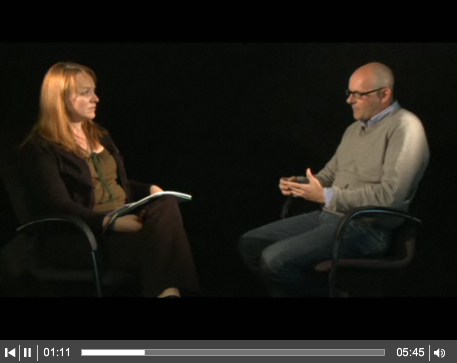
There was an overall feeling of positivity in the Frontline Club last night as the panel, chaired by the Observer‘s foreign affairs editor Peter Beaumont, discussed what the future might hold for the Egyptian people after a year of military rule.
Indeed, despite recognising the number of challenges facing the revolutionary movement, each of the speakers expressed optimism for the future.
One of Egypt’s main problems, it was pointed out by a member of the audience, is its State-run media, controlled by the military, which has maintained strong support for the army, and contempt for the revolutionists.
“State media is run as a State of misinformation consistently,” answered Hossam Abdalla, a political activist involved in Egypt’s student movement during the 1970’s. “It is not surprising [that] the army still hold more than 50 per cent of the country’s support, because of continued misinformation.”
He pointed out, though, that not long ago this figure stood at 70 per cent, and that support for the revolution is increasing. “Before 25 January, the revolutionary movement would have got 2-3 per cent approval, but now it is more like 20 per cent, and that will continue to rise.”
Abdel Latif El Menawy who, as the former head of the Egyptian State media, including for a period whilst it was under the control of the military, was in a perfect position to judge whether reform is needed, and whether it is likely to occur.
“It is required. But is it possible or not – that is the real question.” His “dream”, he explained, was for a media station designed for the public, but admitted the government did not have the power to do this. He said: “The challenge for the future is to create a public media, a tax payer public media.”
In spite of wide-spread military control of the State, Egyptian writer Tarek Osman, author of Egypt on the Brink: From Nasser to Mubarak, said that the revolutionary movement will succeed because of the number of young people in the country.
“If you look at Egypt in 1980, we were roughly 45 million people; today we are 80-85 million people,” he said. “So you have roughly 35-40 million people born in this time, two-thirds of them under 20 years old. [Their] grand objective, is trying to reject a generation of failure, to create a whole new State.”
Whether they are equipped to succeed, with a strong military power in place, is debatable but each member of the panel was confident of eventual success.
Ahdaf Soueif, author of Cairo: My City, Our Revolution, said: “I’m totally optimistic. Every time we talk about the revolution we carry thoughts of people who have been killed or injured, but they are actually a reason to be optimistic.
“They are a very powerful reason why nobody is going to back down, why the revolution will continue, and why it will actually achieve the goals which these people made their sacrifices for.”
Watch the event here:
]]>Following the tumultuous events in Egypt we are holding a special First Wednesday debate to both take stock and to look at the impact that the ousting of president Hosni Mubarak could have on Egypt and its neighbours in the Middle East.
We will be joined by experts on the region and journalists fresh from reporting the remarkable events in Egypt to discuss the nature of the protests and what lies ahead for the country.
With the constitution suspended, parliament dissolved and power is in the hands of the Supreme Council of the Armed Forces, can the people’s hope of Democracy be fulfilled?
What inspiration will people in other countries in the Middle East take from the fact that Tunisian President Zine al-Abidine Ben Ali and the Egyptian president have both been forced to step down?
Join us as we discuss the prospects for democracy throughout the region.
Chaired by Paddy O’Connell of BBC Radio 4’s Broadcasting House.
With:
Lindsey Hilsum, International Editor for Channel 4 News;
Dr Omar Ashour, lecturer in Middle East politics and the director of the MA in Middle East Studies Program at the Institute of Arab and Islamic Studies, University of Exeter, author of The De-Radicalization of Jihadists: Transforming Armed Islamist Movements and a pro-democracy activist close to the youth movement in Cairo;
Peter Beaumont, foreign affairs editor at the Observer;
Dr Maha Azzam, Associate Fellow of the Middle East and North Africa Programme at Chatham House;
Ahdaf Soueif, political and cultural commentator and author of the bestselling The Map of Love which was shortlisted for the Booker Prize for Fiction in 1999 (via Skype from Cairo).
Picture credit: Adam Makery, Al Jazeera English
]]>Peter Beaumont drops by the Frontline Club tonight to discuss his latest book – The Secret Life of War: Journeys Through Modern Conflict – and his life spent reporting from the frontlines of many wars. The Observer Foreign Affairs Editor has had a change of heart of late, see below, and it will be interesting to hear his thoughts on his profession, the risks involved and exactly how and why this change happened. We start at 7pm GMT/11am PST Tues, 12 May. If you can’t join us at the Club, please join us online on the Frontline Club live channel of Events page,
]]>It is not always the big things. Last September, on the eve of an ordinary assignment, I woke up and realised I never wanted to see an airport again. I didn’t want the smell or the sight of them. The grey, boring moments spent waiting in departures lounges I felt had eaten up my life. I didn’t make it to Heathrow.
It was a crisis that had been building for over a year. In my last year reporting from Iraq, something had happened. Rather than seeking the most meaningful stories, I had slipped into chasing the most dangerous ones. And in the process I had become someone I didn’t want to be. Not someone who wrote about the consequences of war, but someone who had become part of its logic. link
Peter Beaumont, Observer journalist who has reported from war zones for twenty years, talks about his experiences on the Guardian website with Tracy McVeigh today. The newspaper runs an excerpt from his latest book, The Secret Life Of War today. Peter will be at the Frontline Club on May 12 to talk more about his life as a journalist on frontlines around the world. Most interesting in the article at The Guardian is the postscript,
]]>It is not always the big things. Last September, on the eve of an ordinary assignment, I woke up and realised I never wanted to see an airport again. I didn’t want the smell or the sight of them. The grey, boring moments spent waiting in departures lounges I felt had eaten up my life. I didn’t make it to Heathrow.
It was a crisis that had been building for over a year. In my last year reporting from Iraq, something had happened. Rather than seeking the most meaningful stories, I had slipped into chasing the most dangerous ones. And in the process I had become someone I didn’t want to be. Not someone who wrote about the consequences of war, but someone who had become part of its logic.
When, on the last day of what would be my final trip in 2007, a car bomb exploded in front of the vehicle that I was in, it didn’t seem to matter. It was, I rationalised at first, an ordinary event in the country that is in conflict. Except that it did matter, in ways I could not then imagine. I dreamed about explosions. I jumped at slamming doors. I experienced periods of recklessness and of stultifying dissatisfaction. Two months later I found myself explaining why I never wanted to go back to Iraq again. And later still, why I had had enough of travelling.
The writing of The Secret Life of War was part of the crisis. In two-and-a-half years of working on it almost every day, I’d come to expect that when it was done, I would have written my last words about the conflict. But there was no sense of catharsis, no sense even of completion. Now at least I am happy with it for what it is, an attempt to deliver a personal, tentative and partial description of aspects of the experience of war.
But I am travelling again. This time I made it to Heathrow and Sarajevo. In January I covered the violent aftermath of the conflict in Gaza, and plan to return to finish a long-term project. I am not certain I understand fully what has changed. But I am no longer the person who came back from Iraq. Less confident and more careful, I have, I hope, reconnected with the person I once was – a person who cared about the victims more than the rituals of war.
I have realised too that everyone who is engulfed by war – willingly or not – loses something. For me that has been a connection to ordinary life, to my children and friends, and habits that, as I grow older, I have learned can never be repaired. In that knowledge, perhaps, there is a balance to be found. link