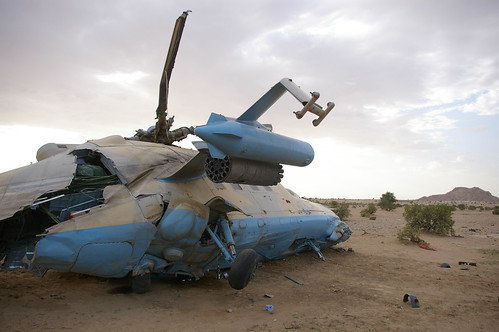
Crashed Chadian helicopter. David Axe photo.
by DAVID AXE
On April 16, a Chadian helicopter with at least three people aboard crashed in Adre, a town abutting the border with Sudan in the desert region shared by the two countries. One person died in the crash, while two were injured. The incident was an unwelcome reminder of five years of conflict between the two impoverished nations — even as that conflict finally shows signs of winding down.
On April 17, the two countries re-opened their official border crossings. “Sudanese taxis are going back and forth and so are the people,” a government official in Adre told AFP.
Until a dramatic thawing in tensions that began this winter, Chad accused Sudan of harboring rebels aiming to bring down the government in N’Djamena. Likewise, Sudan accused Chad of aiding insurgents targeting Khartoum. Both sides relied heavily on helicopters to pursue rebel groups in the expansive desert border region, helicopters those rebels have sought to shoot down to register their resistance.
Rebels apparently downed a Russian-built Chadian gunship back in 2008, injuring the two Ukrainian mercenaries at the controls. Just last month, rebels in Sudan’s western province of Darfur claimed to have destroyed two Sudanese helicopters. So there might have been a moment when observers feared the crash in Adre was also the work of insurgents — and a potential blow against a fragile peace. After all, there had reportedly been “many bandits” around Adre, according to Mahamat Tahir Issa, an independent Chadian correspondent.
It turned out the helicopter crash was “an accident,” Issa said. “Everything is quiet for the time being.” But political complications and continuing security concerns, on both sides of the Chad-Sudan border, threaten the newborn peace.
]]>
AMISOM peacekeepers. U.S. Army photo.
by DAVID AXE
Forces belonging to the U.S.- and U.N.-backed Transitional Federal Government (TFG) in Somalia have mobilized for a major offensive against Islamic militants who control much of southern and central Somalia. On Friday, a local journalist who spoke with World Politics Review reported seeing government forces, as well as peacekeepers from the African Union Mission in Somalia (AMISOM), preparing for battle.
“In the last 24 hours, we have seen many convoys, including tanks from the AMISOM bases,” reported the journalist, who requested anonymity to protect him from Islamist reprisal. “I can see the logistics [convoys] of AMISOM troops going through the city — especially around their bases.” He added that he also saw TFG troops deploying north of Mogadishu, in areas of the city dominated by al-Shabab, an Islamic group that in recent years has aligned itself with al-Qaida, particularly the terrorist network’s Yemeni branch.
In the last year, the 5,000-strong AMISOM contingent has assumed a more active role in Somalia’s civil war. Ugandan tanks and mortars provide heavy firepower for the peacekeepers and the TFG. Exchanges of mortar and gunfire between al-Shabab and pro-government forces killed more than 250 Somali civilians in January, according to the U.N., making it the bloodiest month since August for the war-torn country.
On Jan. 26, al-Shabab attacked an AMISOM hospital in Mogadishu, killing one peacekeeper and at least four civilians. Some reports indicated the attacker was a suicide bomber. Al-Shabab began adopting al-Qaida-style suicide tactics four years ago; such bombings are now common. A suicide attack on Mogadishu’s Shamo Hotel in December killed scores of people attending a medical school graduation. Several government ministers and reporters died in the blast. Another local journalist, Mohamed Omar Hussein, was at the scene and narrowly avoided injury.
The preparations for major combat come just days after Kenyan Vice President Steven Musyoka made the rounds in Washington, warning of the growing threat from Somali Islamists. “As a result of what is going on in Afghanistan, some of these [Afghan] extremists are leaving for Somalia,” Musyoka claimed during an interview at the New America Foundation, a Washington think tank. “Unless the rest of world looks at Somalia as a peace challenge, it may be too late.”
]]>
Let’s be perfectly clear about this: deploying Western forces to establish a no-fly zone over Darfur is a bad idea, and would only further entangle foreign powers in a war in which they have no clear interest. Not to mention, the logistics and rules-of-engagement would be nightmares. Fortunately, the U.S. Air Force doesn’t seem terribly enthusiastic about such a deployment, according to a report by Marc Schanz for Air Force magazine:
According to Gen. Roger Brady, head of US Air Forces in Europe with administrative control of 17th Air Force (Air Forces Africa), a component of the new US Africa Command, planning for such a contingency has not left the gate yet. “I don’t think that idea is probably well enough developed for us to start counting heads as to who might or who might not [participate].”
(Photo: EUFOR)
]]>
Daniel Abbott over at tdaxp is editing a new book on fifth-generation warfare, to be published by Nimble Books. I’m writing a chapter addressing Somalia, piracy (pictured), human security and 5GW in Africa. Here’s a brief sample:
]]>The “fourth generation” of war entailed irregular combatants fighting for an ideological cause, seeking to remake society according to their ideals. Fifth-generation war, or 5GW, now coalescing, is less clearly ideological but just as sweeping in its goals. 5GW is when a party exploits or encourages an existing or emerging crisis to achieve strategic goals that those most directly involved in the crisis might not even be aware of. 5GW is a form of stealthy proxy war.
“The systematic alteration, or replacement of, an existing rule set is your strategic goal,” Thomas Barnett wrote of 5G fighters. “You’re not happy with things the way they are, so you make those around you unhappy enough that they too, are unhappy with the ways things are. Shock them hard enough, and you can trigger their own movement toward new rule sets that move the pile for you.”
Where fourth-gen combatants might blend in with the surrounding populace most of the time, they still periodically emerged to form military-style units. 5G fighters, by contrast, remain “subtle actors.” They may never once wear a uniform or carry a rifle. Their weapon is the desperate population of a society on the brink; their major tactic is unrest; their goal is to undermine the established order in the interest of changing it, or just leaving it in ruins.
No continent poses less of a traditional military threat to the United States than Africa. But in an age of 5GW, where subtle actors can exploit humanitarian, economic and other crises to undermine the power and legitimacy of the industrial state, no continent poses a greater non-traditional threat. An increasingly volatile Africa begs for greater U.S. intervention and risks corrupting that very intervention, turning American strength into weakness.
For America, 5GW in Africa is a damned-if-you-do, damned-if-you-don’t proposition. There are no easy answers to Africa’s worsening crises, and there is no consensus on how, or whether, the United States should intervene. Doing anything might make the continent’s problems worse. So might doing nothing. And despite its distance and its still-tiny slice of world trade and military power, in the age of 5GW, a suffering Africa is a threat to the United States.

U.N. officials and aid workers are gathering in eastern Chad to discuss preparations for an alarming contingency. With the recent arrest warrant for Sudanese President Omar Bashir and his subsequent ejection of foreign aid groups from Darfur, the U.N. and Chad’s humanitarian community are worried that thousands of Darfuri refugees currently living in camps in western Darfur might flee to eastern Chad.
Problem is, with 300,000 refugees in a dozen major camps, eastern Chad is already full up. The existing refugee population has strained water and wood resources to the breaking point; additional thousands of refugees will exacerbate conflict with native Chadians over resources.
Some foreign officials have mulled a partial military response to Bashir’s moves. Considering Sudan’s heavy reliance on its small air force to bombard rebels and their haven villages in Darfur, Secretary of State Hillary Clinton and others have proposed a multi-national air deployment to enforce a no-fly zone over Darfur. The Swedish air force has already prepared its Gripen fighter squadrons to support such a deployment, if requested by the U.N.
Chris Albon at War & Health says the U.S. Air Force should send fighters, perhaps even F-22s. If a U.N. no-fly zone were a good idea — and it’s not clear that it is, considering it might only escalate a conflict in which we have no clear interest — F-22s are the last fighter I would send. Why? Consider the picture above, snapped by a French helicopter pilot at the major airbase in eastern Chad, where any no-fly force would likely be based. Can you imagine what that sand would do to an F-22’s stealth coating?
(Photo: via EUFOR)
]]>
U.N. officials are scrambling to prepare for the prospect of tens of thousands of refugees pouring into eastern Chad from Darfur to escape escalating tensions in Sudan. An mass movement of displaced peoples will pose major challenges to the European Union peacekeeping force in Chad and Chadian government troops, considering that combatants in the Darfur conflict mix with, and make their bases among, the refugee population. Military forces in Chad will be faced with identifying and perhaps even engaging fighters who are nearly indistinguishable from the refugees surrounding them.
Displaced people represent an increasingly important "battlespace" (ugh, I hate that term) in the 21st century. Refugees’ hardships make them a fertile recruiting ground for insurgents, and their movements can carry insurgencies across borders and into vulnerable communities. As gravely, the blending of insurgents and refugee communities puts aid groups in the awful position of unwittingly providing assistance to combatants.
In light of this, military forces must prepare for conflict in the refugee battlespace. But how?
At the Joint Readiness Training Center at Fort Polk, Louisiana, the U.S. Army trains combat brigades for upcoming deployments to Iraq and Afghanistan. The training tries to simulate conditions on the ground in those countries, by populating the ranges with actors and expatriates portraying civilians and local leaders caught up in the fighting (pictured). JRTC’s Lieutenant Colonel Robert Morschauser said units can request training scenarios in which refugees (played by actors) are displaced by some event and attempt to cross an active battlefield. The U.S. soldiers must avoid hurting the refugees while hunting down the cause of the displacement.
Great. But there’s a problem. In writing the scenario scripts, the Army relies on advice from the U.S. State Department’s Provincial Reconstruction Teams. Actual humanitarian groups do not provide any input. In order to accurately portray the desperation and confusion of mass displacement, the Army should solicit advice from non-partisan aid groups with deep experience in real refugee crises, rather than relying only on government reconstruction teams.
(Photo: me)
]]>