 Watch the video stream of The Meaning of Jihad ]]>
As one of the earliest Arabs to join the Afghan Jihad, the Algerian Islamist Abdullah Anas counted as brothers-in-arms the future icons of al-Qaeda’s global war, from Abdullah Azzam to Osama bin Laden, and befriended key Afghan resistance leaders such as Ahmad Shah Massoud.
Brushing shoulders with everyone from Zarqawi to Haqqani, Anas distanced himself from their movements, disagreeing with their narrow interpretations of political Islam. While he remains committed to Jihad, to this day Anas takes issue with the extremist trajectories of his one-time companions.
Using Anas’ memoirs, To The Mountains: My Life in Jihad, From Algeria to Afghanistan, and his intimate knowledge of the networks that formed during the Soviet-Afghan war as a springboard, this panel will be tracing the journey of ‘Jihad’ – and what it means for our societies today.
Speakers:
Abdullah Anas is an Algerian politician-in-exile and former member of the mujahideen who fought alongside bin Laden before falling out with the al-Qaeda leader over his plans for a global Jihad. He lives in London, having gained political asylum.
Tam Hussein is an award-winning investigative journalist and writer who has reported on UK Jihadist networks and British foreign fighters in Syria.
Jonathan Powell was Chief of Staff to Tony Blair from 1997 to 2007 and the chief British government negotiator on Northern Ireland during that time in office. Jonathan was a British diplomat from 1979 to 1996 working on the negotiations to return Hong Kong to China in the early 1980s, the CSCE human rights talks, CDE arms control talks with the Soviet Union in the mid 1980s, and the ‘Two plus Four’’ talks on German reunification in the late 1980s. Jonathan has also participated in a number of negotiations between governments and insurgent groups in Europe and Asia working closely with Martin Griffiths at the Centre for Humanitarian Dialogue.
Photograph courtesy of Dawei Ding via Creative Commons
]]> Watch the video stream of The Price of Peace: An Evening With María Jimena Duzán]]>“My life is governed by only one thing; journalism.”
This Thursday the Frontline Club welcomes Colombia’s leading reporter, María Jimena Duzán, in conversation with freelance journalist and author Ed Vulliamy, to count the costs. The cost of 30 years spent reporting civil war, of facing drug cartels armed with just a pen – and the cost Colombia is paying to protect the fragility of peace.
2 years into the historic agreement between Colombia’s government and the leaders of the main Marxist rebel group, the Revolutionary Armed Forces of Colombia (FARC), the country faces serious obstacles in the path of realising a lasting peace. Conservative President Ivan Duque makes no secret of his lack of faith in the Havana accord. Murder rates are on the rise, again. New and increasingly bloody narcoparamilitary groups fight each other for control of cocaine production that continues to feed north America’s seemingly insatiable desire for the drug. As Venezuela sinks further into crisis, and the second term of President Maduro shows little light for hope, Colombia is host to over one million refugees and rising.
Join Maria and Ed Vulliamy as they discuss how – and if – Colombia can keep paying the price of peace.
Speakers:
María Jimena Duzán is an internationally renowned and award-winning journalist and author; in 2005, she won the Premio de Periodismo Simón Bolivar, has been honored by the Alliance des Femmes International, and is a recipient of a Nieman fellowship. By age 30, she had already worked as foreign editor, columnist, and chief investigator for El Espectador, the Bogotá daily, covering the Colombian drug trade. Her writing has appeared internationally in El Tiempo, The Wall Street Journal, Newsday, Marie Claire, and Revista Semana. After her sister was gunned down while reporting on a story about drug trafficking and paramilitary squads, Duzán went into exile; she told this story in her book Mi viaje al infierno. She continues to write and appear on radio programs, as well as teaching journalism in Bogotá, where she founded and directed the country’s first post-graduate degree in journalism.
Ed Vulliamy is a journalist and author who has worked for more than 30 years as a staff international reporter with the Guardian and Observer newspapers of London. He won all major awards in British journalism for his coverage of the Balkan wars between 1991-5, and discovered the gulag of concentration camps operated by the Bosnian Serbs in the Northwest Krajina region of Bosnia. As a result, he became the first reporter to testify at a war crimes tribunal since those at Nuremberg, testifying in nine trials at the ICTY, including those of Radovan Karadžić and General Ratko Mladić. His most recent publications include ‘When Words Fail: A Life With Music, War and Peace’.
photograph by kind permission of freelance photojournalist Camilo Rozo @rozomilo
Watch the video stream of The Price of Peace: An Evening With María Jimena Duzán
Vulliamy spoke with Néstor Osorio Londoño, Colombia’s Ambassador to the United Kingdom and Charlotte Gill, the director of the Caravana charity which promotes and protects human rights in the country. The audience all had the same question in mind – why did 50.2% of voters choose to reject the offer of peace?

In a war that has killed 250,000 and displaced more than 6 million, Gill thinks that “victims’ voices were lost” as the peace deal was debated in the build up to the referendum. Colombia’s largest cities largely rejected the deal offered by the government.
“It’s not just putting down your gun, it is looking at the systemic reasons why that violence occurs, why impunity exists for that violence, and really tackling those.” For the victims peace means truth, justice and guarantees of no repetition. “It’s not necessarily about retribution,” Gill said.
Londoño is optimistic that the negotiations have opened the doors to peace, and to an understanding of the conflict.
“One of the biggest revelations of this process has been to witness the personalities of the Farc leaders and for them to discover the personalities of our negotiators. They are very articulate, intelligent people that have been genuinely fighting for a cause but with the wrong methods. I think that this [peace] process has allowed them to become closer to society.”

Yet, Londoño is the first to admit the process had its flaws, as – he reminds us in the wake of the British vote on the EU – referendums do. “Many of the people who vote No just vote against the government, and wake up thinking ‘Oh my goodness, I voted No but I didn’t know we were going to win’,” he said, “It’s like the Brexit feeling.”
Gill agrees, “If you feel totally isolated, vulnerable and attacked by the state then engaging in a process that’s driven by the state may not be something you want to be part of.” She believes this could also explain the extremely low turnout of 38% – along with complacency as polls pointed to support for the peace treaty. With Hurricane Matthew tearing through the country on the same day people may have been reluctant to go out and vote.
Nor did all people understand the terms of the vote. They were given very little warning, Gill said. Especially in such a polarised and dispersed society, six weeks was not enough time to reach the people.
“People were not sufficiently educated and informed about what was going on,” Londoño agrees. He wonders how many people read the 297-page peace accord, and accepts the government should have done more: “If you are thinking about consulting your people you have to educate, inform. This vote wasn’t very well informed. It was a reactive passion.”

Yet, Londoño does not regret putting the decision to the public, when it could have easily been passed through Congress with a majority. “It is important to give the people the last word on a matter of crucial importance to the country,” he said. After all, “peace belongs to the country and to the people of Colombia.”
The result must not lead to another dragging peace negotiation, Londoño insists. Nor can it be solved through minor changes. “There must be real and concrete modifications to political participation and justice,” he said.
]]>On 6 April 1994, a plane carrying Rwandan President Juvenal Habyarimana was shot down over Kigali airport. The events that followed saw bitter ethnic divisions engulf the country: neighbour turned on neighbour and in the space of 100 days an estimated 800,000 Rwandans, mostly Tutsis, were killed.
At the time the international community was heavily criticised for its slow response and now declassified diplomatic cables have revealed that the US, Britain and the United Nations were explicitly warned that a “new bloodbath” was imminent in Rwanda.
Twenty years on we will look at how communities in Rwanda have been reconciled, the political, social and economic strides the country has taken and what more still needs to be done. We will also ask if the international community has learnt its lessons and if it can ensure that such a failure to react will never occur again.
Chaired by foreign affairs editor of Sky News, Sam Kiley. Through the 90’s he served as Africa bureau chief for The Times, covering the genocide in Rwanda and its aftermath in the Democratic Republic of Congo (formerly Zaire).
The panel:
David Belton worked as a producer at BBC Newsnight in the 1990s where, amongst many foreign assignments, he covered the civil war in Bosnia and the genocide in Rwanda. In 2002, he co-wrote the story and produced the award-winning feature film Shooting Dogs based on real events that had taken place during the Rwandan genocide. He has since produced and directed many critically acclaimed and award-winning documentaries for British and American television. When The Hills Ask For Your Blood: A Personal Story of Genocide and Rwanda is his first book.
Eric Murangwa Eugene is a Rwandan survivor of the 1994 genocide and former Rwandan international football player who founded Football for Hope, Peace and Unity (FHPU Enterprise) an initiative which uses sport and football in particular to assist the transformation of Rwandan community for social change and reconciliation here in the UK and in Rwanda itself.
Mukesh Kapila, CBE is professor of Global Health and Humanitarian Affairs at the University of Manchester. Previously he was Under Secretary General at the International Federation of Red Cross and Red Crescent Societies and the UN Resident and Humanitarian Coordinator for Sudan. He was the first UK government official to enter Kigali in 1994 after the genocide. He is author of Against a Tide of Evil.
His Excellency Williams Nkurunziza is the high commissioner of the Republic of Rwanda to the United Kingdom and non-resident ambassador to Ireland. His previous posting was as high commissioner to India. Prior to his diplomatic career, he served as director general of the Rwanda Investment and Export Promotional Agency (RIEPA), during which time he worked to reposition post-genocide Rwanda in the international marketplace as an ideal investment destination and a reliable trading partner. During this time, he also served on President Paul Kagame’s Presidential Economic Advisory Council.
]]>https://soundcloud.com/frontlineclub/the-fog-of-peace
In war there is rarely a single action or answer that will bring peace. As we are seeing with the conflict in Syria, the process of negotiation and resolution is incredibly complex. As the focus swings from intervention to international conferences, how do you begin to forge an agreement?
In a unique account of the process of conflict resolution, The Fog of Peace: The Human Face of Conflict Resolution offers an insight into psychological theories, geopolitical realities and first-hand peace-making experience.
The authors will be joining us to share their analysis of international diplomacy and the complexities of conflict resolution. They will be exploring the question of intervention and examining the impact of the changing nature of warfare and technology.
Chaired by Channel 4 News presenter, Jon Snow.
With:
Gabrielle Rifkind is the director of the Middle East programme at Oxford Research Group. She is a group analyst and specialist in conflict resolution immersed in the politics of the Middle East. Rifkind combines in-depth political and psychological expertise with many years’ experience in promoting serious analysis and discreet dialogues with groups behind the scenes.
Giandomenico Picco served as under-secretary general of the United Nations and was personal representative of the secretary general for the United Nation year of dialogue amongst civilisations. He led the task force negotiations to end the Iran-Iraq war and the freedom of Western hostages from Lebanon. Over decades he helped securing the freedom of 127 individuals unjustly detained from 4 different countries.
]]>Civil wars are tragedies for the countries they consume, but they can also be dangerous for neighbouring states. Almost three years into the political and humanitarian crisis in Syria, what challenges does the ongoing violence pose for peace and stability in the region? And what can be done to prevent the crisis from stoking existing tensions in countries such as Lebanon? Join us to discuss these and other pressing questions, with:
Victoria Stamadianou, the Lebanon country manager for International Alert.
Nadim Shehadi, an associate fellow for the Middle East and North Africa Programme at Chatham House.
Julien Barnes-Dacey, a senior policy fellow at the European Council on Foreign Relations (ECFR). He was based in Syria from 2007 to 2010 as a journalist, writing for the Christian Science Monitor, The Wall Street Journal and the Financial Times.
Martin Chulov, Middle East correspondent for The Guardian.
Chaired by Dan Smith, secretary general of International Alert.

https://soundcloud.com/frontlineclub/peace-talks-war-and-peace-in
This event is organised by International Alert, in partnership with Sussex University’s School of Global Studies.
In the media, lead coverage is often given to stories and images from the front lines. As the old newsroom saying goes: “If it bleeds, it leads.” But what happens when a conflict fades from the headlines and the long path to peace begins? Can the power of the media be harnessed to highlight positive stories of peacebuilding, reconciliation and change?
Join us to explore how the media depicts the stories of both conflict and peace, with:
Martin Bell, veteran war correspondent.
Timothy Large, Editor-in-Chief, Thomson Reuters Foundation.
Cynthia Weber, Professor of International Relations, University of Sussex.
Chaired by Dan Smith, Secretary General, International Alert.
The event is free to attend and will be followed by a drinks and canapés reception.
]]>The decision to go into Afghanistan was necessary as a kind of “acting out” to restore American national confidence and pride in the wake of the terrorist attacks of September 2001, but it was done with little idea about what was to be achieved by it.
That was the claim of Jean MacKenzie, senior correspondent for GlobalPost and previously programme director for the Institute for War & Peace Reporting in Kabul, about the decision of president George Bush to send troops into Afghanistan less than a month after the terrorist attacks of 11 September, 2001.
"We had to go in, America had to kick ass because we had been attacked and we had to prove that we were big guys, and there was very little resistance to going in to Afghanistan, Afghanistan was a very convenient ass to kick, because it was not being really defended," said MacKenzie.
MacKenzie, who was taking part in a recent discussion titled: Counterinsurgency and the "War on Terror": Doomed to fail? agreed that America had to react to the terror attacks in New York and Washington. The problem was not the decision to intervene, but the fact that it was done without a clear idea of what it would accomplish, she said:
"We didn’t need to go in with this open-ended brief of we’re going in there to get rid of al-Quaeda, now we’re going in there so that little girls can go to school and maybe we’re there so women don’t have to wear burqas and now we’re there, as Time magazine tells us, so that women’s noses are not cut off. Where does it stop? We needed to define our goals from the very beginning."
There was also a lack of clarity about who the enemy was, said MacKenzie, who claimed local groups could manipulate NATO or the International Security Assistance Force into fighting their battles by claiming their opponents were Taliban:
"We go into an area, like in Kunar, where two groups are fighting over logging rights – another gets close to us and says they are the Taliban. We start fighting them and they fight back and as soon as they do, they become an insurgency."
As a result of the lack of clarity the rhetoric about the US mission in Afghanistan had taken on a life of its own, MacKenzie argued:
"It’s a very broad statement but I think we are now fighting the Afghan people, the Afghan society. We say the Taliban stone women for adultery, the Taliban stone young couples, the Taliban throw acid in the faces of school children.
But in most of these cases, if you unravel it, it’s not the Taliban, it is the community that has done these things. So if we are fighting those manifestations of Afghan culture, we are not fighting the Taliban, we are fighting Afghan society, we are fighting a culture that we find noxious. That, I think, is quite a bit beyond our brief."
Ten years on, the mood in Afghanistan was one the “darkest despair”, said MacKenzie, adding that there is little trust on the ground in the ability of the Afghan forces to protect the people. In addition, things have gone "way beyond the point" when outside nations could impose anything on the country:
"There was a point at the beginning when there was a certain amount of hope and goodwill among Afghans, but I don’t feel it there any more," she said.
"The Afghans are more and more pessimistic, they have given up on their own government, how do you fight counterinsurgency when you have no legitimate government to partner with? How do we begin to do anything?
Yet the US is likely to leave Afghanistan with "honour and dignity in the strategic communications sense," said MacKenzie, who predicted that from now until the end of 2014 the US administration was going to be "busily engaged in painting a narrative of victory":
All that is required for us to have won is for the media to pack up and go home so there’s no focus on what’s actually happening and for us to redefine victory and to move the goalposts as it were."
Malte Roschinski, a security consultant, political analyst and author who reported from Afghanistan for AFP news agency, was also pessimistic about the future of Afghanistan and said he believed the best that the US could do was to "come up with a good PR strategy and hope for the next six months or so it’s going to stay fairly quiet".
]]>"After that the media focus will have moved away from the country. There will be stories afterwards but the media works in cycles and public attention has just so much bandwidth anyway so it’s just going to be a PR exercise."
As a daring and impassioned journalist with a decades-long career, John Pilger has inspired and motivated many to ensure human rights and preserve unfiltered truth.
From films such as Year Zero: The Silent Death of Cambodia (1979) to The New Rulers of the World (2001), he has unrelentingly made this his commitment. This continues with his newest film, The War You Don’t See (2010). In this work, Pilger masterfully presses against those who weaken journalism’s efficacy in the current political climate.
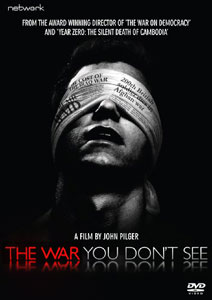
Complementing previous works such as Noam Chomsky’s book on media manipulation, Manufacturing Consent (1988), and Adam Curtis’s films on mass psychology and the politics of fear, The Century of the Self (2002) and The Power Of Nightmares (2004), Pilger lends his experience in media to answer similar questions posed in those works about the role of public relations and media in war, journalists in the advancement of a war agenda and the reporting of war crimes. At its conclusion, the message is and clear: when searching for the truth, always challenge the official story.
Truth be told, The War You Don’t See is remarkably relevant to today’s world. At first, Pilger’s effort details the history of public relations and fuses it with the current backdrop of the dual wars in Afghanistan and Iraq. Concepts such as propaganda and media manipulation are analysed as means of conveying official truths about war.
In a tense and demanding manner, the film’s images of bullet-riddled buildings, explosions and death in Baghdad, Kabul and Palestine shatters the viewer’s outlook on mainstream media like glass. Interviews are conducted in a powerful face-to-face manner that pulls no punches. To that end, it includes a soundtrack of simple yet beautiful orchestral passages that add to the film a solemn character. In total, it makes The War You Don’t See offers a rewarding viewing experience will be detailed more greatly below by theme.
Public Relations: The Facts Don’t Matter Anymore
In The War You Don’t See, the early machinery of media propaganda is detailed at length. From the 1910’s and 20’s work of Walter Lippmann and Edward Bernays, who improved techniques of public relations during the First World War to the Bush and Blair “Shock and Awe” doctrine of in the Iraq invasion of 2003, an understanding of the role of social psychology acts as a foundation to Pilger’s argument.
War Drums Beating
With UK/US official narratives, press releases and statements intertwining with the supposed objective reporting of Western media, the co-opting of the Fourth Estate for official purposes becomes apparent. In his familiar manner of grilling those in power, Pilger highlights government-PR inspired news and the media circus that it generates.
“…I’m not the vice-president in charge of excuses“ – a former CBS anchor Dan Rather
With the cordial commentary and praise of American and British journalists about their country’s leadership in times of hardship, the interest of media to portray conflicts in a favorable manner to governments and business is apparent.
Embedding or In Bed?: Journalists in the Game and Made for TV moments
“…I didn’t really do my job properly. …One didn’t press the most uncomfortable buttons hard enough…” – Rageh Omaar, former BBC world affairs correspondent
According to the film, current wars instigate media circuses and plenty of carefully orchestrated photo ops. In the run up and early years of the Iraq war, the mainstream media appears as a complicit tool of elite power interests, backing prevailing government views despite dissent or independent journalism that strayed from pro-war narratives, or their accompanying iconic images.
Everlasting Images
In occupied Iraq, the tumbling of Saddam’s statue in Baghdad and the placing of an American flag on his head “…gave no sense of the bloody conquest of Iraq that was already underway.” Against the jubilation and news clips of war proponents glorifying American weapons and military might, Pilger places shots of buildings in ruins, adults facing hardship and wounded and killed children.
Independent Journalism Vs. the “Propaganda of Fear”?
Like in his other films, another motif common to the work is the scale of suffering of ordinary people. To that effect, the work of independent journalists Mark Manning and Rana al Aiouby‘s during the Battle of Fallujah, Iraq is featured. It deviates from the official and mainstream portrait of events, using examples from history like Wilfred Burchett’s detail of an Atomic plague, or Dahr Jamail’s revealing and horrific footage of the torture of Iraqi citizens in the second Gulf War.
The propaganda of fear is described as having begun as early as the Vietnam War. To Pilger, it is “…the blueprint for the wars of today” in Afghanistan in Iraq. Pilger asserts: “…As in previous wars, public memory of the Vietnam war was greatly influenced by Hollywood”. In keeping with the tradition of films that aggrandise government war efforts, Iraq war movies attempt to inspire a masculine, aggressive, and staunchly supportive viewpoint of an occupation, with the on-screen Western powers nearly always championing a noble cause against a dim-witted and ultimately unsuccessful enemy effort.
“Modern democracies don’t leave marks” – Phil Shiner of Public Interest Lawyers
Other parts of the Wars We Don’t See also include soldiers abusing Iraqi civilians secretly on tape, as embedded journalism is the point of view of the troops, not the civilians. With that being the case, atrocities by coalition forces can be concealed, shrouding the views of afflicted peoples in official, sanitised manner. The disconnect between western audiences and those announced in death tolls is apparent, as the press “plays down the carnage”, and distinguishes between unworthy and worthy victims, with the latter bizarrely labeled peculiar for disapproving of having their houses invaded and loved ones killed.
A Major Deception
““If you look at every war, or every coup, or every regime that Britain is supporting or involved in…it’s usually accompanied by an increasingly sophisticated public relations operation by the Government…” – Mark Curtis, British historian
Another aspect of the invisible war includes no accountability of media personnel. Able to spit factoids or spin events, governments, acting as information machines, take the view that if journalists are not particularly supportive to their accounts, they could be frozen out of the access, as the apparatus “…would make life harder for them.” This implies why important dissenters to war aren’t heard, for example, Charles Hanley’s analysis of WMD sites and Scott Ritter’s detail of completely eliminated weapon sites in Iraq before Gulf War Two began.
The Narrative of Mainstream Journalism
Pilger encounters the reaction of mainstream media participants that seek to downplay any observed complicity. In this effort, he does not go unchallenged. ”It’s not up to me to make a judgment.” says one Britis
h journalist to Pilger. “We’re there to report what their claims are and hold them up to scrutiny, and to investigate.” Just the same, in this film, investigative journalism is portrayed as a bulwark against conflict.
Preventing wars?
As the film progresses, the media spin of governments is documented as an example of the War We Don’t See. In some countries, after a government crime is committed, intimidation from embassies not to reveal damaging information to host countries covering the incident is apparent. Spokesmen from guilty governments act as spinsters, offering official lies as truth, using doctored sources to strength their claims. Commentators convince the public to go along for the ride.
The UK and US Government reaction to WikiLeaks
According to Pilger, just as some governments spin the truth, the Obama Administration and British Ministry of Defence have attacked “truth-tellers” WikiLeaks, Julian Assange and others who deviate from the official narrative or spectrum of discourse and punditry. To stress this point, Pilger reveals a leaked secret British Government file which sees investigative journalists involved with the propagation of WikiLeaks’ source material as a threat to be neutralised by various means. Leaked material, such as the 2010 release of “Collateral Murder”, is described as an example The War You Don’t See.
“The Public is a threat that needs to be countered…”
"…The more information the public has, the more difficult it is for them (governments) to pursue policies that maybe are abusive of human rights or involving supportive a repressive regime.” – Mark Curtis, British historian
Perhaps what’s most important about this film is its simple message. For John Pilger, the mainstream Fourth Estate is not doing its job properly. Whereas independent journalists are able to articulate the truth in a sophisticated manner, mainstream sources remain disinterested in their work. Time and again, they prefer baseless information, sound bytes and sensational footage of clamoring crowds that rouse emotion to the hard tasks journalists must perform. In Pilger’s final remarks in the film, what remains clear is that more than ever, uncompromised, brave journalism is needed in our world, always challenging the official story, in his words, “however patriotic it appears, or however seductive or insidious it is.”
]]>
A write up of a Q&A section with Assange, which followed the speeches, can be found here (part I) and here (part II).
]]>