Patrick Cockburn, Middle East Correspondent for The Independent, has been reporting on the region for over 25 years and has published four books on the recent history of Iraq. His forthcoming book, The Age of Jihad: The Islamic State and the Great War for the Middle East, presents a compelling new analysis of the dominant conflict of our time; the Sunni – Shia war and the subsequent origins of Daesh.
Cockburn argues that the rise of Daesh did not explode suddenly in Syria after the Arab Spring as the conventional view holds, but over several years in occupied Iraq. It is in the sectarian conflict that engulfed Iraq following the war of 2003 that patterns were established that would later spill over into Syria with such devastating results.
Patrick Cockburn will join us in conversation with Azadeh Moaveni to discuss in depth the current turmoil in the Middle East and the fraught role the West has played in the region from 2001 to present.
Azadeh Moaveni is a former Middle East correspondent for Time magazine. She reported from throughout the region for much of the past decade, and speaks Persian and Arabic. Her books include Lipstick Jihad, Honeymoon in Tehran, and she is co-author, with Shirin Ebadi, of Iran Awakening.
]]>The threat posed by the Islamic State of Iraq and al-Sham (ISIS) and the international network of militants it has spawned will be with us for a “generation”, according to experts speaking at the Frontline Club on Wednesday 24 September 2014.

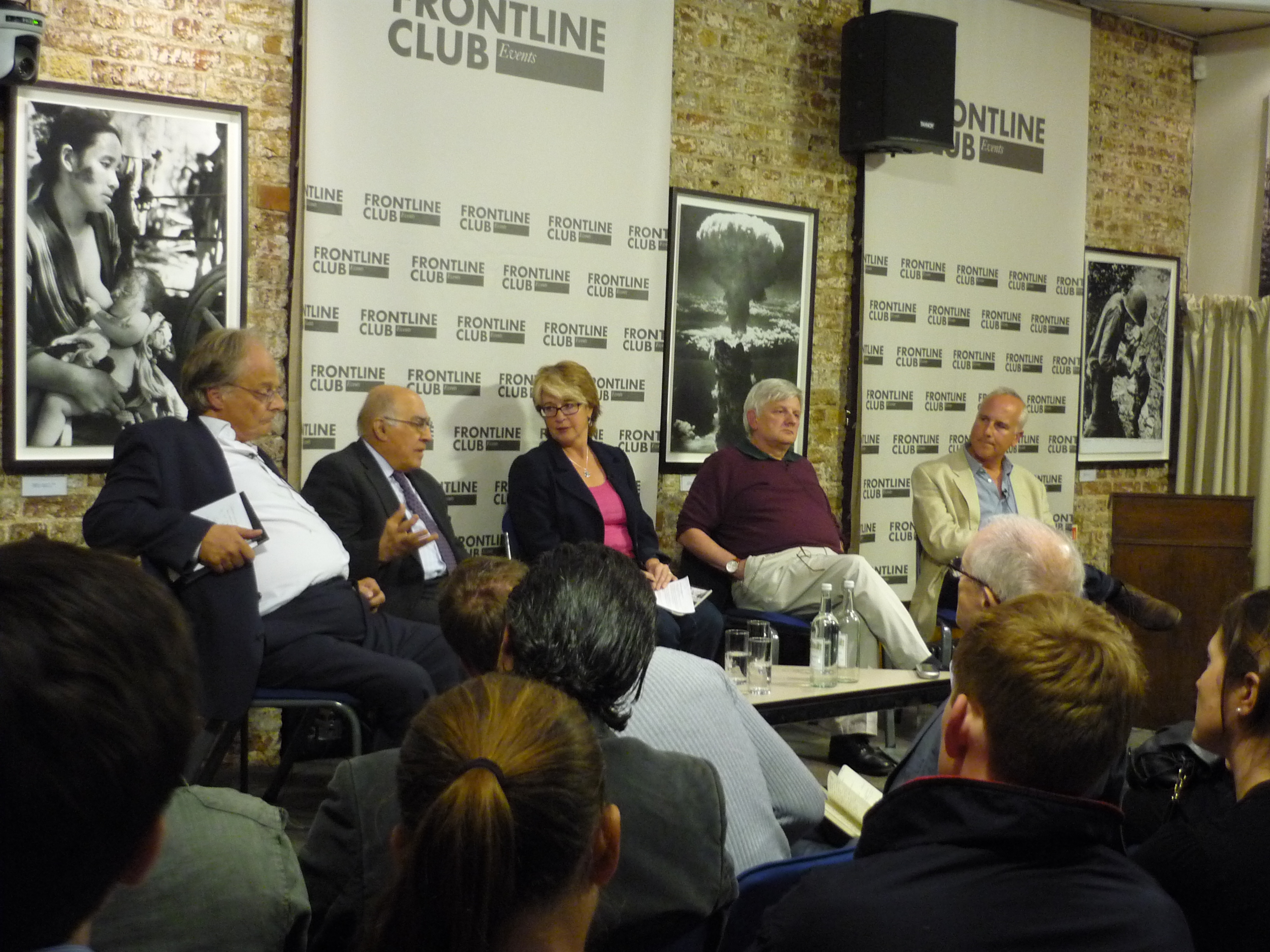
From Al-Qaeda to ISIS: terrorist tactics. Panel discussion at the Frontline Club, 24 September 2014. From L to R: Patrick Cockburn, Peter Neumann, Sam Kiley, Alia Brahimi and Aymenn al-Tamimi. Photograph by Richard Nield
On the day that the UN security council agreed to launch an effort to prevent the flow of foreign jihadis in support of the Islamic State and US-led airstrikes continued in Syria, the Frontline Club panel underlined the seriousness of the ISIS threat and sought to explain its appeal to an estimated 15,000 foreign fighters.
Hosted by Sky News foreign affairs editor Sam Kiley, the debate brought together Peter Neumann, Professor of Security Studies at the Department of War Studies, King’s College London, and founder and director of the International Centre for the Study of Radicalisation (ICSR); Alia Brahimi, visiting research fellow at the Oxford University Changing Character of War Programme at Pembroke College, Oxford and author of Jihad and Just War in the War on Terror; Aymenn Jawad al-Tamimi, a recent graduate from Brasenose College, Oxford University, and a Shillman-Ginsburg fellow at the Middle East Forum; and Patrick Cockburn, a Middle East correspondent since 1979 and author of The Jihadis Return: Isis and the New Sunni Uprising.
The panel was unanimous in its belief that the airstrikes launched by a US-led alliance on Monday 22 September would not bring a speedy halt to the ISIS insurgency, something that UK prime minister David Cameron and a spokesperson for the US defence administration later admitted.
“I don’t believe the air campaign is going to be able to defeat ISIS, or that a more intensive military campaign would either,” said Neumann. “We’re going to be down there for years.”
Military strikes against ISIS ignore the root of the problem, the panel argued. “I’m pessimistic about the efficacy of airstrikes,” said al-Tamimi. “What is needed is a change of mindset on the ground. It’s local mindsets that matter here in Iraq now.”
“The US is trying to cut them off at the head, but we have to cut them off at the legs and deal with the causes,” said Brahimi.
The popularity of ISIS was attributed to a range of factors, including government failings and the organisation’s successes on the battlefield. “Maliki’s heavy handed responses to political issues in Iraq have definitely played a part,” said Brahimi. “Both Maliki and Assad have attempted to deploy military solutions to political problems.”
“One simple thing in ISIS’ favour is victory,” said Cockburn, pointing to the organisation’s military successes in Mosul, Anbar and Tikrit, and the fact that it has inflicted heavy defeats on the Syrian army. “In the context of great numbers of bitter, angry Sunni young men in Syria and Iraq, their lives pretty hopeless. . . . All of a sudden there’s this victorious army that they can join. It’s all very appealing.”
ISIS has taken advantage of a groundswell of anger and disillusionment among unrepresented Sunnis, which make up about 20% of the population in Iraq and 60% in Syria, and tapped into a history of insurgency that dates back to the US-led invasion of Iraq in 2003.
“ISIS has ridden on the back of an overall revitalised Sunni insurgency in Iraq,” said Brahimi. “You can draw a straight line between [the invasion of Iraq] and the rise of ISIS. So many in Syria . . . cut their teeth in the Iraqi insurgency, trying to take the whole territory in the war against the US.”
For the time being, ISIS is focused on the ‘near enemy’, but it is likely that it will eventually move against Western targets. “[ISIS leader Abu Bakr al-] Baghdadi will relish straying onto [Al Qaeda leader] Ayman al-Zawahiri’s ground,” said al-Tamimi. “Conducting attacks against the west has the ability to re-energise the ranks and silence internal critics. Baghdadi and Al-Zawahiri are in a race.”
The conflict has attracted between 12,000–15,000 foreign fighters to Syria and Iraq in the past three years, the largest overseas participation of independent fighters since Afghanistan in the 1980s, according to Neumann. Foreign combatants make up an estimated 40% of ISIS recruits.
Many were initially motivated by humanitarian reasons, but more recent converts to the ISIS cause are driven by a mixture of ideology, idealism, and adventure. “The idea of a caliphate . . . motivates people to build something that can be there in a thousand years time,” said Neumann. “It’s like an adventure holiday minus the alcohol.”
“The narrative is increasingly utopian and the reality increasingly dystopian,” said Brahimi. “We have to make more of that.”
The broad international appeal of ISIS is storing up huge problems for the future, and this is something that airstrikes will not change. “You have 15,000 people who may go to other conflicts, go back to their own countries, or stay in the region,” said Neumann. “These networks will keep us busy for another generation.”
Watch and listen back here:
]]>
On Monday 15 September, the Clubroom hosted another fascinating night of discussion following the presentation of Patrick Cockburn’s new book, Jihadis Return: ISIS and the New Sunni Uprising.
 It was a popular event and those lucky few who booked their tickets left the night, as promised by our exceptional chair Ed Vulliamy, merrier and wiser.
The next BookNight coming up in October will present Robert McCrum and his compilation of the hundred greatest novels of all time. The books “choose themselves”, says Robert, but how fascinating it will be to hear how he chooses novels that choose themselves; what gets left out, how the public reacts – and we round the table, indeed – to his selection. Here’s the list so far.
Robert is a former editor-in-chief at Faber and Faber (during crucial years, 1980–96, pioneering and championing the new fiction of Milan Kundera, Paul Austin, Peter Carey and illustrious others – plus the poetry of Seamus Heaney) and now über-literary-editor of The Observer and The Guardian.
Please watch this space,
The Frontline BookNight Team
]]>
Following the success of our BookNights with Carlotta Gall, Tim Butcher and Nick Davies, it is our honour – Ed and mine – to announce the next two forthcoming dinners.
On Monday 15 September we welcome Patrick Cockburn, who will – with striking topicality – talk about his new book, The Jihadis Return: ISIS and the New Sunni Uprising. Patrick needs no introduction to Frontline members, who in turn do not need persuading of the fact that he is alone and unique in the depth of his knowledge and experience in Iraq. Where many of us have roamed – Bosnia here, Iraq there, Afghanistan and wherever – Patrick has ploughed his furrow since before the West’s first Iraq adventure in 1991, breaking only to write a poignantly powerful and intimate book with his son. The Jihadis Return is a bit like a packed-explosive IED itself: small and super-charged.
While the West remains torn between belligerence and war-weariness in Iraq, ISIS marches on; and as the crisis deepens, there is no one who can inform us better than Patrick, from the ground he has trodden for 25 years, on the options and lack of them. While you you wait for your copy of the book to arrive, here is an extract from The Jihadis Return, as well as Patrick‘s latest thoughts on the subject, in the wake of the execution of our colleague James Foley.
Members can book in online here.
In October – after four nights featuring Afghanistan, Bosnia, phone-hacking and Iraq – we’re going to shift into a more literary gear, partly at least, to welcome Robert McCrum, on an evening during the week beginning 20 October. Robert is a former editor-in-chief at Faber and Faber (during crucial years, 1980–96, pioneering and championing the new fiction of Milan Kundera, Paul Austin, Peter Carey and illustrious others – plus the poetry of Seamus Heaney) and now über-literary-editor of The Observer and The Guardian.
Robert is reaching the half-way mark in compiling a vast list of, and guide to, the hundred greatest novels of all time – week by week, one year in, one to go. The books “choose themselves”, says Robert, but how fascinating it will be to hear how he chooses novels that choose themselves; what gets left out, how the public reacts – and we round the table, indeed – to his selection. Here’s the list so far.
And there is something special in this half-way mark for Frontline members. It so happens that numbers 50 and 51 are Virginia Woolf’s Mrs Dalloway and F. Scott Fitzgerald’s The Great Gatsby, both of which are intrinsically linked to World War One. (The connection is unavoidable in so many other works of the time, including No. 46, Joyce’s Ulysses.) Virginia Woolf’s Septimus Warren Smith is the first literary character to explore the phenomenon known then as ‘shell shock’, and its impact on how he views war and the society to which he returns from the trenches in 1918. It is only by having been a soldier that Gatsby becomes sufficiently ‘classless’ as to meet a debutante like Daisy, only to realise . . .
So: members might like, for this evening, to read (or more probably re-read) either or both these books, ready to discuss them – and the theme of war and literature – in addition to Robert‘s list generally. The BookNights thereby mark, in their literary and less bellicose way, the ubiquitous commemorations.
The format for both nights will be as tried and tested: drinks from 7:00 PM, dinner at 7:30 PM – getting to know one another over starters before I introduce and cue our guest. The author of the evening will then speak a while, after which the discussion begins. Carlotta Gall and Tim Butcher needed no ‘chairing’, but the discourse with Nick Davies needed, perhaps, a tighter rein. We’ll gauge that as we go. Same ethos as usual: this is NOT a “book club”, more a 19th century salon after which people leave drunker, better-fed and wiser than when they arrived, having hopefully made new acquaintances, friends, lovers, who knows.
Very best wishes, see you there –
Pranvera Smith & Ed Vulliamy
Frontline Club BookNights

The idea behind members’ BookNights is to have a thoroughly good time, encourage reading and discussion of reading, and to end the night happier and wiser than when it began. For more information about membership and the other benefits on offer, please contact Membership Coordinator, Sophie Kayes.
Following the success of our BookNights with Carlotta Gall, Tim Butcher and Nick Davies, it is our honour to announce the forthcoming dinner.
On Monday 15 September, we welcome Patrick Cockburn, who will – with striking topicality – talk about his new book, The Jihadis Return: ISIS and the New Sunni Uprising. Patrick needs no introduction to Frontline members, who in turn do not need persuading of the fact that he is alone and unique in the depth of his knowledge and experience in Iraq. Where many of us have roamed – Bosnia here, Iraq there, Afghanistan and wherever – Patrick has ploughed his furrow since before the West’s first Iraq adventure in 1991, breaking only to write a poignantly powerful and intimate book with his son. The Jihadis Return is a bit like a packed-explosive IED itself: small and super-charged.
While the West remains torn between belligerence and war-weariness in Iraq, ISIS marches on; and as the crisis deepens, there is no one who can inform us better than Patrick, from the ground he has trodden for 25 years, on the options and lack of them. Here, while you wait for your copy of the book to arrive, are his latest thoughts, in the wake of the execution of our colleague James Foley.
The format for the night will be as tried and tested: drinks from 7:00 PM, dinner at 7:30 PM – getting to know one another over starters before the introduction of the evening’s guest author. Patrick will then speak a while, after which the discussion begins. Carlotta Gall and Tim Butcher needed no ‘chairing’, but the discourse with Nick Davies needed, perhaps, a tighter rein. We’ll gauge that as we go. Same ethos as usual: this is NOT a “book club”, more a 19th century salon after which people leave drunker, better-fed and wiser than when they arrived, having hopefully made new acquaintances, friends, lovers, who knows.
Very best wishes, see you there –
Ed Vulliamy
Frontline Club BookNights
Menu £25 per person excluding drinks
Starters
Smoked Mackerel fillet with beetroot & horseradish cream
Pork belly salad with caramelised apple & dandelion
Pea & watercress soup
****
Main Courses
Roast rump of Norfolk Lamb with courgette, mash & black olive jus
Wild sea trout with linguine & lobster bisque
Pumpkin & chickpea tagine with couscous & minted yogurt
****
Desserts
Raspberry & blackcurrant parfait
Dark chocolate & salted caramel tart with creme fraiche
Lemon posset with shortbread
On Wednesday 16 October animated anecdotes, socio-political retrospectives and media insights dominated the discussion about the fascinating life of talented journalist Alexander Cockburn.
Chaired by journalist and broadcaster Charles Glass, the event at the Frontline Club hosted Cockburn’s brother and Middle East correspondent since 1979, Patrick Cockburn, as well as Ellin Stein, author of the book: That’s Not Funny That’s Sick: The National Lampoon and the Comedy Insurgents Who Captured the Mainstream. Also speaking, were close friends of the late Cockburn, professors and acclaimed writers, Joe Paff and Robin Blackburn. The evening also featured readings from Cockburn’s last work: A Colossal Wreck: A Road Trip through Political Scandal, Corruption and American Culture.

From left to right: Patrick Cockburn, Robin Blackburn, Charles Glass, Ellin Stein and Joe Paff.
In the presence of Alexander Cockburn’s close family and friends an intimate tone was set. Glass started discussions with a friendly warning:
“Never cross a Cockburn, if you cross one of them . . . they will swarm over you like a squadron of B-52s. . . . That’s one of the qualities I admire of the Cockburn’s, they always come to one another’s defence.”
Alexander Cockburn’s loyalty to others, his beliefs and his engaging writing skills were aspects emphasised by all the speakers. After listing the various papers Cockburn wrote for when he moved to America in the 1970s, Stein praised Cockburn’s “unity of vision” and went on to say: “He tied the aesthetic into its social use.”
Cockburn’s ruthless journalistic approach when working in America was described by his brother as being unique:
“He won the reputation for lots of British reporters as being radical, . . . going from radical incisive British journalism to America and being part of a new wave. Actually I think it was Alexander and that was it.”
Stein went on to read extracts from his published work that, according to her, exemplified Cockburn in his “attack mode” and another in his “positive mode”.
Evident to the audience was that Cockburn was no doubt a man of multiple ‘modes’. His daughter Daisy Cockburn spoke warmly of her father’s eccentric habits and how she admired his detailed letters to her with his “muscular and robust approach to language”.

From left to right: Patrick Cockburn, Robin Blackburn and Daisy Cockburn.
Cockburn’s tenacity and endless energy evidently took shape not only in his writing, but in all that he did. Paff gave lively examples of Cockburn’s relentless enthusiasm to organise every aspect of life, from his attention to detail in cooking recipes to the arrangements of Paff’s own son’s wedding. All this summarised well a man who had time for everyone and anyone. In Paff’s words:
“He saw more in them [the ordinary man] than they saw of themselves, and they loved him for this.”
Alexander Cockburn’s approach was evidently a humanistic one. His persistent challenging of the dominant power structures meant he often had to fight the media outlets that supported them.
“What still strikes me about Alexander,” said Patrick Cockburn, “is how fundamentally serious he was, how judicious in weighing the evidence, how averse to conspiracy theories, how little influenced by conventional wisdom.”
According to Blackburn and Paff, Cockburn was not short of unconventional material for his polemical writings. Paff explained in a satirical tone:
“The year he arrived in America – 1971 – was the year we [America] were blowing up islands in the Barrier Straits with nuclear weapons. . . . It became wackier than ever. They suddenly thought they could mine with chemicals weapons and build canals. . . . So Alexander had this array of targets to hit here.”
Praised by Glass for his “insight and foresight”, Cockburn notably criticised the Enron Corporation at a time when the mainstream press continued to sing its praise. Similarly, he expressed concern for the US’s new foreign policy strategy in the immediate aftermath of the 9/11 attacks.
Cockburn’s disagreements with fellow journalist Christopher Hitchens seemed to be on everyone’s mind during the Q&A. His brother diplomatically urged everyone to read the book for more insights.
Paff concluded on the issue of journalists who challenge the status quo:
“In this world it’s counter-punch not punch, we are receiving the blow and trying to stay alive.”
The discussion ended as it had begun, with a warning. This time from Paff, who mocked the “looming clock of doom” with its ever-present “apocalyptic threats”. His was a cynical reminder that behind the strategic socio-political threat always lies a far greater hidden one.
Watch it back and listen to the podcast:
]]>The month of Ramadan is usually a time for festivities and celebration but in Syria there is little to rejoice about. The United Nations has estimated around 93,000 Syrians have died since the civil war began in 2011 and the number of refugees fleeing the country recently exceeded 1.5 million.
On Wednesday 17 July, the Frontline Club hosted a discussion with four leading journalists to dissect recent developments on the ground in Syria, in the international community and to analyse the role the media has played in reporting the conflict. The event was chaired by the BBC’s Chief International Correspondent Lyse Doucet.
A consensus was made early on that the Syrian conflict has reached an impasse. James Harkin, director of think-tank Flockwatching and a journalist who has covered the Syrian conflict for numerous publications, argued that despite recent media analysis that President Assad is winning the war, the reality is a stalemate:
“On the ground the regime forces are regaining Homs. They may even be able to recapture the whole of Homs, but if they do their combined forces . . . won’t be able to hold the city for very long. There simply aren’t enough government forces to recapture the whole city. As for government forces marching on Aleppo, that is propaganda puff… ”
Patrick Cockburn, a Middle East correspondent for over forty years who has written for the Financial Times and The Independent, agreed with Harkin but focused on how poor reporting has led both governments and the public to have a skewed idea of what is happening on the ground:
“At the beginning of this conflict, the idea of the citizen journalist . . . was taken somehow as being neutral, but it’s not citizen journalists or citizen activists, it’s citizen propaganda. It gave an impression early on that the government was on the verge of defeat. . . . Giving the impression that Assad was going to go down at any time.”
He further argued that no side would gain any “conclusive victory” over the other which will mean no solution for Syria.
“Cutting to the chase, I don’t think there will be successful negotiations. There may be a ceasefire and maybe you can do it in two hops. Until you have a ceasefire you have what we called in Northern Ireland ‘the politics of the last atrocity’ where everyone is so het up about things that no one can really talk until the level of violence is reduced.”
Anthony Loyd, an award-winning writer and current roving foreign correspondent for The Times, concurred with the previous two speakers in that the north of the country has now reached a bloody stalemate, but recent successes by government forces will “make them even more intransigent to negotiations.”
For Dr Halla Diyab, an award-winning screenwriter, producer and broadcaster from Syria, the question of who will win is a relatively unimportant one. What is happening in Syria now is simply war:
“These people have killed what ordinary Syrians want… What we need to work on now is how to end this conflict… We need to strengthen the political opposition in Syria – where are the future Syrian leaders, ministers, MPs? Where are the people who will stand in future elections? The West has to order a ceasefire and bring Assad and the opposition to the negotiating table and find strategies to contain violence and extremism in the country.”
Diyab further opened up the debate by arguing that Syria has now become a proxy war for other countries – Qatar, Saudi Arabia, Egypt, Turkey, Russia and America – all weighing in and supporting their own national and ideological interests.
There was disagreement on various issues including on whether and how the rebels should be armed, with reference to the arming of the Mujahideen in Afghanistan as an example of how one can never be sure who one is arming and where the weapons may end up.
Diyab and Harkin also disagreed strongly on the role Salafism is playing in the country, especially with younger Syrians.
The debate finished with all parties predicting a gloomy near future for Syria.
https://soundcloud.com/frontlineclub/syria-conflict-developments-on
]]>Last night’s talk looked at the future of fixers in foreign reporting and at the relationships that develop when the ‘mad circus of the international press’ arrives to cover a news story, desperately needing to hide their ignorance of the country, culture and language.
The discussion was chaired by Charles Glass, broadcaster, journalist and writer, who was joined by Ilene Prusher, an independent journalist based in Jerusalem and author of the recently published book Baghdad Fixer; and Patrick Cockburn, senior Middle East correspondent since 1979 for the Financial Times and, presently, The Independent.
Lending some sense of reality to the discussion was Suliman Ali Zway, a Libya-based freelance journalist who switched from a career in construction to working as a fixer during the Libyan revolution. What started as translation work soon developed into ‘explaining the country, the culture and what led to such a revolution.’
Not only is a fixer’s local knowledge literally life-saving to foreign reporters, but Prusher also enjoys the camaraderie that comes through working with the often extraordinary characters who became her fixers. From Afghan poets to doctors who worked in hospitals at night and as fixers with journalists during the day, these people acted as a cultural membrane that inspired the story of Baghdad Fixer.
“I think there has been a steady progression towards recognising the important work that fixers do, that they are actually journalists in their own right. A few days ago, Lyse Doucet said to me: ‘I’m trying to ban this word.’ Part of the idea of this book is to expose it – some people really respect what they do but there are also journalists who put them in danger” said Prusher.
Glass agreed that the fixers always seem to suffer the worst fate, and are abandoned by the journalists and the news organisations that depend upon them so totally. Ali Zway was in agreement:
“Eventually the foreign journalist will leave and if they write something about someone they don’t like, you’re left behind. It’s not that the foreign journalist does not want to help you, but there is not a staff job for fixers within newspapers that would ensure your safety or ensure that your family is looked after when you’re gone. The problem is the relationship between the fixer and the organisation, not the fixer and the journalist.”
A BBC World Service producer in the audience asked what he could do in his role to try and make his fixers safer; Ali Zway’s answer was very straight forward – insure fixers the same way you would insure your staffers.
Other questions looked at the role of foreign correspondents and fixers in a future of diminishing budgets, of increasingly dangerous and scattered front lines, and of the demands of new media.
Cockburn agreed that the front lines had changed, adding that the fighters had changed too, no longer trying to cultivate the press but instead targeting the foreign reporters.
For Prusher, covering conflict was:
“…an extremely important thing to be doing with my life and that I got to be a witness through this small window in history – to see a society in the midst of conflict, in transition – is kind of a privilege …. Now, I feel overwhelmed by the pressures that new media have put on journalists. It used to be that you could go out into the field and focus on your story, and these days it seems there is a competition as to how much you can tweet whilst you’re in the field, updating all day long, this is one of the barometers by which we’re judging journalism. I wonder if that is really the recipe for great journalism.”
In 2007, following the murder of Ajmal Naqshbandi in Afghanistan, the Frontline Club set up the Fixers’ Fund, a special project to raise money for the families of fixers killed or injured around the world while working with the international media.
Watch the full event here:
]]>CBS News’ Elizabeth Palmer led an expert discussion at the Frontline Club on 11 September regarding the latest crush of violence in Iraq.
The panel painted a portrait of a country desperately in need of peace, independence, rule of law, reconciliation with its traumatic past, and unity amidst hardening divisions along ethnic, class, and religious lines. Yet none of these needs are being met.
Professor Charles Tripp lamented Iraqis’ inability to trust their government, with a:
"Parliament that sat for 20 minutes in the whole of the year 2010 after being elected … a judiciary which seems to be completely in the pocket of the executive power, and of course a police that you have to be very wary of calling."
Tripp expressed sadness at a "hatred of the state" that he perceived fueling many Sunni and Shi’a attacks.
"The blowing up of people who are looking for employment … of a large number of people standing outside army recruiting or police recruiting. These are people who are just like [their killers] in some senses, these are, you know, sad people who are looking, desperate for employment."
Kamran Karadaghi, distinguished Kurdish Iraqi journalist, downplayed recent attacks as anything out of the ordinary.
"This was something that was meant to happen," he said. "There is always from time to time a wave of violence in Iraq … Iraqi people are very violent. Killing, getting rid of others, is something which sometimes is like a normal thing."
Different factions who make up the government, The Independents‘ Patrick Cockburn added:
"Sunnis, Shi’a, Kurds … none of these people like each other … [but] they all have quite a lot to lose if the present system collapses. So despite the very high levels of violence … in a way it has a sort of grisly stability."
Karadaghi agreed.
"Being an oil economy … everybody in Iraq wants to be a part of it. So this is why, despite … all the animosities … nobody actually left the government. They are all still in the government. This kind of arrangement will continue."
On one topic, however, the panel found optimism, Kurdish independence.
Karadaghi, as well as Tom Hardie-Forsyth, a senior adviser to the Prime Minister’s office, Kurdistan Regional Government (KRG), Northern Iraq, both touted the transparency and success of recent Kurdish oil contracts, a more stable and prosperous way of life in the region, and a stronger sense of unity and purpose among Kurds.
"They are the largest disenfranchised nation in the world. They deserve [independence]," Hardie-Forsyth said.
But are they ready for it?
Karadaghi smiled: "Not yet, but like Andy Murray said, getting closer."
]]>
In the past few months a fresh wave of violence has swept through Iraq. The 23 July saw the worst of these attacks when a string of coordinated bombings and shootings in 15 cities across the country left over 100 people dead and many more injured.
But do these recent events really signal new depths of instability in a nation that has already suffered so much trauma in recent history? Is there a way through the maze of sectarian rivalries and power plays? And what, if any international intervention could take place to remedy the Iraqi predicament? The panel discussion on the 11 September saw four experts wrestle with these questions.
Much of the discussion focussed on precarious political situation, which is inevitably reflected in the wider community. Kamran Karadaghi, distinguished Kurdish Iraqi journalist emphasised the cyclical pattern of such violence, attributing this to underlying sectarian and therefore political fractures which have never completely healed. It is other interests, he said, that hold these factions in the balance, not true reconciliation:
“I felt that there never was real reconciliation among the different … political players.”
Senior Middle East correspondent for the Independent Patrick Cockburn, also pointed to the fragile sectarian situation within the political sphere:
“None of these people like each other, a lot of them hate each other, some have tried to kill each other, but a certain stability is there in the balance of power between them, and they all have quite a lot to lose if the present system collapses.”
During the debate the presence of oil also emerged as a key factor at play within the continuing unrest in Iraq. Putting aside sectarian conflict for a while, Professor Charles Tripp, explained how the focus on oil wealth creates a "kind of wary stability" within the government. Along with this elitism he argued, comes destabilising effects within the general populace. "If you create class privilege you create class resentment" he said, referring to the the lack of trust in state institutions.
Adding to this Tom Hardie-Forsyth spoke of his extensive military experience and criticized the inadequacy of Western intervention during the recent occupation:
“We did not have the boots on the ground to fulfil our obligations as an occupier to the civil population under the Geneva Conventions. Instead we left reconstruction and security to a bizarre alliance between private and public sector.”
Western mistakes he argued, contributed to the continuation of Mukhabarat state governance-mentality, which in turn has lead to the disenfranchisement of ordinary Iraqis. Perhaps the most poignant question asked during the evening was whether the ‘signature of Saddam Hussain’ was still visible within Iraq. The panel agreed that Al-Maliki’s security orientated government would certainly imply so.
For reactions to the discussion including those of panelist Kamran Karadaghi, watch below:
Frontline Club Events – Iraq: Escalating violence and sectarian division from Lizzie Kendal on Vimeo.
You can watch the full debate here.