
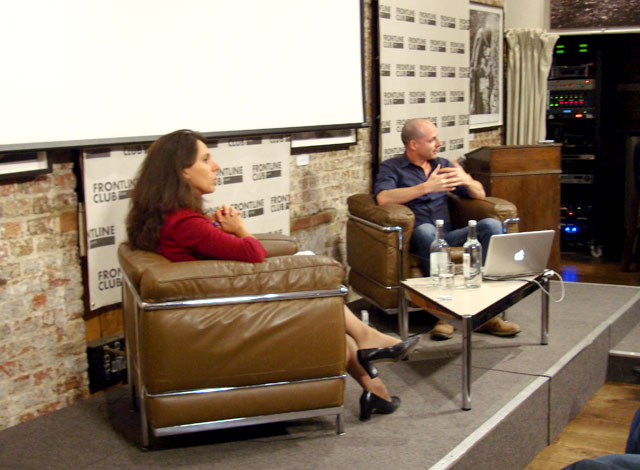
For the second PhotoTALK event with the World Photography Organisation the subject was how to gain commercial success. Discussing this topic at the Frontline Club on Tuesday 22 January, chaired by designer Stuart Smith, were the managing director of Balcony Jump Management Tim Paton, Magnum Photos photographer Chien-Chi Chang, director of Panos Profile Francesca Sears and photo editor, advisor and photographers’ coach Monica Suder.
Each of the panel first took the audience through what they do within the photographic industry and Suder was asked to detail the key mistakes that photographers make.
“Procrastination,” she said. “Not wanting to promote yourself and . . .”
“Bad editing,” Sears added.
Suder continued:
Yes, very bad editing. . . . Half the time they don’t really know their strength. They don’t know who they are. . . . What is your vision? What are they about? What do they want to say to the world? Because if you don’t have anything to say, you’re history.
Smith asked Paton what the best way to get attention from an agency is:
It’s a combination of the perfect storm; I get an email from the photographer, I’ve seen some work of theirs in a great piece of editorial, a couple of art buyers are talking about them, a couple of stylists are talking about them and all of a sudden this guy or girl is on the scene and you’re hearing about them quite a lot. So you sort of need a combination of a lot of things – a straight email, unless it’s absolutely exceptional . . . [shrugs].
Paton added later on:
It’s all about your website, absolutely all about your website . . . that’s the first port of call. . . . Work out your website so that you get to the images quickly, you don’t want: “I picked up a camera at the age of eight.” You really don’t need all that. You just want to get the images nice and quickly and give a good description of what you do fairly early on.
On the subject of still photographers diversifying into moving image, because now the cameras they use for stills can do video too, Sears responded:
It’s really, really hard because the general market for that is online and the budgets aren’t there yet. . . . You’re not going to make money back on making a multimedia. And the worst part is that photographers on assignment are often expected to shoot video as well, sometimes during the same period of time and barely getting compensated differently.
To which Chang added:
We are talking about at least six different skill sets at least, we’re talking about still, moving image, sound and then the editing. That’s a complete and utter different skill set. So for me working with the right editor – it’s very important. It takes time to develop that kind of trust and understanding.
Do students get the right training in their colleges before they enter the commercial world?
Paton answered:
A lot of the students I see coming out of college are not commercially minded which I think is a shame because they should be. They need to be.
Suder continued:
It’s a good idea for a student after they’ve finished their studies to work with a photographer they admire or someone in the same direction, in the same type of photography. They can pick up a lot. What to do and what not to do . . . What really is great is to listen to them on the telephone: how they handle a possible assignment, how they talk to their clients, how they present themselves on the phone and negotiate. These are things that take a while to get good at.
Sears added:
If I was looking for a course I would be really vigilant to find the modules that will help you in the real world.
How important is social media for photographers?
Sears:
If you’re on a big project or you’re on a campaign and you’ve got something to say then maybe fine. But for most of them, it’s not yet working because they don’t have their own brand. For those that have their own brand [such as Magnum’s Alec Soth], have a following, are building it, have something to say, have a message to convey, are working with an NGO or it’s an ad campaign, then there’s probably a reason, but otherwise [it’s not really important].
Paton:
As an example, Lara Jade has got 25,000+ followers on Twitter. It doesn’t work out as often as you might think. My theory on this, it’s probably the wrong theory, is that her generation of 23-year-olds, they’re not commissioners yet. So in five years time when they’re 28–29 and they’re starting to commission, they’re picture editors, they will be used to receiving Twitter feeds and seeing work on that. I think the commissioners now are not engaged with that so much.
Sears:
I don’t think you can ignore it but I think it’s a space to watch like it was with multimedia. We’re still working it out. I definitely wouldn’t dismiss it.
One of the final statements from the floor was about the overriding feeling that the old ways of contacting people about your work still stand:
What does come across . . . is that we should probably get off the computer and get back to old fashioned business tools and communication skills. I feel . . . everyone forgets about making the phone call. . . . I don’t think that at university we learn those skills at all and I think that’s a learning curve.
Paton finished by saying:
I think it’s a very important thing to get out and do more face to face.
Watch the full discussion here:
]]>https://soundcloud.com/frontlineclub/in-the-picture-brave-new-burma
This event is organised in partnership with the Asia House Festival of Asian Literature.
Twenty years in the making, Nic Dunlop‘s new book Brave New Burma is an intimate portrait of Burma through pictures and words. It takes the reader from the front lines of the ongoing civil war to its deceptively tranquil cities; from the home of Aung San Suu Kyi to the lives of ordinary people and their struggle to survive.
In a talk chaired by BBC foreign correspondent and writer Fergal Keane, Dunlop will present images from Brave New Burma and speak about the changes he has witnessed in the two decades he has covered Myanmar as it opens up to the outside world.
Nic Dunlop is a Bangkok-based photographer and writer represented by Panos Pictures in London. In 1999, he received an award for his discovery and exposure of Pol Pot’s chief executioner Comrade Duch, a story told in his book, The Lost Executioner. Dunlop also co-directed Burma Soldier, an HBO film which was awarded the Grand Jury Prize at the United Nations Association Film Festival and nominated for an Emmy for Outstanding Individual Achievement in Writing.
Picture credit: Burma’s Army © Nic Dunlop/Panos Pictures

Aiming to dispel the familiar and stereotypical image of refugees living in camps World Press Photo Award winning photographer Andrew McConnell previewed a new body of work about the 50% of refugees now living in cities at the Frontline Club’s, In the Picture: Urban refugees with Andrew McConnell, on September 24.
Taken over the last four months, in seven cities and four continents, with the help of the International Rescue Committee (IRC), McConnell photographed and produced short films about individual refugees in cities such as Nairobi, Bangkok, Kuala Lumpur, Jordan, Port-au-Prince and New York.
Dr Sara Pantuliano, a political scientist and Head of the Humanitarian Policy Group at the Overseas Development Institute (ODI) introduced McConnell and he wasted no time in getting to his motivations behind the project:
"The whole reason for this project is this new phenomenon, that refugees no longer flee to camps, that the old stereotypes don’t really fit anymore. Over half the world’s refugees live in cities. And so what I hope to achieve with the work is to challenge those stereotypes and hopefully present a new way of viewing refugees in the modern world."
Pantuliano asked whether McConnell had any expectations about what he would find when starting the project:
"There were no huge surprises, I found what I suspected I would find. People living in terrible conditions, in very small cramped places, one family in one room … the same things repeated themselves; the same fears, fear of detention, the authorities, afraid to go outside."
The element of fear was not the only similarity that McConnell found between the people he met:
"They had an incredible resilience, they’ve suffered things that you and I can only imagine. That will to survive was there in each and every one of them – they weren’t giving up."
McConnell relayed the stories of the people in his photographs from a lady who had escaped with her family to Burundi from Congo where she had been kidnapped and raped by FDLR or Mai-Mai forces; to Syrians who had fled over the southern border into Jordan after conditions in Homs became unbearable.
He then took the audience through how he tried to convey these people’s stories through his images:
"The whole series was photographed at night time and what I’m really trying to do is give a sense really, how forgotten these people in cities are … They don’t understand what rights they have and so they’re afraid to go outside, they suffer discrimination, it’s hard to find employment and so they often find themselves hidden away."
"We were really here trying to give a sense of the isolation these people feel, coming to a foreign city like this and trying to some how survive."
McConnell has big plans for the project – there will be an exhibition in St Pancras Station in January and after that he hopes to take it to Brussels and New York.
Listen to Andrew McConnell on his photographs:
Listen to Andrew McConnell on why refugees choose cities instead of camps:
]]>
As urbanisation reshapes much of the world, refugees are increasingly moving to built up areas, including large towns and cities. Working with the International Rescue Committee and the European Commission’s humanitarian aid and civil protection department ECHO in eight cities across four continents, Panos Pictures photographer Andrew McConnell has spent many months documenting the new reality for refugees. Through images, refugee testimonies and video, the resulting body of work presents a unique insight into the lives of urban refugees today and challenges commonly held stereotypes. From Somali refugees in Nairobi to Syrian refugees in north Jordan, and from Burmese refugees in Kuala Lumpur to Afghani refugees in New York, the story of where people flee when all is lost is changing.
McConnell will present his work at the Frontline Club in an event moderated by Dr Sara Pantuliano, Head of the Humanitarian Policy Group at the Overseas Development Institute (ODI).
Andrew McConnell began his career covering the end of the conflict in his home country Ireland, before venturing overseas to document social issues around the world. McConnell‘s work has been published and exhibited internationally, appearing in National Geographic Magazine, Time Magazine, The New York Times, The Guardian, FT Magazine, Vanity Fair, the Sunday Times Magazine and Der Spiegel among other publications. In 2011, he won two 1st prizes at World Press Photo Awards and two National Press Photographers Awards, including the prestigious Best of Show.
Dr Sara Pantuliano is a political scientist with more than 20 years’ experience in conflict and post-conflict contexts. Prior to joining ODI, Pantuliano led UNDP Sudan’s Peace Building Unit. She has written extensively on Sudan and is a regular media commentator on Sudan and humanitarian issues. Pantuliano is the Managing Editor of Disasters, the leading peer-reviewed journal in the field of natural catastrophes and man-made disasters, anda member of the World Economic Forum’s Global Agenda Council on Catastrophic Risk.
]]>Picture credit: Andrew McConnell / Panos Pictures / IRC UK
As urbanisation reshapes much of the world, refugees are increasingly moving to built up areas, including large towns and cities. Working with the International Rescue Committee and the European Commission’s humanitarian aid and civil protection department ECHO in eight cities across four continents, Panos Pictures photographer Andrew McConnell has spent many months documenting the new reality for refugees. Through images, refugee testimonies and video, the resulting body of work presents a unique insight into the lives of urban refugees today and challenges commonly held stereotypes. From Somali refugees in Nairobi to Syrian refugees in north Jordan, and from Burmese refugees in Kuala Lumpur to Afghani refugees in New York, the story of where people flee when all is lost is changing.
McConnell will present his work at the Frontline Club in an event moderated by Dr Sara Pantuliano, Head of the Humanitarian Policy Group at the Overseas Development Institute (ODI).
Andrew McConnell began his career covering the end of the conflict in his home country Ireland, before venturing overseas to document social issues around the world. McConnell‘s work has been published and exhibited internationally, appearing in National Geographic Magazine, Time Magazine, The New York Times, The Guardian, FT Magazine, Vanity Fair, the Sunday Times Magazine and Der Spiegel among other publications. In 2011, he won two 1st prizes at World Press Photo Awards and two National Press Photographers Awards, including the prestigious Best of Show.
Dr Sara Pantuliano is a political scientist with more than 20 years’ experience in conflict and post-conflict contexts. Prior to joining ODI, Pantuliano led UNDP Sudan’s Peace Building Unit. She has written extensively on Sudan and is a regular media commentator on Sudan and humanitarian issues. Pantuliano is the Managing Editor of Disasters, the leading peer-reviewed journal in the field of natural catastrophes and man-made disasters, anda member of the World Economic Forum’s Global Agenda Council on Catastrophic Risk.
]]>With the Frontline Club’s Photo Week 2012 drawing to a close, join us for this photography networking party sponsored by Chivas Regal.
We will be celebrating 25 years of Panos Pictures with a clutch of Panos photographers. A presentation of their work will be on display throughout the evening.
This event will be a chance for those in the photojournalism industry and those with an interest in photography to come together to meet, network and enjoy themselves in a relaxed environment.
Drinks will be provided courtesy of Chivas Regal.


]]>
Paul Lowe will be in conversation with the Director of Panos Pictures, Adrian Evans and two Panos photojournalists, Andrew Testa and Chloe Dewe Mathews.
]]>For 25 years photo agency Panos Pictures has been operating as the commercial arm of the development NGO the Panos Institute (now Panos London). Over that period Panos Pictures’ photographers have covered events at the epicentre of history and on the peripheries of the world, focusing on social and development stories globally.
This event will bring together key voices in Panos Pictures to discuss the developments at Panos and in the photojournalism industry over the past 25 years, and what the future holds.
Award-winning photographer and Senior Lecturer in Photography at the University of the Arts, London, Paul Lowe, will be in conversation with the Director of Panos Pictures, Adrian Evans, and two Panos photojournalists, Andrew Testa and Chloe Dewe Mathews.
Freelance documentary photographer Chloe Dewe Mathews joined Panos Pictures in 2011. She has worked all over the world, and her most recent project Caspian won her the 2011 British Journal of Photography International Photography Award.
Andrew Testa began his career freelancing for the Guardian and Observer in the early 90s. Covering a wide range of topics, from the emerging environmental protest movement, to the war in Kosovo, he quickly made a name for himself. Since then has accumulated an array of prestigious awards, including three World Press Photo Awards, and has twice been named Amnesty International’s Photojournalist of the Year.
]]>