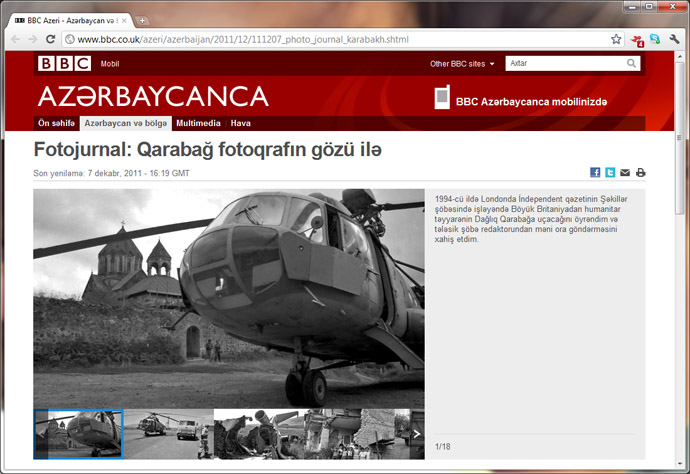
The BBC’s Azerbaijani Service has published a gallery of my photographs taken in the disputed territory of Nagorno Karabakh in 1994. Over 25,000 people were killed in the war waged in the early 1990s and a million forced to flee their homes. Since a ceasefire agreement was signed in 1994 attempts to mediate a peace deal through the OSCE Minsk Group have faltered and The Economist recently put the number of deaths on the front line since then at 3,000. Below is the English text from which the captions were taken and translated into Azerbaijani:
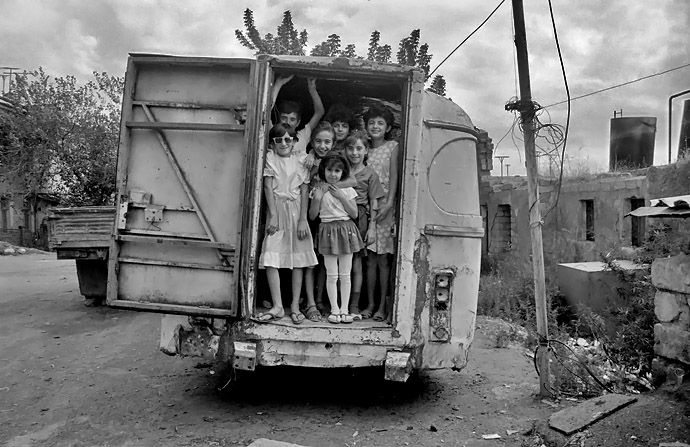
Nagorno Karabakh © Onnik Krikorian 1994
The Black Garden Revisited
When news of a humanitarian flight leaving the UK for Nagorno Karabakh reached me while working on the Picture Desk of The Independent in London in 1994, I jumped at the chance to request that the newspaper’s Picture Editor send me with it. He agreed, and in August I made my first ever trip to Armenia and the South Caucasus. The ceasefire between Armenia and Azerbaijan had been signed just months earlier and some analysts and international observers were warning that a new offensive might start within days or weeks, breaking the fragile armistice.
It didn’t, but the journey from Armenia to Karabakh was still perilous at times with the military helicopter carrying journalists and aid workers seemingly destined to smash into the side of a mountain at one point when it had no choice but to hug the terrain after a radio message warned of Azerbaijani jets in the vicinity. Yet, it wasn’t so much the military situation that interested me, but the people. More significantly, perhaps, it was the people on both sides whose hopes for a lasting peace have been continually dashed by nearly 18 years of political manipulation and intrigue.
Back then, the military buffer zone was called just that. There was no reference to the territories as ‘liberated’ by the Armenian side, even in interviews we held with the then Armenian Defense Minister, the late Vazgen Sargsyan who was assassinated in 1999. Then, just as they remain on the official level today, they were seen simply as a bargaining chip in ongoing negotiations to determine the final status of the disputed territory. Back then, there was actually hope that a negotiated settlement could be reached, ushering in a new period of peace and stability for Armenians and Azerbaijanis in the South Caucasus.
Yet, accompanied as we were for some of the trip by the Armenian writer Zori Balayan, one of the main nationalist agitators in Armenia and Karabakh, another line was also spun: that of Armenians and Azerbaijanis being destined to remain enemies without any common ground. However, when two journalists from Time magazine and I heard that Azerbaijani Prisoners of War (PoWs) were being held on the floor of a hospital in the Karabakh capital we successfully managed to escape the organized press tour and stumbled upon something remarkable.
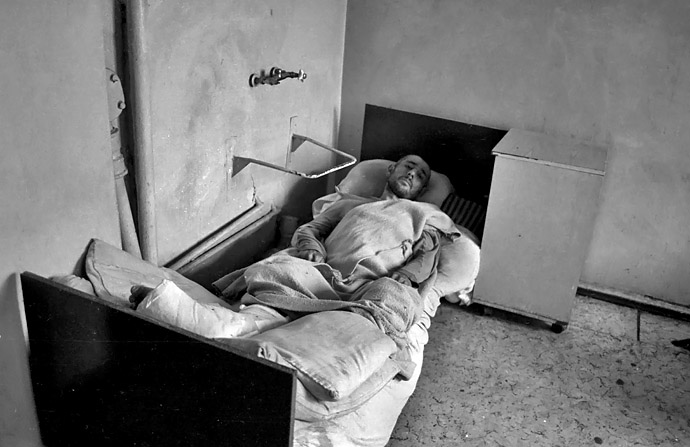
Azerbaijani Prisoner of War (PoW), Nagorno Karabakh © Onnik Krikorian 1994
In addition to the PoWs, who like many of their Armenian counterparts had been conscripted against their will, Azerbaijani civilians were also being held for exchange with Armenians taken hostage by the other side. Among them were children. Many, in fact, or at least until we discovered that not all of them were Azerbaijanis. They also included Armenians who had been allowed to play with the captives in an otherwise free environment. Until this day I remember being unable to tell them apart, and usually when I find myself observing the interaction between Armenians and Azerbaijanis at events held in Georgia and elsewhere.
And it’s true. Ethnic Armenians and Azeris are able to coexist together in countries outside the conflict zone, and they share much in common. While in Nagorno Karabakh in 1994 I photographed an Armenian wedding, for example, but the most recent marriage I shot was in 2009 in the ethnic Azeri village of Karajala in Georgia. Both, as well as every Armenian wedding in between, has been pretty much identical – from the food down to the music. I’ve also been working on documenting those villages in Georgia with a mixed ethnic Armenian and Azeri population and where both speak the other’s language.
That’s not to ignore the pain and suffering experienced by both sides in the conflict, but simply to say that in the years since the 1994 ceasefire it’s become more and more difficult for me to view the conflict as an ethnic one. Instead, and while nationalists and politicians on both sides appear to manipulate the conflict by insisting that it is, my main problem still remains being unable to tell most Armenians and Azerbaijanis apart. This is especially true for the children, which leads me on to my personal favorite photograph taken in Karabakh in 1994.
It was of a little girl, Gayaneh, close to Aghdam in the village of Khrmort. Aged well beyond her years with an expression scarred by the horrors of war, she broke into a smile only when I stuck my tongue out her from behind the camera. As she did so it was then that I found myself hoping that a lasting peace would come to the region. Unfortunately for Gayaneh and myself, as well as new generations in Armenia and Azerbaijan who are unable to remember the time when both sides did live peacefully together, we’re both still waiting…
—
Onnik Krikorian is a journalist and photographer from the UK based in Yerevan, Armenia. He is also the Caucasus editor for Global Voices Online and his own personal project amplifying alternative narratives on the Nagorno Karabakh conflict is at http://peace.oneworld.am. Follow the project on Twitter at @caucasusproject or join the Facebook Page at http://www.facebook.com/ConflictVoices.
The BBC Azeri gallery is at Fotojurnal: Qarabağ fotoqrafın gözü ilə.
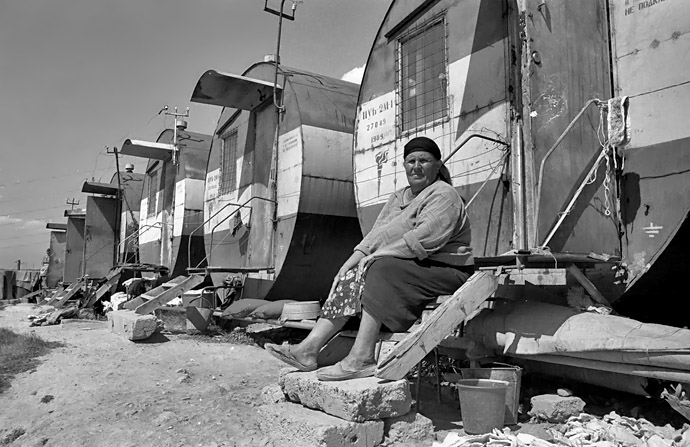
Refugee from Nagorno Karabakh, Armenia © Onnik Krikorian 1994
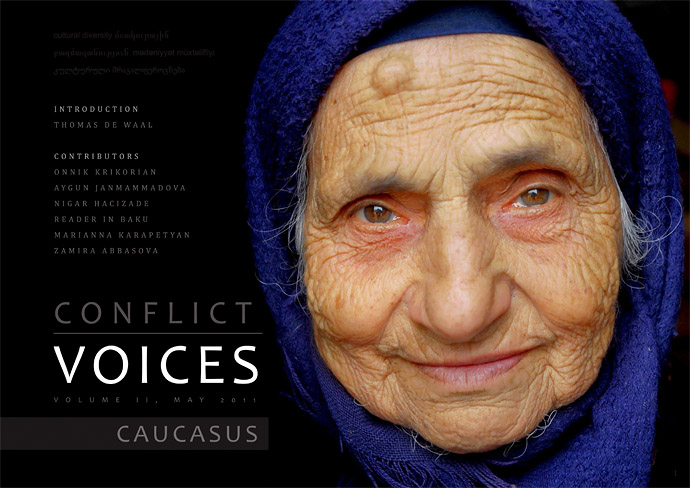
Caucasus Conflict Voices is a voluntary grassroots initiative to amplify alternative views on the conflict between Armenia and Azerbaijan over the disputed territory of Nagorno Karabakh. Today marks the 17th anniversary of the 1994 ceasefire, but both sides are as far away as ever from signing a permanent peace deal. Marking the anniversary, the second edition of Caucasus Conflict Voices is now available for browsing online or downloading.
It also features an introduction by Thomas de Waal, senior associate in the Russia and Eurasia Program at the Carnegie Endowment and author of Black Garden: Armenia and Azerbaijan through Peace and War, calling for a third narrative in the conflict — a narrative of peace.
Caucasus Conflict Voices — May 2011
Introduction by Thomas de Waal
Anyone who works with the conflicts of the Caucasus learns to live with contradiction. If you watch state media in Armenia or Azerbaijan or hear some politicians speak, you could believe that these two nations are implacable enemies on the verge of war. One Azerbaijani friend told me that nowadays whenever he hears the word "fascist" he expects to hear the word "Armenian" attached to it. In many ways the modern identities of independent Armenia and Azerbaijan and of the small statelet of Nagorny Karabakh are defined by rejection and hatred of the other.
Yet as soon as you probe deeper strange things start to happen and this picture begins to blur. A long conversation with an Azerbaijani about how terrible the Armenians are ends with the admission that his grandmother was actually…Armenian. A Karabakh Armenian talks about the crimes of the Azerbaijanis and then casually lets slip that he had Azeri friends at school and still remembers a lot of the language.
Move outside the conflict zone and these hidden signs of compatibility come out into the open. In the territory of Georgia, Armenian and Azeri villagers live side by side. There is trade and even inter-marriage. Armenians and Azerbaijanis often prefer to do business with each other than with Georgians.
We hear far too little of what I call this "third narrative" of the Armenian-Azerbaijani conflict, a narrative of peace. It spins the idea that the two peoples are capable of getting along fine, have lived together in the past and, if politicians are able to overcome differences on the Karabakh conflict, can live together in the future. International mediators are too timid to speak this narrative or feel that it is not their business. The media in both countries suppresses it.
This is why I congratulate Onnik Krikorian for the work he has done over the past few years, both in print and in images, and which is published here. He has given a voice to these alternative points of view and given a vivid picture of the different and much more positive Armenian-Azerbaijani reality that still exists in ordinary people and in Georgia.
Look at these pictures and descriptions of villages such as Tekali and you see that the problem there is not ethnic incompatibility or historical injustice, but poverty — poverty that will have a much better chance of being fixed if the Karabakh conflict can be overcome and money can be diverted from buying expensive weapons. It is a totally different and refreshing approach and he has done it pretty much by himself.
Send this collection to anyone who thinks they understand the Armenian-Azerbaijani conflict and be pleasantly surprised by their reaction.
Thomas de Waal is a senior associate in the Russia and Eurasia Program at the Carnegie Endowment. he is also the author of Black Garden: Armenia and Azerbaijan through Peace and War. link
Articles, opinions and photos are available on the latest edition of Caucasus Conflict Voices here or for browsing below.
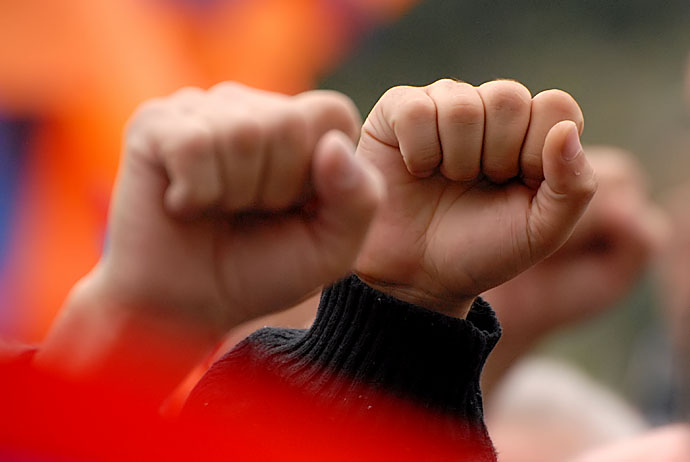
Opposition Rally, Liberty Square, Yerevan, Republic of Armenia © Onnik Krikorian 2007
Recent events in Tunisia and Egypt have captured the attention of the world’s media and also encouraged and inspired other movements elsewhere, albeit in much bloodier ways as this week has shown in Bahrain and Libya. Not to be outdone, opposition groups in the South Caucasus are also looking to replicate similar events at home, and particularly in Armenia and Azerbaijan. But, while the continuing debate between the cyber-utopians and cyber-sceptics continues as to the precise role of social media in uprisings in the Arab world, opposition groups here most definitely believe it holds the key to succesful regime change.
In Armenia, blogs played an important role in the post-election standoff between the opposition and government in February 2008 and particularly for 20 days during the State of Emergency declared after clashes with security forces on 1 March 2008 left 10 people dead. Nothing changed, of course, with the newly elected president, Serge Sargsyan, still in power today, but many referred to new media as having become the new Samizdat, the Soviet-era practice of disseminating alternative information in an environment of significant censorship. Now, nearly three years later, the opposition says it believes an Egypt-style uprising will occur in Armenia, and social media will play an important role.
PanARMENIAN.Net – Coordinator of the opposition Armenian National Congress (ANC) Levon Zurabyan said that monitoring of Facebook shows that ANC supporters make majority of this social network users in Armenia.
“It means that, first, ANC enjoys great support among Armenia’s population. Second, ANC is basically supported by educated people, who are familiar with internet and social networks technologies,” Zurabyan told a PanARMENIAN.Net reporter.
He added that “social networks provide with a great opportunity for overcoming the information blockade imposed by the authorities, specifically, through controlling the entire television.”
Many, however, are not so convinced with one local blogger pointing out that Zurabian himself does not apparently have an account. And although the Armenian government claims Internet penetration stands at nearly 50 percent, the real figure is more likely to be around 10-12 percent according to some IT specialists. One indication of that can already be seen simply by examining how popular some of the most accessed sites are. Facebook, for example, is second only to Google in Armenia according to Alexa, but there are only 132,000 registered users of the social networking site at present. Moreover, some analysts argue, it is unlikely that such a high level of support exists online and even more unlikely that it would take to the streets.
Though promoting the development of civil society in Armenia, Facebook cannot be turned into a tool for implementing a revolution in the country, according to information security expert.
As Samvel Martirosyan told a news conference in Yerevan, social networks helped to organised civil actions in Armenia, however only 1-1,5% of the users supporting the action online are ready to defend their position in real life.
In fact, while there are some opposition activists on Facebook, there are also government supporters and they too would become just as active, even if they are not at present, as one of the most well-known nationalist bloggers in Armenia recently remarked at a press conference in the capital, Yerevan.
Organization of a ‘Twitter revolution’ will not be an easy task, according to Tigran Kocharyan. Although major fundings for popularization of social networks like Twitter and Facebook in Armenia suggest the possibility of organizing opposition revolts, both Armenian authorities’ awareness of the methods of operating in social networks and anti-opposition Armenian blogger groups might prevent them, he believes.
But it’s more than just that, others believe. Although tens of thousands turned out for opposition rallies following the bitterly disputed presidential election in 2008, no critical mass was reached. Although there was deep resentment towards the authorities, the opposition failed to gain their trust especially as its leader was the first president of the country and considered by some to be just as corrupt and undemocratic when he was in power in the early to late 1990s as what exists today. In an opinion piece, the editor of one online publication also notes that Armenians are simply unable to lead or think for themselves.
[…] there is the answer to why such a revolt will not (even if some think it should) occur in Armenia.
Here, there is no “people power”. There are 10s of thousands – as proved in 2008 – who are willing to follow a leader, but none who are willing to lead themselves. There are no grass-roots movements here, where the soil of democratic will remains infertile even two decades after the toxic waste of communism should have been cleaned.
When a man, sadly and quite literally, sparked a social movement in Tunisia, his countrymen recognized themselves in his tortured desperation.
In Armenia, those who have valid grievance are waiting for an authority figure to voice it for them. That a populist, Tigran Karapetyan, with a message no deeper than bumper sticker slogans, could rally 6,000 or more followers – as many, in fact, as the major opposition bloc – indicates how low the bar has dropped on social movement in Armenia.
[…]
And, into any discussion of whether things in Armenia are getting better or worse under this leadership – and there’s some of each – arises the phrase that is on protest placards in Cairo: “illegitimate government”. Sadly for Armenia’s hopes of becoming democratic, this “illegitimate government” may very well be better than the alternative that would have emerged had elections three years ago been held fairly.
Lacking a movement that grew organically, Armenians at both political polarities were willing to follow dubious leaders in that ill-fated election.
"There is no political group leading the people,” a human rights activist in Cairo told media. “There is
no one leading the people. People are just doing it.”
Of course, with or without Egypt and Tunisia, the opposition would still have held mass rallies in the capital given that today marks the third anniversary of the disputed 2008 presidential vote and 1 March is traditionally the day to mark the bloody post-election clashes. But with, or most likely without, the use of social media combined with traditional means of public outreach, the opposition again failed to attract significant numbers onto the streets yesterday. Radio Free Europe might have estimated the number in attendance as being at least 10,000, but other media outlets such as Reuters and AFP did not, instead putting the number at half that.
YEREVAN – Around 5,000 opposition supporters rallied in the Armenian capital on Friday, calling for the government’s resignation and an Egyptian-style uprising in the former Soviet republic.
"The movement to change governments which started in Kyrgyzstan, Tunisia and Egypt is continuing, and sooner or later it will reach us because the situation in Armenia is no better and hatred of the authorities is no less," said opposition leader and former president Levon Ter-Petrosian.
Supporters of Ter-Petrosian’s Armenian National Congress bloc demonstrated against alleged political injustice, difficult social conditions and rising inflation in the landlocked country.
But turnout at the rally was not large by local standards and did not suggest that political unrest was imminent.
Yet, despite low Internet penetration in the country, social media could have been used. However, there was no sign of any real activity on Facebook or Twitter. A Facebook support page for the opposition has just 915 members at time of writing and a group set up to invite Armenians to attend managed to attract 430 people while more than double that said they would not participate. Even today, following yesterday’s rally, Facebook remains quiet while Twitter doesn’t bring up much at all, with what little there is mainly coming from news sites in Azerbaijan, Armenia’s main foe in the region. And on YouTube, video coverage of the opposition rally in Yerevan from the main online opposition media outlet isn’t attracting much interest at all.
At time of writing, one video was viewed 1,411 times and a second 2,208 times. Naturally, there was at least a spike in traffic on the A1 Plus main site, but not by much. With the population of Armenia put at around 3.2 million, A1 Plus received 21,467 visits across its entire site yesterday and 27 percent of that was from outside Armenia. Of course, Internet penetration remains low, but it’s more than simply that. Instead of the opposition telling everyone that they have huge support among the population, online and offline, they need to develop an outreach strategy instead. Certainly, if there is an Egypt-style uprising in Armenia, which most analysts doubt, social media doesn’t look as though it will play any significant role for now at least.
Instead, perhaps the opposition in Armenia should follow the example of activists in neighboring Azerbaijan who are very social media savvy in comparison. For now, though, any strategy seems to be simply setting up one or two Facebook pages and assuming that people will naturally be interested in sharing the information among their own peer-to-peer networks. Yesterday’s rally, however, showed that to be very far from the truth. But, with new Wikileaks cables released this week showing that there’s plenty of things wrong in the country, there’s certainly enough information to use in such a campaign. If only they knew how.
]]>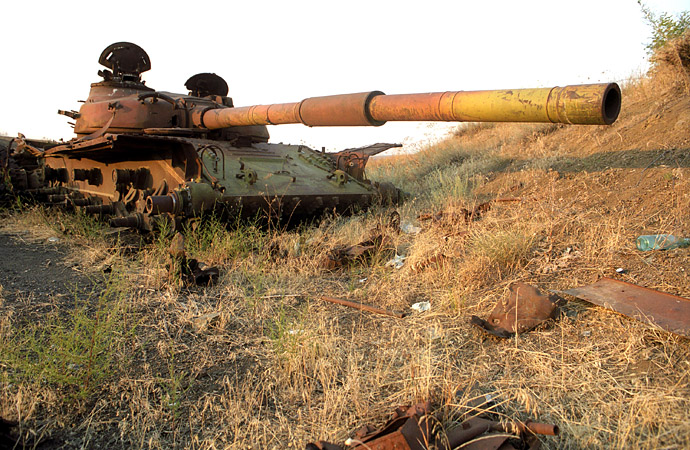
16.7 kilometers south of Lachin, Armenian-controlled Azerbaijan. Photo © Onnik Krikorian
While it didn’t come as much of a surprise, the latest report from the International Crisis Group (ICG) makes depressing reading. Locked in a bitter stalemate since the war over the disputed territory of Nagorno Karabakh during which around 25,000 were killed and a million forced to flee their homes, a final peace deal remains as elusive as ever. More alarmingly, perhaps, last year was one of the worst in recent history with skirmishes on the front line claiming dozens of lives. Moreover, if talk since the 1994 ceasefire agreement, which effectively put the conflict on hold, had been of conflict resolution, 2011 looks to be more defined by increasing talk of the need for conflict prevention.
An arms race, escalating front-line clashes, vitriolic war rhetoric and a virtual breakdown in peace talks are increasing the chance Armenia and Azerbaijan will go back to war over Nagorno-Karabakh. Preventing this is urgent. Increased military capabilities on both sides would make a new armed conflict in the South Caucasus far more deadly than the 1992-1994 one that ended with a shaky truce. Neither side would be likely to win easily or quickly. Regional alliances could pull in Russia, Turkey and Iran. Vital oil and gas pipelines near the front lines would be threatened, as would the cooperation between Russia and Turkey that is central to regional stability. Another refugee crisis would be likely. To start reversing this dangerous downward trend, the opposing sides should sign a document on basic principles for resolving the conflict peacefully and undertake confidence-building steps to reduce tensions and avert a resumption of fighting.
There has been significant deterioration over the past year. Neither government is planning an all-out offensive in the near term, but skirmishes that already kill 30 people a year could easily spiral out of control. It is unclear if the leaders in Yerevan and Baku thoroughly calculate the potential consequences of a new round of tit-for-tat attacks. Ambiguity and lack of transparency about operations along the line of contact, arms deals and other military expenditures and even the state of the peace talks all contribute to a precarious situation. Monitoring mechanisms should be strengthened and confidence-building steps implemented to decrease the chance of an accidental war.
At the same time, more has to be done to change a status quo that is deeply damaging to Azerbaijan; 586,000 Azeris are internally displaced (IDPs) from Nagorno-Karabakh and adjacent areas, and some 16 per cent of the country’s territory is occupied. Otherwise, Azerbaijan public opinion and leadership will feel justified to use the military assets Baku has been accumulating at an increased rate: the already substantial defence budget is slated to rise by some 45 per cent between 2010 and 2011, to $3.1 billion out of a total $15.9 billion state budget.
The report, available for download in PDF format here, includes some sensible recommendations such as the need to endorse the basic principles which would form the basis for a later peace agreement, the implementation of confidence building measures such as the withdrawal of snipers from the front line, compliance with arms limitations treaties and agreements, but particularly a change in policy which only aggravates the situation. Unfortunately, though, the task will not be simple, especially in an environment where most Armenians and Azerbaijanis are unwilling or unable to communicate with each other.
A recent household survey by the Caucasus Resource Research Centers (CRRC), for example, revealed that 70 percent of Armenians were against friendship with Azerbaijanis, while 97 percent of Azerbaijanis were against friendship with Armenians. Meanwhile, town hall meetings in Armenia, Azerbaijan and Nagorno Karabakh showed that over 50 percent of Armenians prefer the current situation of ‘no war, no peace’ rather than compromise and release territories surrounding Karabakh currently under Armenian control for a referendum to determine the territory’s status. Only 0.3 percent of Azerbaijanis support such an option.
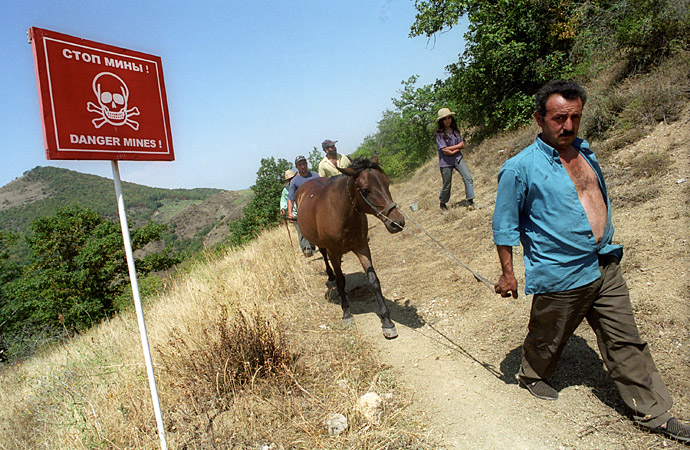
Suarassy, Armenian-controlled Azerbaijan. Photo © Onnik Krikorian
The media in both countries plays a less than constructive role by perpetuating negative stereotypes of the enemy too, and the outlook in general looks bleak. Indeed, some analysts and regional experts preempted the ICG report by wondering if a new war in the near future was now inevitable. Nevertheless, there are some alternative voices starting to emerge although they remain a tiny minority in both countries. It might even be appropriate to call them insignificant, but as they were never heard before, and their existence in an environment hardly conducive to any talk of peace somewhat unprecedented, that’s probably unfair.
In fact, they’re very significant indeed simply because they exist at all, although there is an urgent need to increase their numbers and make alternative views on the conflict more widely available. Although this should be through the mass media, that is next to impossible for now, although social media offers an albeit limited alternative. This is what my personal project, Conflict Voices, and special coverage on Global Voices is trying to achieve. Recently, for example, Marianna Karapetyan, an Armenian now living in Russia, wrote about her close friendship with an Azerbaijani. Such views and realities are rarely if ever heard in the local Armenian and Azerbaijani media.
[…] we made an agreement promising never to discuss the situation between our countries because we knew that, as we’d been told different things, the discussion would never be constructive and only just harm our friendship. This was perfectly convenient for me because, unlike Leyla, I knew next to nothing and I wouldn’t really be able to argue. But realizing this, I was always amazed that she came to meet me first, despite all that true or false information she had been told about Armenia back home. Over time, I started researching the conflict and asking around to fill in the gaps of my knowledge and to understand what had happened. But, as I was learning and discovering more, I never felt my feelings towards Leyla changing. Instead, we became even closer as friends.
Not only that, but I also learned that during the incidents in Baku, her family helped many Armenians in different ways. They traded their apartment in Moscow for one owned
by Armenians in Baku, and even though the Moscow one was way more valuable, so that they could move. Her grandma’s passport was also used to transfer around 50 Armenian women across the border and her neighbor continues to help people sneak through customs in Georgia to see their abandoned homes. In fact, there are many more such stories which I would never have allowed myself to believe before.
And yesterday, in a powerful and spontaneous post for the project, Nigar Hacizade, an Azerbaijani now living in Turkey, made an impassioned plea for peace.
I don’t want to be from a country that is permanently occupied, that is permanently grieving, that has miserable refugees with forever ruined lives. Neither do I want to be from a country that is constantly considering aggression. I don’t want to be from a country where the news accumulates around the enemy, what the enemy does, what the enemy says. I don’t want to be from a country where the word describing the people living next door carries a negative meaning no matter what the topic is. I would like Azerbaijan to free itself from its post-war identification based on Armenia as the enemy.
[…]
I have no concrete answers, certainly not for this piece, but I will end with one thought. I know Armenians think about these questions just like we think about them. They think about peace, justice, their lands, and their legitimate grievances. Believe it or not, they think that they are in the right; isn’t that crazy? Well, it’s not. Neither are we crazy. It’s such a basic idea, yet such a hard nut to crack. But I believe it’s the key to get out of this windowless cell we have locked ourselves in.
I know there are Armenians who want the things that I want, and I know that we have no other choice but to find ourselves a middle ground. We don’t have to meet each other exactly in the middle; we just have to start walking towards each other. We have to do it for ourselves, for our legacy, for our collective dignity.
More of these alternative opinions can be read on the project site and also in the form of a free e-book in English and Russian for viewing online or download.
However, even so, with talk more and more of war, the situation does not look good. In Armenia, for example, some analysts expect nationalist rhetoric against a compromise peace deal to increase in the year leading up to the 2012 parliamentary elections while a new law under consideration in Azerbaijan would effectively make unauthorized cross-border cooperation with Armenian organizations and even media outlets a criminal offense. Indeed, in such an environment, perhaps the question is not if there will be a new war between Armenia and Azerbaijan over Nagorno Karabakh, but unfortunately more one of when.
]]>Although actually underway since June 2008, it’s especially been a labour of love for the past year, but now some of the essays solicited for a personal online project are available as a free e-book for reading online or downloading. Accompanied by colour photographs, the book contains opinions on Armenian-Azerbaijani relations and the conflict between the two countries over the disputed territory of Nagorno Karabakh.
Most of the works are by bloggers from both countries as well as their Diasporas and I’ve often blogged about the project in general on this site. It’s been a huge success to date, and I’ve even presented this work at conferences worldwide. A Russian-language version is currently being prepared and should also be online soon. I’m also hoping to significantly expand on the project next year.
In the 16 years since a 1994 ceasefire agreement put the conflict between Armenia and Azerbaijan over the disputed mainly-Armenian populated territory of Nagorno Karabakh on hold, peace remains as elusive as ever. The war fought in the early 1990s left over 25,000 dead and forced a million to flee their homes.
Since June 2008 Onnik Krikorian has been using new and social media to connect alternative voices in Armenia, Azerbaijan, and the Diasporas of both countries. A cross-border project initiated in September 2009 has since given birth to Caucasus Conflict Voices, a collection of contributions to date from Armenian and Azerbaijani bloggers.
The first collection includes color photographs alongside contributions from Onnik Krikorian, Zamira Abbasova, Marine Ejuryan, Aygun Janmammadova, Sasun Khachatryan, Scary Azeri, Lena Osipova, Liana Aghajanian, Kevork Oskanian, and Arpine Porsughyan. It can be downloaded in PDF format (1.7mb) from the project site: link
Incidentally, I’ve been covering the Nagorno Karabakh conflict since 1994 when I visited as a photographer for The Independent, assisted Thomas de Waal with Black Garden: Armenia and Azerbaijan Through Peace and War, and have fixed for the BBC and The National on this subject as well. A lot of my work to date has especially focused on the danger of landmines and UXO.
Anyway, definitely looks like more of the same in 2011, and not least in terms of documenting positive examples of Armenia-Azerbaijan coexistence in neighboring Georgia, the increasing use of new and social media in cross-border communication, and departure into a few other areas so far generally not covered by the local and international mainstream media. Stay tuned…
]]>With few expecting a breakthrough in negotiations between Armenia and Azerbaijan to resolve the long-standing conflict over the disputed territory of Nagorno Karabakh, if the likelihood of ethnic Armenians and Azeris ever being able to live together in peace again seemed remote, you’d be wrong. A recent working visit to Georgia, the third of the three South Caucasus countries, demonstrated that more than many could ever have possibly imagined.
True, footage of a school where ethnic Armenians and Azeris study together shot by a friend for Al Jazeera English was an indicator that it is possible, but the number of other such examples was surprising. There was the Azeri tea house run by ethnic Armenians in Tbilisi where Armenian, Azeri, Farsi, Georgian, Kurdish, Turkish, and Russian are spoken almost on a daily basis, but there were also countless ethnic Azeris who spoke Armenian to Armenians who could also speak Azerbaijani.
Yet, few — if any — local media outlets in the region report on such a reality.
[…] The influence of the media from neighboring Azerbaijan and Armenia is not yet big enough to lead to emergence of conflicts: […] As a conclusion, I would like to return to one of the stereotypes that are most common both on grassroots level and in the official discourse of Armenia and Azerbaijan, according to which states Armenian and Azerbaijani peoples cannot live side by side. I hope that many of those who are subject to the hypnotic influence of such myths will learn about the existence of villages like Tsopi, which is by far not the only existing remnant from the times when the lives of the two peoples were closely intertwined. […] from a more general point of view representatives of different national communities, including Armenians and Azerbaijanis, are destined to a to co-existence as neighbors, as in the case of the villagers of Tsopi. It is necessary to pay attention to these spaces of coexistence and then probably there will be much more chances to make the perspective of peace closer to this region. link
The visit was the second phase of an initial attempt to overcome negative stereotypes of the "enemy" in the South Caucasus conducted in September 2009 with regional analyst and prominent Azerbaijani blogger Arzu Geybullayeva. It was supported by the British Embassy in Yerevan, Armenia, and Transitions Online, an online publication dealing with the former Soviet world. Some posts and photographs are available in English, Azerbaijani and Russian on TOL’s blog where there will soon also be some podcasts.
Until then, some of the images shot are above and below, and it’s worth quoting the impressions of a Georgian participant in the project, Dodi Kharkheli, aka Dodka.
I am a citizen of Georgia.
I was born and brought up here, never leaving its borders until two years ago. I have heard about the conflict between Armenia and Azerbaijan, but I have never felt it.
Why?
Well, everyday I see kids playing in the yard. Some of them are ethnic Georgians, some Azeri, and some of them are Armenians.
They play hide-and-seek. Sometimes they fight. And even if they fight, cry and run to their parents, the next day I still see them playing together.
[…]
I see them falling in love, getting married, having kids, getting divorced. Or staying married until the end of their days (for believers of "happily ever after").
No wonder that I see surprise in the eyes of an Armenian trader who works at the same table as an Azeri and Georgian trader in the Marneuli market when we ask her about relationships between the ethnic groups.
She is surprised why we are even asking. How could they have problems? They are friends, they work together.
[…]
I hope to see peace in South Caucasus.
If people from Georgia, Azerbaijan, Armenia can coexist here, then surely they can coexist anywhere.
And as the project is ongoing, hopefully serving as an example of how online tools can provide an alternative to what is usually a xenophobic and nationalist media, you can follow it on Twitter @caucasusproject. There is also a round up of some of the posts made already, including translations into French and Russian, on Global Voices Online while the main site for all current and future phases of the project is at http://www.oneworld.am/diversity/.
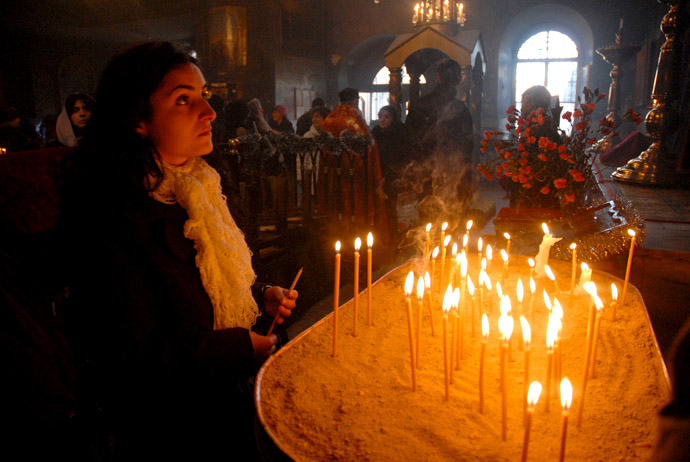
Armenian Church, Tbilisi, Georgia © Onnik Krikorian / Oneworld Multimedia 2009
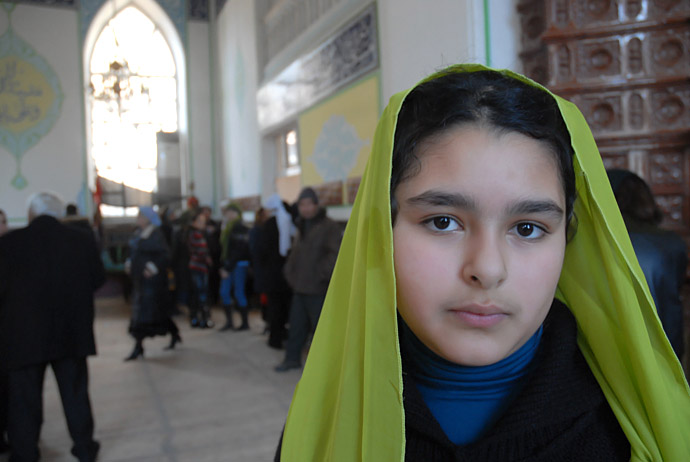
Ethnic Azeri, Mosque, Tbilisi, Georgia © Onnik Krikorian / Oneworld Multimedia 2009
]]>
In the 15 years since the May 1994 ceasefire agreement put the conflict between Armenia and Azerbaijan over the disputed territory of Nagorno Karabakh on hold, various peace proposals have faltered. But if Armenia’s first president, Levon Ter-Petrossian, was forced to resign in 1998 by nationalist hardliners in his government opposed to a compromise settlement, the main obstacle in recent years has been public opinion.
In Azerbaijan, belicose rhetoric against Armenians has become common, and even recently spilled out into something as trivial Eurovision, while political forces in Armenia — and on both sides of the divide — recklessly exploit the conflict to either maintain or come to power. Meanwhile, the local media continues to perpetuate negative stereotypes of the "enemy" while propaganda and misinformation on both sides has drowned out what little communication and discussion there has been — or prevented what could be.
Of course, it shouldn’t come as any surprise. With new generations of Armenians and Azerbaijanis unable to remember the time when both lived side by side together in peace, such rhetoric is extremely effective in post-Soviet societies where intolerance has risen to alarming levels and critical independent thinking is discouraged. Ironically, as Thomas de Waal wrote three years ago, the same reality might well be behind the conflict in the first place.
Contradictory national narratives pervaded both societies at all levels. Before fighting began, intellectuals had formulated detailed arguments that formed a national frame of reference for what happened on the battlefield. These positions were first staked out during the 1960s post-Stalinist ‘thaw’ initiated by Soviet leader Nikita Khrushchev, which created conditions for sanctioned, or ‘orthodox’, forms of nationalism. These proved difficult to control, however, as diametrically opposed versions of history were later propagated by writers such as Zia Bunyatov and Zori Balayan.
When the dispute broke to the surface in 1988, teams of pamphleteers and propagandists on both sides were ready to rush into the breach and they began producing works with titles such as ‘Karabakh: the guilty party in the tragedy is well known’. Disappointingly little has changed in this regard. These ideological battles continue to this day on the internet among a narrow audience, yet opinion polls in both countries suggest an overwhelming majority of respondents find it impossible to countenance Karabakh being given to the ‘other’ in any peace agreement. […]
[…]
A key point must be made here, which is that these underlying structural tensions in the architecture of the region had little impact on the daily life of the residents living there. As most Armenians and Azerbaijanis will tell you, they traditionally had a better trading relationship with each other than either community did with Georgians; rates of intermarriage were also high. Soviet Karabakhis from both communities tended to be bilingual, on good terms with their neighbours and little concerned by the nationalist narratives being advanced by intellectuals in Yerevan or Baku.
It is an elementary mistake therefore to see the Karabakh conflict as a clash of ‘ancient hatreds’ or as a religious dispute. Links of culture, business and marriage still bind Armenians and Azerbaijanis together in Moscow, Georgia and Iran – anywhere in fact outside the zone of the Karabakh conflict.
[…]
[…] the heart of the conflict lies within the narrow political narratives that Armenia and Azerbaijan have come to employ both in imagining themselves and the other. To break out of the prison of the conflict, they need to begin the titanic effort of a genuine dialogue about their common future. […] link
True, Armenians and Azeris have been meeting at conferences, workshops and other events aimed at promoting regional stability and peacebuilding in the years since the ceasefire, but none have had any noticeable effect on relations between the two countries. Cynics even argue that such meetings in third countries amount to little more than all-expenses paid trips abroad while others question whether occasional meetings can ferment genuine relationships and cooperation between those involved in the first place.
Even Internet forums established to facilitate communicaiton between the two sides usually end up as new battle grounds. One civil society activist in Armenia explained it thus:
Observing the methodology was my deepest disappointment and frustration with Armenian-Azerbaijani rapprochement. I’m not sure, but it’s either a lack of professionalism or deliberated hostility training/simulation… And now they’re are looking for people with blogging experience. Why? Do they need new technologies and levers to disseminate that enmity, frustration online?
Yet, despite the risks, the increasing popularity of sites such as Facebook as well as other new mediums for self-expression such as blogs offers the potential for social media and other online tools to move in to fill the information gap and cross the communication divide. In an interview held for Global Voices Online, Micael Bogar, Projects Manager at the American University’s Center for Social Media offered her own opinion. Although not a means in an end in themselves, these tools certainly have a place as part of larger and wider initiatives.
However, she says, many of those working in this area are not interested in using low cost tools which could prove more effective than what exists at present because international donors are not interested in supporting lower cost initiatives while those involved in existing projects receive larger grants for activities even if they turn out to be unsustainable. Nevertheless, those who realize that establishing trust and forming friendships has to occur daily could use such tools as Facebook and Skype to cross ceasefire lines and closed borders to contribute to the process.
[…] I think you can’t do it just with social media tools, but as we’ve seen over the past 15 years you definitely can’t do it by meeting in Tbilisi for a weekend every summer. It becomes just like Facebook – an entertainment – and I’ve had experience with these conferences in Tbilisi where it’s just one big coffee break and a waste of money so I think that both of those combined could propel us along.
I hate to be a pessimist, but I think that much of civil society currently working on peace building initiatives are not necessarily not very serious about their work, but many are just in the NGO world to make a living. I think there’s a clear sort of radical character or quality that’s needed in order to be serious about conflict resolution in the South Caucasus and I would say that it requires almost a rejection of the current system in place.
I think that when you have those fundamental elements in an activist or a conflict-resolution advocate then it’s going to be a natural move to go into social media […]. For those who aren’t using it, I think they’re either just older and not aware of it or just uninterested in using cheap tools when they get can receive big grants to keep themselves in business. link
I had those moments when I would have been one of those people who said this is not going to work and even after we were into it for a week or so. Sometimes you just think that there is no way that these students are going to find consensus. Initially, when you’re doing a program like this – and my background is with the Israelis and Palestinians, actually – you work in those situations and you’re really optimistic that the students will find commonality simply because they’re teenagers, and then inevitably something is said, some small comment is made, and it just gets explosive and you think wow, this is not going well. There were those moments where I thought that I had underestimated the intensity of the conflict and students’ emotions, but they came back together.I was so impressed with the students when they got involved in an intense conversation. There were a lot of tears, but they would really pull themselves out of it […]. By the time we were done, and we started off with students not even making eye contact, they were giving each other a hug or trading email addresses after really exhibiting a commitment to continue their work. That was really an inspiring moment […].[…] but my optimism is definitely tempered by a realization that these are young people who are soon going to be on the frontlines.[…]The leaders are talking to each other, but god forbid that people actually do. link
[…] if Adnan and Emin could see this they’d probably be kind of proud of the fact that this small kind of rapprochement has taken place.[New media tools] will certainly help in getting young people to get better acquainted with each other, but at the same time you have to realize that it also helps people reaffirm their biases. If you go round the Internet and look for Armenian and Azerbaijani web sites that speak of the other country you get into a lot of trash and very harmful discourse from nationalist websites.
I do hope that people get better acquainted and get to know each other’s culture better and realize how close they are actually related culturally and socially, but one cannot ignore the existence of a lot of web sites and online users who actually fire up the differences between the two nationalities. So, I’m mildly optimistic, but at the same time think we should be very cautious as well about what we find on the Internet as well. link
Time will tell whether many involved with peacebuilding and conflict resolution initiatives will migrate at least some of their activities online, but there is also the danger that will not devise a well thought out strategy in order to do so. Moreover, although peace activists such as Georgi Vanyan are very open in their offline and online activities, others are not. Indeed, most deny access to journalists and shy away from any independent media coverage, preferring to keep everything closed or under control in much the same way as governments in the region do.
Information is key, but control of that information remains more important to such groups even if that means the populations of both countries continue to have existing prejudices reinforced by negative images of the other pumped out by the media on an almost daily basis. Until that changes, nothing else will in the South Caucasus. However, as Internet penetration and especially mobile access increases in the region, online social networking and new media tools offer the opportunity to change the situation significantly, but only if there’s the will and expertise available to do so.
For now, prominent bloggers such as Liana Aghajanian and Arzu Geybullayeva represent a glimmer of hope.
I would very much like to have more debate among bloggers in Armenia and Azerbaijan, especially young ones, to share experiences and talk about our day to day lives, basically. It’s just made so difference and I think […] we really need some kind of initiative for debate because I would really, really like to see borders opened and conflict resolved and […] be friends with Armenians. Reminiscing, my mum says that when she went to school she had Armenian friends, Russian friends, it was all a mix and I would very much like myself or my children as they grow up to be able to say the same kind of thing to their children and to their friends. link
Hopefully such voices will not be drowned out by those who will undoubtedly eventually seek to silence them.
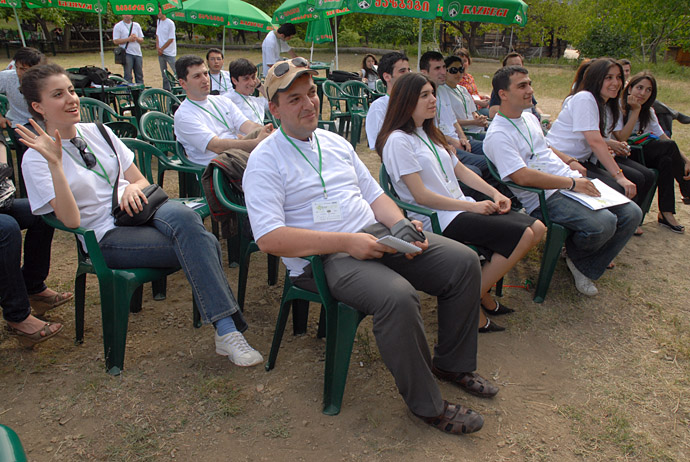
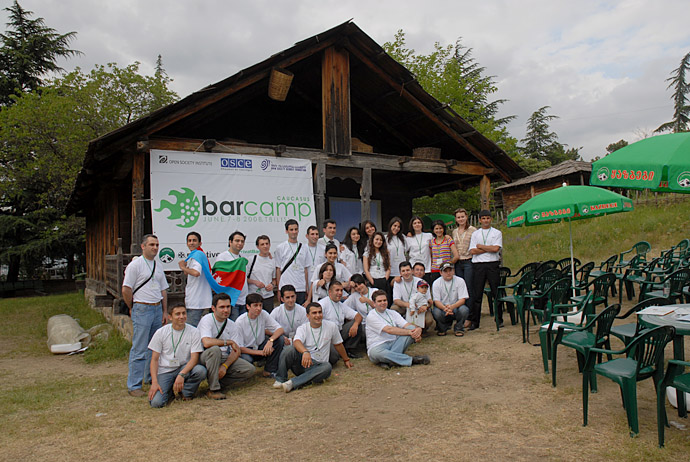
Armenian and Azeri bloggers, Barcamp Caucasus, Tbilisi, Georgia © Onnik Krikorian / Oneworld Multimedia 2008
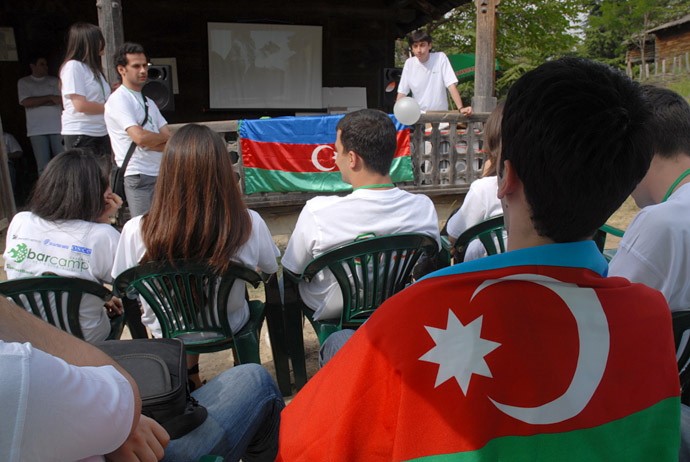
Azeri bloggers, Barcamp Caucasus, Tbilisi, Georgia © Onnik Krikorian / Oneworld Multimedia 2008
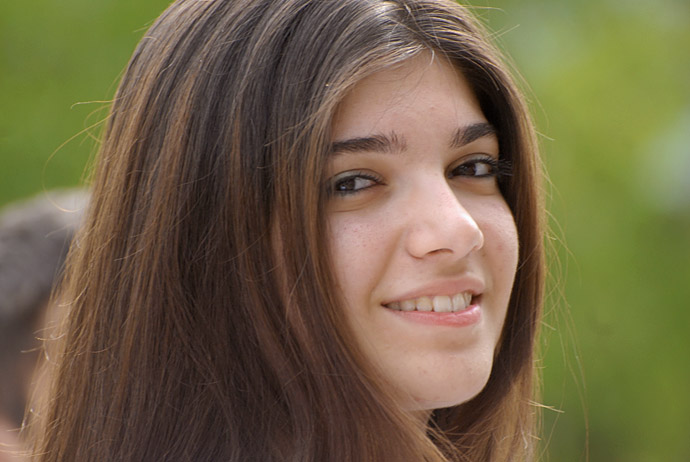
Azeri blogger, Barcamp Caucasus, Tbilisi, Georgia © Onnik Krikorian / Oneworld Multimedia 2008
]]>
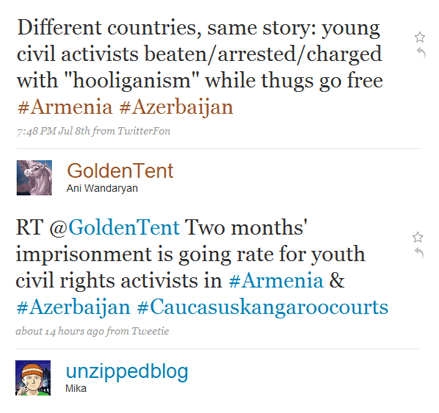
Despite the similarities, however, and the obvious need to consider the way authoritarian governments in the region intimidate and silence youth activists, the situation is complicated by the fact that Armenia and Azerbaijan are still technically at war over the disputed territory of Nagorno Karabakh. In such an environment the local media in both countries either censors itself or perpetuates negative stereotypes of the “enemy.” So, if quoting the two tweets would be logical in the larger world outside the region, that’s not the case here.
What I wasn’t expecting, however, was to a receive a message from an acquaintance in Baku not only requesting that I remove them from a post for Global Voices Online, but also attempted to belittle the entry which others appreciated in order to achieve that purpose.
[…] the post seems so ugly, maybe you’d simplify it, make it more readable and attractive? It is unintelligible. And I have a personal request […], can you remove that Armenia reference from the beginning, please?
Reluctantly, and somewhat stupidly, I agreed. However, the matter didn’t stop there. A second message from someone in Azerbaijan followed.
I have read your posts and I know of your take on this position. No matter how discouraging it is going to sounds, I’m going to ask you not to post any links to your articles. If the authorities are tracking facebook activity then they will look for tools to derail our cause; one of which could be them referencing that “Armenians” are behind the attempts to destabilize… […] I hope you will understand.
Of course, I do understand, but the absurdity of the situation is striking. Nothing will ever change if such attitudes and fears are the prevalent ones. Moreover, even if the authorities and pro-government media in Azerbaijan will do anything to discredit pro-democracy activists, the fact is that I am still a British citizen albeit with a weird Armenian name. The situation became even more ridiculous and disappointing when an Azeri friend I was hoping to meet in Tbilisi cancelled out of fear that the authorities in Baku would find out and use it against her.
True, the pro-government media already had a field day when they discovered that Olesya Vartanyan, another journalist with an Armenian name, had contributed to a report on Hajizade and Milli’s detention for the New York Times. For those attempting to shift attention away from the illegality of their detention and suspect court hearings held behind closed doors, it didn’t matter that Vartanyan is not only a Georgian citizen, but also apparently only a quarter Armenian anyway. Of course, with or without Vartanyan, they would have found something else to exploit… and they did.
Indeed, when almost every single notable democracy, human rights and media organization or watchdog backed Hajizade and Milli, the authorities alleged some kind of international conspiracy against Azerbaijan. The obedient and unprofessional Azeri media bought into the argument even if it was actually the illegality of the case and the skilled use of social networks and new media which saw their detention make headlines worldwide while that of activists in Armenia was unfortunately ignored. Frontline’s Matthew Collin saw it that way, anyway.
[…] after allegedly being involved in a fight in a restaurant in the capital, Baku, […] their friends believe they were targeted for their use of online media like Facebook, YouTube and Twitter to build support for pro-democracy youth groups in this oil-rich but politically intolerant country. […] their case has become an international issue partly due to their own networking skills and the mainstream media’s post-Iran obsession with online culture, but also thanks to the tireless work of other bloggers […]. link
try instead of recognizing and addressing the genuine grievances and concerns of the majority. Yet, despite the intolerance and animosity in both countries when it comes to the other, there were some signs of hope when a few progressive Armenians openly supported Hajizade and Milli.
I would very much like to have more debate among bloggers in Armenia and Azerbaijan, especially young ones, to share experiences and talk about our day to day lives, basically. It’s just made so difference and I think […] we really need some kind of initiative for debate because I would really, really like to see borders opened and conflict resolved and […] be friends with Armenians. Reminiscing, my mum says that when she went to school she had Armenian friends, Russian friends, it was all a mix and I would very much like myself or my children as they grow up to be able to say the same kind of thing to their children and to their friends. link
ace, and even war. This is now the choice that everyone has to make. As a British citizen resident in the region, I’ve already made mine and my name doesn’t even enter into it. If anyone has a problem with that please take your complaint to the British Embassy in Yerevan or Baku. Oh, and get a life…
The last time I visited Nagorno Karabakh was in 2006. Well, the intention had not been to visit Karabakh itself, but rather the strategic town of Lachin situated within what the international community considers sovereign Azerbaijani territory under Armenian control. However, despite years of working on a long-term photographic project in the town, I was instead detained by the local National Security Service (NSS) and my travel plans altered in unexpected ways.
 |
I was instructed to present myself immediately to the Foreign Ministry in Stepanakert, capital of the unrecognized and self-declared republic, and then return to Armenia.
Despite being entitled to visit Lachin as a holder of a 10-year Armenian residency visa, my detention had no legal basis and not least because I had already been welcomed by the regional deputy governor of part of the occupied territories as well as by the head of settlement. Indeed, I was actually detained upon leaving his office in the formerly Azeri and Kurdish-inhabited town that Armenians have since renamed Berdzor.
Besides, being married at the time to an Armenian citizen, my wife had relatives living in Lachin and we had constantly visited them. There had never been a problem.
Three years ago, however, that had all changed. With attempts to settle parts of the territory surrounding Karabakh faltering, the subject for two articles published by the Institute for War & Peace Reporting (IWPR) and EurasiaNet was sensitive enough to put the internal security services on edge. A senior official in Lachin later alleged that the order for my detention had come from Yerevan, but that still remains unclear.
Regardless, the excuse given in Stepanakert for my expulsion was laughable. "Nobody may enter Lachin," I was told much to the confusion of a local representative of a Diaspora foundation who accompanied me. As he scratched his head in confusion and disbelief I had to state the obvious. "So why did the acting governor not only welcome me, but also suggest villages that I should visit to interview residents for my articles, then?"
And, with the road from Armenia to Karabakh actually passing through the center of Lachin, there’s no avoiding entering the town anyway. Instead, it was all quite clear. The authorities in Yerevan and Stepanakert were on edge about the exodus of settlers from Armenia inhabiting the regions surrounding the disputed territory and just wanted journalists to stay out. Fair enough, I thought, especially as I had enough material for my articles.
I did, however, promise myself not to go anywhere near Karabakh in the future. Unless I really had to, that is.
Well, three weeks ago that time came in the form of a fixing gig for the BBC and a photo assignment from The National. It would be interesting to see if I would be welcomed again in much the same way as before. Thankfully, I have to say, the situation was less tense and the authorities more inviting and accommodating this time round. Indeed, long gone were the days when journalists required written permission to travel anywhere outside the capital.
Access without permission was unfettered with the obvious exception of Aghdam, a once bustling market town inhabited by Azeris razed to the ground after it was taken by ethnic Armenian forces during the war of the early 1990s and still somewhat of an embarrassment when photographs of the ruins turn up in foreign publications, as well as the frontline itself. Still, the main purpose of the visit was to assess the mood in Karabakh in light of renewed efforts to resolve the conflict over the territory with Azerbaijan.
Surprisingly, Stepanakert was bustling with lots of construction everywhere. A new building for the Karabakh National Assembly took pride of place in Republic Square and luxury hotels were springing up elsewhere. Moreover, and despite concerns recently expressed by the unrecognized republic about a possible deal being hammered out by the presidents of Armenia and Azerbaijan, there seemed to be no feeling of imminent danger. Nevertheless, questions still need to be asked about where most of the money is coming from and whether the 148,000 population is accurate.
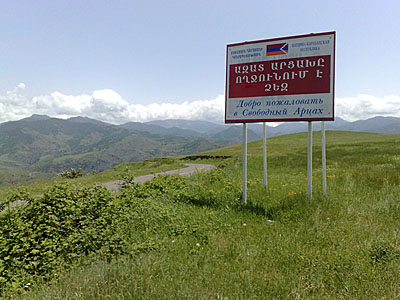 |
Yet, despite all the trappings of statehood, Karabakh still effectively remains an outpost of Armenia. Police, buses and civilian vehicles all have Armenian and not Karabakh number plates while the Armenian dram remains the local currency. Unrecognized by any other country in the world including Armenia, Karabakh residents travel abroad on Armenian passports and there is no official border between the two. Only a single sign welcoming visitors to "Independent Artsakh" stands by the roadside upon leaving Armenia.
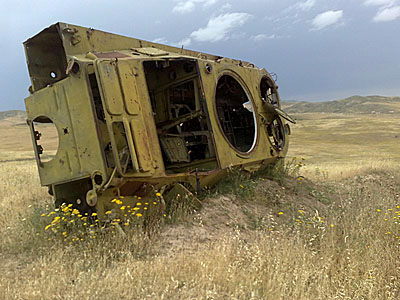
Nevertheless, while Stepanakert might be bustling and calm, the frontline is not. Despite an agreement to withdraw snipers from the ceasefire line, Azerbaijan reportedly changed its mind after the much-publicized Moscow Declaration. As a result, tensions remain high with the time taken to target and fire at soldiers and civilians alike put at 6 seconds upon sighting. With the stand-off position between Karabakh and Azerbaijan forces so tense and as close as 20-40 meters in some locations, it is no wonder that clashes and skirmishes break out from time to time.
Even so, despite the risk of such clashes spiraling out of control, none of those officials or civilians interviewed in seemed anywhere close to being ready to embrace any form of a compromise peace deal. Moreover, what was concerning was that if once the territories around Karabakh had been described as a temporary security buffer zone they were now being referred to as "liberated." In the here and now, this means from the families that once lived in them.
Depressingly, otherwise moderate voices were of the same opinion even if there can never be any peace without their return. Basically, while the so-called Madrid Principles appear to be the basis for efforts to finally resolve the conflict 15 years after the 1994 ceasefire, the mood in Stepanakert was ostensibly conciliatory only in tone and not in substance. Removed from the negotiating process since former Karabakh president Robert Kocharian
took the presidency in Armenia, Stepanakert seeks a new role even if it had never been a full or equal side in the talks in the past.
Others, however, are somewhat cautious about such a move given that Armenia’s first president was forced to resign from office while considering a similar compromise deal by key figures from Karabakh and other officials. "If Karabakh is allowed the right to determine its own future, could territory be returned?" I asked Giorgi Petrossian, Karabakh’s Foreign Minister. "Let us take part in the negotiations and then you’ll find out," he responded. It is doubtful that anyone would risk such a move without a clear position being stated first.
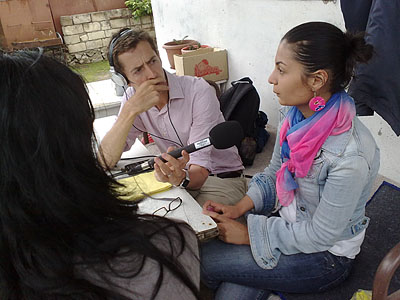 |
Lusine Musayelyan, a young 20-year-old journalist in Stepanakert who knows a mutual friend in Baku, perhaps represents the position of most Karabakh Armenians. "Why should we give up anything?" she asked somewhat rhetorically in between interviews held with the BBC and The National. "Because maybe there will be a new war in 5 or 10 years," I responded. Her eyes dulled. "Yes. Maybe," she said solemnly, resigned to the possibility that fresh conflict is not as unlikely as some local analysts suggest.
Her father was killed during the war so I wasn’t going to continue the conversation in such circumstances any longer, although I did wonder if there wasn’t a similarly bouncy and attractive 20-year-old girl in Azerbaijan also mourning the loss of one of her parents. Besides, Lusine is not what can be considered a die-hard nationalist and there was at least some sign of hope – or kind of. Sitting with us was a senior official from Karabakh’s Ministry of Foreign Affairs, and when Lusine and I spoke about our mutual friend in Baku she lost her patience and reacted.
"If you like Azeris so much why don’t you go and marry one!" she exclaimed. Despite believing that people are people wherever you are, I nevertheless decided not to respond.
Instead, undaunted, we continued to talk about a new breed of young Azeris who have become more active in their society in recent years. Although small in number, they appear to offer much in terms of offering hope for the future even despite the war. "Yes," the Karabakh official suddenly added much to my surprise. "I have some good Azeri friends too. The family of one even helped save Armenians when the troubles began. They risked everything to help their Armenian neighbours."
But it is this first knee-jerk reaction that remains the default in a region described by friend, journalist and and Black Garden: Armenia and Azerbaijan through Peace and War author Thomas de Waal as resembling a "geopolitical suicide-pact." In an article for openDemocracy he described the situation thus. "This kind of zero-sum thinking is most acute […] between Armenians and Azerbaijanis, many of whom seem content to see their respective country suffer so long as the other side in the Nagorno-Karabakh conflict is feeling pain too," Tom wrote.
 |
Meanwhile, Armenians and Azeris live and work together side by side in Russia, as well as Georgia and elsewhere, while being at each other’s throats in their own countries. Aside from religion, sharing more similarities than differences, the reason for that is simple. The Karabakh conflict continues to be exploited by nationalists in both countries to justify the increasingly authoritarian nature of their respective regimes. At the same time, Karabakh is used by all political forces to maintain or come to power.
Ethnicity takes precedence over citizenship while Armenians and Azeris look more to the past than to the future. History is subjectively selective and each considers that it was only they that suffered. Instead, the repercussions from the tit-for-tat expulsion of each from both republics continue, with Yerevan and Baku now virtually mono-ethnic and suffering from the lack of charm and energy that cosmopolitan cities generally possess. A curse ethno-nationalism in the South Caucasus might be, but visit Tbilisi to see what cultural diversity can also offer.
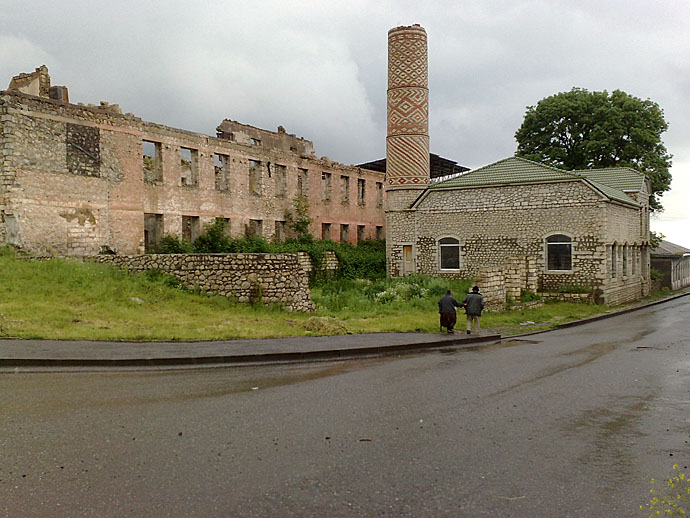
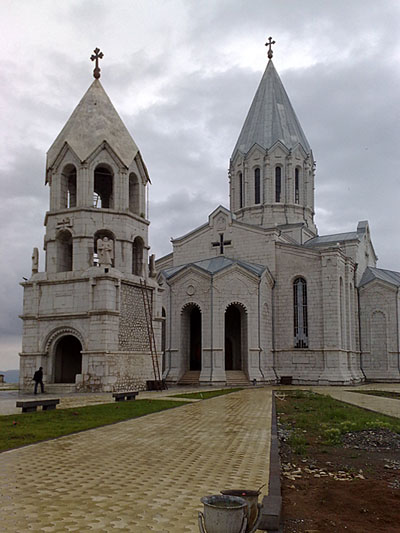
However, even the idea of eventually restoring the once splendid Karabakh town of Shusha to its former glory is unlikely in the present environment. A major cultural center mainly inhabited by Azeris at the time of the 1989 census, Armenians say they can never live with Azeris again. The feeling might well be mutual. A notable tourist destination in the Soviet years, now the town is scarred and battered after much of it was destroyed by Armenians after its capture in 1992. Efforts to rejuvinate the town have been half-hearted at best with much of it remaining in ruins.
On the other side of the ceasefire line, Baku’s almost constant rhetoric of war doesn’t help either, but that’s no surprise, I suppose. Even Georgia’s Saakashvili did much the same when, after boasting he would give South Ossetians and Abkhaz separatists reason enough to return to the fold, he then ordered the bombardment of Tskhinvali, capital of the former. So much for patience or recognizing the rights of what you earlier claimed were your own citizens, then.
Armenians in Karabakh do not want to be part of Azerbaijan and are not being given any reason to change that position. Moreover, entrenched and hard-line positions on both sides are self-perpetuating and counter-productive even if the OSCE Minsk group is believed to be facilitating negotiations over a compromise peace deal which would allow Karabakh to determine its own fate in a referendum to be held anywhere between 5-10 or even 15 years after a final agreement. In return Armenians would return at least six of the seven Azeri regions under their control.
But nationalist ideologies which have no place in the modern world continue to be perpetuated by the near constant dissemination of propaganda from both sides as well as the lack of communication between Armenians and Azeris as individuals. There are exceptions, of course, but civil society appears to have failed to engage in genuine peace-building and conflict-resolution initiatives while the local mass media prefers to either promote negative stereotypes of the "enemy" or practices self-censorship.
The prospects for peace look slim unless genuinely encouraged and guaranteed by the international community.
Unfortunately, as it stands, while nationalists in Armenia refuse to consider that Azeri IDPs have the right under international law to return to their homes in the territories surrounding the territory or to towns such as Shusha in Karabakh proper, their counterparts in Azerbaijan at the same time fail to even pause for thought about the grievances and aspirations of Karabakh’s Armenians. Indeed, the prevailing mood on both sides is perhaps best described by David Pugh’s Seven Rules of Nationalism.
1. If an area was ours for 500 years and yours for 50 years, it should belong to us – you are merely occupiers.
2. If an area was yours for 500 years and ours for 50 years, it should belong to us – borders must not be changed.
3. If an area belonged to us 500 years ago but never since then, it should belong to us – it is the Cradle of our Nation.
4. If a majority of our people live there, it must belong to us – they must enjoy the right of self-determination.
5. If a minority of our people live there, it must belong to us – they must be protected against your oppression.
6. All the above rules apply to us but not to you.
7. Our dream of greatness is Historical Necessity, yours is Fascism. link
On a brighter note, and despite the seemingly intractable nature of the Nagorno Karabakh conflict, the BBC’s Tom Esslemont does at least manage to inject a little humour into proceedings in an excellent radio report while one of the first articles written by Daniel Bardsley for The National on mine and UXO clearance in Karabakh by the HALO Trust was published this weekend. There will be more to come accompanied by my photographs, but because they were commissioned those in this post are once again from my trusty Nokia N82.
Tom also has a text and video reports from Karabakh here and here.
 |
Meanwhile, on a more personal note, some of us will be hoping for peace, but continue to fear the worst. What could be a colourful culturally rich and enticing region will instead remain ripped apart by ethnic divides and geopolitical intrigues which continue to threaten its long term stability, prosperity and full potential as a link between East and West. Instead of compromise in the interest of peace and reconcilliation, an arms race looks set to continue until something finally snaps or one side gives in. Those on both sides should probably take a look at long hard look at Conciliation Resources recent report, The Karabakh Trap. It’s available in English, Armenian, Azeri and Russian.
The conflict between Armenians and Azeris over Nagorny Karabakh (NK) continues to pose serious dangers to the future of the South Caucasus but is still low on the international agenda. There is a misconception that it is ‘frozen’, yet the conflict is gradually thawing and there is a danger that fighting could resume.
Although a peace agreement is in everyone’s long-term interests, the parties involved are driven by short-term motives and are more comfortable with the status quo. They are caught in a ‘Karabakh trap’, where societies have been encouraged to have unrealistic expectations of what can be achieved and where compromise is fraught with risk. link
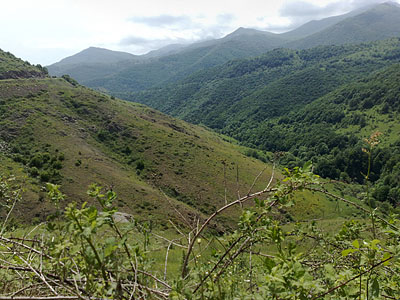
Photos from top to bottom: Mosque, Shusha, Nagorno Karabakh — Askeran, Nagorno Karabakh — Sign welcoming visitors to Nagorno Karabakh — Tom Esslemont interviewing Lusine Musayelyan for the BBC — Cathedral, Shusha, Nagorno Karabakh — Lachin © Onnik Krikorian / Oneworld Multimedia 2009
]]>They laid flowers at the scene of the shooting and posted placards, some of which denounced official corruption. The authorities initially tolerated those protests, but as of May 4 police began systematically removing flowers and protest placards without any explanation. Several protesters were detained: five of them were sentenced on May 9 to between three and 10 days in jail.
The authorities ignored the students’ demands for a day of official mourning, and held the Flower Festival as planned. Police forcibly detained for several hours up to 50 young people who gathered in silent protest close to the main venue; some of them were reportedly beaten.
To be sure, the Baku protests were not as numerous as those in Moldova last month to protest the perceived falsification of the parliamentary elections. Nor were they as spectacularly violent and destructive.
But they appear to have followed much the same pattern, with disparate youth and student organizations communicating among themselves by e-mail to organize protests. […] link
Among those detained were several bloggers, including Frontline’s own Ali S. Novruzov, and social media tools such as Twitter were used to follow their arrest and later release. It is also believed that social networking sites such as Facebook were used to arrange and coordinate the protest in addition to those blogs which later carried many first-hand accounts of the incident.
Coordinated by various means, including online social networks such as Facebook, turnout for the peaceful protest last Sunday might have been small, but its significance was enough to force the hand of the authorities. The demonstration was dispersed and 50 people, including at least 3 bloggers, were detained.
[…]
Tools such as Twitter were used to send out updates on the detentions. Although there are known problems with sending out tweets via SMS on certain cellular phone networks in Azerbaijan, one foreign blogger, International Federation of Liberal Youth General Secretary Bart Woord, updated followers from his Blackberry via Twitter’s web interface.
Global Voices Online and Global Voices Advocacy were quick to respond and spread the word while the Committee to Protect Bloggers also followed up on the detentions. Meanwhile, OL!, a progressive Azeri youth movement notable for its use of new media, also sent out similar tweets.
Of course, the main accounts came after those detained were released and video interviews were posted on the OL! blog. […] link
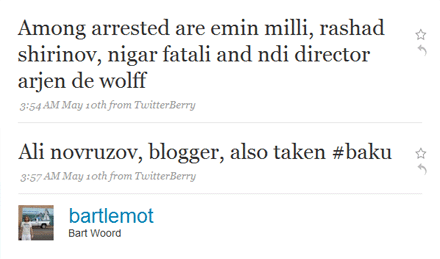

One of those bloggers, regional analyst Arzu Geybullayeva, also wrote an article on the protest and detentions for the online Italian magazine Osservatorio Balcani e Caucaso. Interestingly, the unprecedented use of social media tools by activists in the region followed the publication of my article in the same magazine on the use of new media by civil society and political activists by only a few days.
Certainly, the use of online tools by alternative voices in the South Caucasus is now beyond doubt. As mentioned in an earlier post, however, what remains to be seen is how quickly governments in the region will respond to a new online threat which challenges their control of news and information. For now, with internal security services in Armenia paying increased attention to online activity, signs are that such a move might come sooner rather than later.
]]>