Tucked away deep in the heart of Russia, there is a hidden city where thousands of men, women and children live and work behind barbed-wire fences monitored by armed guards. The residents are told they are the nuclear shield and saviours of the world. They are told that everyone on the outside is the enemy. One of the most contaminated places on earth, and home to Russia’s largest stockpile of nuclear materials, this place is called CITY 40.
Built after the Second World War to create the Soviet Union’s nuclear weapons program, City 40 is one of Russia’s secret closed cities, collectively known as Z.A.T.O.
In this feature-length documentary, the film crew gets smuggled inside CITY 40 and – behind a psychological façade of normality – they encounter a single mother and a handful of other brave residents who risk their lives to warn us of the human and environmental catastrophe that threatens the region.
Directed by: Samira Goetschel
Country: USA
Runtime: 75′
https://www.facebook.com/CITY40documentary
Will 2013 see an escalation in tensions between Israel and Iran? The Frontline Club in association with BBC Arabic brought together an expert panel to decipher the drumbeat of war and predict what 2013 may hold.
Channel 4 News presenter Jon Snow began by telling an audience at LSE’s Sheikh Zayed Theatre on 12 December, that the consequences of military strikes would be “unbelievably catastrophic”.

- From left: Meir Javedanfar, Azadeh Moaveni, Jon Snow, Abdel Bari Atwan, and Scott Peterson debate war and peace between Israel and Iran in the Sheikh Zayed Theatre at the London School of Economics.
Abdel Bari Atwan, editor-in chief of the London-based Arabic newspaper Al Quds Al Arabi, opened the debate by stating he feels war is imminent. Iran is tripping into the same fate that awaited Iraq during the last two decades, he said:
“When I say the comparison with Saddam Hussein and Iran, it is because the Israelis…want these weapons actually to be exclusive to the Israelis so they can scare the people from the Middle East and they can actually expand as they like…
The Israelis are preparing themselves… The war against Gaza, which lasted about eight days, it was to test the Iranian missiles [from Hamas]…to test the Iron Domes, which [are] supposed to actually intercept all kinds of missiles…from Iran in particular.”
Toward this agenda, America supported Israel, Atwan said:
“[The U.S.] doesn’t want any regional superpower to possess nuclear weapons or weapons of mass destruction in order to threaten [its] domination of the oil fields in the Gulf. That’s facts… Saddam Hussein tried to do so, and he paid the price – his regime [was] deposed. The Iranians are repeating the same mistakes in the eyes of the Israelis and the Americas.”
Israeli-Iranian analyst Meir Javedanfar disagreed:
“It’s not because we don’t want the Iranians to have nuclear weapons. It’s because of this regime… [It] has called for Israel to be eliminated, time and time again… [It] has put its hatred into action. We saw in the Second Intifada, 700 Israelis were killed by suicide bombings paid by Iranian money, half of it at least… You would not want that regime to have a nuclear weapon.”
Moreover, Javedanfar added:
“I don’t think there will be war… We see that the sanctions and the diplomacy are [already] hurting the Iranian regime very badly…
[And] I don’t see Ayatollah Khomeini having the confidence to tell his officers that, ‘tomorrow we’re going to kick out all the IAEA inspectors, we’re going to take that enriched uranium…and we’re going to make a bomb with it,’ because the moment he does that, that’s the moment he’s going to risk an American attack.”
Other panelists Azadeh Moaveni, former Middle East correspondent for Time magazine and Scott Peterson, journalist and photographer, agreed with Javedanfar that war seems improbable.
Javedanfar thought injustice in Palestine, rather than nuclear saber-rattling in Tehran, was ultimately Israel’s greatest danger:
“Israel’s security? You know what? We can beat the Iranian regime. The Iranian regime doesn’t scare me. [But] if these guys, the Palestinian people, don’t have a state, that is an existential threat to the security of the state of Israel.”
The panel mostly agreed, with relief, that Israeli Prime Minister Benjamin Netanyahu, who has been particularly vocal in antagonizing Iran, seems somewhat isolated on this issue within Israel itself.
When the topic turned to sanctions against Iran, echoes of Iraq reemerged. Moaveni argued that they destroy goodwill and are excessively cruel.
“It is becoming impossible to be middle class anymore in Iran,” she said. “This is the slow dying of the Iran middle class… Do we want to impoverish another major Middle Eastern middle class the way we’ve done [in Iraq]?”
Snow ended the discussion by highlighting the need for the West to engage Iranians with the respect he thinks they crave. And to resolve tensions, he offered his own alternative:
“When you spend time on the streets in Shiraz, in Tehran… you meet young people who look west. This doesn’t happen anywhere else in the region. These people look remorselessly west… And, you go around, and you ask people, and they want ipads! That’s why I’ve always said: if you want to bomb Iran, bomb it with ipads… That’s what people want… They want life. And they want joy… It isn’t as if they crave a prayer-mat.”
Watch the full event here:
]]> So the Liberal Democrats want to
 scrap, replace, consider replacing…hang on a minute, let’s find the manifesto…"commit not to replace the Trident nuclear weapons system on a like-for-like basis" if they are voted into office.
And I would be very surprised if the Trident issue fails to make an appearance in tonight’s leaders’ debate. After all, it marks a clear policy distinction; Labour and the Conservatives have both said they would renew Trident.
Or does it? The Liberal Democrats have been at pains to point out that they would not scrap Britain’s independent nuclear deterrent but they have not given much indication of what they might replace it with.
So I thought I’d investigate whether better options than Trident might be available.
Before we get going, it might be worth laying out what the Trident system is and why there is talk of replacing it.
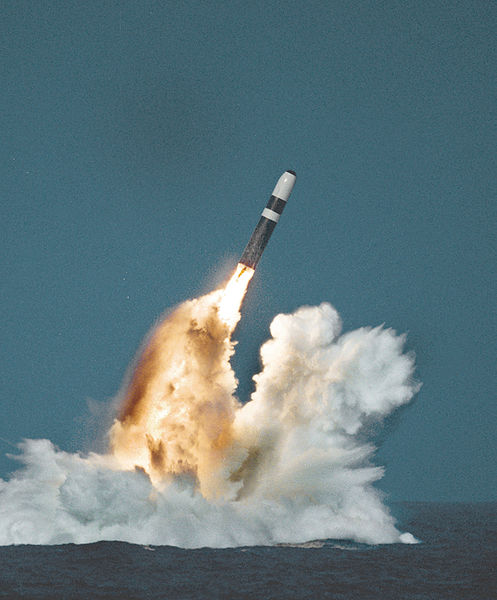
The name Trident refers to the Trident D5 missiles used in the system. The missiles are carried by four Royal Navy Vanguard-class ballistic missile submarines operating continuous at sea deterrent patrols.
The first of these submarines was launched in 1992 and has a shelf-life of 25 years, although it is hoped it will last until 2022 and possibly longer. Similarly, the Trident missiles would need to be modernised if they are to last beyond 2020. That means decisions have to be taken as to whether Britain should replace the submarines and extend the life of the missiles.
The Government published a White Paper on the issue in 2006. These are the alternatives that were considered and why they were rejected:
1. Large aircraft equipped with cruise missiles.
This option was rejected "primarily because of vulnerability to pre-emptive attacks" and the procurement cost involved in buying new aircraft. New cruise missiles would also have to be purchased. (Trident missiles are of the ballistic variety).
2. Silo-based with adapted Trident missiles
Housing a weapons system on the UK mainland was also partially ruled out due to their vulnerability to attack. At the risk of stating the obvious the paper noted that silos "are immobile" and "impossible to conceal". Whereas in the US, you can disperse separate silos across thousands of miles, in the UK one nuclear attack could potentially knock out numerous silos all at once. The silos would also be expensive to build.
3. A surface ship with Trident missiles
This option was rejected because a surface ship is easier to locate, track and attack, whether by sea or from the air. A submarine is far more elusive.
4. Abolish Britain’s nuclear deterrent
This was quickly rejected by the Paper, and apparently also by the Lib Dems although they also say "it cannot be eliminated". Confused? Yes, so am I. The Green Party have said they would dismantle nuclear missiles if you want to vote for outright disarmament.
5. The Raider CS 35 (Sorry, I may have made that up)
The overall conclusion was that renewing Trident was by far the most cost-effective option. It is much cheaper than air or land based systems and equivalent in cost to the surface ship option but with better strategic capabilities.
Of course, a government White Paper is unlikely to be the last word on any issue. Which brings us to the Liberal Democrats own paper on the alternatives entitled ‘Policy options for the future of the UK’s nuclear weapons‘, where you might expect to find the cheaper option everybody has been missing clearly spelled out. Unfortunately, I was disappointed.
Here the Liberal Democrats effectively rule out significant changes to the Trident system and instead propose some tweaks. Namely, the possibility of ending continuous at sea deterrent patrols, and using a modified Astute submarine that carries fewer missiles.
There is one proposal – ‘virtual deterrence’ – that would be a clear departure. This would mean the UK would declare that it was still a nuclear weapons state but would "decommission all or a portion of the current Trident system". This seems highly problematic to me. Confusion over whether a country has or hasn’t got nuclear weapons doesn’t seem too helpful. (See Iraq).
In any case, this is all talk and not a commitment to any of these particular paths.
It seems the Liberal Democrats might not actually have formulated any policy that is radically different from Labour and the Conservatives except on one particular point: they just want to talk about Trident in the imminent Strategic Defence Review.
This is Paul Ingram, the Executive Director at the British-American Security Information Council, over at Arms Control Wonk:
"They are looking for a small ask, that the issue be considered within the long-awaited Defence review promised by all major parties contesting the election…Beyond this, don’t expect anything substantial from the Lib Dems, as they will likely be spending what political capital they have after any indecisive election looking for deals on electoral reform."
So a request to Sky News tonight for some clarification: please ask Mr Clegg what he would replace Trident with.
Photo: Wikimedia, Public Domain

Note: This post will be cross-posted at Talk Issues soon.
]]>