As the relationship between the press and the web rapidly develops, questions continue to arise over the future of print, and the impact the Internet is having on quality journalism.
The evening will bring together outlets both old and new, and feature some of the country’s leading editors and data journalists, including:
Data panel:
Conrad Quilty-Harper – The Telegraph, Ampp3d
Mona Chalabi – The Guardian‘s Datablog; FiveThirtyEight
Dan Knowles – The Economist
Nicola Hughes – The Times, DataMinerUK
Michael Blastland – Author, The Tiger that Isn’t; Broadcaster, Radio 4
https://soundcloud.com/frontlineclub/the-death-of-traditional-media
Editor’s panel:
Luke Lewis – Editor, Buzzfeed UK
Merope Mills – Editor, Saturday Guardian
Pete Picton – Deputy Publisher, Mail Online
Helen Lewis – Deputy Editor, New Statesman
George Brock – Head of Journalism, City University; author, Out of Print
https://soundcloud.com/frontlineclub/the-death-of-traditional

“[the invasion of privacy] came to a head when my little boy died of cot death… My husband and I wrote to every Fleet Street editor we could think of to ask them and beg them personally not to send a reporter to the funeral. The Sun chose to put a photographer there and made it their front page the next day…”
“The first thing the Leveson inquiry has done is to absolutely make it ok to say what you think… Function number 2 is before an inquiry ever reports people concentrate a lot on things they didn’t think about before. The third function… it might say ‘we should do this’… I would say it’s already worked on levels 1 and 2 – I’d say that was a gain.”
“We had reliable sources that didn’t turn out to be quite right… We acknowledge we’ve made a mistake… we acknowledged it 34 times.”
“Tony Parsons for example… he’s got a broadsheet mind and a tabloid tongue and he speaks to people in the country who don’t understand complicated issues in language that they understand – and that is the great thing that tabloids can do.”
As revelations from the phone hacking investigation continue, join us for the first event of 2012 to discuss what has been revealed about the workings of the tabloid press and what the fall out will be for the journalism industry.
A lively public meeting hosted by Paddy O'Connell of BBC Radio 4's Broadcasting House.
]]>
Since the Leveson Inquiry hearings began on 14 November some of the worst of British journalism has been laid bare by the victims of phone hacking, politicians, journalists and editors who have spoken.
As revelations from the phone hacking investigation continue, join us for the first event of 2012 to discuss what has been revealed about the workings of the tabloid press and what the fall out will be for the journalism industry.
A lively public meeting hosted by Paddy O’Connell of BBC Radio 4’s Broadcasting House.
With:
Tom Latchem, freelance journalist, writer, broadcaster and former TV editor for News of the World. Twitter: @theboylatch
Anne Diamond, a journalist who for the past 25 years has been working in daily TV, radio and national newspapers. She is a regular panelist for The Wright Stuff on Channel 5 and a regular columnist for the Daily Mail. She hosts The Anne Diamond Show daily on BBC Radio Berkshire. She gave evidence at the Leveson inquiry on Monday 28 November.
Peter Wilby, who writes a weekly column for the New Statesman, the magazine he edited between 1998 and 2005. A former education correspondent for both the New Statesman and the Sunday Times, he was editor of the Independent on Sunday from 1995 to 1996.
Ben Fenton, chief media correspondent at the Financial Times. Twitter: @benfenton
George Brock, Professor and head of journalism at City University. A journalist at The Observer from 1976 to 1981 he moved to The Times in 1981 and held positions from foreign correspondent to managing editor before leaving in 2009. He is a board member of the World Editors Forum, and a member of the British committee of the International Press Institute. Twitter: @georgeprof
]]>At our First Wednesday Special, discuss the cultural and political changes set in motion by the events of 9/11 ten years ago and look ahead to the next decade.
We’ll also be discussing extremism, Somalia, photography in transit and the cult of youth in newspapers and there’s also a great opportunity to hear from industry veterans Martin Bell and the New York Times‘ David Carr and Richard Gizbert of Al Jazeera English.
Our screenings include a double bill of films by John D. McHugh, a special preview of The Debt, insight into the world of teenage miners in Bolivia and human trafficking in Nigeria.
Go to our website for further details of all the talks and screenings, PLUS a preview reading of Bang Bang Bang, a multimedia storytelling masterclass with Brian Storm and third party events on remembering 9/11 and on investigative journalism.
Follow us on Twitter and catch up on any events you missed on the Forum blog or download our podcasts on iTunes.
]]>
Former Israeli President Moshe Katsav is back in court in Jerusalem on Monday, appealing his April conviction and seven year sentence for indecent assault and sexual harassment of two female employees.
In Dharamsala, Lobsang Sangay is sworn in as the new Prime Minister of the Tibetan Parliament-in-Exile, following the Dalai Lama’s announcement in March that he is stepping down from Tibetan political leadership.
Tuesday is International Day of the World’s Indigenous People. Celebrations of indigenous culture and discussions on human rights, social and economic development and international cooperation take place around the world.
Grameen Bank founder Muhammad Yunus and UN Emergency Relief Coordinator Valerie Amos address the InterAction Annual Forum, which kicks off in Washington on Wednesday. The forum brings together NGOs, government agencies and international organisations to discuss development, with the focus likely to be on the current drought and famine crisis in the horn of Africa.
In London, Shrien Dewani is expected to find out whether he will be extradited to South Africa to stand trial for alleged involvement in his wife Anni’s murder last November.
On Thursday, Sri Lanka shuts down a number of national parks to begin the first large-scale census of its wild elephant population by counting them as they approach watering holes. The census will allow policy-makers do enact more effective conservation policies.
The US Presidential race continues to heat up, as candidates for the Republican nomination face off in a TV debate from Iowa State University ahead of Saturday’s Ames Straw Poll, a traditionally important gauge of support for Presidential wannabes.
As the European debt crisis rumbles on, France and Greece both release second quarter GDP figures on Friday, while Greece is also due to make a relatively small bond repayment of €480m.
Meanwhile, ABC publishes July circulation figures for UK newspapers. Media-watchers will be paying particular attention to the sales of Sunday papers following the 10 July closure of News of the World.
Saturday is the 50th anniversary of the construction of the Berlin Wall, which is being marked in Germany with a commemoration ceremony attended by President Christian Wulff.
The Dalai Lama begins a three-day visit to Toulouse, while in his adopted home country of India, Hindus celebrate Raksha Bandhan, signifying the bond between brothers and sisters.
On Sunday, neighbouring Pakistan celebrates Independence Day. Last year’s celebrations were cancelled due to the floods that killed some 2,000 people and displaced or affected another 20 million.
]]>
From America they write that the population of the United States is 40 million and they publish 7,643 newspapers. However, in all Europe, Asia and Africa with several hundred million inhabitants, there aren’t so many newspapers. The reason is that the population of the country mentioned above is completely literate and they read newspapers every day. (The Cultivator, January 1, 1876)
America was a land of inventions then as well:
A writing machine is invented in America which looks like a piano. When you push its keys, each writes a separate letter. Reportedly, this machine writes much faster and better than handwriting. (The Cultivator, October 8, 1876)
America was also our fierce rival back then:
As no kerosene was imported from America this year, price of a pood of Baku kerosene has risen to six rubles and half. (The Cultivator, February, 1877)
What French newspapers wrote about America:
French newspapers report that something like a telegraph is invented in America which allows speaking [through it]. They have tested this telegraph as such: when one preacher in Boston started to talk, people of Salem, a city in a distance of 250 versts, could listen to him. Then the preacher heard back the cheers and applauds of the crowd. And now, music will be played in New York and people of Philadelphia, a city in a distance of 500 versts will listen and applaud. This equipment is called a telephone. (The Cultivator, April 28, 1877)
Perhaps this was the first time when broad Azeri public heard about telephone.
And most hilarious piece ever:
New York, America, 26 October – In American Republic, a person named Gilding[?] was elected the President (that is a ruler) for 4 years. They say the aforementioned person was a tailor. (The Cultivator, November 6, 1876)
Subsequent research has proved that this news was at least mock 
| Daily Show Full Episodes |
Political Humor | Newt Gingrich Unedited Interview |
The Daily Show take a tour of the offices of the New York Times. If you want to know what’s black and white and red all over… watch the video above.
]]>
Tonight we’ll be discussing the ongoing MP Expenses scandal in the UK and whether or not the story was a triumph of journalism or the chequebook. Roy Greenslade chairs the discussion tonight 8 June and we start at 7:30pm GMT. As usual, if you can’t make it to the Club in person you can watch the discussion and join in the chat live on the Frontline Club broadcast channel, on this blog post or on the Club events pages,
With each new tranche of revelations about MPs expenses the Daily Telegraph has continued to put on sales and gained kudos for its good old fashioned journalistic scoop. With a story that has shaken Westminster to its foundations the Daily Telegraph has been able to set the news agenda, releasing its revelations ahead of the 10pm news bulletins. The daily diet of scoops is said to have boosted newspaper sales by tens of thousands and web traffic has also increased and no doubt will, in financial terms at least, justify the cost of obtaining the information. But what does the expenses scandal tell us about journalism today? link
On the panel we have Andrew Pierce, assistant editor at The Daily Telegraph, Stephen Tall, editor at large with the Liberal Democrat Voice, the journalist Heather Brooke, author of ‘Your Right to Know’ and Frontline favourte Roger Alton, the editor of The Independent.
]]>
The quarterly Frontline Broadsheet is coming. It’s high quality. It’s printed – and yes I do mean on paper, we’re doing this the old fashioned way – and it’s subscription only. To find out more send an email to broadsheet@www.beta.frontlineclub.com with the word BROADSHEET in the subject header. For blog readers and Twitter followers, here’s a taster of what to expect,
Peter Stanford on Tony Blair’s Catholicism
Muzamil Jaleel on Pakistan’s ï¬ght against Jihad.
The future for peacekeeping in Kosovo
Julian Cardona, photo essay, on fear and death in Mexico
Martin Bell on the return of British sleaze
Clive Stafford Smith on Anglo-American torture
David Hoffman on the police and databases
Baroness Susan Greenï¬eld issues a warning
George Sotiropoulos behind the Greek protests
Ed Vulliamy on Italian artists ï¬ghting the Maï¬a
John Carlin and his Hollywood coincidence
Robert Fox questions Gergiev’s political allies
Simon Freeman: the demise of football managers
Comic strip GOBAMA: Frontline’s resident president by Stephen Daly.
Illustrators and photographers include Chris Riddell, Shirley Hughes and Clara Vulliamy, David Hoffman, Tom Stoddart, Julian Cardona.
I for one, can’t wait… I’ll have more on this next week.
UPDATE: There’s the beginnings of a facebook group.
]]>"Less fortunate young Syrians who [didn’t go to the American school] used to look forward to movie night at the [American] Cultural Centre every Wednesday. … Movie night was a refreshing two hours of enriched entertainment in a city where American culture is hard to come by."
The problem is, the op-ed is littered with factual errors which drill a hole through Rasha Elass’s central argument.
She rightly mourns the closure of the American Cultural Centre – shut in retaliation at the US army’s attack on a village near the Iraqi border last year. But to say that Syrians would flock there to get a rare glimpse at life in the land of milk and honey is just wrong.
American culture is everywhere in Damascus. This is not North Korea. Walk down any Syrian street and it won’t be long before you come across a shop filled from floor to ceiling with American DVDs – films, documentaries and TV series, all subtitled, all costing pennies, and many available here before they come out in the States.
Elass bemoans the lack of up-to-date Western newspapers. It takes three or four days, she claims, before they clear the state censors. True enough, but even in Beirut the papers are at least two days old. And it’s cheaper and easier to scan through the articles on the internet, surely.
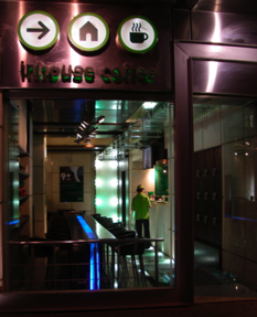
But Elass didn’t have much luck with the web. Sitting in her upmarket cafe called InHouse – whose green and grey colours, comfy sofas, and students spread across the tables make this place a identikit copy of Starbucks (there’s that American culture again) – she found that three of the five websites she logged on to were blocked.
Even the staff in InHouse could’ve helped her download a little program which runs in the background on your computer, and lets you visit any site you like – blocked or not.
Wifi is becoming so popular in Damascus that it’s hard to find a cafe without bright young things tapping away on Facebook (yes, that’s Facebook – the site that’s ‘banned’ in Syria). Although Elass tells us that InHouse is one of the few places you can log on.
Syrians are a lot more connected than she’d have us think. According to the International Telecommunications Union, the internet penetration rate is actually 17% – not a measly 3%.
And that’s not the only thing she underestimates. She quotes an average monthly wage of $40 – that’s the weekly wage, not the monthly. And that only applies to government employees – in the private sector it can be considerably higher.
Syria is a country with an active blogging community, high mobile phone usage, and growing level of English-language skills. To claim Syria’s youth is covered in a cloak hiding the outside world from their innocent eyes is painfully short of the mark.
]]>