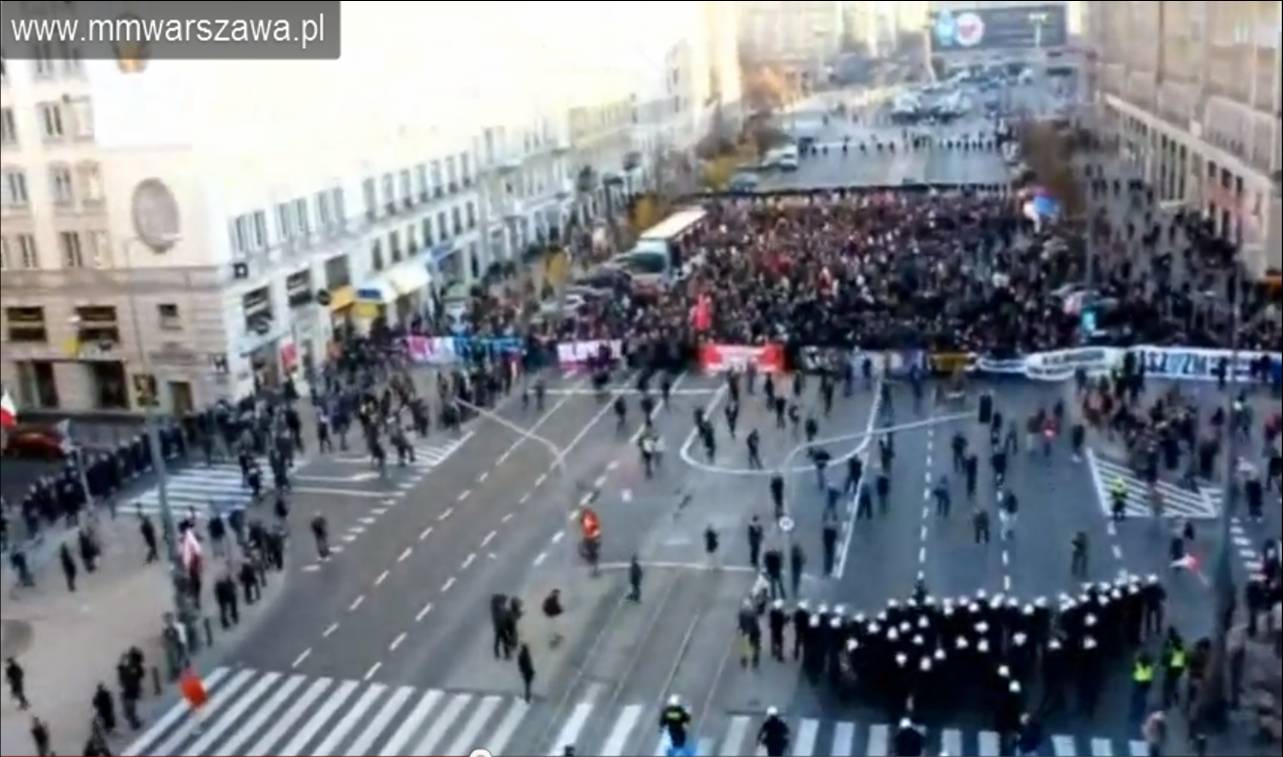
In November 2011, Polish firm RoboKopter filmed striking images of a political demonstration in Warsaw using a video camera attached to a drone or unmanned aerial vehicle (UAV).
The New York Times heralded the footage as signalling the arrival of ‘drone journalism’. Since then, we haven’t seen many newsgathering drones in UK skies, but we might well be seeing them some time soon.
Drones have been receiving more attention in recent months usually in the context of military operations. The Bureau of Investigative Journalism has been tracking the controversial use of drone strikes by the US military in Afghanistan, Pakistan and Africa. It has also emerged that the RAF were flying US drones during the conflict in Libya last year.
But much smaller UAVs – whether fixed wing or rotary – are now being used in civilian settings not for targeted killing but for image gathering. Last week, BBC Newsnight explored some of the issues around civilian drones and earlier in the year, Al Jazeera English filmed a training exercise with the German fire brigade which showed how UAVs could support firefighting.
I understand that several media organisations in the UK have already started to explore how they could use UAVs for newsgathering.
UAVs for Aerial Newsgathering
Aerial footage is not new of course, but UAVs are much smaller than helicopters allowing them to provide imagery from previously inaccessible locations.
The fact that they are unmanned also means there is no risk to a journalist or pilot. The latest models are being equipped with high definition technology allowing them to potentially provide stunning footage of national celebrations, political protest, natural disasters and conflict.
Safety, legality and ethics
The use of UAVs for newsgathering nevertheless raises a host of practical, legal and ethical issues. Question marks remain over safety concerns and the reliability of the technology, although the UAV industry is developing features such as an automatic ‘return to base’ function if the battery runs out or the operator loses control.
Legally, there is already a fairly well-established regulatory framework in place in the UK for flying UAVs which is outlined in guidance issued by the Civil Aviation Authority (CAA).
But this is an evolving area. The CAA’s chapter on ‘Civil Operations, Approval to Operate [UAVs]’ was completely rewritten in the latest guidance for August 2012. The requirements for ‘the licensing and training of United Kingdom civil Remote Pilots have not yet been fully developed’ and there is no European-wide standard to test UAV pilot competency.
It is likely that larger media organisations will look to fully licensed and CAA approved UAV operators to provide them with a newsgathering capability or apply for their own licenses to operate UAVs. But there is no particular reason why smaller organisations or individual ‘citizen’ ‘drone’ ‘journalists’ couldn’t do the latter and attempt to gather their own footage.
Gizmodo recently featured the (intriguingly named) Spy Hawk RC Glider which allows you to record video from the sky for a mere £250. With a battery life of 15 minutes it’s unlikely to have any heavyweight journalistic applications but we can expect the cost of more sophisticated equipment to come down.
Ethically, UAVs are likely to compound longstanding editorial dilemmas. It is not hard to imagine scenarios in which the deployment of UAVs for newsgathering is likely to directly invade individuals’ privacy or indirectly facilitate ‘collateral intrusion’.
These concerns might need to be balanced against a ‘public interest’ defence in a situation where it is deemed that the footage reveals serious wrongdoing.
News organisations might then face requests from other organisations for access to video footage. Only last year, the Metropolitan Police asked UK media organisations to handover footage of the London riots, but the police have already been exploring the deployment of their own UAVs and are likely to continue to do so in the future.
Indeed, in a rather strange – but perhaps not unrealistic vision of the future – it is possible to envisage a stand off between a fleet of media-operated UAVs and their police counterparts at the site of a protest or emergency. Newsgathering sorties might have to be coordinated or argued over with ‘rival’ UAV operators or interested parties.
Another possible scenario which raises some profound questions is the use of UAVs in the context of conflict. What would happen if a news organisation flew a UAV from Jordan over the border into Syria? Will opposition activists of the future be streaming live video footage to YouTube shot with UAVs?
Newsgathering UAVs coming soon?
Until now, these have been hypothetical debates set out in ‘future scenarios’ by interested thinkers and there has not been much visible evidence of UAVs being deployed by media organisations in the UK.
But recently I’ve been in contact with several people from the media and UAV industries. Behind the scenes discussions are taking place about UAVs for newsgathering and I think we can expect to see major developments in this area within a year and perhaps even by the end of 2012.
It would not be a surprise to see UAV footage being played out on air in the near future and maybe we’ll run into some of these other issues before too long as well. So watch this space – the one just above your head.
]]>- Libel
- Contempt
- Reporting the courts
- Sexual offences
- Privacy and confidentiality
- Copyright
The course acts as a refresher and to update delegates on new areas of media law or would serve as an introduction to media law for those with little or no experience in this field.
The course includes updates on:
Legal areas being explored by the Leveson inquiry:
- Bribery Act,
- RIPA,
- Data Protection Act
- Misuse of Computers Act
- Media ethics, the PCC and the future of media regulation.
The session is suitable for those working in print, online or broadcast journalism.
The day is a mixture of lectures and interactive workshops where attendees will work in teams to solve legal problems drawn from real-life situations.
Those attending will leave with a good working knowledge of the legal issues listed above as well as the ability to recognise where risks arise, take action to avoid them and ensure they can defend themselves effectively from legal threats.
Schedule:
Morning – Crime, the courts and victims
9.30am – Crime and reporting proceedings – magistrates, crown court and other courts
10.30am – Children, and anonymity
11am – Sexual offences and victims’ anonymity
11.30am – Contempt of Court – dangers and defences
Afternoon – Libel, privacy and ethics
1.30pm – Libel – dangers and defences
2.30pm – Privacy, confidentiality, data protection and the public interest
3pm – Ethics and the Leveson inquiry
4pm – Copyright
4.30pm – Questions and finish
Trainer Bio:
David Banks has been a journalist for 24 years and has been training journalists since 1999. He is an expert on media law and has taught courses to most of the major national and regional newspaper groups, as well as a range of other organisations. He was a member of the Ministry of Justice working party on libel reform in 2010 and contributed to the Leveson Inquiry into press standards earlier this year. He co-authored three editions of McNae’s Essential Law for Journalists and now writes for The Guardian on media law.
]]>19.00 Keynote speaker: Gavin Sheppard, marketing director, Media Trust.
19.30 Panel discussion: The future of newsgathering and the changing media landscape
Change in the media landscape is constant. Technology and new media has enabled both journalists and citizens on the street to actually break news themselves. With a smart phone or iPad, one can discover, capture footage and report news instantly.
Journalism has entered the digital revolution – the age of mobile and crowd sourced street reporting. With the emergence of citizen journalists becoming a trusted source, how will media organisations adapt their newsgathering methods and maintain readership?
Consider media reports from countries like Sierra Leone or Syria. The authorities have not shown any responsibility to protect journalists or those independently newsgathering and reporting from the scene. According to the Committee to Protect Journalists, ten journalists have been killed in Syria since November 2011 – two of which were British nationals working as independent newsgatherers. What can be done to ensure the safety of citizen, independent and career journalists?
Moderated by:
Nikki Bedi, a television and radio presenter of Indo-Anglian descent, began her career in Mumbai as both a stage and television actress. Spotted by Channel 4 she moved into broadcasting and has worked in India, the U.S.A and now the UK; hosting her own chat show on Star TV, film shows for Universal’s channel The Studio and NOW TV and she now works for the BBC. She is a regular interviewer alongside Clive Anderson on Radio 4’s Loose Ends, works on Radio 2, can be seen on To Buy Or Not To Buy on BBC1 and currently presents her own nightly radio phone-in show Nikki Bedi on BBC London 94.9. She can also be seen reviewing the papers on Sky News.
With:
Paul Lewis, special projects editor for the Guardian. He joined the Guardian as a trainee is 2005 after studying at Cambridge University and Harvard University. He currently runs teams of journalists at the newspaper working on a range of investigations. He recently led Reading the Riots, a major research project into the causes and consequences of the England riots, in collaboration with the London School of Economics. London-based he lectures across Europe about the use of social media in journalism and teaches a masterclass in investigative reporting. This year he was nominated for both Reporter of the Year and the Orwell Prize for Journalism, named Reporter of the Year at the British Press Awards 2010 and won the 2009 Bevins Prize for outstanding investigative journalism.
Matthew Eltringham, editor of BBC College of Journalism. He was previously Assistant Editor of Interactivity and Social Media Development at the BBC. He developed programmes to bring social media skills to all journalists within BBC News and extended the BBC’s involvement in social media. In 2005 he set up the user-generated content (UGC) Hub – an innovative award-winning team that has developed expertise in digital editorial engagement with social media and user-generated content.
Mark Evans, head of home news at Sky News. He has been a journalist for 20 years, working in local, regional and national newspapers before joining the TV world with Sky News in 2001. Since then Sky News has further developed into a multi-platform organisation, leading the way in the provision of news for the web, radio, hand-held technology and in HD on TV. His position as head of home news puts him on the news front line, pushing those innovations while maintaining Sky News’ second-to-none record in editorial content.
Gavin Sheppard, marketing director at Media Trust and Community Channel, he leads the organisation’s marketing and communications services, including training and resources, media volunteers and Press Association partnership Community Newswire. In 2009 he launched Media Trust’s pioneering digital media work with communities across England, Community Voices, which is currently working throughout the UK. He has more recently also led on the development of a UK-wide community reporters network newsnet, which will support the production and distribution of quality local news over the next three years.
Ravin Sampat, editor at Blottr. He previously worked within the editorial team at DMGT on their local community hubs LocalPeople and ThisIs. Prior to this, he spent two years in India working as the editor of a lifestyle magazine, freelance copywriting and consulting. He is currently leads the editorial team at Blottr, and is responsible for curation of editorial content and recruiting new contributors.
In partnership with Media Trust.

Photo credit: Emma Suleiman
]]>Suitable for all those wishing to embrace the fundamentals of documentary and newsgathering production capabilities in broadcast television, corporate promotions and Web publication.
- Multimedia researchers
- Print Journalists
- NGO’s
- Corporate PR’s – and all those wishing to enter the video production sector.
This 4 day course over 2 weekends will introduce the basics for producing documentary and newsgathering programming and promotional information videos.
The first weekend will cover: industry standard research, writing and pitching techniques; UK broadcasting guidelines on sex, race, violence and the interpretation of the terms; interview techniques including cut aways, ‘crossing the line’, ‘noddies’; covert filming: uses and abuses and legal issues; legal requirements when shooting in public and private places; permits, release forms and other considerations; insurance issues: public liability; personal insurance etc… ; copyright protection; ownership of materials and developing relationship between all those involved behind and in front of the camera. You will also learn how to prepare an industry standard production budget, a production and post-production schedule.
During the intervening week, in your own time, you will be required, working in teams of 2 – 3, to research a 5 – 10 minute production idea of your choice, write a production treatment, prepare a production budget, a production schedule and a verbal ‘pitch’.
The second weekend you will ‘pitch’ (a verbal presentation) to the tutor and, as is common practice, must be prepared to justify your idea verbally towards an objective and coherent production. You will be able to finish or otherwise modify your treatment, budget and schedule after which your written treatments will then be evaluated along with your budgets and schedule details. Your submissions will be evaluated by your tutor along with staff members of the Frontline Club. There will be no grades awarded but your treatments and the clubs’ evaluations may be published on the Frontline web site. You will also be provided with a certificate from the Club stating that you have completed the course successfully and references can be provided in the event of a job interview.
Tutor: Mike Dodds.
Experienced documentary filmmaker; first as a DOP on current affairs series ‘World in Action’, ‘This Week’ and ‘Panorama’ in the UK and ‘60 minutes’ for CBS and arts programmes for WNET in the USA; later a director of an independent production company functioning as director/producer or executive producer for some 40 hours of programming for Channel Four and the BBC in the UK. Awards include: RTS, EMMY, and Prix Italia. Past teaching experience: European Film College in Denmark; Westminster University; Thames Valley University and the NFTS.
]]>"Kein zweiter Hudson-River-Tweet" (Stefan Winterbauer, Meedia.de)
"Not a second Hudson River tweet"
Two months have past since Germany was stunned by a killing spree in which 15 people died in Winnenden, just north of Stuttgart.
At about 0930 on March 11 a former pupil of the Albertville Secondary School walked into the school and began shooting pupils and teachers.
He killed nine pupils and three teachers. He fled the school and shot and killed three other people before turning the gun on himself and taking his own life. His last moments were captured on a mobile phone video camera.
It was a major event in Germany for the media and also on the micro-blogging network Twitter. However, it’s interesting to look back at how German media used Twitter for newsgathering, reporting and communicating with Twitter users.
As the headline above suggests, if German media pinned their hopes on Winnenden being their first big Twitter event, a Twitter Ereignis – a test case where Twitter users quickly provide dramatic front page photos, a river of descriptive tweet-quotes from the scene and a way to contact eyewitnesses, then it didn’t work out that way. In fact, Winnenden may have set back the German media’s credibility in how they use social media for reporting.
The German word for gun rampage or killing spree is Amoklauf. A simple connection of the Indonesian word amok, that you’d no doubt recognise, and the noun Lauf – meaning run. Lets keep that in mind for later.
Along with #winnenden, #amoklauf or #amok were terms used on Twitter to discuss the shootings, and by German media, who turned to Twitter to gather any information, photos, or interviews with people at the scene.
It’s widely acknowledged that @tontaube was the first to post a tweet about the shootings in Winnenden. Note, it was about an hour after the shooting began.
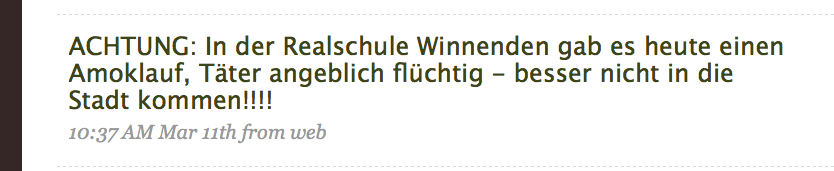
"Attention: In the Winnenden high school today there was a gun rampage, the perpertrator is supposedly still on the run – best not to come into the city!!!!"
@tontaube’s first tweet was a warning to her friends and followers. She sent this tweet from her office located a few kilometres from the Albertville Secondary School. What she tweeted was accurate. There was a shooter at large in Winnenden, but @tontaube was relaying information passed to her from a colleague whose husband phoned to say he was stopped by police on the road leading to the school.
Her 129 character tweet began to gain traction. In an interview with a youth programme on Bavarian public television BR, @tontaube said she was first contacted by the media about an hour after her initial tweet. German tabloid Bild was the first to reach her, then other media including N-TV, Stuttgarter Nachrichten and CNN – all of course seeking updates and interviews.
BR’s interview with @tontaube also shows she posted tweets making it clear to followers and journalists that she was not at the scene and was tuning into local radio reports for new information.

"Dear Press: I actually also don’t know about this mad guy… #winnenden #amok"
And, there lay one of the main problems for the media trying to use Twitter in Winnenden. There just weren’t active Twitterers in the immediate vicinity of where the shootings were taking place.
Lets back track a little bit and look at how one media outlet used Twitter to cover the story. After news of the shootings broke, journalists from the magazine Focus scrambled to get down to Winnenden to report.
One of the first steps of the Focus team was to open a new Twitter account dedicated to this event. But the username they choose to report events and communicate with the Twitter community instantly drew fire for being inappropriate – @Amoklauf.
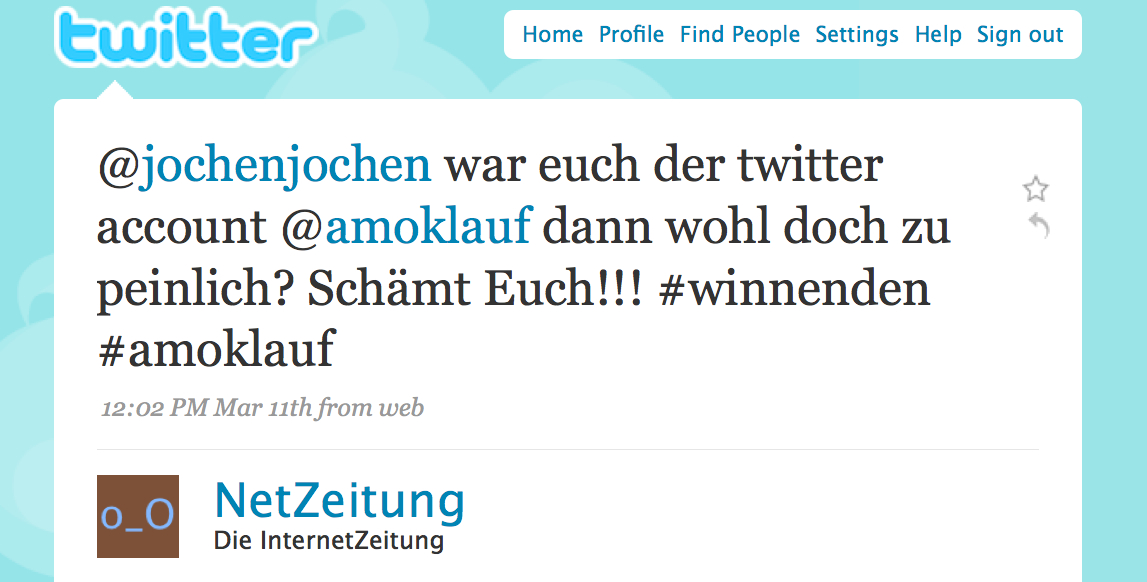
"@jochenjochen was the twitter account you chose @amoklauf actually too embarrassing for you? Shame on you!!! #winnenden #amoklauf"
(Tweet to @jochenjochen – Jochen Wegner, Chief Editor of Focus Online)
Perhaps to put it in an English context, it would be interesting to consider how English speaking users of Twitter in similar circumstances would react to a journalist gathering information via a new Twitter account called @gunrampage or @killingspree.
Of course, you could also argue: what’s in a Twitter name? Does that even matter? Afterall the term or phrase was used in headlines and TV news graphics. But I think it runs deeper than that. Will you have credibility in the eyes of Twitter users if you’re starting from scratch with a new account – even if you are a big media brand? Have you thought about your Twitter ‘tone’ or ‘voice’? Do you know and understand your audience on Twitter?
In the case of Winnenden, German media seemed to be going through a lot of learning by doing on a big story.
Focus soon backed down in the face of protest. @Amoklauf was deleted and @FocusLive was used instead.
But, even then, @FocusLive was not winning fans. In a blog post about Twitter and Winnenden, journalist and blogger Stefan Niggemeier points out that the journalists using @FocusLive were at first tweeting more about how they were getting to Winnenden or needing toothbrushes if they stayed in town overnight, rather than offering any new information. I think Herr Niggemeier raises some good points for journalists to consider their purpose and method of using Twitter on a story such as a mass shooting.
In response to criticism about their use of Twitter, Jochen Wegner, Chief Editor of Focus Online, said:
"We will find
a way to use Twitter and other social networks, that fits both the networks and the journalistic standards. Ironically we’ve been also heavily criticised, for not communicating via Twitter and only posting links of our reports."
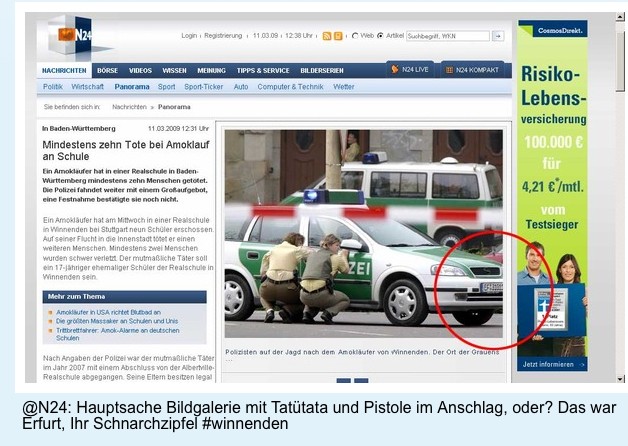
If Twitter during Winnenden did not prove to be effective for news gathering it certainly helped to point out the media’s errors in reporting the event. Here’s a useful example from Twitpic
http://twitpic.com/photos/brunser
The caption reads: "@N24: What matters is a photo gallery with flashing lights and pistols drawn, or what? That was Erfurt, you losers #winnenden"
Twitter user @brunser noticed that the German TV news channel N24 was using a photo from the 2002 Erfurt shootings in their online reports of Winnenden. @brunser has circled the police car number plates that give the game away, and even sent a couple of cheeky tweets to the channel’s @n24_de and @N24 twitter accounts to point out their error. However, there’s no public reply to @brunser from N24 acknowledging their actions.
If I’m painting a gloomy picture of German media using Twitter then that’s not what I set out to do. There are several media outlets using Twitter to good effect. I do like the way for instance regional newspaper Der Westen is using Twitter to engage with readers. I check out their stories online because of the way they tweet. At the heart of it, Der Westen is keeping it simple. They appear to know their audience, they’re being social and I think winning respect.
Looking wider, debate in Germany still continues over how the media used photos and videos of victims and the teenage shooter from social media sites. That’s another story. However, I’ll end this post with some Twitter thoughts from Marcus Boesch – aka @blogschau. Marcus produces a weekly blogging and social media programme on German international radio. I asked him how German media views Twitter and social media for news gathering.
@Blogschau discusses Twitter and Winnenden from Guy Degen on Vimeo.
]]>