
Investigative journalist Nick Davies treated the Frontline Club to a detailed insight into his new book, and into the saga that dominated seven years of his life – uncovering the hacking scandal at News of the World.
One thing that he makes clear in the book, Hack Attack, is that the investigation uncovered far more than just illegal activity at one of Britain’s top newspapers – it also shed light on the power a media mogul had accumulated. As the subtitle of the book asked: Has the truth caught up with Rupert Murdoch?
Asking this question and many more was City University lecturer and former editor-in-chief and CEO of ITN, Stewart Purvis, who did not let The Guardian journalist off lightly, diving straight into some difficult questions about Davies’ own ethics and background.
In the wake of the revelations, Davies has faced a barrage of often vitriolic criticism. Purvis asked whether, in the face of so much over-whelming hostility, Davies ever thought of calling it a day. “I’ve read you elsewhere saying that underlying all your journalism is some deep-seated need to hit back at all who take power and abuse it”.
Davies agreed that part of his journalistic drive over such a long investigation came from a desire to speak out against abuse, but it also came from the necessity to defend his own credibility:
“Because [News International] kept attacking us, I couldn’t let the story drop. It wasn’t just a question of putting out a story and telling the truth, we had to defend our credibility.”
Purvis also raised the point that it fell to “little old you” to fully expose the hacking scandal when the trial of Goodman and Mulcaire in 2007 clearly pointed back to the paper. Davies‘ role in the story has been held as both an indictment to the failings of the free press and also as a validation of the strengths of the press. Was there a simple explanation?
“First of all you have newspaper failings: they’re owned by Murdoch, they’re up to the crimes themselves, they’re Tory supporters – all really worrying things that are influencing so-called ‘news judgment’. Beyond that, you have the PCC that I would say was, in certain important respects, intellectually corrupt. And beyond that you have the thing that makes this story worth writing about. . . . It’s about power and the way that power works.”
The media mogul of Davies‘ book generates fear in two ways: first by exposing people’s personal lives, hurting and humiliating them, and secondly, through organisational fear:
“If you are trying to get your party elected and you see your campaign being destabilised by hostile newspapers, you can’t run your organisation. What I think is interesting is that like a bully, once they have beaten up a few kids, people will start to tiptoe around the bully and placate him.”
Referring to this later on, Purvis pulled out a comment from The New York Times review of Hack Attack by David Carr, who wrote that “despite the book’s title, the truth never catches up with Rupert Murdoch.”
So has it? Almost. Davies said that during the summer of 2011, there was a chain reaction of disgust building on the emotional impact of the Milly Dowler story, The Telegraph‘s revelations that families of the victims of the London bombings had had their phones hacked, as had families of soldiers killed in Afghanistan. Suddenly nobody wanted to be Rupert Murdoch’s friend and everyone was changing sides.
“There was a moment when the truth caught up with him. But . . . slowly the power comes back.”
A member of the audience asked, “As in the context of big stories and big exposes, where does this one rank?” to which Davies answered with a story:
“I was at university when the Watergate scandal broke . . . and the idea that these two guys, Woodward and Bernstein, armed only with notebook and pen, could bring down the most powerful politician in the world because he was abusing his power, was just sensationally exciting. So I thought, ‘Okay, I’ll go and be a reporter.’ . . . [Then after the phone hacking scandal exploded] the phone rang one night and I picked it up and a gravelly voice said, ‘This is Carl Bernstein – I just want to say well done,’ and it brought tears to the eyes! It was like God calling!”
Watch and listen back here:
]]>https://soundcloud.com/frontlineclub/insight-with-nick-davies-hack-attack
In July 2011, revelations that journalists from The News of the World hacked the phone of murdered schoolgirl Milly Dowler created public outrage. But we were soon to learn this was just the tip of the iceberg. The revelations that followed revealed a scandal that has since engulfed Fleet Street, Scotland Yard and Downing Street.
The man behind that story, and the years of investigative work that came before it, was Nick Davies. In his new book Hack Attack: How The Truth Caught Up With Rupert Murdoch, Davies recounts his painstaking investigation and exposes the inside story of what went on in the newsrooms and the corridors of power.
Nick Davies will be joining us in conversation with Stewart Purvis, to talk about the investigation, the revelations and the future of press regulation. We will be asking how the press have changed in a post-Leveson world and whether they have really reformed.
Nick Davies writes investigative stories for The Guardian, and has been named Journalist of the Year, Reporter of the Year and Feature Writer of the Year in British Press Awards. He has written five books: White Lies, Murder on Ward Four, Dark Heart, School Report and Flat Earth News.
Stewart Purvis is professor of television journalism at City University. He is a former editor-in-chief and CEO of ITN, Ofcom’s Partner for Content and Standards, and author of When Reporters Cross The Line: The Heroes, the Villains, the Hackers and the Spies.
]]>By Nicole Hunt
This week begins and ends with big trials, with German businessman Gerhard Gribkowsky’s high-profile corruption trial kicking things off in Munich on Monday. The former BayernLB risk manager is accused of accepting a £28m bribe during the 2006 sale of the bank’s shares in Formula One holding company SLEC. The shares were sold to CVC Capital Partners; Bernie Ecclestone, who runs F1 on behalf of CVC, is expected to testify on Gribkowsky’s behalf during the trial.
In other big testimony news, British lawyer David Mills is scheduled to testify at Italian Prime Minister Silvio Berlusconi’s bribery trial in Milan, where Berlusconi is accused of paying Mills £350,000 in exchange for favourable testimony in court cases in 1997 and 1998.
On Tuesday, a Paris court is expected to rule on whether former News of the World reporter Neville Thurlbeck and his employers, News Group Newspapers, breached French privacy and defamation laws by publishing his 2008 article about former FIA president Max Mosley’s sex life.
Moving away from the courts for the mid-week, the annual EU-China Summit takes place in Tianjin, with EU High Representative for Foreign Affairs Catherine Ashton leading the EU delegation and human rights and trade expected to dominate the agenda.
The UN Population Fund (UNFPA) releases its State of the World Population 2011 report on Wednesday, five days before the world’s population is set to hit seven billion.
Wednesday is also the first of two interesting days at the European Parliament, as MEPs vote on the EU’s 2012 draft budget in Strasbourg. The budget controversially includes a 4.9 per cent spending increase while the euro zone debt problems increase and member states are paring back domestic spending.
On Thursday, the Parliament’s Conference of Presidents unveils the winner of this year’s Sakharov Prize for Freedom of Thought, which last year went to Cuban dissident Guillermo Harinas Hernandez, who was unable to collect his prize in December because he was not allowed to leave Cuba. This year’s nominees include five Arab Spring activists (nominated jointly), including: Tunisian Mohamed Bouazizi, whose self-immolation on 17 December 2010 was the catalyst for the region’s pro-democracy protests; Egyptian youth activist Asmaa Mahfouz; Libya’s longest-serving prisoner of conscience, 77-year-old Ahmed al Zubair Ahmed al Sanusi ; Syrian activist Razan Zeitouneh; and Syrian cartoonist Ali Farzat.
Irish voters go to the polls to elect their President for a seven-year term, as well as to have their say in two referendums on constitutional amendments, one of which would allow a reduction in judicial salaries while the country tries to cut costs. A by-election also takes place in Dublin West, following the death of former Finance Minister Brian Lenihan on 10 June.
The three-day Commonwealth Heads of Government meeting begins in Perth, Australia on Friday. The Queen, who is wrapping up an 11 day visit to the country, official opens proceedings.
Italy holds the last of three bond auctions this week, hoping this month’s offering of three and 10 year bonds will garner more interest than previous auctions, which have received a lukewarm response as the country’s debt rating has been downgraded.
In Iran, President Mahmoud Ahmadinejad celebrates his 55th birthday.
Israel’s social justice movement, which held sporadic protests in the summer and set up a tent city on Tel Aviv’s Rothschild Boulevard, has called for mass demonstrations on Saturday to protest rising living costs in the country.
Kyrgyzstan’s long-awaited presidential election takes place on Sunday. Following widespread rioting in April 2010, President Kyrmanbek Bakiyev’s leadership collapsed, and Rosa Otunbayeva’s interim government took over. Elections were initially scheduled for October 2010, but were later put off for a year as Otunbayeva officially took over as President; she is not permitted to run in this election.
Local elections also take place in Colombia, where the mayoral race in the capital of Bogota where former Mayor and Green Party candidate Enrique Peñalosa leads polls. Unsuccessful Presidential candidate Antanas Mockus, who abandoned his own mayoral bid, has thrown his support behind Independent candidate Gina Parody, but it remains to be seen whether his backing will be enough to put her ahead of Peñalosa.
Bahrain’s Royal Commission of Inquiry into political unrest earlier this year is due to issue its findings. The Commission includes Egyptian UN war crimes expert Mahmoud Cherif Bassiouni, Canadian ICC judge Philippe Kirsch, British human rights lawyer Nigel Rodley, Iranian lawyer Mahnoush Arsanjani and Kuwaiti law expert Badira al Awadi.
Finally, former Egyptian President Hosni Mubarak could return to court in Cairo, depending on the outcome of a 22 October Appeals Court hearing. If the court rules against a motion requesting that Mubarak’s trial venue and judge be changed, his murder trial is scheduled to resume on Sunday. However, if the court approves the motion, the trial is likely to be delayed while a new venue and judge are arranged.
]]>We have now opened the survey up to the public and we would very much like to encourage you to participate by clicking here. We intend to publish more results later in the month, and will be using the contributions as part of a report that we will be submitting to the government select committee that has been assembled to gather evidence on the future of investigative journalism.
Of those who have so far responded to the survey, a majority believe:
* The phone hacking scandal will not fundamentally change the relationship between politics and journalism (Yes 18%; No 45%; Too early to tell 36%)
* Phone hacking was a widespread practice used by more media groups than just News International (Yes 82%; No 0%; Don’t know 18%)
* Illegal practices such as blagging, bribery etc. were accepted as common practice in journalism (Yes 91%; No 9%; Don’t know 0%)
*That the Press Complaints Commission should not be scrapped, but instead restructured (Yes 9%; No 9%; It shouldn’t be scrapped, but it should be restructured 73%; Don’t know 9%)
A majority of members also said they:
* Had confidence in the Media Ethics inquiry committee not to harm press freedoms (Yes 64%; No 18%; Don’t know 18%)
* Did not believe the introduction of new statutory powers over the press was the best solution (Yes 0%; No 82%; 18%)
* Felt David Cameron’s reputation and leadership has been harmed by the scandal (Yes 73%; No 18%; Don’t know 9%)
* Unanimously agreed that the industry of journalism should implement a new code of ethics, similar to a Hippocratic oath (Yes 100%; No 0%; Don’t know 0%)
Asked to propose a change to media regulation in the UK, contributions included:
* I would change the libel laws, which currently prevent journalists from reporting important issues which are in the public interest (eg: Trafigura case). There needs to be a way of separating out the exposure of corruption/wrong-doing by a company such as Trafigura and the exposure of some footballer’s sexual habits. The latter is not necessarily in the public interest, unless he has a campaign to tell young people to be faithful to their spouses or somesuch. The former is.
* The fit and proper test applied to owners, editors and board members.
* Improve the right to privacy. France’s privacy laws are tougher than those in the UK but France remains a thriving democracy, even if we Brits don’t like to admit it.
* Hold the press accountable for incorrect or malicious reporting.
* Create an independent regulator that is neither for or against the press, but is genuinely independent.
* To have a [regulatory] body with more ability to act – more teeth.
Asked what function investigative journalism serves for society, respondents wrote:
* To watch the watchers and expose wrongdoing and hypocrisy.
* Its function is to reveal the truth, to root out facts many people often want to keep hidden, to re-establish fairness, to shine light in dark places. Good investigative journalism is journalism’s strongest suit.
* Investigative journalism should call the powerful to account, and expose corruption. It is important in any democracy. It has nothing to do with prying into the private lives of celebrities – that’s a separate matter. Journalists may need some subterfuge to carry it out, but this is not the same as hacking into the telephones of celebrities to get gossip.
* Journalism can hold individuals and institutions accountable in the way that elections every five years or AGMs do not. Its purpose should be to uncover that which others might wish to remain hidden. Preferably issues that affect society, not the issue of which slapper Giggsy is shagging.
Asked how the phone hacking scandal would end, answers included:
* With the weakening of News International, and diminution of Rupert Murdoch’s power in British politics. I also think the tabloids may be ‘tamed’ to some extent but the danger is that important investigative reporting in the public interest will be caught in the same net.
* There will be a lot of early retirement (on full pensions of course) of many older hacks, of many more papers than have been implicated right now. There will be some calls for an independent press. Give it two months and it will all be forgotten.
* News Corp ousting the Murdochs, a few policeman and Coulson in jail.
* It will be old news at some point. Old scores will have been settled and new ones started. It will be referred by the sanctimonious to grab moral high ground when it is useful. Although it is extremely serious, it is being treated as a drama which devalues the important ethical implications.
* Cameron is brilliant; he can charm his way out of a crisis and turn on the head of a pin, so I don’t think it will bring him down – though it could. I think it will inevitably lead to greater press regulation which is why we need to ensure our voice is heard soon and with strength and conviction.
* In 24 months we will have forgotten all about it.
If you would like to participate in the survey, you can do so here. It will be open until 12pm on 10 August, after which time the final results will be published alongside full statistics.
]]>Former Israeli President Moshe Katsav is back in court in Jerusalem on Monday, appealing his April conviction and seven year sentence for indecent assault and sexual harassment of two female employees.
In Dharamsala, Lobsang Sangay is sworn in as the new Prime Minister of the Tibetan Parliament-in-Exile, following the Dalai Lama’s announcement in March that he is stepping down from Tibetan political leadership.
Tuesday is International Day of the World’s Indigenous People. Celebrations of indigenous culture and discussions on human rights, social and economic development and international cooperation take place around the world.
Grameen Bank founder Muhammad Yunus and UN Emergency Relief Coordinator Valerie Amos address the InterAction Annual Forum, which kicks off in Washington on Wednesday. The forum brings together NGOs, government agencies and international organisations to discuss development, with the focus likely to be on the current drought and famine crisis in the horn of Africa.
In London, Shrien Dewani is expected to find out whether he will be extradited to South Africa to stand trial for alleged involvement in his wife Anni’s murder last November.
On Thursday, Sri Lanka shuts down a number of national parks to begin the first large-scale census of its wild elephant population by counting them as they approach watering holes. The census will allow policy-makers do enact more effective conservation policies.
The US Presidential race continues to heat up, as candidates for the Republican nomination face off in a TV debate from Iowa State University ahead of Saturday’s Ames Straw Poll, a traditionally important gauge of support for Presidential wannabes.
As the European debt crisis rumbles on, France and Greece both release second quarter GDP figures on Friday, while Greece is also due to make a relatively small bond repayment of €480m.
Meanwhile, ABC publishes July circulation figures for UK newspapers. Media-watchers will be paying particular attention to the sales of Sunday papers following the 10 July closure of News of the World.
Saturday is the 50th anniversary of the construction of the Berlin Wall, which is being marked in Germany with a commemoration ceremony attended by President Christian Wulff.
The Dalai Lama begins a three-day visit to Toulouse, while in his adopted home country of India, Hindus celebrate Raksha Bandhan, signifying the bond between brothers and sisters.
On Sunday, neighbouring Pakistan celebrates Independence Day. Last year’s celebrations were cancelled due to the floods that killed some 2,000 people and displaced or affected another 20 million.
]]>
The inquiry into the media’s relationship with the public, police and politicians was announced following revelations of phone hacking at News International’s News of the World.
Lord Justice Brian Leveson has been given scope by Prime Minister David Cameron to look at all media.
"It may be tempting for a number of people to close ranks and suggest that the problem is or was local to a small group of journalists then operating at the News of the World," Leveson said at a news conference.
"But I would encourage all to take a wider picture of the public good and help me grapple with the length, width and depth of the problem.
"I would rather invite editors, proprietors of magazines and journalists to assist me by providing a wide range of examples of what is contended to be appropriate for one reason or another across the fullest range of titles," Leveson added.
Reuters says the judge did not specify whom he might call, but said he would use his powers to call for witness statements and any relevant documents as soon as possible.
]]>Watch the event here.
Rupert Murdoch’s positive contributions to the British press as well as the negative effects of his influence were discussed by a Frontline Club panel on phone hacking last night.
Although some of the panelists concluded that the positives might even outweigh them, the negatives are “awfully negative”, said chair Jon Snow, presenter of Channel 4 News.
Ever since the phone hacking scandal exploded earlier this month after the revelation that the News of the World hired an investigator to hack into murdered schoolgirl Milly Dowler’s phone, Rupert Murdoch’s influence has been unanimously decried.
Much reflection on the value of a reportedly dying empire has followed.
Panellist David Banks, a former Daily Mirror editor who also spent 14 years working for News Corp, said:
He begat a whole generation of journalism that we may not approve of. He pushed boundaries. I can divorce Rupert Murdoch from his power base. I rather like the man.
Without Murdoch quality papers like the Times and the Sunday Times would not exist today, added panellist Toby Young, a journalist for the Spectator and Daily Telegraph Snow pointed out the role Murdoch played in promoting premiership football and bringing satellite TV to millions of homes.
However, Jane Martinson, women’s editor at the Guardian, who until recently was media editor, said she Murdoch should not be discussed in extremes:
Rupert Murdoch as a bogeyman has not been the case for some years. [But] I wouldn’t go as far as to say the man is a saviour.
After many years in thrall to the Murdoch empire politicians finally called both Rupert and his son James Murdoch to account last week. Martin Moore, director of the Media Standards Trust and founder of the Hacked Off campaign, said politicians felt able to speak against Murdoch only after the revelations about Milly Dowler emerged.
When we went with the Dowlers to see the party leaders. They were remarkable, dignified … You could see the leaders [more] emboldened than they were before. They believed it was wrong and they had the public behind them.
The panel also discussed what had created the culture that led to widespread illegal activity. David Banks said the disappearance of the old, grey-haired editor-in-chief with a pipe and a strong moral code had resulted in a more reckless culture:
It is no coincidence that the last four or five editors of the Sun have all come from the showbusiness route. They have been quite young. No ethical background. No sense of someone behind them saying, ‘you can’t do that’.
In response to the panel’s comments about tabloid newsroom culture, James Anslow, a fomer News of the World employee who was in the audience,said the phone hacking scandal had surprised him.
“The idea that this is a culture that has been infected is hyperbole. I know of no ‘don’t ask, don’t tell policy’,” he said.
The role of press regulation has come under much scrutiny as a result of the phone hacking revelations. However, there was concern about the future of newspaper journalism if statutory regulation moving towards statutory regulation would be detrimental to journalism, argued Toby Young:
If journalism becomes wholly professionalised it becomes much harder to speak truth to power. We are not going to have quite such an energetic, rambunctuous media.
But Martin Moore said rather than statutory regulation a more “concise privacy law and first ammendment-style defense” should be developed. Such a stronger public interest defense would embolden journalists and solve the problem of what do when private or sensitive information is published online.
Review by Rebecca Omonira-Oyekanmi
]]>
The closure of the News of the World following further revelations that schoolgirl Milly Dowler's phone was allegedly hacked by private investigators has failed to draw a line under the growing crisis.
The print media has long defended its freedom from outside regulation. Is there a future for statutory regulation of the press or is it time for the Press Complaints Commission to be scrapped as actor and recent privacy crusader Hugh Grant has claimed?
Join us at the Frontline Club with an expert panel to discuss this ever-deepening scandal, as we consider what 'hackgate' might mean for the future of British journalism.
]]>View in iTunes
The closure of the News of the World following further revelations that schoolgirl Milly Dowler’s phone was allegedly hacked by private investigators has failed to draw a line under the growing crisis.
The print media has long defended its freedom from outside regulation. Is there a future for statutory regulation of the press or is it time for the Press Complaints Commission to be scrapped as has been called for by actor and recent privacy crusader, Hugh Grant?
The scandal poses massive questions — and not just for journalists. With Rupert Murdoch’s takeover bid for BSkyB in tatters, for instance, where do the events of the past two weeks leave Murdoch’s empire? And as more allegations surface concerning former NotW editor Andy Coulson, are Labour backbenchers right to call for prime minister David Cameron — who employed Coulson as his communications chief — to resign?
Join us at the Frontline Club with an expert panel to discuss this ever-deepening scandal, as we consider what ‘hackgate’ might mean for the future of journalism, politics and power in Britain.
Chaired by Channel 4 News presenter Jon Snow.
With:
David Banks, former editor of the Daily Mirror and editorial director of Mirror Group Newspapers. Worked in London, New York and Sydney over a thirteen-year career with Rupert Murdoch’s News Corp during which he edited two papers in Australia. Now a columnist and regular broadcaster.
Jane Martinson, women’s editor of the Guardian and former media editor;
Martin Moore, director of the Media Standards Trust, an independent charity that looks for ways to foster high standards in news and a founder of the Hacked Off campaign;
Toby Young, freelance journalist and associate editor of The Spectator, where he writes a weekly column. He also blogs for the Daily Telegraph and is the author of How to Lose Friends & Alienate People and The Sound of No Hands Clapping.
]]>Next week there will be an opportunity to discuss what the phone hacking scandal might mean for the future of British journalism at a special event chaired by Channel 4 News presenter Jon Snow.
There are still a few tickets left for our photography networking party. An opportunity to meet people from all branches of the photography industry and debate "Who gets the credit?". Free drinks will be available, courtesy of Chivas Regal.
]]>
After Assange gave his acceptance speech, there was time for a question and answer session. He spoke in depth in reponse to many questions, giving insight into his position on everything from the role WikiLeaks may have played in the uprisings across the Arab world, to his opinion of the News of the World phone hacking scandal.
You can now find the first half of our edited transcript of the Q&A below.
*****
What role did WikiLeaks have in the creation of the Arab Spri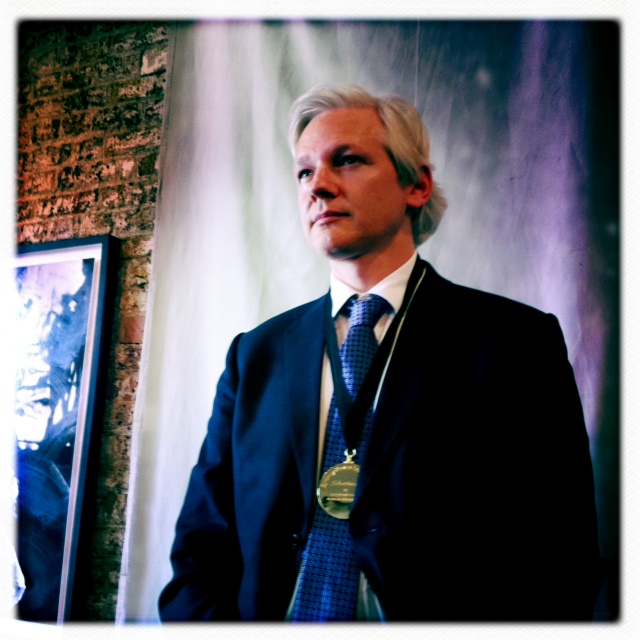 ng?
ng?
Yes it does appear that there was a significant role. I saw a documentary recently interviewing professors and people in the street in Tunisia outlining some of what that role was. We tried very hard to release as much material relevant to that part of the world back in early December. A wonderful Lebanese newspaper by the name of al Akhbar took alot of our material and translated it to Arabic. And other sites also translated it to French and that material then spread. al Akhbar, for its efforts, was attacked and redirected to a Saudi website for 24 hours. It was then attacked by computer hackers using denial of service attacks and then increasingly sophisticated denial of service attacks, and finally, very sophisticated hackers that I attribute to the state intelligence went in and wiped out their entire publishing operation for months. Approximately one month ago, they started publishing again.
In relation to Egypt, I think our most significant role there was to concentrate on the information to do with [former army general Omar] Suleiman and [former president] Hosni Mubarak. Suleiman you may remember was posited as being a vice president who would somehow take over the role of Mubarak. And he … was a long term partner with Israel and the United States. He was a trusted pair of hands as far as they were concerned in relation to the relationship between Egypt and Israel. [He was] involved personally, it is alleged, in the torture of a number of rendered people.
So, by bringing all that information out on a consistent basis when no one else was willing to do so, we made it very difficult for the west to be able to posit Suleiman as an alternative power structure within Egypt […]
We must remember [American] vice-president [Joe] Biden said on the one hand that I was a high tech terrorist and on the other hand that Mubarak was not a dictator.
What do you think about Australia’s hypocrisy championing freedom of speech during the [Arab] revolutions but denouncing yours; and what would you say to detractors who accuse you of hypocrisy, and say you’re all for transparency unless it’s turned on you (in terms of accusations of ego or your court cases)?
There’s a comment I saw on a newspaper article last night that puts it well: WikiLeaks is the most scrutinised organisation per capita in the world. We have something like ten to twenty full time staff and a large volunteer core … We are a very small operation. We had (or have) an 120 man CIA taskforce, operatives here in the UK and in other countries, all scrutinising us – and an extremely contemptive media. Like it or not we are the most transparent organisation in the world. Of course, it is our role to give knowledge to the people about power; it is not our role to prevent people giving knowledge to people about power. In fact, one of our core principles is to protect the identities of whistleblowers. So sometimes one needs to be opaque to protect people. We are an organisation facing extraordinary threats from a superpower. It is absurd that should need to make that statement, but that is the reality.
The reality is that here I am in an absurd situation receiving the Sydney peace medal. I am an Australian citizen and I am receiving it in London. At the same time, I have a state surveillance device attached to my ankle. That is the absurd situation we are in. So this rhetorical threat to try and apply a double standard to us is just that.
And you will notice a similar – this is a basic trick in rhetoric – one was done last year, when we exposed the deaths of 20,000 people in Afghanistan, including many children killed by special forces operations and so on. The response by the United States government to our exposure of all that blood, was to say: Julian Assange has blood on his hands. The first response. Because we were saying that they were wading in blood. And so that is just a basic trick of rhetoric.
If you now Google ‘blood on hands’ and ‘WikiLeaks’ without the word Pentagon, you will see there is approximately 770,000 web pages. If you Google for Pentagon and ‘Blood on hands’, without the word WikiLeaks, you will see there’s about 60,000 web pages. So in terms of the amount of articles that have been published, many talking about the blood of the Pentagon, the blood of WikiLeaks – there has been ten times as many that have been about the blood that WikiLeaks has supposedly caused and yet even these organisations cannot adduce a single case of anyone being harmed by our work over the course of [the last] four years.
What about [recently killed al Qaeda leader] Osama [bin Laden] and the alleged Mush-Bush deal between then US president George W. Bush and then Pakistani president Musharraf? Do you have any WikiLeaks cables supporting the allegation that there was a secret deal between the two presidents at the time? … And what do you make of operation Geronimo?
We have a lot of documents, but the cables along are 285 million words and I do not have them all in my brain at any one point in time. That’s why we’re working with 73 other media organisations … in order that you may do this work that you are able to do more efficiently than us, and directly to your audience. So I don’t have off hand more information about that.
I saw commentary by the former heads of ISI [Pakistani intelligence agency, Inter-Services Intelligence] in the Pakistani press talking about what the relationship should be between the ISI, the Taliban and the United States. And I think that was the clearest description that I have seen. Which is: there are two superpowers in Afghanistan right now: they are NATO (minus Europe) plus the United States. That’s the reality that people don’t want to talk about: that Europe is a superpower. Europe added together spends just over half as much money as the entire United States on military expenditure. Europe is a superpower. And we can see that happening in Libya now, that Europe is acting together with the United States, like a superpower, in the conflict.
So we have two superpowers ensconcing themselves for 10 years in Afghanistan right on the border of Pakistan – and we must understand these borders are a bit artificial; the language crosses over the border and the culture crosses over the border – it is the national incentive of Pakistan, in so far as the ISI is acting in a legitimate way, it is acting to protect the national identity of Pakistan to make sure that those forces eventually leave. And so I assume, in so far as the ISA is acting for the national interest of Pakistan, it is engendering a situation to make sure western forces will leave Afghanistan.
Just a general question on the ethics, and how
you derive the ethics of openness, investigation and privacy. Where does one make the ethical distinction between an operation say, WikiLeaks directed towards powerful institutions and processes and something such as the News of the World phone hacking scandal and the processes therein. What is not merely the contingent ethical decision, but what is the deeper political ethical basis on which one would make those distinctions?
I quite like it [the question]. And this probably horrified my British colleagues and my lawyers, but I wrote about the News of the World phone hacking scandal. And what I said back about a year and a half ago is that the British press should be very careful what they are doing in relation to spending time on that as opposed to all the other injustices that they could be spending their time on. Because we had been involved in something called the Petrogate scandal in Peru just a few months before, where we revealed 87 telephone intercept tapes of Peruvian politicians speaking for businessmen. The famed audio tapes. And that was the biggest political story in Peru that year.
And to engender a climate where that is hard to do is extremely dangerous. Now of course, the media abuses people and misuses its power in approximate proportion to the size of the particular industrial grouping. And News Corporation is a very large industrial grouping, and it uses its power accordingly. But when organisations like the Guardian write over a hundred stories about putting in default passwords in to voice mailboxes – because that’s what we’re actually talking about here – they are taking space from other things and they have other agendas at work. The other agendas at work are: attacking a newspaper rival; the New York Times became involved because similarly it wants to attack the Wall Street Journal.
It is to say, that the interests of the proletariat, which are the readers of the News of the World, are insignificant and are not important, and that the middle class moral majority that embodies itself in the Guardian is to be the arbiter of what is important and what is not important.
The reality is – if readers of the News of the World (and there are very many) find a particular thing to be of significance, to be influential to their lives, about how that person truly behaves … people have a right not to be influenced by people whose external affairs and statements do not mirror their internal affairs and statements. It also seems to me to be a way to get in to the Guardian news about celebrities and tabloid salacious rumours: you can just report on what News of the World are saying.
So generally I say that the public interest is to be determined by what the public is interested in. Because otherwise, who’s going to determine the public interest if it’s not the public? Is it going to be a self-appointed committee of people? Well who appoints those people? Who appoints that committee? Through what process? How do we know that process won’t become corrupted?
That said, I do think there should be redress for libel say, committed by very powerful organisations against smaller organisations. There should be opportunities for redress against large institutions abusing small institutions.
Part II of our Q&A transcript can be viewed here, with Assange commenting on the Lockerbie bombing, distrust between Pakistan and the United States, and the Wall Street Journal’s new ‘Safe House’ leaks site.
]]>