“That four thousand word report from the Syrian refugee camp…will not be read as much as ‘10 cats that have got thoughts about Syria’,” New Statesman‘s Deputy Editor Helen Lewis said in her opening statement on the second panel of the Grapevine event at the Frontline Club on Thursday 23 January.
Read highlights of the first panel discussion here.

Merope Mills, Luke Lewis and Pete Picton
The chair head of journalism at City University, George Brock, got straight to the point and asked the panel ‘is traditional media actually dying and does it matter?’
Deputy publisher of Mail Online Pete Picton said categorically:
“If journalism is what we’re talking about then no absolutely not, in fact it’s thriving.”
Editor of Buzzfeed UK Luke Lewis:
“It’s an amazing time for journalism, not just for new outlets like Buzzfeed, the traditional ones are thriving. It was only a week or two ago that The Telegraph posted their figures of a £60million profit last year. The Guardian has had their best scoops in their history.
“Media is a really big place and we don’t need anyone else to fail in order to Buzzfeed to succeed.”
All the panelists agreed that, while media isn’t dead, the business model has to change.
http://twitter.com/rebeccacmyers/status/426478712826368002
Editor of the Saturday Guardian Merope Mills:
“The way people approach print media has to change…the traditional media money making model is dead.”
"There is still an appetite for print journalism, but the business model has to change." Merope Mills, @guardian #fbj
— Sarah Biddlecombe (@_sarahstweets) January 23, 2014
http://twitter.com/bspeed8/status/426469810109939713
H Lewis said that there is a real problem with public interest journalism:
“Who is going to be in an online only economy commissioning that four thousand word report from the Syrian refugee camp – I just don’t see that that’s a viable business model for anybody because it won’t be read by enough people. It will not be read as much as ’10 cats that have got thoughts about Syria’ – no offence to Buzzfeed.”
Buzzfeed taking a hit for cats – good retort from luke lewis #fbj
— Tom Witherow (@TomWitherow) January 23, 2014
L Lewis:
“Yes most of it is entertaining lists, you’ll also see some other stuff in there… Max Seddon we’ve got on the ground in Kiev at the moment, he wrote a series of explosive reports on what’s happening in Kiev as good as impact reporting you’ll see anywhere.”
@lukelewis says that he wants Buzzfeed to eventually supply as trusted news as the @nytimes #fbj
— Max Benwell (@Max_Benwell) January 23, 2014
Mills noted the changes she’d recognised in print media:
“There is a theme among the [print publications] that are growing and they do tend to be those longer analytical – the New Statesman is one… Nobody wants to read breaking news anyone, we all know the Victoria Line’s flooded with cement and that will be old by tomorrow.”
Mills echoed the comment made by Mona Chabali in the first panel of the evening:
“All the reporters have to be reporting a more in depth piece, the why’s of the ‘gays in Russia’ rather than the just ‘gays are being beaten up’. That is the piece you want to read at the end of the week.”
In reference to another signifying characteristic of Buzzfeed the idea of a move away from display to native advertising.
L Lewis:
“It’s nothing new, people talk about sponsored posts like it’s a new thing…[in magazines] advertorials have been around for decades. The only thing you have to worry about is that there’s a clear dividing line between what is editorial and what is commercial.”
A question from the audience asked, if you don’t charge for it how can you put a value on it?
Picton said:
“You value it in time. It’s far more competitive to get our readers to read us… time is a big currency now…that’s one of the key metrics for us now, to keep them on the site.”
Time spent engaging with online content is the new form or readers' currency. #fbj
— Hari Sethi (@Hari_Sethi) January 23, 2014
Another audience member asked the panels opinion on maintaining journalistic integrity in the battle for getting as many clicks as possible in light of the recent CNN headline which seemed to go a step too far.
@MartinBelam @jburnmurdoch @alexparsons CNN had a go & got it fairly wrong today #fbj: pic.twitter.com/uwukxg3UrE
— dan barker (@danbarker) January 23, 2014
The panel agreed that the headline missed the mark on the sensitive issue, L Lewis said about the wider topic of click bait:
“You keep hearing this word clickbait and it really annoys me because it suggests there’s another kind of headline you don’t want people to click on. I don’t know who these journalists are who are writing articles that they don’t want people to read.”
http://twitter.com/rebeccacmyers/status/426477918437801985
H Lewis added:
“Isn’t it sad that the art of the pun is now dead? I loved a good/bad pun.”
To which L Lewis replied:
“I think the pun’s had a good 200 years.”
Following the success of their events, Grapevine are launching a data-focused site in the coming months. Get in touch with Harry Lambert (@harrylambert1), Max Benwell (@maxbenwellreal) or Rebecca Choong Wilkins at contact@grapevinevents.co.uk.
Watch and listen back:
Whistleblowers make the world a safer place debate
You can listen to the podcast here and here’s a round-up of what some of the blog posts and websites said about the event.
Following Tuesday’s event, Sophia Spring‘s blog post In the Picture: On your doorstep, photography and poverty includes a slide show of her photographs and write up of the discussion between Liz Hingley and Gideon Mendel speaking about their work with Diana Smythe, deputy editor of the British Journal of Photography.
For quotes from our panel: Dina Matar, senior lecturer in Arab media and political communication at SOAS; Faisal J. Abbas, a blogger for the Huffington Post; Hugh Miles, award-winning investigative journalist specialising in the Middle East and North Africa and Ayman Mohyeldin, Middle East-based correspondent for Al Jazeera English, take a look at Can Arab state-owned media recover from crisis of credibility?which also has video of the discussion chaired by author and broadcaster Tom Fenton.
On our Frontline blog Deborah Bonello has written from Mexico about training for journalists covering drug-related violence.
Davide Morandini, an Italian freelance photojournalist based in Cairo, Egypt explains the opposition’s decision to suspend demonstrations, and cancel today’s protests calling for the Supreme Council of Armed Forces (SCAF) to step down in Why the revolution should leave Midan Tahrir, for a moment at least.
]]>
You can view the full event here.
Discussion about the Frontline Club/New Statesman debate on Saturday has continued in blogs and on Twitter, under #fcnsdebate.
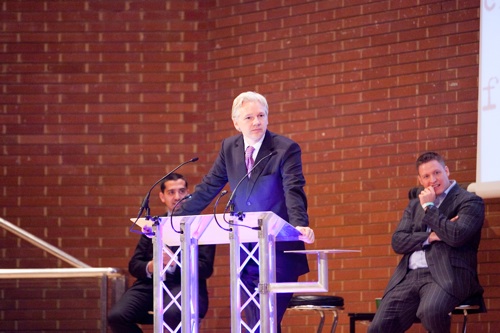
The New Statesman‘s two-part coverage of the event plus video of all the speakers, photo library and live blog is here. Video of WikiLeaks founder Julian Assange speaking, not surprisingly in favour of the motion that whistle blowers make the world a safer place is at the end of this post.
Journalist Patrick Smith, who has included the above widget showing all the #fcnsdebate has written an account of the evening, with audio, of each of the speakers here. He writes that where Assange “is on stronger ground…”
is on the effect Wikileaks has had in Asia, Africa and across the developing world. Certainly among cynical hacks in the London media jungle (or rather, thoses that don’t work for the Guardian), there is a feeling that the “cablegate” leaks didn’t contain much of interest. Though embarrassing for the US State Department, there was a lot of nonsense too, such as the revelation that French premier Nicolas Sarkozy once chased a rabbit around his office.
But Assange pointed out that the Indian national paper The Hindu has put cablegate leak-based stories on its front page 21 times in the last six weeks – Indian readers are fascinated by the revelations on Indian government corruption.
Elsewhere, Assange’s claims about the significance of revelations on WikiLeaks in the development of an anti-corruption movement in India are reported by The Hindu and Times Now.
Here’s what other websites and blogs have had to say about the debate:
The Guardian picks up on Assange‘s claim that WikiLeaks is ‘more accountable than governments’
Dominic Ponsford on Press Gazette’s Wire, focuses on Assange‘s claim that WikiLeaks could have stopped the war in Iraq.
The Register headlines on Assange‘s claim that Google hits ‘prove’ WikiLeaks didn’t have the blood of Afghans on its hands.
Thinq focuses on Assange‘s mention of the Vietnam and Iraq wars and whether WikiLeaks might have prevented them, while Sefrew’s blog quotes ex MI5 agent Annie Machon who was invited to contribute during the debate:
If we lived in an ideal world where we had transparency, freedom of information and real democracy we wouldn’t need whistleblowers. We need some sort of protection for whistleblowers but until then we have WikiLeaks.
Finally, the hindustantimes remarks that on the fact that,
in a land of atheists, as close to 800 people queued outside Kensington Town Hall in west-central London to hear the words of God.
Picture credit: Sophia Spring
]]>Join the Frontline Club and New Statesman for a provocative public debate featuring Julian Assange, founder of WikiLeaks.
For this very special event at Kensington Town Hall, the New Statesman and the Frontline Club host a challenging debate in which some of the most prominent public figures on secrecy and transparency issues will go head to head.
]]>EXTERNAL EVENT AT THE KENSINGTON TOWN HALL
Join the Frontline Club and New Statesman for a provocative public debate featuring Julian Assange, editor in chief of WikiLeaks.
Over the past 12 months, official secrecy has been challenged like never before. Three of the biggest ever leaks of classified information – the Iraq War Logs, the Afghanistan War Logs and Cablegate – shook the world and prompted governments to reconsider how they share information.
Since the start of the Obama administration in 2009, the US government has brought charges against five defendants suspected of leaking classified information. Before Obama, the US government had only ever filed similar charges three times in 40 years.
For this very special event at Kensington Town Hall, the New Statesman and the Frontline Club host a challenging debate in which some of the most prominent public figures on secrecy and transparency issues will go head to head.
Amid the intensifying crackdown on whistleblowers, the debate will ask: are UK and US officials correct to argue that those who publish leaks threaten national security? Or do we need them to expose wrongdoing because, as transparency advocates argue, governments always abuse secrecy?
The event will feature an interactive section where the audience will be able to vote on the motion.
Chair: Jason Cowley, editor of the New Statesman.
Proposition:
Julian Assange, editor-in-chief of WikiLeaks
Julian Assange is the 39-year-old editor in chief of WikiLeaks. Queensland-born Assange has been the subject of public calls for his assassination from leading US politicians and faces an ongoing espionage investigation. In 2010 he overwhelmingly won Time magazine’s Readers’ Choice Person of the Year poll and was named Le Monde’s Man of the Year. He has also been awarded the Amnesty International UK Media Award and the Sam Adams Award for Integrity in Intelligence. In February 2011 his organisation, WikiLeaks, was nominated for a Nobel Peace Prize after publishing three of the biggest leaks of classified information in history, the Afghan War Diaries, the Iraq War Logs and Cablegate.
Clayton Swisher, head of Al-Jazeera’s Transparency Unit
Clayton Swisher is the head of Al Jazeera’s Transparency Unit (the team that produced the Palestine Papers in January 2011). An ex-federal investigator-turned-investigative journalist, he is a former Director of Programs at the Middle East Institute and a current term member with the Council on Foreign Relations. As a journalist he has covered the 2008 U.S. Presidential Elections, the Arab-Israeli conflict, and the on-going war in Afghanistan, and has also authored two books: The Truth About Camp David (New York: Nation Books, 2004) and The Palestine Papers: The End of the Road? (London: Hesperus, Mar 31, 2011).
Mehdi Hasan, senior political editor, New Statesman
Mehdi Hasan is a former editor in the news-and-current-affairs department at Channel 4, where he worked on the award-winning Dispatches documentary strand. He is a regular guest on Sky News and the BBC, appearing regularly on Question Time and The Daily Politics. He is an occasional presenter on LBC radio and the co-author of a forthcoming biography of Ed Miliband – Ed Miliband and the Remaking of the Labour Party (London: Biteback, summer 2011).
Opposition:
Sir David Richmond, former director, defence and intelligence, British Foreign & Commonwealth Office
David Richmond was a British diplomat for more than 30 years. His career included postings to Baghdad, Brussels and New York, where he worked on the UN Security Council. In 2000 he became the first UK representative to the EU’s political and security committee in Brussels and was closely involved in the creation of European security and defence policy. In 2003 he returned to Baghdad (where he had first been posted 20 years earlier) and was later appointed UK Special Representative for Iraq. In his last posting, he was director general for general defence and intelligence and a member of the Foreign Office Board.
Bob Ayers, former director of the US Department of Defence Information Systems Security Programme
Bob Ayers had a distinguished career in the US government. In 1992, he was appointed director of the defence department’s Information Systems Security Programme. He next assumed the post of director, defensive information warfare, leading the programme designed to protect DoD systems from systematic cyber attacks. From 1990-92, he was responsible for the security of more than 40,000 classified intelligence-processing systems at 55 locations across the world. Bob is a noted public figure, appearing on television and radio in the US, in the UK and worldwide, and publishing many articles.
Douglas Murray, author and political commentator
Douglas Murray is a bestselling writer and award-winning political commentator. Since 2007 he has been director of the Centre for Social Cohesion. From April 2011 he will be associate director of the Henry Jackson Society. Murray appears regularly in the British and foreign media. A frequent guest on Question Time and Newsnight, he is also a columnist for Standpoint magazine and writes for many other publications, including the Spectator and Wall Street Journal. In 2008 he co-authored Victims of Intimidation: Freedom of Speech Within Europe’s Muslim Communities. His latest book, on the Saville inquiry into Bloody Sunday, will be published later this year.
Also participating: former MI5 whistleblower Annie Machon and HBOS whistleblower Paul Moore.
For media & press queries please contact events@newstatesman.co.uk – or call 020 7936 6456.
Please book online, for any other enquiries contact events@www.beta.frontlineclub.com – or call 020 7479 8940

]]>
Next Tuesday a collective of photographers will be discussing their experiences documenting poverty on their doorstep in the UK. On Wednesday a panel of experts will be discussing state media in the Middle East and North Africa, looking at its role in post-revolution countries, the influence of Al Jazeera and BBC Arabic and the power of the internet and social media to circumvent media power.
Our screenings in the week ahead include Oscar nominated GasLand looking at the cost paid for the search for natural energy production and Sex, Death and Gods offering an unseen glimpse into the lives of a little understood sect of Hinduism. ]]>