Three military episodes are dominating headlines following reports from the German parliamentary ombudsman to the military.
– The treatment of officer-cadets onboard the German Navy tall ship Gorch Fock, including events surrounding the death of a female midshipman after she fell from the ship’s rigging during a training exercise, and whether several fellow midshipmen behaved in a way that could be deemed mutinous. Currently the vessel is in Argentina. The captain has been relieved of his command. An investigation is underway and the vessel has been ordered to return to Germany. (DW-TV report in English)
– The investigation into the death of a soldier in December last year at the Pol-e-Chomri base in Afghanistan. It was first suggested an accident occurred while the soldier was cleaning his weapon. German media are now reporting up to 10 troops may have been fooling around and the soldier was killed by the weapon of a comrade.
– Feldpost: the unauthorized opening and tampering of letters posted by soldiers deployed in Afghanistan.
Minister zu Guttenberg obviously has a lot of explaining to do about what’s happening inside the German military and his own department. He is also under pressure from opposition parties over whether he’s adequately informed parliament about the Gorch Fock incidents.
All of this comes at a time when Germany’s troop commitment in Afghanistan (and the timing of a possible withdrawal) is under debate, as well as what is the future of a smaller, professional German armed forces following the ending of compulsory military service.
Thomas Wiegold of the excellent German defence blog augengeradeaus.net has produced a good Audioboo summary of the Gorch Fock reports in English.
And a Süddeutsche Zeitung interview with Minister zu Guttenberg also tries to zero-in on what the Minister did or did not know about these events and what action he is taking. A translation is below.
(Interview conducted by Peter Blechschmidt, published 21 January 2011.)
]]>SZ: Minister, is the Bundeswehr covering up unpleasant truths?
Guttenberg: That should never be the strategy of the Bundeswehr, and that is also not the case.
SZ: But in the case of the soldier killed in northern Afghanistan also with the situation onboard the Gorch Fock has your Ministry not told the whole truth?
Guttenberg: Nonsense. In the case of the soldier killed it was officially known on the day after the accident, that possibly a second person was involved. The public prosecutor’s office were immediately informed and is investigating. With the investigation underway to gain evidence of the actual events, we can not make comments out of respect to those involved.
SZ: And of the alleged mutiny onboard the Gorch Fock, you hadn’t heard anything up till now?
Guttenberg: I was informed about that accusation through the documents of the military ombudsman dated 17 January. I immediately directed the Inspector of Navy and the head of the legal department here in the Ministry to clarify the facts. You will not hear any pre-judgement from me. But if these accusations are true, then there will be clear consequences. Generally speaking: degrading drill can not be tolerated. And the accusation of mutiny is a very serious one, in light of what I know so far.
SZ: But aren’t the accusations relating to the Gorch Fock so grave that you as Minister should have been informed?
Guttenberg: Part of the investigation will be to determine if the lines of communication were respected. If there were failures there will be consequences. All of that must be clearly explained. On this matter I have little patience.
SZ: After the death of the female midshipman aboard the Gorsch Fock the training exercise was suspended. At that time the impression came about this appears to have been merely an act of compassion.
Guttenberg: The responsible Inspector of Navy had decided out of technical reasons to suspend the training and to send the training crew back to Germany. The Gorch Fock though should continue her journey.
SZ: And you hadn’t heard about the opening of letters posted from Afghanistan?
Guttenberg: The responsible military leadership in charge did not have any knowledge of this. My mind reading skills are therefore very limited. But here too the investigations are in full swing.
SZ: Are these emerging developments now not posing the question of whether the inner leadership of the Bundeswehr has failed?
Guttenberg: Should the allegations turn out to be true we will most likely be dealing with individual failings. The inner leadership is successful and widely accepted within the Bundeswehr. To draw conclusions about the majority of Bundeswehr from potential individual misconduct – after all it’s about 250,000 soldiers – would be totally unjustified.

by DAVID AXE
The Navy’s shipbuilding strategy hinges on buying at least 55 copies of the 3,000-ton Littoral Combat Ship, a vessel supposedly optimized for near-shore warfare, with a shallow draft and improved maneuverability.
But the Navy’s not waiting around for the delayed and over-budget LCS. USS Donald Cook, a 9,000-ton Burke-class destroyer designed for open-ocean combat, braved outdated charts and her fairly deep draft to perform her own littoral combat mission in recent weeks, when she patrolled just a mile and a half from Somali pirate camps soon after deploying to East Africa this summer.
In nautical terms, a mile is pretty damn close. In pushing so close to the pirate camps, “DC” Captain Derek Granger hoped to send a clear message to potential sea bandits. “If they’re sitting on the beach, wondering if they should make an, ahem, sojourn, and they see the Donald Cook … they may rethink.”
DC took the opportunity to gather intel for her NATO commodore. “My crew loved it,” Granger says. “In there close, providing video and photographic info back to the boss … it’s useful.”
During her near-shore patrol, DC sent out two boarding teams to investigate suspect skiffs. Turned out they were both legit fishing boats. But Granger didn’t know that when he ordered his people to travel a mile away in Rigid-Hull Inflatable Boats — too far for DC to provide quick support. That, and not the shallow water, was the most stressful thing, Granger says.
(Photo: David Axe)
]]>
by DAVID AXE
A year into the “global war on piracy,” naval operations have settled into a comfortable routine. The world’s maritime bodies have agreed on a 50-mile-wide “security lane” connecting the Gulf of Aden to the Indian Ocean. Commercial ships are encouraged to travel inside that lane. Each of the roughly 20 NATO, E.U. and U.S. coalition warships in the region is assigned a squarish portion of the security lane to patrol. Recon aircraft from Djibouti crisscross the skies, spotting suspected pirates and directing the warships to investigate. Merchant ships also spot possible pirates and radio in their locations.
This is a “surveillance-driven” model, in the words of Commodore Steve Chick, senior officer of the five-ship NATO force. It has its disadvantages. The surveillance model is mostly reactive, and it’s aimed at interdicting pirates in the terminal phase of a potential attack — that is, when the pirates are already close enough to represent a danger. For this reason, the counter-piracy fleet often counts on stalling tactics to keep merchant ships safe until warships can respond. Merchants are instructed to sail fast, zig-zag and use their hoses to keep pirates at bay while warships and helicopters race to the rescue.
There’s another, potentially better, way of countering pirates, Chick explains. He calls it an “intelligence-driven” model that relies on a better understanding of pirates’ infrastructure and attitudes. By this method, a warship might sail a circuit within sight of a pirate port. The vessel’s presence is meant to bottle up pirates, while also creating an impression of overwhelming power that hopefully would deter future pirates from every setting sail, even after the warship has left.
USS Donald Cook — “DC” to her crew — has already tested out Chick’s new intel method, and other ships might do the same, as counter-piracy operations evolve. “There’s a bit of hearts and minds there, as well,” Chick says, adding that a visible warship presence can encourage the vast majority of Somalis who oppose piracy, but have been cowed by the sea bandits’ wealth and aggression. DC routinely sends boarding teams to talk to friendly Somali fishermen, “asking what they’ve seen and what they know” regarding pirates, Chick says. As the intel approach gains acceptance, this kind of interaction will only grow in importance.
(Photo: David Axe)
]]>
by DAVID AXE
After a year of rapid growth, the international naval force assembled to combat Somali piracy has stabilized at what will probably be its permanent level. There are around 20 vessels and a handful of land-based aircraft from some dozen navies, organized into three major flotillas plus independent patrols. The U.S.-led Task Force 151, NATO’s Maritime Group 2 and the European Union’s Operation Atalanta represent the bulk of the forces, with India, China, Japan, South Korea, Russia and Iran sailing alone.
This diverse force coordinates its efforts through an ad-hoc "deconfliction board" that makes sure ships’ patrol areas aren’t overlapping. "We try to avoid the little-kid-soccer syndrome, where there’s one skiff and all the nations go after this one ‘ball,’" said U.S. Navy Rear Admiral Scott Sanders, from U.S. Central Command. "We stay spread out."
Sanders described a recent operation against a pirate skiff, to illustrate the results of this teamwork. "We had a Japanese P-3 [patrol plane]. It detects something. At that point, the Republic of Korea navy launches a helicopter for support. At the same time, we have a German and a Greek warship that [each launch] helicopters. We end up getting a Norwegian fast craft. It finds the skiff and boards it, and find weapons. That’s two task forces, plus two independent nations.
There have been fewer major pirate hijacking this fall, compared to last. Should we attribute this to more effective military patrols? Yes and no, said Royal Navy Capt. Keith Blount. "I think the success were seeing out here is for a number of reasons. … The military aspects are working better together than they ever were." But the commercial shipping industry’s internal reforms might be the biggest factor, Blount said:
They’ve been very robust in the countermeasures they’re using: not letting pirates on board, maneuvering the ship very hard, repelling boarders with fire hoses, putting razor wire at access points, locking the doors at the superstructure area. That very well may deter pirates and they just pull away. If the pirates are being particularly persistent, it buys time for military units to get there. Because of the larger number of military units, we can get there pretty quickly now. Put those things together and put in the powerful cooperative aspect, and the number of successful pirate attacks is driven down.
I’ll be joining the NATO counter-piracy force next week. You can support my coverage with a donation.
(Photo: U.S. Navy)
Related:
Building the Somali Navy, 500 Guys at a Time
French Propose “Stupidity Tax” for Pirate Victims
After Rain Break, Somali Piracy Set to Return
Dilbert Does Somali Pirates
Coast Guard: Secret Weapon in the War on Piracy
Nigerian Crew Outwits Somali Pirates
Sam Jackson to Portray Mysterious Kenyan Piracy Expert
Somali Pirates Trained in the Soviet Union? You Betcha
Pirates Have Stingers? Probably Not …
NATO Frigate’s Pirate Catch-and-Release
Video: Navy, Coast Guard Grab Pirates
NATO Back in the Pirate-Fighting Business
Somali Insurgent’s Tips for Fighting Pirates

Operation Continuing Promise in Latin America is just two years old. So is Africa Partnership Station. But already, the Navy is re-configuring to double or triple the number of these smart-power operations it supports. It might seem like naval smart power came out of nowhere, to dominate planning overnight.
But Continuing Promise grew out of Admiral James Stavridis’ long career thinking about new uses for naval forces. And Africa Partnership Station is actually a clever evolution of a program dating from the 1970s. In that decade, the Navy launched its “West African Training Cruise,” aiming to visit major regional allies once every five years or so. “That’s not a way to build partnerships,” said Lieutenant Commander Chris Servello, an APS planner aboard Nashville. “We need to be down here more often.”
In 2005, 6th Fleet Vice Admiral Harry Ulrich — Stavridis’ intellectual twin for Africa — decided the Navy needed to boost its operations along the continent’s western coast. His choice of vehicle was a seemingly odd one. Ulrich tapped the repair ship Emory S. Land, pictured, for a four-month deployment, delivering trainers and maintainers to several African nations. Land helped fix African navies’ old boats and give sailors refresher training. Servello called it a “test case” for Africa Partnership Station. “It was well received.”
Next, 6th Fleet began expanding on the concept, sending frigates and amphibious ships to drum up interest in deployment’s like Land’s. In 2007, the Navy formalized what Ulrich and Land had pioneered, and Africa Partnership Station was born.
(Photo: Navy)
]]>
Last summer, Defense Secretary Robert Gates warned about the “creeping militarization” of U.S. foreign policy. “Broadly speaking, when it comes to America’s engagement with the rest of the world, it is important that the military is — and is clearly seen to be — in a supporting role to civilian agencies,” Gates said.
Does USS Nashville’s smart-power deployment to West Africa represent this militarization of what should be strictly peaceful, civilian functions? After all, Nashville is delivering forms of assistance not normally associated with the military. Scientists are aboard to deposit ocean buoys that are part of a global-warming warning system. At every port, Nashville hands over small batches of humanitarian aid. Various U.S. ambassadors have embarked for brief stints in order to accompany Commodore Cindy Thebaud on high-level meetings with local elected officials.
Two civilian diplomats integrated into Nashville’s crew said not to worry. “The core of what we’re doing is fundamentally military,” one said. Both asked not to be named for this story.
He was referring to the military training programs that comprise the heart of Africa Partnership Station. It’s a traditional military job, using strictly military tools, and doesn’t represent an armed usurping of any civilian organization’s mission.
But what about all those “tertiary” activities: the humanitarian assistance, the science, the diplomacy? “We’re sensitive to that balance,” one of my sources said. In other words, in its current mix, Nashville’s mission is still military enough that anything else the ship might be doing feels, to the State Department, to be a side project rather than an intentional invasion of State’s space.
“I see Africa Partnership Station as a vehicle for ‘whole-of-government’ efforts,” said one of the diplomats. And besides, the other added, “our diplomacy has been historically under-funded and under-staffed.” The 500-strong Nashville crew is equal in size to “10 percent of our entire foreign service.”
So we don’t have much of a choice. If State is going to perform “expeditionary” outreach missions at all, it’s going to have to rely on the military for transportation and logistics, while keeping an eye on that “balance” between military and civilian functions.
(Photo: David Axe)
]]>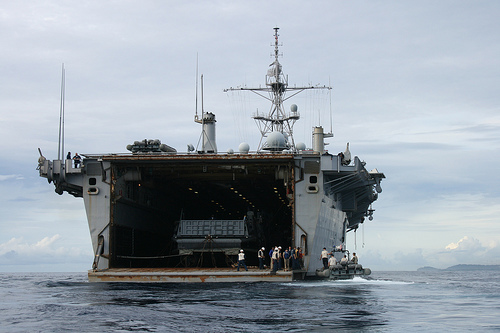
USS Nashville lost a day’s work in Libreville, Gabon, last week, when upon arriving in the West African capital, the crew discovered that the 40-year-old Nashville wouldn’t fit at the city’s tiny pier. Instead, she anchored a mile offshore, and used her boats to ferry people (see video).
The issue was less Nashville’s sheer bulk — 570 feet long, 17,000 tons displacement — than her draft. The 40-year-old gator’s bottom is only 20 feet underwater, but she needs extra clearance to suck seawater for her old-fashioned steam-generating boilers. The crew told me a modern ship, with a gas-turbine power-plant, wouldn’t have such problems.
Which raises the question: Is Nashville, and any ship like her, the right platform for Africa Partnership Station? Lieutenant Commander Chris Servello said amphibious ships, in general, make good foundations for these soft-power missions, for they are “non-threatening” and can carry lots of stuff. But Commodore Cindy Thebaud said it’s possible to be too big. “Many of the navies and coast guards with which we work are very small and easy to overwhelm,” she said. She strongly hinted that smaller vessels, perhaps better suited to really shallow waters, are the way to go.
Fortunately, the Navy’s on it. The next iteration of Africa Partnership Station, this summer, will be anchored on Swift, the 300-foot-long catamaran, drawing only 11 feet. The Navy has only two catamarans in service, but will add at least 10 in coming years.
(Photo: David Axe)
]]>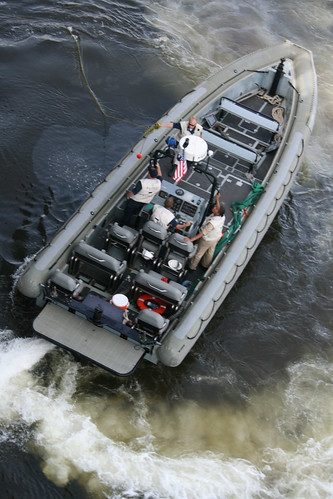 They escort USS Nashville into port. They haul cargo: thousands of pounds of it. They ferry the commodore and her staff, plus the humanitarian and training teams, to their missions ashore. They’re training aids themselves, for teaching African sailors how to handle small craft. USS Nashville’s 11-meter Rigid-Hull Inflatable Boats, pictured, are the workhorses of Africa Partnership Station. In a sense, Nashville is just a floating hotel for people and a launch platform for the speedy RHIBs.
The Cold War at sea might have belonged to nuclear-powered submarines, aircraft carriers and missile-armed destroyers. But for the irregular threats — pirates, smugglers, insurgents — and peacemaking missions of the 21st century, the RHIB and its airborne cousin, the helicopter, are the most important weapons. Lucky for us, they’re both fairly cheap, although they do require somewhat more expensive mother-ships (carriers, amphibious ships or other vessels) as launch platforms.
The “RHIB era” is only just beginning. When the Navy finally gets around to designing berthing modules to add Marine squads to the Littoral Combat Ship, it’ll be RHIBs that will carry those Marines into combat. With Secretary of Defense Robert Gates looking to trim the Navy’s old-school amphibious-assault force, littoral ships with RHIBs will fill the gap, dispersing Marines into coastal waters in small, nimble groups.
(Photo: David Axe)
]]> Africa Partnership Station is about a lot of things. It’s the major test-case for emerging “smart-power” doctrine. It’s also an excellent vehicle for “military diplomacy,” science and humanitarian work. But primarily, APS — now in its third year — is about delivering training aid to West African governments, on request. In that way, USS Nashville, the 40-year-old amphibious ship currently wearing the APS banner, is essentially a floating schoolhouse.
It’s simple: West African nations can appeal through their defense attaches for a particular type of maritime training assistance. Maybe they need help with fisheries protection, or boat-boarding operations, or coastal land combat. APS headquarters in Europe weighs each request and tries to match it with available resources. Eventually, the client and the customer compromise, and a training plan is put into place.
So Nashville calls at various ports in Ghana, Gabon, Nigeria, Cameroon and Senegal. She deploys her training teams ashore, or the students embark for their courses. Some of the training is strictly classroom stuff, with textbooks and Powerpoint presentations. Other training is hands-on. Trainees might handle hoses on Nashville’s flight deck to learn firefighting techniques. In this way, Nashville’s people have trained hundreds of West African sailors, marines and coast guardsmen since deploying in January.
But wait, there’s more. In addition to the training in each port, the Navy has invited aboard Nashville sailors from various West African navies. They are integrated into the crew as so-called “ship-riders.” Paired with a U.S. sailor, the ship-riders get on-the-job training operating Nashville’s systems. Plus, there are foreign staff officers on the APS staff that oversees Nashville’s activities. They’re not formally considered students, but working in an international staff is undoubtedly highly educational.
It’s a great construct, in theory. But for all Nashville’s eagerness to collaborate with West African nations, are the Africans themselves equally receptive?
Depends. “The individuals are in receive mode,” says U.S. Marine Corps Lieutenant Colonel Carl Friedrich, commander of the 30-man Marine training contingent on Nashville. By the same token, the African nations’ senior leadership are eager to accept what Nashville offers, according to APS Commandant Cindy Thebaud.
But officers on Nashville say there’s another, key level within African nations’ command structures that resists collaboration. West African militaries are strongly “garrison-minded,” in the sense that most soldiers, sailors and airmen in these countries spend the bulk of their careers performing a menial job at a single base under one commander. It’s a static, personality-driven model of military service. At the unit level, it’s all about comfort and job security, so there’s no incentive for commanders to release their subordinates to attend some American training course. A commander in a patronage military doesn’t need better-trained troops. He just needs his troops to keep pushing brooms and standing guard, so that he can keep up appearances and keep everyone paid.
No wonder, then, that the Marine training courses that Friedrich oversees never get as many students as APS planned for. Unit commanders just refuse to let people go.
Time and again, Thebaud has stressed that APS is a process, and an education for all participants. For our West African partners, APS must help break the garrison mentality in order to forge truly effective maritime forces.
(Photo: David Axe)
]]>
I won’t lie to you. I had never even heard of Sao Tome and Principe until two days before visiting. It’s a tiny island nation a couple hundred miles off the Gabonese coast, heavily reliant on sea trade and fishing. One problem: like many West African nations, Sao Tome has only a tiny, under-equipped coast guard. The U.S. Navy has given the STCG a couple Automated Identification System consoles for monitoring ships’ radio beacons, and some radars to spot smugglers and illegal fishermen who turn off their AISs. But one of Sao Tome’s AISs wouldn’t boot up, and the Boston Whaler boat they use to inspect suspect vessel had problems with its engine and fuel tank.
Enter USS Nashville and Africa Partnership Station. The ship anchored off Sao Tome on April 18 and began shuttling people ashore to fix the AIS and the Boston Whaler. APS chief Commodore Cindy Thebaud and the U.S. ambassador to Gabon (who also handles Sao Tome) followed, for meetings with the country’s senior leadership.
The U.S. Navy’s relationship with Sao Tome is “not ideal,” in the words of one officer. Even semiannual visits by U.S. ships aren’t frequent enough to keep high-tech systems and finicky boats working. Better to teach the STCG to fix its own systems. But Nashville’s visit was for just one day — not long enough for thorough training. Ensign Jason Stephens, whose team fixed the AIS, radars and boats, did his best to show Sao Tomean officers the steps he was taking. But that was a half-measure, when full measures are called for.
The situation in Sao Tome speaks to the vast demand for maritime partnerships in West Africa. Nashville and her teams are just scratching the surface of the region’s needs. The next APS, traveling on the catamaran Swift, is being planned for this summer. Hopefully she’ll call at Sao Tome for longer than one day.
(Photo: David Axe)
]]>