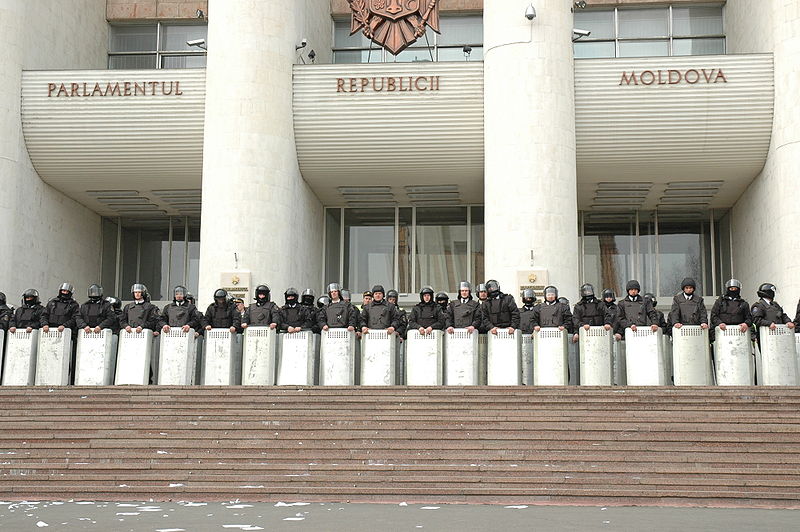
 You can find the latest on the progress of the dispute over Moldova’s election over at Reuters and the BBC. The government has agreed to recount the votes from the elections on 5 April. Opposition parties say this course of action takes no account of their concerns over fradulent voter lists. They are also worried that a recount might be used to get the Communist Party an extra seat in Parliament, allowing President Vladimir Voronin’s successor to be elected unopposed.
In the meantime, here are three updates on the rather less important Twitter angle.
1. Natalia Morar says Twitter was used
In a piece in The Guardian, Natalia Morar, one of the organisers of the protest last Tuesday, says Twitter was used to help organise the initial flash mob.
"We decided to organise a flash mob for the same day using Twitter, as well as networking sites and SMS…Not only did we underestimate the power of Twitter and the internet, we also underestimated the explosive anger among young people at the government’s policies and electoral fraud".
I think it had already been established that Twitter was involved given the commenters on this blog and the establishment of the pman hashtag.
Although I am somewhat intrigued as to why Twitter doesn’t seem to get a mention on Morar’s blog by name on the 7th April (neither here nor later) given what she says about Twitter to The Guardian. Perhaps she is aware that the Twitter angle is helping to keep Moldova in the news? Perhaps The Guardian went in with the intention of getting a quote on Twitter?
In any case, in this interview she still backs up my point that this wasn’t just about Twitter as certain news articles implied. And it hardly needs mentioning that the "the explosive anger among young people at the government’s policies and electoral fraud" might have something to do with all of this.
2. Ethan Zuckerman’s tweet data
Ethan Zuckerman has done some excellent work looking at some of the data from #pman. I agree with Ethan that more quantitative work needs to be done in this area. I often think that it must be possible for somebody to programme far more useful Twitter analytics software than we currently have available.
What I would guard against is the temptation just to look at Twitter because in theory it’s relatively easy to access. Although it might be more difficult to look at blogs, forums and social networking sites in this way, I think researchers should nevertheless be attempting to pull out examples of the interactive nature of social media. For example, it would be really useful for someone to see how this played out on blogosfera.md and Odnoklassniki.
3. Evgeny Morozov’s latest Foreign Policy post
Evgeny wrote a post saying that the Twitter revolution is not a myth. Although I have to say I think we’re looking at Twitter’s role from different angles rather than being diametrically opposed. Here’s a good example first up.
a) Evgeny:
"But to prioritize the internal organizational elements of this story is to entirely miss out on the crucial role that Twitter played in mobilizing the masses outside of and far away from the square (and, in part, getting some of them TO the square in the first place). I can think of many situations, in which what is happening outside — and especially what is being discussed outside — is far more important than what is happening inside the rioting crowds."
There was a reason I prioritised the organisational elements of the story. And that was because various articles and news headlines kept prioritising the organisational elements of the story. They gave two impressions. First, the impression that Twitter alone was directly responsible for getting thousands of people to the square and second, that thousands of people were using Twitter at the square to "storm the presidency". Neither of these impressions is true. I think this excerpt from Evgeny’s post actually backs up my argument:
"Yes, as Daniel Bennett points out in his critique, Twitter may not have played a role in coordinating events in the square. But there was NO coordination in that square – all reports look like it was total chaos and anarchy. With or without Twitter, there was nothing to organize as the genuine political agenda seemed to be amiss."
But Evgeny’s emphasis in the original quote was on the way Twitter was used to mobilise awareness and support both within and outside Moldova. I don’t think you can fault his conclusions with regard to the way Twitter enables the thoughts of a few to be disseminated far more widely and the potential impact that has on coverage of the event.
(b) Evgeny:
"Perhaps, the biggest fallacy committed by the critics of my "Twitter revolution" thesis has been to assume that Twitter exists in some sort of isolated environment that is easily quantifiable and shut off from other media platforms. It’s this kind of assumption that leads them to conclude that "few Twitter accounts=few reasons for the Twitter revolution to happen."
One of my main points was that this was about social media more widely and not just about Twitter. ("I would suggest this was a much wider social media campaign.") I agree it’s possible that tweets might have a wider life than on Twitter and I’m sure they do, but if they do we should be able to find some examples which might be worth bringing to the debate. (You might also argue it the other way and say that blogs have a wider life than just being on a blog because they can be fed through Twitter/Facebook/forums etc).
According to Ethan’s data, the site which was referred to most on tweets between the 7th and 12th April was Revolutie Moldova. This doesn’t have an embedded Twitter feed on it. The 9th most referenced site (although there is one broken link at number 4) does have one. But it’s the only one of the top ten, suggesting Twitter was not as integrated as we might think. On the other hand, it is highly likely that several of thes
e sites were following the #pman hashtag and not having Twitter embedded on blogs might not mean that much.
I might get round to doing more research into this at some point, but it’s an example of the sort of thing that needs to be done
Photo: Wikipedia Commons, User: VargaA
]]>
According to the BBC thousands of protesters descended on Moldova’s parliament building yesterday to demonstrate against the Communist Party’s victory in last Sunday’s elections. The protesters are thought to be primarily made up of students and young people who claim the results of the election were fradulent despite being approved by election monitors.
Unsurprisingly you could follow what was happening on Twitter. The key hashtags are #pman (the acronym of Piata Marii Adunari Nationale, the square where the protests were taking place), #Chisinau, and #Moldova.
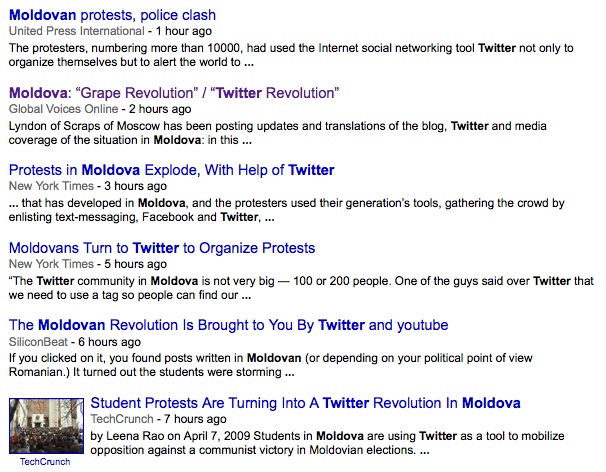
But a number of commentators claimed that this was the beginnings of the first Twitter revolution and that Twitter had played a "key role in organising the protests".
The Telegraph, for example, jumped straight in with this headline: "Students use Twitter to storm presidency in Moldova". Another Telegraph blog post pointed to this foreign policy piece which claimed that after the Orange Revolution in Ukraine, Twitter "will usher in another revolution in neighbouring Moldova". A TechCrunch post on a similar theme is being retweeted numerous times as I write.
But where’s the evidence?
Read the rest of this post on Daniel Bennett’s blog.
]]>
According to the BBC thousands of protesters descended on Moldova’s parliament building yesterday to demonstrate against the Communist Party’s victory in last Sunday’s elections. The protesters are thought to be primarily made up of students and young people who claim the results of the election were fradulent despite being approved by election monitors.
Unsurprisingly you could follow what was happening on Twitter. The key hashtags are #pman (the acronym of Piata Marii Adunari Nationale, the square where the protests were taking place), #Chisinau, and #Moldova.
But a number of commentators claimed that this was the beginnings of the first Twitter revolution and that Twitter had played a "key role in organising the protests".
The Telegraph, for example, jumped straight in with this headline: "Students use Twitter to storm presidency in Moldova". Another Telegraph blog post pointed to this foreign policy piece which claimed that after the Orange Revolution in Ukraine, Twitter "will usher in another revolution in neighbouring Moldova". A TechCrunch post on a similar theme is being retweeted numerous times as I write.
But where’s the evidence? Not many of the people who have actually written these and similar articles have bothered to find some tweets that might hint at some kind of organisational role for Twitter:
@Moscovici "Opposition leaders to gather in the main square. Protesters to move from official building to the main square. Chisinau, Moldova #pman"
@Ceziceu tomorrow at 10.00 A.M. , 8 april, the protest from Chisinau continues! #pman
But Evgeny Morozov’s foreign policy article notes that "there is little to none cellphone coverage in the square itself…so protesters have to leave it to post updates to Twitter via GPRS technology on their mobiles". This suggests that the organisational role of Twitter was not particularly substantial at the scene of the protest.
Indeed, an eyewitness account by Dorina on Kosmopolito.org outlines how difficult it would have been to use Twitter effectively at the protest itself:
"…It was after this altercations that people in the offices that were trying to access different online media sources had really slow connection or could not access the web pages at all. Later on we understood that internet connections were down, local television did not broadcast and the national public television was broadcasting relaxation shows. Also, after 11.30 AM we could not reach protesters from the Square via their cell phones".
The New York Times has spoken to Mihai Muscovici who said he could provide Twitter updates from Chisinau, the Moldovan capital. But he suggests that the Twitter community in the whole of Moldova is around 100 to 200 strong and there is scant mention of the organisation of the protests at all apart from a rather vague quote the Times has put in at the end of the piece.
But was Twitter used in the original organisational process? It might be worth trying to work out who helped organise the protests in the first place and how they organised it.
Natalia Morar(i)
A more in depth look at Twitter while reporting on this story might have picked up this LiveJournal blog. The blog belongs to Natalia Morar or Morari, a Moldovan investigative journalist for The New Times, based in Chisinau who was barred from entering Russia in late 2007 and again in 2008. She’s listed as one of the members of ThinkMoldova, an organisation that wants to get young people in Moldova to "directly participate in proposing new ideas and take part in the decisions important for their own future and their country".
And after the elections on Sunday, that’s exactly what Morar and several others set out to do. (I’ve used ‘Google translate’ to help me with her blog in Russian hence accuracy may will not be 100%. If you can help with a more accurate translation please get in touch). Here’s how they organised the ‘youth initiative’ protests according to Morar’s blog:
"Six people.
10 minutes for creativity and action.
A few hours of information on networks, facebook, blogs, SMS to friends and e-mail newsletter.
All of the organization – through the Internet.
Even if Google translate has spectacularly let me down, and she does in fact mention Twitter at all somewhere in this post, I would suggest this was a much wider social media campaign. Morar continues:
"On the street came out 15 thousand young people! See the video yourself. And this is just a few hours of information dissemination, without television or other media.
Our initiative group called "I’m not a communist." It includes several non-governmental organizations – our association and organization ThinkMoldova HydePark. Only the young, and no parties.Our action team announced April 6, the National day of mourning and called on all young people, disagree with the results of elections in the Moldavian Parliament, to arrive at a monument to Stefan cel Mare and light a candle. The application filed by 50 people. It is 15 thousand. They chanted "Down with communists!", "No censorship", "Better be dead than communist!", "We bring change!" After lighting candles, we went across the column to the presidential administration, and th
en at the national assembly area. Within a few hours of traffic on the main street of Stefan cel Mare was blocked."
She confirmed that on the square "cellular communications" were blocked. Indeed, far from using Twitter she notes that:
"As all has begun to develop quite chaotic, we are immediately on the ground created a youth organization committee and asked all to go away tomorrow, 10:00 am. Today we had one just a megaphone and was difficult to coordinate all actions."
In short, unless you can demonstrate that this blog is not what it seems (possible but looks unlikely to me) or you can find some hard evidence (which may exist) for Twitter’s substantive use in these protests other than the establishment of a hashtag #pnam, I’m not convinced that Twitter played a key organisational role.
As it stands, the Twitter revolution is a myth. What happened, and is still happening, in Moldova is a protest organised using social media.
UPDATED 2pm
1. Evgeny Morozov at ForeignPolicy.com seems to have qualified his assessment of Twitter’s role in the Moldovan protests later in the afternoon after his initial ‘Twitter revolution‘ post. Some good points here though.
2. Dumitru, one of the commenters below, states on his blog that:
"The protests in Chisinau have started because young students were unhappy with the elections stolen by the Communist Party. They have organized themselves through blogs, and social networks like Facebook and Odnoklassniki.ru."
In a comment on Evgeny Morozov’s blog Dumitru adds:
]]>"In fact Twitter did not play that big role. The story is quite simple – young and active bloggers decided to have a flash-mob action, lighting candles and "mourning Moldova" because of Communists victory, which nobody recognized due to the multiple violations before and during the campaign. They agreed on the time and place of the action through the network of Moldovan blogs (blogs aggregator blogosfera.md), and social networks like Facebook/Odnoklassniki, etc."