“Where can I go to have a decent life?”
On Friday 11 June, Shorts at the Frontline Club took viewers on a cinematic journey that showcased the different ways used to document the world we live in.
The theme: migration and the phases of migration.
Two at the Border by Tuna Kaptan and Felicitas Sonvilla shone a light onto the lives Ali and Nasser. The two friends attempt to make ends meet by helping refugees to the Turkish-Greek border. Ali is Palestinian, traumatised by the violence he has witnessed. “Problems, problems everywhere,” he repeats with bloodshot eyes.
“Where can I go to have a decent live?” Ali asks the universe.
As if replying to Ali, Europe’s response to the rising number of refugees has been increased militarisation of the Greece–Turkey border. The film is dedicated to Naser, who attempted to smuggle himself into Greece. The boat he was on allegedly capsized in the Aegean Sea, and he has been missing ever since.
What can await those who make it across the border to Greece? Xenos documents the desperation of Abu Eyad, whose departure from the Palestenian refugee camp Ain el-Helweh in Lebanon was the subject of Mahdi Fleifel’s award-winning documentary A World Not Ours (2012). Xenos is narrated through a telephone conversation between the two childhood friends. Slowly the reality of life across the border becomes apparent to Mahdi as a bitter nightmare of depression, heroin addiction, sex with men for money and the impossibility of seeing their families again.
 The Source by Marcin Sauter spirited the audience to Nagorno-Karabakh, illustrating what it’s like to stay where everyone else has left. The black and white film projected a stylised impression of trauma and loneliness felt by a woman who stayed where no one else could. In a village destroyed and deserted by war.
Separation and acute loneliness continued in the film Adrift by Frederik Jan Depickere. We listened to Simu’s story against the stark, industrial visuals of the Arctic. Simu dreamt of becoming a pop singer. In life, his father was tortured to death for founding the anti-government UPF. His older brother suffered the same fate. Simu’s mother disappeared. His sister died of HIV as they were being smuggled from Uganda. He cannot return. As he shovels the snow, he thinks his dream is dead.
The final film of the evening broke slightly from the theme of migration and touched more upon identity. What happens when one plays for a national team and the political context of what you represent changes? The Opposition by Ezra Edelman and Jeffrey Plunkett chronicles the events around the qualification play-off games for the 1974 World Cup between Chile and the USSR. Chilean football players were faced with a choice between staying part of the US-backed dictator Augusto Pinochet’s charade, or using one’s privileged position to represent the oppressed.

Whether directly linked to migration or not, all the films explored the human struggle to live. To live a decent life in dignity.
]]>
In May, Armenia and Azerbaijan will mark the 15th anniversary of the 1994 ceasefire agreement which put the conflict over the disputed territory of Nagorno Karabakh, a mainly ethnic Armenian-populated autonomous oblast situated within Azerbaijan, on hold. Since then, international mediators continue to talk of a lasting peace agreement being in reach, but few following the negotiations are as optimistic.
With a new generation of Armenians and Azeris growing up unable to remember the time when both lived together, it’s perhaps no wonder. Nationalists and politicians in both countries continue to exploit the unresolved conflict to further their own political and economic ambitions — and despite the overlaps in culture and history which Thomas de Waal, author of Black Garden: Armenia and Azerbaijan through Peace and War, touched upon during an interview in 2002.
Yet, civil society groups appear to half-heartedly engage in peace-building initiatives, apparently only in order to receive funding from international donors, and change their position depending on local political developments. However, there could be a glimmer of hope if a recent documentary aired on Al Jazeera English is anything to go by. Visiting the Caucasus late last year, journalist Michael Andersen discovered such an example in the Republic of Georgia.
While fixing the Armenia leg of the film, Michael told me about a Georgian village where Armenians and Azeris live, work and study alongside each other. Footage of the school in Sopi is now available online as part of the second half of the 22-minute documentary. Brief it may be, but the sight of teachers and children from both sides working and studying together is encouraging.
Although the two ethnic groups follow different religions, for example, one Azeri child seems hard pressed to name any differences other than language.
In Baku, an alternative voice among the local media went further.
Nowhere in the world can you find two groups of people closer to each other. That is why we often have these stupid disputes between Armenians and Azeris. "This house is Armenian" or "this house is Azeri." Or "this music is Armenian or Azeri." This is exactly because the two have so much in common. […] I normally say, and people don’t like this, that Armenians are just Christian Azeris and Azeris are just Muslim Armenians. That is how much they are alike. […] link
But perhaps that isn’t so surprising.
On my first visit to Nagorno Karabakh in 1994 for The Independent, I photographed prisoners of war held in the self-declared republic’s capital, Stepanakert, and remember the Armenian children playing with the kids of Azeri civilians also held hostage. Others would add that not only do both live side by side in Moscow, but in order to reach Tbilisi from Yerevan, Armenians have to pass through the mainly Azeri-populated Georgian region of Marneuli.
They do so without encountering any problems, but the situation in Armenia and Azerbaijan is very different.
Media outlets, civil society groups and political parties alike continue to push propaganda intended only to perpetuate hatred rather than resolve a conflict which arguably holds back the democratic development of both countries and also threatens the long term stability of the South Caucasus. Thankfully, a recent conference in Vienna organized by International Alert finally recognized the problem although the resulting conclusion was long overdue.
Participants in the forum discussed the possibility of holding mutual visits on the Armenian-Azerbaijani border, as well as online discussions and lectures. Details on such initiatives remain in the works. A final document, adopted without the co-chairmen’s participation, agreed with the Minsk Group that "civil society . . . is insufficiently informed and is misinformed." It added that "language of enmity is used increasingly." link
Certainly, the Internet changes the entire situation. Moreover, it had been doing so long before the conference participants owned up to their own failings, as the American University’s Center for Social Media wrote in November.
Bloggers in the South Caucasus are multiplying overnight. As Internet access becomes more common and the first post-Soviet generation grow older, blogs in this region flourish. […]
[…]
[…] With blogging becoming such a popular tool for self-expression, it will be interesting to see if the ripe moment emerges when Georgians, Azerbaijanis and Armenians really do have a reason to unite together. It is my guess the blogosphere will be the place in which it happens. link
Having already met Azeri bloggers in Tbilisi, I’ve also made contact with other bloggers from Azerbaijan online even if I still can’t visit the country on a British passport. At the same time, Facebook and Internet chat has transformed these initial contacts into normal online social interaction. The possibilities are endless, and a new project launched in January hopes to build on that in order to bring Armenian, Azeri and American teenagers together.
As mentioned in a previous post on this blog, DOTCOM has literally harnessed the power of the Internet to circumvent ethnic fault lines. Yes, there are still obstacles that need to be overcome, but the potential for the project funded by the U.S. State Department’s Bureau of Educational and Cultural Affairs and implemented by Project Harmony is there. Already, participants are showing that the issues which concern them most are common to all.
So, when DOTCOM asked whether I would agree to be interviewed along with an Azeri analyst/blogger as a project module for the 90
participants to respond to over the next rwo weeks, I jumped at the chance.
After reading our DOTCOM interview with our two professional bloggers Arzu Geybullayeva and Onnik Krikorian, below, please ask one question (right here in the COMMENTS box) about media, blogging, social change, and citizen action here – and feel free to add to the conversation as it unfolds. link
Of course, it remains to be seen how the online conversation will unfold, but it can only be hoped that DOTCOM and other similar initiatives will achieve results. Fifteen years ago I met my first Azeris held captive in Nagorno Karabakh, but now I am meeting professionals and friends online or in Tbilisi. The Internet keeps lines of communication open even if there are those in both countries who would rather they didn’t exist at all.
Only last week, for example, I spoke to an Azeri friend in Baku over Skype. With telephone communication to Armenia reportedly blocked, it was the first time she had ever spoken to an "Armenian."
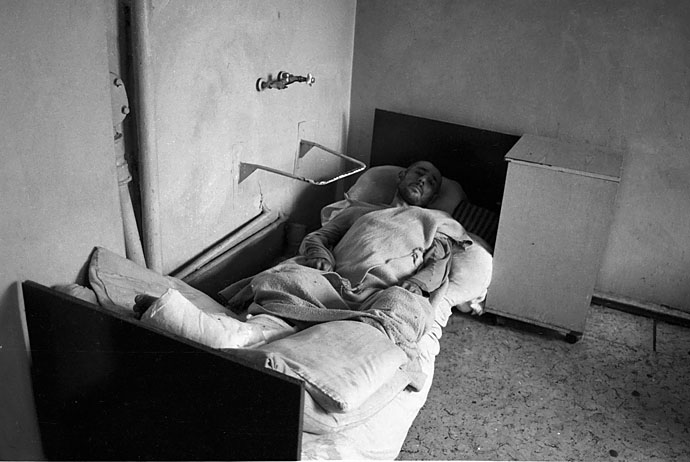
Photo: Azerbaijani Prisoner of War, Stepanakert, Nagorno Karabakh © Onnik Krikorian / Oneworld Multimedia 1994
This was originally posted to Onnik’s Frontline blog. You can follow Onnik’s reports from Armenia and the Caucasus here.
]]>Fourteen years since the 1994 ceasefire agreement that froze the conflict between the two over the mainly Armenian-populated territory of Nagorno Karabakh, nationalism has been used by the authorities and opposition in both countries to either come to power or retain it. Nevertheless, if the situation might at first seem unresolvable as a result, an interesting example of how things could be exists in Armenia.
A public school in Yerevan began on Monday a four-day series of events designed to promote Armenian-Azerbaijani reconciliation by enabling its students and teachers to hold discussions with visiting public figures from Azerbaijan.
The Days of Azerbaijan at the Mkhitar Sebastatsi Educational Complex will also feature presentations by the visiting Azerbaijanis and their Armenian partners as well as an arts exhibition and the screening of a documentary film on the conflict between the two South Caucasus nations. The events are sponsored by the British Embassy in Armenia and the Armenian Center for Peace Initiatives, a non-governmental organization.
The Azerbaijani delegation that arrived in Yerevan on the occasion includes three human rights campaigners, a journalist, a writer and an NGO activist.
"This is just an attempt to give our students and teachers a better idea of our neighbors and to discuss our outstanding problems in the process," Ashot Bleyan, the Mkhitar Sebastatsi director, told RFE/RL. He expressed hope that such initiatives will make Armenian society "more tolerant." link
However, not everybody was tolerant of such a controversial and unexpected event, and especially when the school is run by a former Minister of Education widely considered a "traitor" by nationalists in the country precisely because of his position on the Nagorno Karabakh conflict and relations with Azerbaijan. Regardless, a report on the web site of an NGO linked to the school shows that new approaches could contribute to peace-building initiatives.
90 participants from Armenia, America and Azerbaijan will work online to explore media literacy and the role that web-based social networking can play in changing stereotypes and perceptions.
• 30 participants from Armenia, America and Azerbaijan will travel on overseas exchanges to work with their DOTCOM peers to motivate change in their communities.• Media produced during the program will be released via the Internet and through a network of global NGO’s and media organizations, using Web 2.0 tools such as personal blogs, mySpace, Flickr and Youtube to reach audiences worldwide.
• Community service projects with youth and community groups in the U.S. and abroad will provide an opportunity for students to engage in community service in a tangible, concrete way with their DOTCOM peers.
• A participant-run weblog and online community will provide an open exchange of news and images from participants’ communities and countries, allowing for dialogue and exchange among participants on current events and social issues. link
Most consider this to be the main obstacle to peace between the two countries. Another is the lack of democratic thought in both countries, but in both cases education is key to changing the situation and ending the stalemate.